
APIs for Stablecoin Treasury Operations: Key Capabilities to Evaluate
A practical evaluation guide for treasury APIs covering balances, wallet operations, fiat conversions, batch payouts, approvals, webhooks and reconciliation.
A stablecoin treasury API should cover the full lifecycle of company funds: balance visibility, fiat and stablecoin conversion, payment creation, approvals, signing, settlement tracking and reconciliation. Evaluate it by testing real treasury flows, not counting endpoints. The strongest API will prevent duplicate or misrouted payments, expose pending and reserved funds, preserve references across every step and produce audit evidence that matches the treasury interface.

A stablecoin treasury API connects finance systems to the accounts, wallets and payment rails used to hold and move company funds. It may support balance reporting, deposit address creation, fiat-to-stablecoin conversions, transfers, batch payouts and transaction reconciliation.
The commercial investigation should go beyond asking whether an API exists. Finance and engineering teams need to understand which workflows are covered, how transaction states are represented, where approvals happen and what evidence is available after a payment.
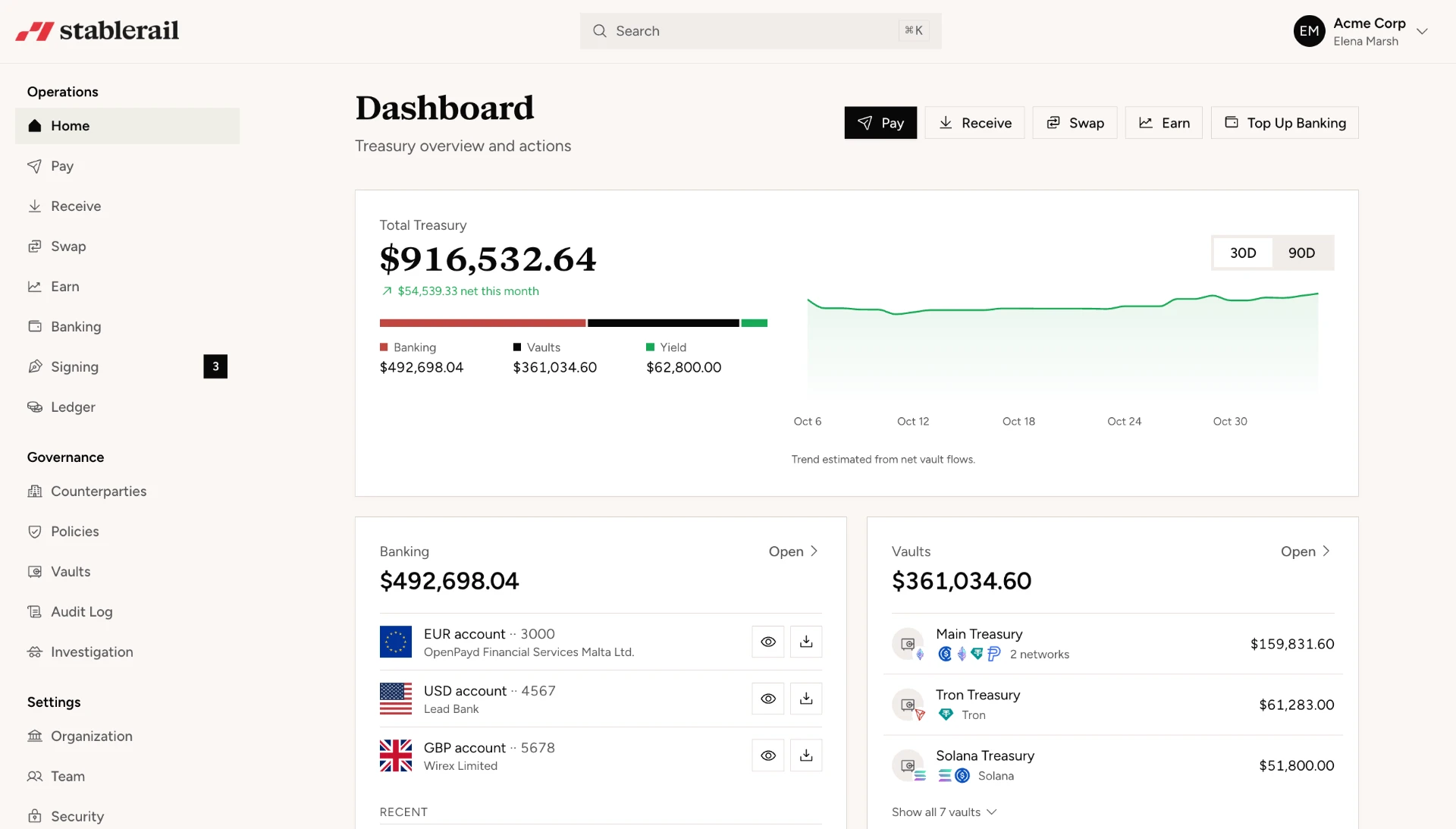
For a platform such as Stablerail, that investigation can span self-custodial USDC and USDT vaults, fiat accounts, on/off-ramps, multi-network payouts and treasury-funded cards. Confirm API coverage for each required workflow rather than assuming that every dashboard feature has an equivalent endpoint.
Start with the operating model
Document the intended flow before comparing API specifications. A typical workflow might be: read an EUR balance, obtain a conversion quote, convert EUR to USDC, create 200 contractor payments, obtain treasury approval and monitor each transfer until final settlement.
The required API surface depends on where funds sit and how they move:
- Fiat balances: EUR, USD or GBP held in named or virtual account structures.
- Stablecoin balances: USDC or USDT held in wallets or self-custodial vaults.
- Fiat rails: SEPA and SEPA Instant, ACH, Fedwire, SWIFT, Faster Payments, CHAPS and BACS.
- Blockchain networks: Ethereum, Base, Arbitrum, Polygon, Tron, BNB Chain, Optimism and Solana.
- Destinations: company wallets, exchanges, vendors, employees or contractor wallets.
Settlement expectations differ materially. SEPA Instant payments commonly arrive within seconds when both institutions participate, while standard SEPA is generally processed within one business day. ACH can take one or more business days depending on the service and cut-off. Blockchain timing varies by network, congestion and the confirmation policy applied by the platform.
Core API capabilities to test
| Capability | Questions to ask | Finance output |
|---|---|---|
| Balances | Are available, pending and reserved balances separate? Are fiat, token and network dimensions included? | Cash position and liquidity forecast |
| Addresses | Can addresses be created or assigned by entity, customer or invoice? Which network is explicitly returned? | Deposit attribution |
| Conversions | Are quotes time-limited? Do responses show rate, fees, expected output and minimum or maximum amounts? | Conversion cost record |
| Transfers | Are internal, blockchain and fiat transfers distinct? Is an idempotency key supported? | Payment instruction and status |
| Batch payouts | Can individual items fail independently? Are validation results available before submission? | Batch summary and item-level results |
| Webhooks | Are events signed, ordered and retryable? Can missed events be replayed? | Automated status updates |
| Reconciliation | Are stable identifiers, timestamps, fees, references and downloadable reports available? | Ledger matching and audit support |
Balances and addresses
A treasury API should return more than one headline balance. Finance normally needs the asset, account or vault, network, legal entity and balance state. Reserved funds matter when payouts have been approved but not yet broadcast.
Address responses should always identify the blockchain network. The same stablecoin ticker does not make two networks interchangeable: USDT on Tron and USDT on Ethereum require different transaction handling. Test whether unsupported asset-network combinations are rejected before funds move.
Conversions and corridor pricing
For an on/off-ramp, inspect both the quote and execution lifecycle. A useful quote includes the source amount, destination amount, exchange rate, platform fee, network or banking cost where applicable, expiry and settlement method.
Compare the response with the provider's published corridor pricing, then establish how slippage or an expired quote is handled. The API should not silently execute a materially different conversion. Stablerail supports fiat and stablecoin on/off-ramps across relevant treasury corridors; the applicable pricing and availability should be checked for the entity, currency and jurisdiction involved.
Transfers and batch payout automation
Reliable payout automation requires idempotency. An idempotency key lets a client safely retry a request after a timeout without creating a duplicate payment. Also test pre-submission validation for wallet format, supported network, available balance, allowlist status and payment limits.
For batches, require an item-level identifier and status. One invalid address should not make the other 199 outcomes impossible to reconcile. If your use case includes vendors, payroll or contractor payments, review the operational flow in stablecoin payouts and confirm which batch functions are available through the API.
Model transaction status as a lifecycle
A boolean “complete” field is rarely sufficient. A transfer may be created, awaiting approval, queued, submitted to a bank or blockchain, confirmed, failed, returned or cancelled. Ask for definitions and permitted transitions for every status.
Useful transaction data includes:
- A permanent platform transaction ID and your own external reference.
- Creation, approval, submission and settlement timestamps.
- Blockchain transaction hash or bank payment reference.
- Source amount, destination amount and fees.
- Failure or return reason using documented codes.
- Network confirmation count where relevant.
Webhooks should complement, not replace, status endpoints. Verify signature validation, retry intervals, duplicate delivery behaviour and event replay. Consumers should process events idempotently because the same notification may arrive more than once.
Approvals, custody and API access
An API credential must not automatically have authority to move all treasury funds. Look for separate permissions for reading balances, creating beneficiaries, preparing payments, approving instructions and executing transfers.
Stablerail uses self-custodial MPC vaults with quorum signing for stablecoin treasury operations. MPC, or multi-party computation, distributes signing authority so that no single complete private key is held in one place. Quorum signing requires the configured number of approvers or signing parties before a transaction can proceed.
During technical diligence, determine whether API-created instructions enter the same approval workflow as dashboard-created payments. Review approval limits, beneficiary allowlists, sanctions and wallet screening, credential rotation, IP restrictions where available, and emergency revocation. Ask whether a compromised integration can only draft a transfer or can also approve and sign it.
Design reconciliation before launch
Reconciliation should connect the API instruction to the bank or blockchain outcome and then to the accounting entry. Avoid matching only on amount and date. Those fields are not unique.
A durable reconciliation key set usually includes the external reference from the ERP, platform transaction ID, batch and item IDs, blockchain hash or bank reference, asset, network, gross amount, fee, net amount and final status.
Test three awkward cases: a blockchain fee charged separately, a fiat payment returned after initial submission, and a batch containing mixed successful and failed items. The platform's audit log and evidence packs should help finance retain approvals, screening results and transaction records, while exports or API responses need to remain suitable for ledger ingestion.
A practical proof-of-concept checklist
- Create read-only and payment-drafting credentials with different permissions.
- Retrieve fiat and stablecoin balances, including pending and reserved amounts.
- Generate or assign a deposit address and confirm asset-network validation.
- Request a conversion quote, let it expire, and inspect the error response.
- Submit the same transfer twice with one idempotency key.
- Create a batch containing one deliberately invalid destination.
- Approve a payment through the required quorum and record the audit trail.
- Disconnect the webhook receiver, reconnect it and replay missed events.
- Reconcile the final transaction, fee and settlement reference to a test ledger.
Use a sandbox for integration work, but repeat key tests with small production amounts because bank cut-offs, network fees and settlement behaviour may not be fully represented in test environments. For implementation questions and current product availability, consult Stablerail help.
Make the decision on complete workflows
The strongest treasury API is not necessarily the one with the longest endpoint list. It is the one that lets finance and engineering complete a controlled workflow from balance visibility through approval, settlement and reconciliation.
Score each provider against the exact assets, networks, fiat rails, jurisdictions and transaction volumes your company needs. Then verify error handling, permissions and evidence with a proof of concept. That approach exposes operational gaps before they become failed payments or unexplained ledger differences.
Frequently asked questions
What should a stablecoin treasury API include?
It should expose available and pending balances, asset and network details, executable conversion quotes, payments, approvals, settlement states and reconciliation records. It should also support idempotent requests, secure webhooks and stable external references.
How do you prevent duplicate stablecoin payouts through an API?
Assign every payment an external reference and send an idempotency key with the request. If a timeout occurs, retry with the same key and verify that the platform returns the original result instead of creating another transfer.
What data is needed to reconcile a stablecoin transaction?
Capture gross and net amounts, asset, network, exchange rate, individual fees, counterparty, status and creation and settlement timestamps. The record should also include the original external reference and the final blockchain hash or bank reference.
Should a treasury API distinguish USDC by blockchain network?
Yes. USDC on different networks represents separate operational balances with different addresses, fee assets and settlement paths. The network and verified contract or mint should therefore be explicit in every balance, deposit and transfer record.
How should webhooks be handled in a stablecoin treasury integration?
Verify webhook signatures, deduplicate events with immutable event IDs and assume delivery may be repeated or out of order unless documented otherwise. Use polling or record retrieval as a recovery mechanism before making final ledger updates.
Finance writers covering stablecoin treasury, payments, compliance, and risk controls.
More about the Stablerail team- Stablecoin treasury managementApprovals, limits, yield and reporting on one balance.
- Stablecoin payoutsBatch contractor and vendor payments with screening.
- USDT vs USDCWhich stablecoin your company should settle in.
- Stablecoin finance glossaryMPC, off-ramp, travel rule and the rest, in plain English.
- Product updatesEverything we ship, month by month.