
USDC vs USDT for Corporate Treasury: A CFO Comparison
Compare USDC and USDT across liquidity, reserve transparency, redemption, network coverage and counterparty risk—and learn when a corporate treasury may benefit from holding both.
%22%20x1%3D%220%22%20y1%3D%220%22%20x2%3D%221%22%20y2%3D%221%22%3E%0A%20%20%20%20%20%20%20%20%3Cstop%20offset%3D%220%25%22%20stop-color%3D%22%23360A0E%22%20%2F%3E%0A%20%20%20%20%20%20%20%20%3Cstop%20offset%3D%2250%25%22%20stop-color%3D%22%23551217%22%20%2F%3E%0A%20%20%20%20%20%20%20%20%3Cstop%20offset%3D%22100%25%22%20stop-color%3D%22%237A1D20%22%20%2F%3E%0A%20%20%20%20%20%20%3C%2FlinearGradient%3E%0A%20%20%20%20%20%20%3CradialGradient%20id%3D%22glow%22%20cx%3D%22348%22%20cy%3D%22290%22%20r%3D%22520%22%20gradientUnits%3D%22userSpaceOnUse%22%3E%0A%20%20%20%20%20%20%20%20%3Cstop%20offset%3D%220%25%22%20stop-color%3D%22%23FFA587%22%20stop-opacity%3D%220.45%22%20%2F%3E%0A%20%20%20%20%20%20%20%20%3Cstop%20offset%3D%2255%25%22%20stop-color%3D%22%23FFA587%22%20stop-opacity%3D%220.08%22%20%2F%3E%0A%20%20%20%20%20%20%20%20%3Cstop%20offset%3D%22100%25%22%20stop-color%3D%22%23FFA587%22%20stop-opacity%3D%220%22%20%2F%3E%0A%20%20%20%20%20%20%3C%2FradialGradient%3E%0A%20%20%20%20%20%20%3ClinearGradient%20id%3D%22glass%22%20x1%3D%220%22%20y1%3D%220%22%20x2%3D%221%22%20y2%3D%221%22%3E%0A%20%20%20%20%20%20%20%20%3Cstop%20offset%3D%220%25%22%20stop-color%3D%22%23F8D6D2%22%20stop-opacity%3D%220.26%22%20%2F%3E%0A%20%20%20%20%20%20%20%20%3Cstop%20offset%3D%22100%25%22%20stop-color%3D%22%23FFFFFF%22%20stop-opacity%3D%220.08%22%20%2F%3E%0A%20%20%20%20%20%20%3C%2FlinearGradient%3E%0A%20%20%20%20%20%20%3ClinearGradient%20id%3D%22accent%22%20x1%3D%220%22%20y1%3D%220%22%20x2%3D%221%22%20y2%3D%221%22%3E%0A%20%20%20%20%20%20%20%20%3Cstop%20offset%3D%220%25%22%20stop-color%3D%22%23FFA587%22%20%2F%3E%0A%20%20%20%20%20%20%20%20%3Cstop%20offset%3D%22100%25%22%20stop-color%3D%22%23DC4A38%22%20%2F%3E%0A%20%20%20%20%20%20%3C%2FlinearGradient%3E%0A%20%20%20%20%20%20%3Cfilter%20id%3D%22soft%22%3E%3CfeGaussianBlur%20stdDeviation%3D%2210%22%20%2F%3E%3C%2Ffilter%3E%0A%20%20%20%20%3C%2Fdefs%3E%0A%20%20%20%20%3Crect%20width%3D%221600%22%20height%3D%22900%22%20fill%3D%22url(%23bg)%22%20%2F%3E%0A%20%20%20%20%3Crect%20width%3D%221600%22%20height%3D%22900%22%20fill%3D%22url(%23glow)%22%20%2F%3E%0A%20%20%20%20%0A%20%20%3Cpath%20d%3D%22M800%20180%20L%201020%20260%20L%201020%20470%20C%201020%20600%2C%20920%20700%2C%20800%20740%20C%20680%20700%2C%20580%20600%2C%20580%20470%20L%20580%20260%20Z%22%20fill%3D%22url(%23glass)%22%20stroke%3D%22%23F4CDC5%22%20stroke-opacity%3D%220.7%22%20stroke-width%3D%223%22%2F%3E%0A%20%20%3Cpath%20d%3D%22M800%20220%20L%20980%20290%20L%20980%20460%20C%20980%20570%2C%20900%20660%2C%20800%20700%20C%20700%20660%2C%20620%20570%2C%20620%20460%20L%20620%20290%20Z%22%20fill%3D%22url(%23accent)%22%20opacity%3D%220.85%22%2F%3E%0A%20%20%3Cpath%20d%3D%22M710%20460%20L%20780%20530%20L%20900%20380%22%20fill%3D%22none%22%20stroke%3D%22%23FFF1ED%22%20stroke-width%3D%2222%22%20stroke-linecap%3D%22round%22%20stroke-linejoin%3D%22round%22%2F%3E%0A%0A%20%20%20%20%3Crect%20x%3D%2226%22%20y%3D%2226%22%20width%3D%221548%22%20height%3D%22848%22%20rx%3D%2218%22%20fill%3D%22none%22%20stroke%3D%22%23F2D0C8%22%20stroke-opacity%3D%220.12%22%2F%3E%0A%20%20%3C%2Fsvg%3E)
For a corporate treasury, choosing between USDC and USDT is not simply a question of which stablecoin is larger. The practical decision depends on where the company operates, which networks its counterparties use, how it enters and exits stablecoins, and what level of issuer and reserve risk it can accept.
Both tokens aim to maintain a value of one US dollar. Neither is the same as holding dollars in a bank account, however. A company holds a token issued by a private entity, backed by reserves and subject to the issuer’s redemption rules. That introduces counterparty risk alongside network, custody and liquidity risks.
The right answer may be USDC, USDT or a controlled allocation to both. Finance teams should compare the complete operating route—from fiat conversion through custody and payments to eventual redemption—not just exchange trading volume.
USDC and USDT at a glance
| Area | USDC | USDT |
|---|---|---|
| Issuer | Circle | Tether |
| Typical treasury fit | US and European fiat connectivity, regulated counterparties and on-chain finance | Global trading, emerging-market settlement and counterparties using Tron |
| Reserve reporting | Monthly reserve reporting with third-party assurance | Quarterly reserve reporting with independent assurance |
| Direct redemption | Available to eligible, verified institutional customers under Circle’s current terms | Available to eligible, verified customers, generally with a high minimum redemption amount |
| Common liquidity profile | Deep liquidity on Ethereum and several newer low-cost networks | Deep global exchange liquidity, with substantial payment activity on Tron |
| Key operational consideration | Confirm that counterparties accept native USDC on the selected network | Confirm network choice carefully because USDT is heavily used across multiple incompatible chains |
Terms, supported jurisdictions and network availability change. Treasury teams should verify current issuer documentation and platform support before adopting either asset.
Liquidity depends on the route, not just the token
USDT generally has broader global exchange liquidity and is frequently requested by suppliers, contractors and trading counterparties outside the US. It is particularly common on Tron, where transfer fees have historically been attractive for high-volume payment use cases, although actual network costs vary.
USDC is widely used by US-facing businesses, regulated financial platforms and on-chain applications. It has strong availability on Ethereum and lower-cost networks such as Base, Arbitrum, Polygon, Optimism and Solana.
Market-wide volume is only one part of treasury liquidity. A CFO should examine the specific corridor:
- Fiat currency: Can the business convert EUR, USD or GBP directly, or is another currency conversion required?
- Banking rail: Is settlement available through SEPA, SEPA Instant, ACH, Fedwire, SWIFT, Faster Payments, CHAPS or BACS?
- Network: Does the recipient require Ethereum, Tron, Solana or another chain?
- Trade size: Is sufficient liquidity available without material price impact?
- Timing: Does the route settle during banking hours only, or can the stablecoin leg operate continuously?
A quoted USDC or USDT price close to $1 does not reveal the full cost. Compare the fiat conversion spread, platform fee, blockchain fee and any recipient-side conversion cost. Published corridor pricing is more useful than relying on headline exchange prices.
Transparency and reserve composition
USDC reserves are primarily held in cash and short-dated US government obligations, including assets held through the Circle Reserve Fund. Circle publishes reserve information monthly, accompanied by third-party assurance.
Tether publishes quarterly reporting on the assets supporting USDT. Its reported reserves have included US Treasury bills, cash and cash equivalents, secured loans, precious metals, bitcoin and other investments. The composition has changed over time, so finance teams should review the latest report rather than relying on an older summary.
For a CFO, the relevant distinction is not just reporting frequency. It is also the nature of the reserves, the entities holding them and the legal route from a token to a redeemed dollar. Third-party assurance is useful evidence, but it is not the same as a full financial statement audit or a government guarantee.
Redemption is a separate liquidity test
Many companies never redeem directly with Circle or Tether. Instead, they convert through a treasury platform, exchange or liquidity provider. That can be operationally easier, but it replaces direct issuer access with another counterparty and fee schedule.
Direct issuer redemption normally requires account approval, know-your-business checks and an eligible jurisdiction. Tether’s published direct redemption terms have generally included a minimum of 100,000 USDT and a fee of the greater of 0.1% or $1,000. Circle’s institutional redemption terms, limits and banking charges should be checked directly because they can depend on account eligibility and transfer method.
Before holding a material balance, test the complete process with a small amount:
- Send fiat from an account in the company’s legal name.
- Buy the selected stablecoin on the intended network.
- Move it into the company’s treasury vault.
- Return part of the balance through the planned off-ramp.
- Reconcile the token amount, fees, bank receipt and settlement time.
This test often reveals more than a general comparison of USDC and USDT. It identifies bank cut-off times, beneficiary requirements, network fees and accounting evidence before they become urgent.
Counterparty risk and loss of the dollar peg
Both stablecoins introduce issuer counterparty risk. Holders depend on the issuer’s reserves, banking relationships, legal structure and ability to process redemptions. Tokens may also be frozen at the contract level when required by law or issuer policy.
USDC temporarily traded below $1 in March 2023 after Circle disclosed reserve exposure to Silicon Valley Bank. It returned toward its peg after US authorities protected the bank’s depositors. USDT has also traded away from $1 during periods of market stress. These events show that even a fully reserved token can face short-term market pricing pressure when redemption access or confidence is uncertain.
A treasury policy should therefore define:
- Maximum exposure to each stablecoin issuer.
- Maximum balance on any exchange, platform or network.
- Approved networks and native token contract addresses.
- Conditions that trigger conversion back to fiat or another stablecoin.
- Who can approve an emergency conversion or transfer.
Network choice creates operational risk
USDC and USDT exist on multiple blockchains, but tokens on different networks are not interchangeable at the wallet level. Sending USDT on Tron to an Ethereum address, for example, may lead to delayed or lost access unless the recipient explicitly supports that network.
Finance teams should also distinguish native tokens, issued directly on a network, from bridged versions created by moving value through a third-party bridge. Bridged assets add another smart-contract or bridge counterparty.
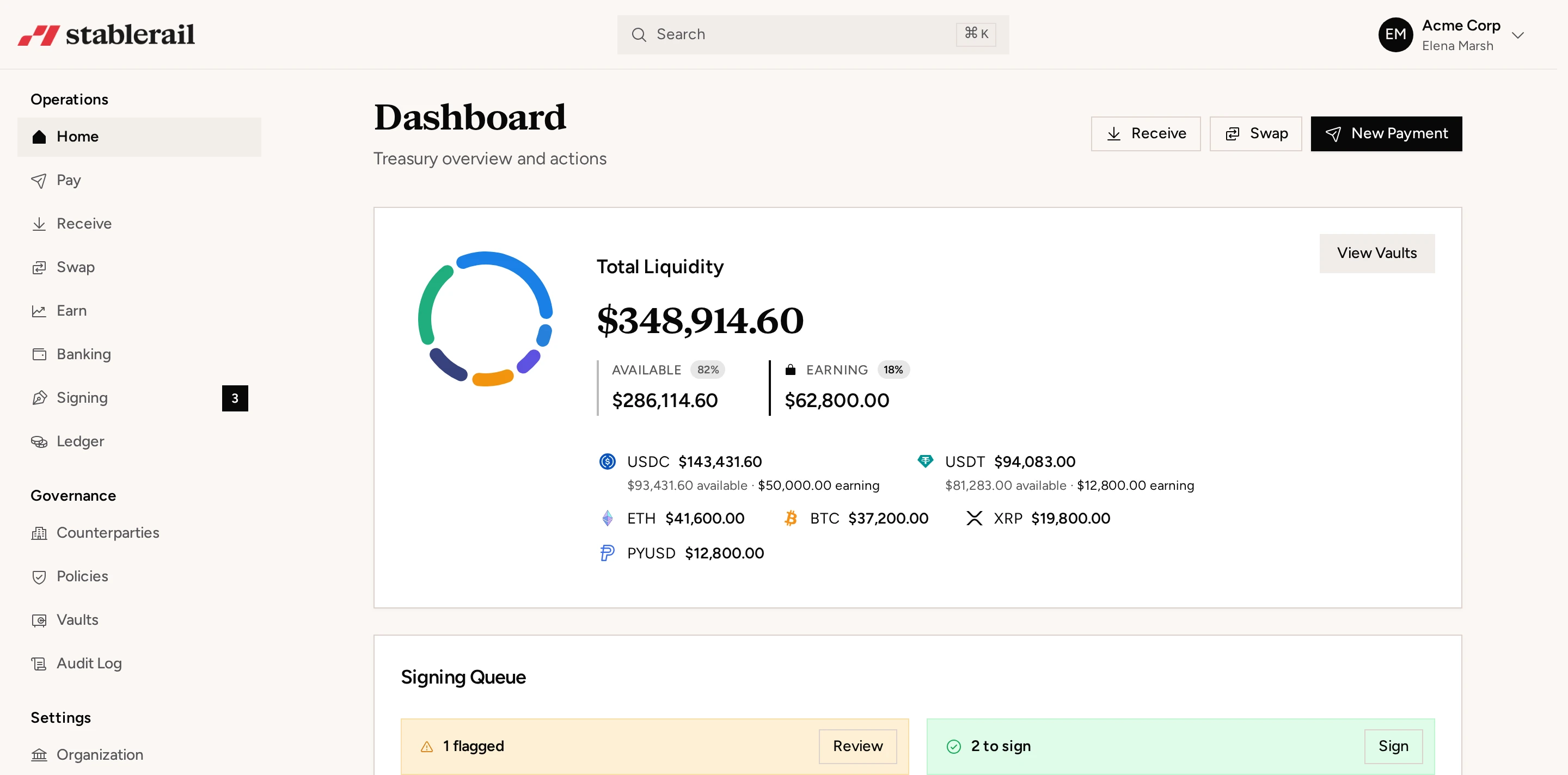
Stablerail supports treasury operations across Ethereum, Base, Arbitrum, Polygon, Tron, BNB Chain, Optimism and Solana, with availability depending on the asset and payment route. Its stablecoin payout tools can be used for batch vendor and contractor payments, while self-custodial MPC vaults and quorum signing help companies separate preparation from approval. MPC, or multi-party computation, distributes signing authority so that one person does not control a complete private key.
Before funding a batch, confirm the token, network and recipient address. Address allowlists, wallet screening and a small test transaction are appropriate for new beneficiaries.
When holding both may be practical
A dual-stablecoin approach can reduce operational dependence on one issuer or liquidity route. For example, a company might keep USDC for USD and EUR treasury conversion while maintaining a smaller USDT balance for suppliers that require payment on Tron.
Holding both does not remove dollar or stablecoin risk. It adds reconciliation work, more contract addresses and potentially more conversion activity. The allocation should follow actual payment demand rather than a passive assumption that diversification is always beneficial.
A practical monthly review should compare opening and closing balances, conversion costs, payment demand by token and network, failed or delayed transfers, off-ramp timing and current issuer disclosures. Idle balances should also be separated from operating cash. If the company uses an earn product, its liquidity terms and additional counterparty risks should be assessed independently from the underlying stablecoin.
Bottom line for CFOs
USDC often fits companies prioritising reserve transparency, US or European fiat connectivity and access to newer on-chain networks. USDT often fits companies that need broad global exchange liquidity or must pay counterparties that operate primarily on Tron.
The decision should be made corridor by corridor. Compare the recipient’s requested asset, supported network, total conversion cost, redemption path and counterparty risk. Then place the chosen stablecoin inside a corporate treasury process with defined exposure limits, quorum approvals and reliable transaction evidence.
Finance writers covering stablecoin treasury, payments, compliance, and risk controls.
More about the Stablerail team- Stablecoin treasury managementApprovals, limits, yield and reporting on one balance.
- Stablecoin payoutsBatch contractor and vendor payments with screening.
- USDT vs USDCWhich stablecoin your company should settle in.
- Stablecoin finance glossaryMPC, off-ramp, travel rule and the rest, in plain English.
- Product updatesEverything we ship, month by month.