
Accepting Stablecoin Payments: Invoices, Payment Links and Reconciliation
A finance-focused guide to accepting USDC and USDT through invoices or payment links, matching on-chain receipts, resolving payment exceptions, and reconciling stablecoins to the ledger.
To accept stablecoin payments reliably, issue structured instructions that specify the exact token, network, amount, destination address, invoice reference and expiry. Monitor the blockchain for the transfer, then match the network, token contract, address, amount and transaction hash to the invoice. Finance teams also need documented rules for confirmations, partial payments, overpayments, refunds, conversion and ledger reconciliation.
%22%20x1%3D%220%22%20y1%3D%220%22%20x2%3D%221%22%20y2%3D%221%22%3E%0A%20%20%20%20%20%20%20%20%3Cstop%20offset%3D%220%25%22%20stop-color%3D%22%233E090D%22%20%2F%3E%0A%20%20%20%20%20%20%20%20%3Cstop%20offset%3D%2250%25%22%20stop-color%3D%22%235C1218%22%20%2F%3E%0A%20%20%20%20%20%20%20%20%3Cstop%20offset%3D%22100%25%22%20stop-color%3D%22%237B1F22%22%20%2F%3E%0A%20%20%20%20%20%20%3C%2FlinearGradient%3E%0A%20%20%20%20%20%20%3CradialGradient%20id%3D%22glow%22%20cx%3D%22645%22%20cy%3D%22-72%22%20r%3D%22520%22%20gradientUnits%3D%22userSpaceOnUse%22%3E%0A%20%20%20%20%20%20%20%20%3Cstop%20offset%3D%220%25%22%20stop-color%3D%22%23FF8E72%22%20stop-opacity%3D%220.45%22%20%2F%3E%0A%20%20%20%20%20%20%20%20%3Cstop%20offset%3D%2255%25%22%20stop-color%3D%22%23FF8E72%22%20stop-opacity%3D%220.08%22%20%2F%3E%0A%20%20%20%20%20%20%20%20%3Cstop%20offset%3D%22100%25%22%20stop-color%3D%22%23FF8E72%22%20stop-opacity%3D%220%22%20%2F%3E%0A%20%20%20%20%20%20%3C%2FradialGradient%3E%0A%20%20%20%20%20%20%3ClinearGradient%20id%3D%22glass%22%20x1%3D%220%22%20y1%3D%220%22%20x2%3D%221%22%20y2%3D%221%22%3E%0A%20%20%20%20%20%20%20%20%3Cstop%20offset%3D%220%25%22%20stop-color%3D%22%23F8D6D2%22%20stop-opacity%3D%220.26%22%20%2F%3E%0A%20%20%20%20%20%20%20%20%3Cstop%20offset%3D%22100%25%22%20stop-color%3D%22%23FFFFFF%22%20stop-opacity%3D%220.08%22%20%2F%3E%0A%20%20%20%20%20%20%3C%2FlinearGradient%3E%0A%20%20%20%20%20%20%3ClinearGradient%20id%3D%22accent%22%20x1%3D%220%22%20y1%3D%220%22%20x2%3D%221%22%20y2%3D%221%22%3E%0A%20%20%20%20%20%20%20%20%3Cstop%20offset%3D%220%25%22%20stop-color%3D%22%23FF8E72%22%20%2F%3E%0A%20%20%20%20%20%20%20%20%3Cstop%20offset%3D%22100%25%22%20stop-color%3D%22%23D94030%22%20%2F%3E%0A%20%20%20%20%20%20%3C%2FlinearGradient%3E%0A%20%20%20%20%20%20%3Cfilter%20id%3D%22soft%22%3E%3CfeGaussianBlur%20stdDeviation%3D%2210%22%20%2F%3E%3C%2Ffilter%3E%0A%20%20%20%20%3C%2Fdefs%3E%0A%20%20%20%20%3Crect%20width%3D%221600%22%20height%3D%22900%22%20fill%3D%22url(%23bg)%22%20%2F%3E%0A%20%20%20%20%3Crect%20width%3D%221600%22%20height%3D%22900%22%20fill%3D%22url(%23glow)%22%20%2F%3E%0A%20%20%20%20%0A%20%20%3Crect%20x%3D%22500%22%20y%3D%22160%22%20width%3D%22600%22%20height%3D%22620%22%20rx%3D%2214%22%20fill%3D%22url(%23glass)%22%20stroke%3D%22%23F4CDC5%22%20stroke-opacity%3D%220.65%22%2F%3E%0A%20%20%3Crect%20x%3D%22540%22%20y%3D%22220%22%20width%3D%22289%22%20height%3D%2214%22%20rx%3D%223%22%20fill%3D%22%23F4CDC5%22%20opacity%3D%220.45%22%2F%3E%3Crect%20x%3D%22540%22%20y%3D%22280%22%20width%3D%22184%22%20height%3D%2214%22%20rx%3D%223%22%20fill%3D%22%23F4CDC5%22%20opacity%3D%220.45%22%2F%3E%3Crect%20x%3D%22540%22%20y%3D%22340%22%20width%3D%22132%22%20height%3D%2214%22%20rx%3D%223%22%20fill%3D%22%23F4CDC5%22%20opacity%3D%220.45%22%2F%3E%3Crect%20x%3D%22540%22%20y%3D%22400%22%20width%3D%22216%22%20height%3D%2214%22%20rx%3D%223%22%20fill%3D%22%23F4CDC5%22%20opacity%3D%220.45%22%2F%3E%3Crect%20x%3D%22540%22%20y%3D%22460%22%20width%3D%22148%22%20height%3D%2214%22%20rx%3D%223%22%20fill%3D%22%23F4CDC5%22%20opacity%3D%220.45%22%2F%3E%3Crect%20x%3D%22540%22%20y%3D%22520%22%20width%3D%22224%22%20height%3D%2214%22%20rx%3D%223%22%20fill%3D%22%23F4CDC5%22%20opacity%3D%220.45%22%2F%3E%0A%20%20%3Crect%20x%3D%22540%22%20y%3D%22640%22%20width%3D%22300%22%20height%3D%22100%22%20rx%3D%228%22%20fill%3D%22url(%23accent)%22%20opacity%3D%220.85%22%2F%3E%0A%20%20%3Cpath%20d%3D%22M560%20700%20C%20600%20660%2C%20640%20720%2C%20700%20680%20S%20800%20690%2C%20820%20670%22%20fill%3D%22none%22%20stroke%3D%22%23FFF1ED%22%20stroke-width%3D%225%22%20stroke-linecap%3D%22round%22%2F%3E%0A%0A%20%20%20%20%3Crect%20x%3D%2226%22%20y%3D%2226%22%20width%3D%221548%22%20height%3D%22848%22%20rx%3D%2218%22%20fill%3D%22none%22%20stroke%3D%22%23F2D0C8%22%20stroke-opacity%3D%220.12%22%2F%3E%0A%20%20%3C%2Fsvg%3E)
Accepting USDC or USDT requires more operational precision than receiving a bank transfer. The payer must use the correct token, blockchain network and destination address, while finance must connect the resulting on-chain transaction to the right invoice. A wallet address alone is not a complete payment process: the company also needs structured payment requests, blockchain monitoring, status rules, exception handling and accounting evidence.
What a stablecoin payment request should contain
A crypto invoice is the commercial record of what the customer owes. Its payment instructions explain how to settle that obligation on-chain. A payment link presents those instructions on a hosted page that can be shared by email, messaging app or checkout flow.
Every request should specify:
- Invoice or payment reference: a unique identifier connected to the customer and accounting record.
- Amount and token: for example, 2,500 USDC. Do not label USDC or USDT merely as “USD,” because the payer must send the stated digital asset.
- Blockchain network: the specific supported network on which payment must be made.
- Destination address: the address controlled by or assigned to the recipient for that payment.
- Expiry: the time after which the request should be reviewed or replaced rather than paid automatically.
- Fee instruction: a clear statement that the full stablecoin amount must arrive and the payer is responsible for wallet or withdrawal fees.
- Status: such as unpaid, detected, confirmed, partially paid, overpaid, expired or under review.
The network is part of the asset instruction, not an optional routing preference. USDC on Ethereum and USDC on Base are recorded on different ledgers. Similarly named tokens can also have different contract addresses. Payment systems should therefore validate the network and token contract or native token identifier, rather than relying only on the ticker shown in a wallet.
Sending the correct token over an unsupported network can prevent automatic matching and may require a recovery process. Recovery is not always technically or operationally possible, so the payment page should require the customer to confirm the token and network before sending.
Crypto invoice, payment link or direct transfer?
| Method | Best suited to | Customer experience | Finance implications |
|---|---|---|---|
| Crypto invoice | B2B sales, retainers and one-off bills | Receives invoice details plus token, network, amount and address | Strong connection between customer, due date, invoice number and payment status |
| Payment link | Remote checkout, account funding and payment collection | Opens a hosted page containing the current payment instructions | Link reference can connect the request to the resulting transaction |
| Direct wallet transfer | Known counterparties with an established process | Receives an address and instructions separately | More manual matching, especially when one address receives many payments |
A payment link reduces copying errors by presenting the amount, token, network and address together. A QR code or compatible wallet connection may prefill transaction details, but the payer must still verify what appears in the wallet before signing. The hosted page should not imply that selecting the correct token automatically selects the correct network.
Invoices are generally better when finance needs a formal receivable, due date and customer record. Payment links are useful when collection needs to happen through a lightweight digital flow. Both can use the same underlying matching process.
How on-chain payment matching works
Blockchain transfers usually do not contain a dependable free-text remittance field equivalent to a bank payment reference. Reconciliation therefore depends on comparing structured request data with the transaction observed on-chain.
The core matching fields are:
- blockchain network;
- destination wallet address;
- token contract or native token identifier;
- stablecoin amount received;
- transaction hash and network;
- sending address;
- block timestamp and internal detection time; and
- confirmation or finality status.
A transaction hash should be stored with its network because hashes are interpreted within a particular blockchain. Finance should also retain a block explorer link or equivalent exportable evidence, but the accounting record should not depend on a public link remaining unchanged.
Matching is simplest when each request receives a unique destination address or another unambiguous identifier supported by the network. If several customers send to one shared address, the process may need to use the exact amount, sender address and expected time window. Reusing one address for multiple invoices with identical amounts creates ambiguity, particularly when customers pay from exchanges whose sending addresses may be shared.
Detected is not the same as confirmed
A transfer can be marked detected when it first appears on the network. It should become confirmed only after meeting the company’s documented confirmation or finality rule. That rule may differ by network, payment value and fulfilment risk.
Confirmation speed depends on the blockchain, congestion, transaction fees and the recipient’s policy. Finance and sales teams should avoid promising a universal settlement time. The operational question is not simply whether the transaction is visible, but whether the company is prepared to release goods, credit an account or recognise settlement at that stage.
Handling partial payments, overpayments and wrong assets
Underpayments
A customer may send a test amount, enter the wrong figure or deduct an exchange withdrawal fee from the invoice total. Set a documented tolerance rather than resolving each discrepancy informally.
- Within approved tolerance: close the invoice and post the difference to the adjustment account authorised by the accounting policy.
- Outside tolerance: leave the invoice partially paid and issue a new request for the balance.
- Multiple transfers: link every transaction hash to the same invoice so the audit trail shows how the total was reached.
- Wrong token or network: place the receipt in manual review. Do not credit it automatically based only on a matching amount.
The payment page should say that the requested stablecoin amount must arrive in full. Network fees are normally paid separately in the blockchain’s gas asset, but exchange withdrawal fees and wallet behaviour vary.
Overpayments and duplicate transfers
An overpayment should not trigger an immediate automatic refund. First confirm the payer, amount and invoice, then check whether the excess was intended to cover another open balance. Duplicate payments should follow the same review.
If a refund is required, verify the destination through a trusted channel. The original sending address may belong to an exchange, payment processor or shared wallet that cannot correctly credit a return. Record the refund as a separate outgoing transaction linked to the invoice and original receipt. Apply approval limits, signing quorum and sanctions or address screening before sending funds.
Reconciliation from blockchain to ledger
Daily reconciliation should connect the commercial receivable, on-chain receipt and accounting entry. If stablecoins are later converted to fiat, the conversion and bank settlement are additional treasury events rather than part of the original customer payment.
| Record | Evidence to retain | Amount or value | Control question |
|---|---|---|---|
| Customer invoice | Invoice ID, customer, due date, requested token and network | Amount billed | Was the request authorised and still valid? |
| On-chain receipt | Network, transaction hash, token identifier, addresses and timestamp | Stablecoin received | Does the observed asset match the request? |
| Accounting entry | Journal ID, ledger account and posting date | Booked functional-currency value | Can the journal be traced to the invoice and transaction? |
| Conversion | Execution record, rate, fees and timestamps | Stablecoin sold and fiat purchased | Are fees and any resulting difference recorded separately? |
| Bank settlement | Bank reference and value date | Net fiat credited | Does the deposit match the conversion proceeds after fees? |
Receiving 10,000 USDC and later selling it for EUR are two distinct events. They can have different execution times, counterparties, fees and accounting treatment. The company’s accounting advisers should determine the appropriate recognition and functional-currency methodology for its jurisdiction and reporting framework.
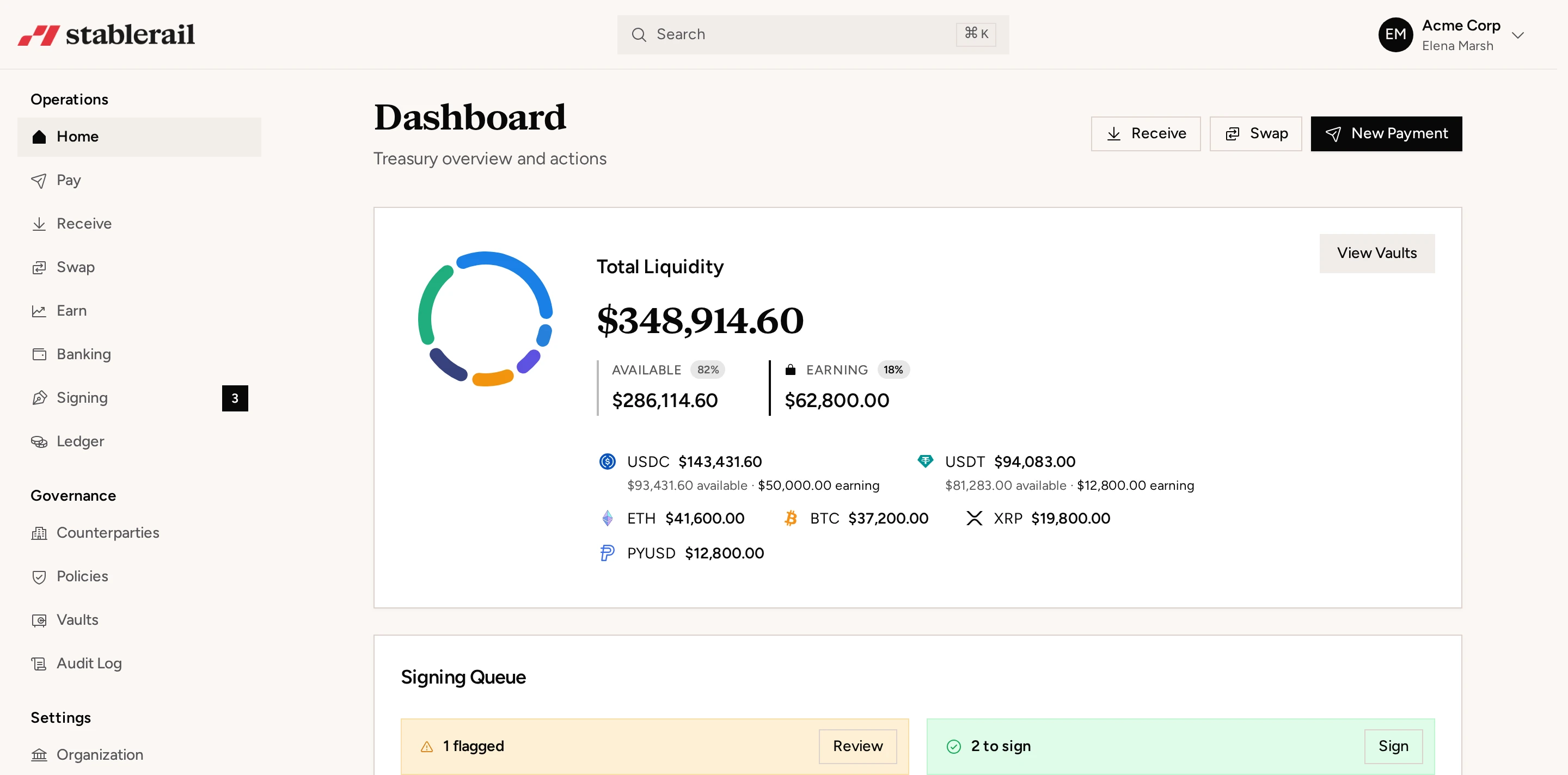
Stablerail provides one business account for USDC and USDT treasury, with approvals and signing quorum, corporate cards, global payouts, fiat off-ramp capabilities and exportable audit evidence. Whichever operating stack is used, finance should be able to export invoice references, transaction details, fees, status changes and approval evidence without rebuilding the history from screenshots.
Stablecoin acceptance checklist
- Choose the exact token and network combinations the company will accept.
- Confirm custody, address ownership and access controls before publishing payment instructions.
- Define invoice expiry, confirmation and fulfilment rules.
- Test a low-value receipt for every enabled token and network combination.
- Document tolerances for partial payments, overpayments and duplicates.
- Create a verified process for refund addresses and outgoing approvals.
- Reconcile invoices, blockchain receipts and ledger entries daily.
- Keep receipts separate from later stablecoin conversions and fiat settlements.
- Export transaction hashes, token identifiers, timestamps, fees and approval evidence for audit.
The reliable approach is to treat every stablecoin payment request as structured financial data. Precise token and network instructions reduce payer errors, deterministic matching connects receipts to receivables, and documented exception rules prevent small discrepancies from becoming month-end reconciliation problems.
Frequently asked questions
How do businesses accept USDC or USDT payments?
Create a payment request that specifies the amount, exact token, blockchain network, destination address, reference and expiry. Monitor that network for the transfer, validate the token identifier and address, and match the confirmed transaction to the customer invoice.
How do you reconcile stablecoin payments to invoices?
Match the invoice against the transaction’s network, destination address, token contract or identifier, amount, sender and transaction hash. Store the network with the hash, then connect both records to the accounting journal and retain exportable evidence for review.
What happens if a customer sends USDC on the wrong network?
Place the transfer into manual review rather than marking the invoice paid automatically. Recovery depends on whether the recipient controls a compatible address on that network and has an approved recovery process; it may not be possible in every case.
Should a business refund a stablecoin overpayment to the sending address?
Not automatically. The sending address may belong to an exchange or shared payment system, so verify a suitable refund address with the customer through a trusted channel and apply the normal screening and approval controls before sending.
When is a stablecoin payment considered final?
A payment is detected when it first appears on-chain and confirmed when it meets the company’s network-specific confirmation or finality rule. The appropriate point for fulfilment depends on the blockchain, payment value and risk of releasing goods or services.
Finance writers covering stablecoin treasury, payments, compliance, and risk controls.
More about the Stablerail team- Stablecoin treasury managementApprovals, limits, yield and reporting on one balance.
- Stablecoin payoutsBatch contractor and vendor payments with screening.
- USDT vs USDCWhich stablecoin your company should settle in.
- Stablecoin finance glossaryMPC, off-ramp, travel rule and the rest, in plain English.
- Product updatesEverything we ship, month by month.