
What to Look for in a Compliant Stablecoin Platform
A practical guide to evaluating stablecoin platforms for KYB, sanctions screening, payment approvals, custody, fiat rails and audit-ready records.
A compliant stablecoin platform should support KYB, sanctions and wallet screening, segregated payment approvals, clear custody arrangements and exportable audit evidence. It must also cover your exact legal entities, stablecoins, blockchain networks and fiat corridors. No platform makes a company compliant by itself, so evaluate how its controls fit your obligations, test flagged-payment workflows and document who remains responsible for each compliance decision.
%22%20x1%3D%220%22%20y1%3D%220%22%20x2%3D%221%22%20y2%3D%221%22%3E%0A%20%20%20%20%20%20%20%20%3Cstop%20offset%3D%220%25%22%20stop-color%3D%22%232E0709%22%20%2F%3E%0A%20%20%20%20%20%20%20%20%3Cstop%20offset%3D%2250%25%22%20stop-color%3D%22%234A0F14%22%20%2F%3E%0A%20%20%20%20%20%20%20%20%3Cstop%20offset%3D%22100%25%22%20stop-color%3D%22%236B181C%22%20%2F%3E%0A%20%20%20%20%20%20%3C%2FlinearGradient%3E%0A%20%20%20%20%20%20%3CradialGradient%20id%3D%22glow%22%20cx%3D%22446%22%20cy%3D%22246%22%20r%3D%22520%22%20gradientUnits%3D%22userSpaceOnUse%22%3E%0A%20%20%20%20%20%20%20%20%3Cstop%20offset%3D%220%25%22%20stop-color%3D%22%23FFB199%22%20stop-opacity%3D%220.45%22%20%2F%3E%0A%20%20%20%20%20%20%20%20%3Cstop%20offset%3D%2255%25%22%20stop-color%3D%22%23FFB199%22%20stop-opacity%3D%220.08%22%20%2F%3E%0A%20%20%20%20%20%20%20%20%3Cstop%20offset%3D%22100%25%22%20stop-color%3D%22%23FFB199%22%20stop-opacity%3D%220%22%20%2F%3E%0A%20%20%20%20%20%20%3C%2FradialGradient%3E%0A%20%20%20%20%20%20%3ClinearGradient%20id%3D%22glass%22%20x1%3D%220%22%20y1%3D%220%22%20x2%3D%221%22%20y2%3D%221%22%3E%0A%20%20%20%20%20%20%20%20%3Cstop%20offset%3D%220%25%22%20stop-color%3D%22%23F8D6D2%22%20stop-opacity%3D%220.26%22%20%2F%3E%0A%20%20%20%20%20%20%20%20%3Cstop%20offset%3D%22100%25%22%20stop-color%3D%22%23FFFFFF%22%20stop-opacity%3D%220.08%22%20%2F%3E%0A%20%20%20%20%20%20%3C%2FlinearGradient%3E%0A%20%20%20%20%20%20%3ClinearGradient%20id%3D%22accent%22%20x1%3D%220%22%20y1%3D%220%22%20x2%3D%221%22%20y2%3D%221%22%3E%0A%20%20%20%20%20%20%20%20%3Cstop%20offset%3D%220%25%22%20stop-color%3D%22%23FFB199%22%20%2F%3E%0A%20%20%20%20%20%20%20%20%3Cstop%20offset%3D%22100%25%22%20stop-color%3D%22%23E85D3A%22%20%2F%3E%0A%20%20%20%20%20%20%3C%2FlinearGradient%3E%0A%20%20%20%20%20%20%3Cfilter%20id%3D%22soft%22%3E%3CfeGaussianBlur%20stdDeviation%3D%2210%22%20%2F%3E%3C%2Ffilter%3E%0A%20%20%20%20%3C%2Fdefs%3E%0A%20%20%20%20%3Crect%20width%3D%221600%22%20height%3D%22900%22%20fill%3D%22url(%23bg)%22%20%2F%3E%0A%20%20%20%20%3Crect%20width%3D%221600%22%20height%3D%22900%22%20fill%3D%22url(%23glow)%22%20%2F%3E%0A%20%20%20%20%3Crect%20x%3D%22340%22%20y%3D%22220%22%20width%3D%22118%22%20height%3D%22108%22%20rx%3D%2210%22%20fill%3D%22url(%23glass)%22%20fill-opacity%3D%221%22%20stroke%3D%22%23F4CDC5%22%20stroke-opacity%3D%220.4%22%2F%3E%3Crect%20x%3D%22480%22%20y%3D%22220%22%20width%3D%22118%22%20height%3D%22108%22%20rx%3D%2210%22%20fill%3D%22url(%23accent)%22%20fill-opacity%3D%220.9%22%20stroke%3D%22%23F4CDC5%22%20stroke-opacity%3D%220.4%22%2F%3E%3Crect%20x%3D%22620%22%20y%3D%22220%22%20width%3D%22118%22%20height%3D%22108%22%20rx%3D%2210%22%20fill%3D%22url(%23glass)%22%20fill-opacity%3D%221%22%20stroke%3D%22%23F4CDC5%22%20stroke-opacity%3D%220.4%22%2F%3E%3Crect%20x%3D%22760%22%20y%3D%22220%22%20width%3D%22118%22%20height%3D%22108%22%20rx%3D%2210%22%20fill%3D%22url(%23accent)%22%20fill-opacity%3D%220.9%22%20stroke%3D%22%23F4CDC5%22%20stroke-opacity%3D%220.4%22%2F%3E%3Crect%20x%3D%22900%22%20y%3D%22220%22%20width%3D%22118%22%20height%3D%22108%22%20rx%3D%2210%22%20fill%3D%22url(%23glass)%22%20fill-opacity%3D%221%22%20stroke%3D%22%23F4CDC5%22%20stroke-opacity%3D%220.4%22%2F%3E%3Crect%20x%3D%221040%22%20y%3D%22220%22%20width%3D%22118%22%20height%3D%22108%22%20rx%3D%2210%22%20fill%3D%22url(%23accent)%22%20fill-opacity%3D%220.9%22%20stroke%3D%22%23F4CDC5%22%20stroke-opacity%3D%220.4%22%2F%3E%3Crect%20x%3D%221180%22%20y%3D%22220%22%20width%3D%22118%22%20height%3D%22108%22%20rx%3D%2210%22%20fill%3D%22url(%23glass)%22%20fill-opacity%3D%221%22%20stroke%3D%22%23F4CDC5%22%20stroke-opacity%3D%220.4%22%2F%3E%3Crect%20x%3D%22340%22%20y%3D%22350%22%20width%3D%22118%22%20height%3D%22108%22%20rx%3D%2210%22%20fill%3D%22url(%23glass)%22%20fill-opacity%3D%221%22%20stroke%3D%22%23F4CDC5%22%20stroke-opacity%3D%220.4%22%2F%3E%3Crect%20x%3D%22480%22%20y%3D%22350%22%20width%3D%22118%22%20height%3D%22108%22%20rx%3D%2210%22%20fill%3D%22url(%23accent)%22%20fill-opacity%3D%220.9%22%20stroke%3D%22%23F4CDC5%22%20stroke-opacity%3D%220.4%22%2F%3E%3Crect%20x%3D%22620%22%20y%3D%22350%22%20width%3D%22118%22%20height%3D%22108%22%20rx%3D%2210%22%20fill%3D%22url(%23accent)%22%20fill-opacity%3D%220.9%22%20stroke%3D%22%23F4CDC5%22%20stroke-opacity%3D%220.4%22%2F%3E%3Crect%20x%3D%22760%22%20y%3D%22350%22%20width%3D%22118%22%20height%3D%22108%22%20rx%3D%2210%22%20fill%3D%22url(%23glass)%22%20fill-opacity%3D%221%22%20stroke%3D%22%23F4CDC5%22%20stroke-opacity%3D%220.4%22%2F%3E%3Crect%20x%3D%22900%22%20y%3D%22350%22%20width%3D%22118%22%20height%3D%22108%22%20rx%3D%2210%22%20fill%3D%22url(%23glass)%22%20fill-opacity%3D%221%22%20stroke%3D%22%23F4CDC5%22%20stroke-opacity%3D%220.4%22%2F%3E%3Crect%20x%3D%221040%22%20y%3D%22350%22%20width%3D%22118%22%20height%3D%22108%22%20rx%3D%2210%22%20fill%3D%22url(%23accent)%22%20fill-opacity%3D%220.9%22%20stroke%3D%22%23F4CDC5%22%20stroke-opacity%3D%220.4%22%2F%3E%3Crect%20x%3D%221180%22%20y%3D%22350%22%20width%3D%22118%22%20height%3D%22108%22%20rx%3D%2210%22%20fill%3D%22url(%23accent)%22%20fill-opacity%3D%220.9%22%20stroke%3D%22%23F4CDC5%22%20stroke-opacity%3D%220.4%22%2F%3E%3Crect%20x%3D%22340%22%20y%3D%22480%22%20width%3D%22118%22%20height%3D%22108%22%20rx%3D%2210%22%20fill%3D%22url(%23accent)%22%20fill-opacity%3D%220.9%22%20stroke%3D%22%23F4CDC5%22%20stroke-opacity%3D%220.4%22%2F%3E%3Crect%20x%3D%22480%22%20y%3D%22480%22%20width%3D%22118%22%20height%3D%22108%22%20rx%3D%2210%22%20fill%3D%22url(%23glass)%22%20fill-opacity%3D%221%22%20stroke%3D%22%23F4CDC5%22%20stroke-opacity%3D%220.4%22%2F%3E%3Crect%20x%3D%22620%22%20y%3D%22480%22%20width%3D%22118%22%20height%3D%22108%22%20rx%3D%2210%22%20fill%3D%22url(%23glass)%22%20fill-opacity%3D%221%22%20stroke%3D%22%23F4CDC5%22%20stroke-opacity%3D%220.4%22%2F%3E%3Crect%20x%3D%22760%22%20y%3D%22480%22%20width%3D%22118%22%20height%3D%22108%22%20rx%3D%2210%22%20fill%3D%22url(%23accent)%22%20fill-opacity%3D%220.9%22%20stroke%3D%22%23F4CDC5%22%20stroke-opacity%3D%220.4%22%2F%3E%3Crect%20x%3D%22900%22%20y%3D%22480%22%20width%3D%22118%22%20height%3D%22108%22%20rx%3D%2210%22%20fill%3D%22url(%23glass)%22%20fill-opacity%3D%221%22%20stroke%3D%22%23F4CDC5%22%20stroke-opacity%3D%220.4%22%2F%3E%3Crect%20x%3D%221040%22%20y%3D%22480%22%20width%3D%22118%22%20height%3D%22108%22%20rx%3D%2210%22%20fill%3D%22url(%23accent)%22%20fill-opacity%3D%220.9%22%20stroke%3D%22%23F4CDC5%22%20stroke-opacity%3D%220.4%22%2F%3E%3Crect%20x%3D%221180%22%20y%3D%22480%22%20width%3D%22118%22%20height%3D%22108%22%20rx%3D%2210%22%20fill%3D%22url(%23accent)%22%20fill-opacity%3D%220.9%22%20stroke%3D%22%23F4CDC5%22%20stroke-opacity%3D%220.4%22%2F%3E%3Crect%20x%3D%22340%22%20y%3D%22610%22%20width%3D%22118%22%20height%3D%22108%22%20rx%3D%2210%22%20fill%3D%22url(%23accent)%22%20fill-opacity%3D%220.9%22%20stroke%3D%22%23F4CDC5%22%20stroke-opacity%3D%220.4%22%2F%3E%3Crect%20x%3D%22480%22%20y%3D%22610%22%20width%3D%22118%22%20height%3D%22108%22%20rx%3D%2210%22%20fill%3D%22url(%23glass)%22%20fill-opacity%3D%221%22%20stroke%3D%22%23F4CDC5%22%20stroke-opacity%3D%220.4%22%2F%3E%3Crect%20x%3D%22620%22%20y%3D%22610%22%20width%3D%22118%22%20height%3D%22108%22%20rx%3D%2210%22%20fill%3D%22url(%23accent)%22%20fill-opacity%3D%220.9%22%20stroke%3D%22%23F4CDC5%22%20stroke-opacity%3D%220.4%22%2F%3E%3Crect%20x%3D%22760%22%20y%3D%22610%22%20width%3D%22118%22%20height%3D%22108%22%20rx%3D%2210%22%20fill%3D%22url(%23glass)%22%20fill-opacity%3D%221%22%20stroke%3D%22%23F4CDC5%22%20stroke-opacity%3D%220.4%22%2F%3E%3Crect%20x%3D%22900%22%20y%3D%22610%22%20width%3D%22118%22%20height%3D%22108%22%20rx%3D%2210%22%20fill%3D%22url(%23accent)%22%20fill-opacity%3D%220.9%22%20stroke%3D%22%23F4CDC5%22%20stroke-opacity%3D%220.4%22%2F%3E%3Crect%20x%3D%221040%22%20y%3D%22610%22%20width%3D%22118%22%20height%3D%22108%22%20rx%3D%2210%22%20fill%3D%22url(%23accent)%22%20fill-opacity%3D%220.9%22%20stroke%3D%22%23F4CDC5%22%20stroke-opacity%3D%220.4%22%2F%3E%3Crect%20x%3D%221180%22%20y%3D%22610%22%20width%3D%22118%22%20height%3D%22108%22%20rx%3D%2210%22%20fill%3D%22url(%23glass)%22%20fill-opacity%3D%221%22%20stroke%3D%22%23F4CDC5%22%20stroke-opacity%3D%220.4%22%2F%3E%0A%20%20%20%20%3Crect%20x%3D%2226%22%20y%3D%2226%22%20width%3D%221548%22%20height%3D%22848%22%20rx%3D%2218%22%20fill%3D%22none%22%20stroke%3D%22%23F2D0C8%22%20stroke-opacity%3D%220.12%22%2F%3E%0A%20%20%3C%2Fsvg%3E)
A compliant stablecoin platform should verify eligible businesses, screen relevant transactions and addresses, enforce payment approvals, explain custody responsibilities and preserve evidence for audit and reconciliation. It must support the specific entities, currencies, networks and fiat corridors your company uses. Software can strengthen compliance, but it cannot determine or satisfy every legal obligation on your behalf.
For CFOs and treasury leads, the practical question is not whether a provider describes itself as compliant. It is whether the platform supplies controls your team can test, evidence your auditors can inspect and processes that match your company’s risk assessment.
Use a control-based evaluation, not a feature count
Begin with your proposed flow: which legal entity opens the account, where funds originate, which stablecoin and network are used, who receives the payment, and how value returns to fiat. Then assign an owner and required evidence to every control.
| Area | What to verify | Practical test | Evidence to retain |
|---|---|---|---|
| Eligibility and KYB | Supported entities, jurisdictions, industries and use cases | Submit a representative ownership structure and expected corridors | KYB status, review dates and information requests |
| Screening | Covered networks, addresses, transaction direction and escalation process | Walk through a simulated or historical alert | Result, timestamp, risk reason and disposition |
| Payment authority | User roles, approval quorum and beneficiary controls | Create, edit, approve and attempt to release a payment | Creator, approvers, changes and release event |
| Custody | Who controls signing authority and how access is recovered | Review signer replacement and employee departure procedures | Custody terms, signer records and access changes |
| Fiat and blockchain rails | Exact currency, country, network and beneficiary coverage | Test one end-to-end production-sized corridor after approval | Transfer status, fees, references and transaction hash |
| Auditability | Export formats, record scope and retention | Reconstruct a payment without relying on screenshots | Ledger export, approvals, screening and supporting references |
Confirm eligibility before building an integration
Stablecoin platform availability can vary by incorporation country, operating location, industry, ownership structure and expected activity. Support for USDC or USDT does not mean that every legal entity, blockchain network, fiat rail or payout destination is available.
Request a written assessment covering the contracting entity, business model, source and destination of funds, expected transaction size and frequency, counterparties, required networks and fiat corridors. Confirm requirements such as ACH, Fedwire, SEPA, Faster Payments or SWIFT separately. The provider should also explain whether correspondent banks, payout partners or other third parties impose additional restrictions.
Understand the KYB process
Know Your Business, or KYB, verifies the company and the people who own or control it. Requirements differ, but a review may request:
- Certificate of incorporation and constitutional documents
- Registered and operating addresses
- Directors, controlling persons and ultimate beneficial owners
- Identity and address evidence for relevant individuals
- Ownership charts for multi-entity structures
- Business model, expected volumes and payment corridors
- Source-of-funds evidence where relevant
- Licences or registrations for regulated activities
Ask which formats are accepted, how additional questions are communicated and what triggers a refresh. Material changes such as a new owner, director, jurisdiction or business line may require an updated review. Finance should have a documented process for notifying the platform rather than waiting for the next periodic check.
Examine transaction, address and counterparty screening
Blockchain screening evaluates addresses and transaction exposure using sanctions data and blockchain analytics. It is not the same as identifying the legal entity that controls a wallet. An address may show no adverse blockchain history while belonging to a supplier, customer or intermediary your company should not transact with.
Determine whether the platform screens outgoing destinations before signing or broadcast, incoming transfers when detected, and all networks it supports. Ask which party reviews alerts, whether funds may be held during review, what information your team must supply and how a final decision is recorded. Sanctions and risk procedures should cover both blockchain information and off-chain counterparty data where applicable.
Before relying on a screening control, obtain clear answers to these questions:
- Is the address screened before an irreversible transfer is released?
- Does coverage apply to deposits, withdrawals and internal transfers?
- Are direct and indirect exposure treated differently?
- Who can clear, reject or escalate an alert?
- Can the result, rationale, reviewer and timestamp be exported?
- What happens if risk information changes after settlement?
No screening tool eliminates false positives or guarantees that an address is safe. Your policy should define when enhanced due diligence is required, who accepts residual risk and when a payment must be rejected.
Test segregation of duties and signing controls
A finance platform should not depend on shared credentials or allow every administrator to move funds. Each person should have an individual account and only the access required for their role. At minimum, distinguish the ability to prepare a payment from the authority to approve and release it.
Test approvals rather than accepting a demonstration. Create payments above and below internal thresholds, change a beneficiary, attempt to send to a new wallet and remove an approver. Confirm what happens to pending transactions when a signer leaves or loses access. For batch payouts, establish whether approval covers the batch total, every underlying payment or both.
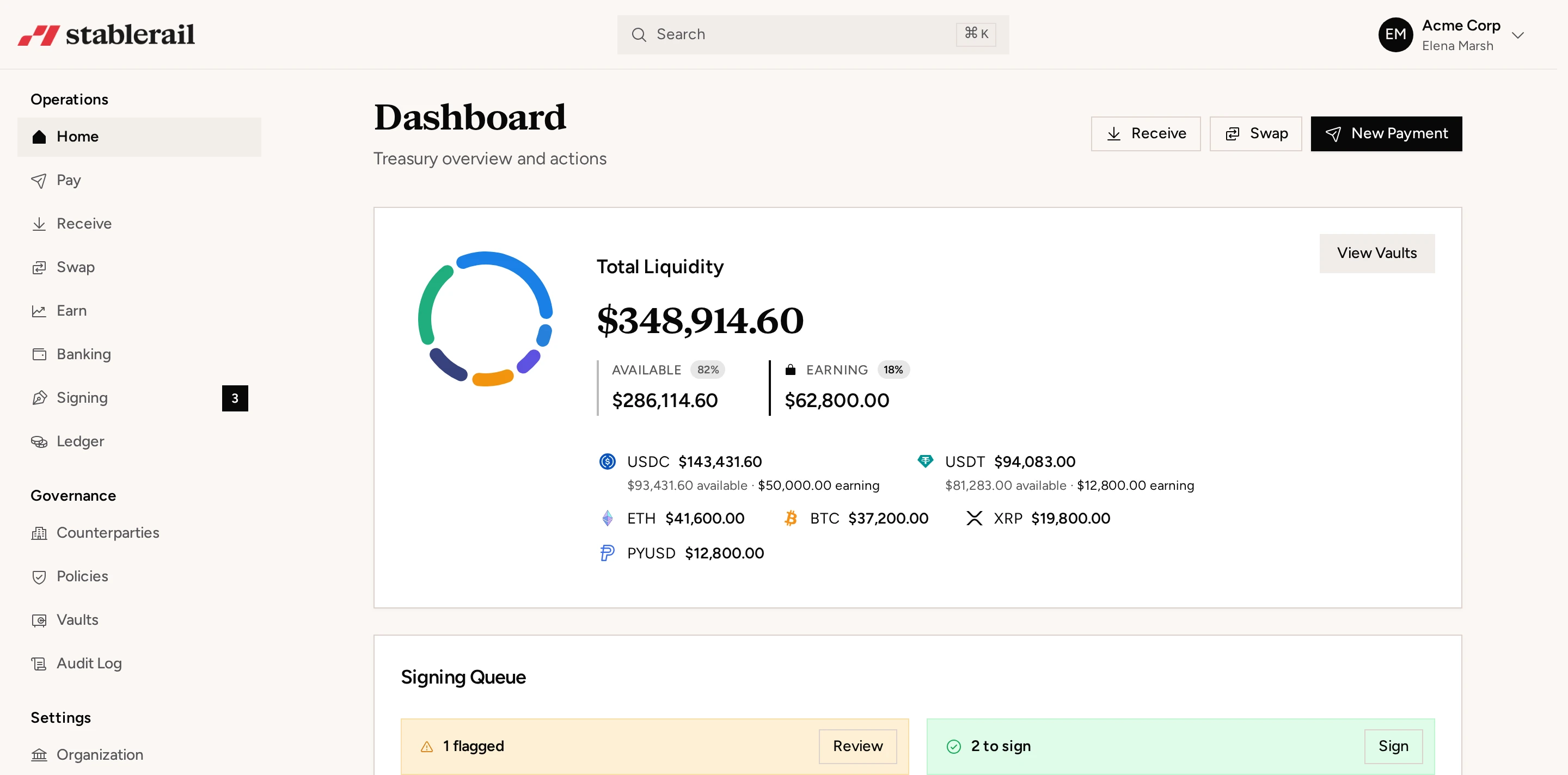
Signing quorum can reduce reliance on one person by requiring the configured number of participants to authorise a transaction. Stablerail provides approvals and signing quorum alongside sanctions and address screening before send, but the company must still define authorised signers, approval limits, escalation paths and access-recovery procedures.
Clarify custody and legal responsibility
Custody determines who can authorise movement of the stablecoins. In a custodial arrangement, a provider or custodian generally controls the keys and processes instructions. In self-custody, the company retains control of signing authority. Hybrid designs can divide operational responsibilities among the company, technology provider and other service providers.
Do not infer the custody model from technical labels alone. Multi-party computation describes how signing material may be distributed; it does not by itself establish which legal party has control. Review the contracts and operating design to identify who can initiate, approve, block or recover access to assets.
Document procedures for device loss, signer replacement, emergency access, employee departures and business continuity. Also determine whether fiat balances, stablecoins, corporate card funds and any yield-bearing or third-party product have different legal and custody arrangements.
Demand audit-ready records, not screenshots
A transaction history is not enough to demonstrate that a payment was authorised and screened. Finance should be able to reconstruct the complete chain from beneficiary setup through approval, blockchain settlement and general-ledger reconciliation.
| Record | Minimum useful detail |
|---|---|
| Stablecoin transfer | Asset, amount, network, source, destination, transaction hash, fee and timestamps |
| Approval | Creator, reviewers, approvers, sequence, changes and final release |
| Screening | Address or transaction checked, result, time, alert reason and resolution |
| Fiat payment | Sender, beneficiary, currency, rail, reference, fees and settlement status |
| Access | User creation, role changes, signer changes and security-relevant events |
| Reconciliation | Internal payment ID linking the invoice, fiat record and blockchain transaction |
Ask for a sample export before procurement is complete. Check whether data is machine-readable, how timestamps and time zones are represented, whether transaction identifiers remain consistent across exports and how long records remain available after account closure. Exportable audit evidence is especially important when treasury activity spans stablecoins, global payouts, fiat off-ramps and corporate cards.
Map every corridor and its failure conditions
Create a matrix for each legal entity, stablecoin, blockchain, fiat currency, payment rail and destination country. USDC on one network is operationally distinct from USDC on another; the same applies to USDT. Sending a supported token over an unsupported network can lead to delays or loss, so the asset, contract and network must all be verified.
For each corridor, document beneficiary requirements, cut-off times where relevant, expected processing stages, transaction limits, conversion method and possible charges. Separate platform fees from blockchain network fees, foreign-exchange costs and correspondent or beneficiary-bank deductions. Ask what causes a transfer to be delayed, returned, frozen for review or rejected.
Run an end-to-end procurement checklist
- Define the flow: list entities, assets, networks, countries, counterparties and fiat rails.
- Assign obligations: involve legal, compliance, finance, tax and security owners.
- Verify eligibility: obtain written confirmation for the proposed use case and corridors.
- Inspect controls: test user roles, quorum, beneficiary changes and alert escalation.
- Review custody: map signing, recovery and legal responsibility for each asset type.
- Complete a controlled transaction: fund the account, receive stablecoins, approve a payout and off-ramp where required.
- Export the evidence: reconcile the invoice, approvals, screening result, fees and settlement record.
- Document exceptions: define who responds when onboarding, screening or settlement fails.
The strongest choice is not the platform with the longest feature list. It is the one that demonstrably supports your operating model, places effective controls before irreversible transfers and produces records that compliance, finance and auditors can independently follow.
Frequently asked questions
Can a stablecoin platform make my company compliant?
No. A platform can provide KYB, screening, approval and recordkeeping controls, but legal obligations depend on your jurisdictions, activities and counterparties. Your company remains responsible for defining its policies, performing required diligence and documenting compliance decisions.
What compliance features should a business stablecoin platform have?
Look for business verification, sanctions and address screening, individual user roles, segregated approvals, signing controls and exportable audit evidence. The platform should also explain custody and confirm support for your exact stablecoins, networks, fiat rails and jurisdictions.
What is the difference between KYB and wallet screening?
KYB verifies a company and relevant owners or controlling persons. Wallet screening evaluates blockchain addresses and transaction exposure for sanctions or other risk indicators. A clean wallet result does not establish the legal identity or legitimacy of its controller, so both processes may be necessary.
What audit evidence should a stablecoin platform export?
Exports should include the asset, amount, network, addresses, transaction hash, fees and timestamps. They should also show who created and approved the payment, screening results and alert resolutions, beneficiary details, fiat settlement status and relevant access changes.
How should a finance team test stablecoin payment approvals?
Create payments above and below approval limits, add or change a beneficiary, and attempt to send to a new wallet. Remove an approver, test the required signing quorum and verify how pending or batch payments respond. The resulting logs should show every material action and approval.
Finance writers covering stablecoin treasury, payments, compliance, and risk controls.
More about the Stablerail team- Stablecoin treasury managementApprovals, limits, yield and reporting on one balance.
- Stablecoin payoutsBatch contractor and vendor payments with screening.
- USDT vs USDCWhich stablecoin your company should settle in.
- Stablecoin finance glossaryMPC, off-ramp, travel rule and the rest, in plain English.
- Product updatesEverything we ship, month by month.