
What to Look for in a Compliant Stablecoin Platform
A practical evaluation framework for stablecoin platforms covering KYB, sanctions screening, custody, payment approvals, supported rails and audit evidence.
A compliant stablecoin platform should give finance teams effective KYB, sanctions and wallet screening, controlled transaction approvals, secure signing, clear jurisdictional coverage and exportable audit evidence. It cannot guarantee that every payment is lawful or make the company compliant by itself. Choose a platform whose controls match your policies, whose custody model is documented and whose records let reviewers reconstruct every payment from request through settlement.
%22%20x1%3D%220%22%20y1%3D%220%22%20x2%3D%221%22%20y2%3D%221%22%3E%0A%20%20%20%20%20%20%20%20%3Cstop%20offset%3D%220%25%22%20stop-color%3D%22%23360A0E%22%20%2F%3E%0A%20%20%20%20%20%20%20%20%3Cstop%20offset%3D%2250%25%22%20stop-color%3D%22%23551217%22%20%2F%3E%0A%20%20%20%20%20%20%20%20%3Cstop%20offset%3D%22100%25%22%20stop-color%3D%22%237A1D20%22%20%2F%3E%0A%20%20%20%20%20%20%3C%2FlinearGradient%3E%0A%20%20%20%20%20%20%3CradialGradient%20id%3D%22glow%22%20cx%3D%221263%22%20cy%3D%22122%22%20r%3D%22520%22%20gradientUnits%3D%22userSpaceOnUse%22%3E%0A%20%20%20%20%20%20%20%20%3Cstop%20offset%3D%220%25%22%20stop-color%3D%22%23FFA587%22%20stop-opacity%3D%220.45%22%20%2F%3E%0A%20%20%20%20%20%20%20%20%3Cstop%20offset%3D%2255%25%22%20stop-color%3D%22%23FFA587%22%20stop-opacity%3D%220.08%22%20%2F%3E%0A%20%20%20%20%20%20%20%20%3Cstop%20offset%3D%22100%25%22%20stop-color%3D%22%23FFA587%22%20stop-opacity%3D%220%22%20%2F%3E%0A%20%20%20%20%20%20%3C%2FradialGradient%3E%0A%20%20%20%20%20%20%3ClinearGradient%20id%3D%22glass%22%20x1%3D%220%22%20y1%3D%220%22%20x2%3D%221%22%20y2%3D%221%22%3E%0A%20%20%20%20%20%20%20%20%3Cstop%20offset%3D%220%25%22%20stop-color%3D%22%23F8D6D2%22%20stop-opacity%3D%220.26%22%20%2F%3E%0A%20%20%20%20%20%20%20%20%3Cstop%20offset%3D%22100%25%22%20stop-color%3D%22%23FFFFFF%22%20stop-opacity%3D%220.08%22%20%2F%3E%0A%20%20%20%20%20%20%3C%2FlinearGradient%3E%0A%20%20%20%20%20%20%3ClinearGradient%20id%3D%22accent%22%20x1%3D%220%22%20y1%3D%220%22%20x2%3D%221%22%20y2%3D%221%22%3E%0A%20%20%20%20%20%20%20%20%3Cstop%20offset%3D%220%25%22%20stop-color%3D%22%23FFA587%22%20%2F%3E%0A%20%20%20%20%20%20%20%20%3Cstop%20offset%3D%22100%25%22%20stop-color%3D%22%23DC4A38%22%20%2F%3E%0A%20%20%20%20%20%20%3C%2FlinearGradient%3E%0A%20%20%20%20%20%20%3Cfilter%20id%3D%22soft%22%3E%3CfeGaussianBlur%20stdDeviation%3D%2210%22%20%2F%3E%3C%2Ffilter%3E%0A%20%20%20%20%3C%2Fdefs%3E%0A%20%20%20%20%3Crect%20width%3D%221600%22%20height%3D%22900%22%20fill%3D%22url(%23bg)%22%20%2F%3E%0A%20%20%20%20%3Crect%20width%3D%221600%22%20height%3D%22900%22%20fill%3D%22url(%23glow)%22%20%2F%3E%0A%20%20%20%20%3Cline%20x1%3D%22200%22%20y1%3D%22250%22%20x2%3D%221400%22%20y2%3D%22250%22%20stroke%3D%22%23F4CDC5%22%20stroke-opacity%3D%220.12%22%2F%3E%3Cline%20x1%3D%22200%22%20y1%3D%22340%22%20x2%3D%221400%22%20y2%3D%22340%22%20stroke%3D%22%23F4CDC5%22%20stroke-opacity%3D%220.12%22%2F%3E%3Cline%20x1%3D%22200%22%20y1%3D%22430%22%20x2%3D%221400%22%20y2%3D%22430%22%20stroke%3D%22%23F4CDC5%22%20stroke-opacity%3D%220.12%22%2F%3E%3Cline%20x1%3D%22200%22%20y1%3D%22520%22%20x2%3D%221400%22%20y2%3D%22520%22%20stroke%3D%22%23F4CDC5%22%20stroke-opacity%3D%220.12%22%2F%3E%3Cline%20x1%3D%22200%22%20y1%3D%22610%22%20x2%3D%221400%22%20y2%3D%22610%22%20stroke%3D%22%23F4CDC5%22%20stroke-opacity%3D%220.12%22%2F%3E%3Cpolyline%20points%3D%22200%2C497%20350%2C255%20500%2C260%20650%2C470%20800%2C427%20950%2C246%201100%2C224%201250%2C466%201400%2C426%22%20fill%3D%22none%22%20stroke%3D%22url(%23accent)%22%20stroke-width%3D%2210%22%20stroke-linejoin%3D%22round%22%20stroke-linecap%3D%22round%22%2F%3E%3Ccircle%20cx%3D%22200%22%20cy%3D%22497%22%20r%3D%229%22%20fill%3D%22%23F8D6D2%22%2F%3E%3Ccircle%20cx%3D%22350%22%20cy%3D%22255%22%20r%3D%229%22%20fill%3D%22%23F8D6D2%22%2F%3E%3Ccircle%20cx%3D%22500%22%20cy%3D%22260%22%20r%3D%229%22%20fill%3D%22%23F8D6D2%22%2F%3E%3Ccircle%20cx%3D%22650%22%20cy%3D%22470%22%20r%3D%229%22%20fill%3D%22%23F8D6D2%22%2F%3E%3Ccircle%20cx%3D%22800%22%20cy%3D%22427%22%20r%3D%229%22%20fill%3D%22%23F8D6D2%22%2F%3E%3Ccircle%20cx%3D%22950%22%20cy%3D%22246%22%20r%3D%229%22%20fill%3D%22%23F8D6D2%22%2F%3E%3Ccircle%20cx%3D%221100%22%20cy%3D%22224%22%20r%3D%229%22%20fill%3D%22%23F8D6D2%22%2F%3E%3Ccircle%20cx%3D%221250%22%20cy%3D%22466%22%20r%3D%229%22%20fill%3D%22%23F8D6D2%22%2F%3E%3Ccircle%20cx%3D%221400%22%20cy%3D%22426%22%20r%3D%229%22%20fill%3D%22%23F8D6D2%22%2F%3E%0A%20%20%20%20%3Crect%20x%3D%2226%22%20y%3D%2226%22%20width%3D%221548%22%20height%3D%22848%22%20rx%3D%2218%22%20fill%3D%22none%22%20stroke%3D%22%23F2D0C8%22%20stroke-opacity%3D%220.12%22%2F%3E%0A%20%20%3C%2Fsvg%3E)
A compliant stablecoin platform should help your company identify risk, enforce payment controls and prove what happened. It should not claim that software alone makes every transaction compliant. The relevant test is whether the platform gives your finance and compliance teams the information, authority and records needed to make defensible decisions.
Evaluate the full operating chain: entity onboarding, product eligibility, counterparty screening, payment approval, transaction signing, settlement and record retention. A weakness at any point can create manual work, unclear accountability or an audit gap.
Start with KYB and entity eligibility
Know Your Business, or KYB, verifies the company applying for an account and the people who own or control it. Complete this assessment before spending time testing payment features. A platform may support your preferred stablecoin but be unable to onboard your legal entity, industry or ownership structure.
A typical KYB review may require:
- Certificate of incorporation or a current registry extract
- Registered and operating addresses
- Articles of association or equivalent constitutional documents
- An ownership chart and details of ultimate beneficial owners
- Identity documents for directors, owners and account operators
- A description of the business model and expected transaction activity
- Source-of-funds or source-of-wealth evidence
- Licences or registrations for regulated activities
- Bank statements, financial statements, invoices or customer contracts
Review time depends on the entity type, jurisdiction, ownership chain and quality of the documents. Ask what triggers enhanced due diligence, how expired documents are refreshed and whether material changes in ownership or business activity require a new review. Treat a guaranteed onboarding date given before the provider has examined your structure with caution.
Confirm each product, jurisdiction and network
Account availability does not mean every feature is available. Eligibility can differ across fiat rails, stablecoins, blockchain networks, corporate cards and payout corridors. Ask for written confirmation covering the exact legal entity and workflow you intend to use.
- Country of incorporation and every material operating country
- USDC or USDT and the required blockchain network
- USD, EUR, GBP and other required fiat currencies
- ACH, Fedwire, SEPA, SEPA Instant, Faster Payments, CHAPS, BACS or SWIFT, as applicable
- Corporate cards, batch payouts, payroll and beneficiary types
- Transaction limits, cut-off times and any restricted business activities
Network support must be precise. Ethereum, Base, Arbitrum, Polygon, Tron, BNB Chain, Optimism and Solana are distinct networks with different address conventions, fees and settlement behavior. Confirm the supported token contract as well as the network. Sending a supported stablecoin over an unsupported network can lead to a lengthy recovery process or permanent loss.
Examine transaction and wallet screening
Screening should extend beyond the company’s onboarding review. A platform may check sanctions lists, counterparty details and blockchain risk indicators at several stages: when a beneficiary is created, before signing, when assets arrive and when previously approved addresses are reviewed again.
Establish exactly what the platform does when it detects a potential match. A warning that users can ignore is different from a hold that requires documented review. Finance teams should also be able to record the evidence considered, the reviewer’s decision and any escalation.
| Control area | Evidence to request | Operational test | Warning sign |
|---|---|---|---|
| Sanctions screening | Lists covered, update process and matching scope | Review a test alert and its disposition record | The provider only says it uses “industry-standard compliance” |
| Wallet screening | Direct and indirect exposure categories and data source | Check an address before initiating a payment | Screening occurs only after funds are sent |
| Decision workflow | Rules for warnings, holds, rejections and escalation | Confirm who can release a held transaction | Any user can override a flag without a reason |
| Ongoing review | Process for rescanning saved or active addresses | Ask how changed risk information is surfaced | An address is treated as permanently safe after one check |
| Case evidence | Reviewer, timestamp, notes and supporting records | Export the complete alert history | Decisions exist only in email or chat |
A risk score is not a legal conclusion. Screening providers may classify exposure differently, particularly where funds passed through several addresses or services. Your policy should define who reviews alerts, what evidence is sufficient, when compliance or counsel becomes involved and who can approve an exception.
Match approvals to the payment process
A single shared login or unrestricted signing key creates unnecessary financial and compliance risk. Look for distinct permissions for administrators, payment creators, approvers, signers and read-only reviewers. The platform should let your team separate payment preparation from approval and signing where your policy requires it.
Useful controls include approval thresholds, multiple approvers, signing quorum, beneficiary allowlists, review of beneficiary changes, transaction limits and restrictions by asset or network. For batch payments, determine whether approval applies to the batch total, each underlying payment or both. The final approval screen should show the beneficiary, destination address, stablecoin, network, amount, network fee and total treasury impact.
Test the controls rather than relying on a feature list. Confirm that a payment creator cannot approve the same payment when segregation of duties is required. Change a beneficiary address after approval and observe whether the platform invalidates the prior approval or clearly alerts the reviewer.
Understand custody and signing
Ask who can move funds, how transactions are signed and how access is recovered. Labels such as “institutional custody” or “secure wallet” are not substitutes for a documented control model.
In a self-custodial MPC arrangement, cryptographic signing material is divided into shares rather than stored as one conventional private key. A defined quorum of shares participates in signing. The relevant diligence questions are who controls each share, whether the platform can move funds independently, how devices and users are replaced, and what happens if the provider becomes unavailable.
Also determine whether workflow approval is technically connected to transaction signing. A platform may record an approval while leaving a separate signer technically able to send a different transaction. Ask whether the amount, token, network and destination approved by users are the same data ultimately signed and broadcast.
Self-custody does not eliminate stablecoin-specific risk. USDC and USDT issuers can restrict addresses in circumstances covered by their terms and legal obligations. Users also remain exposed to smart-contract, blockchain, address-entry and network-selection risks.
Require complete, exportable audit evidence
Your team should be able to reconstruct a payment from its business request through final settlement without combining screenshots, emails and chat messages. The audit trail should identify who created, edited, approved, rejected and signed the transaction, with timestamps and transaction references.
For each payment, look for an export containing:
- Business purpose, invoice and supporting documents
- Beneficiary identity and destination wallet or bank account
- Screening result, alerts, reviewer notes and disposition
- Approval history with users, roles and timestamps
- Stablecoin, network, amount, fees and applicable exchange-rate data
- Blockchain transaction hash or fiat payment reference
- Settlement, rejection, return or cancellation status
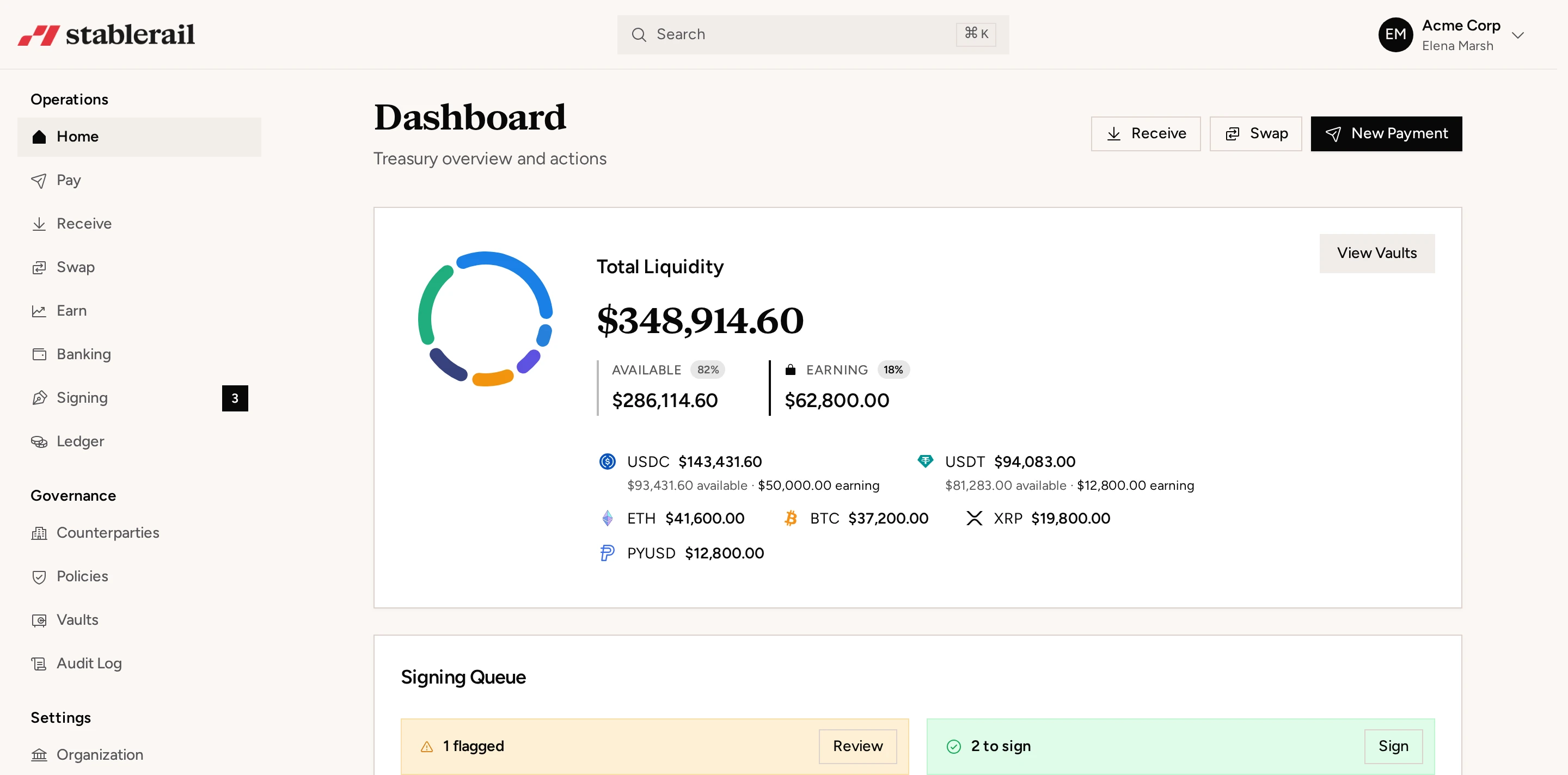
Ask which file formats are available, how records can be filtered and whether data remains retrievable after account closure. Retention obligations vary by jurisdiction, industry and record type, so export records to an archive your company controls. Stablerail, for example, combines USDC and USDT treasury operations with approvals, signing quorum, pre-send sanctions and address screening, global payouts, fiat off-ramp, corporate cards and exportable audit evidence.
Review fees, limits and exception handling
Commercial terms affect control design. Request a breakdown of account charges, fiat on-ramp and off-ramp fees, foreign exchange costs, blockchain withdrawal charges and transfer fees. Separate provider fees from variable network fees. Confirm limits and expected processing windows for each asset, network, currency and payment rail.
Exception handling matters more than an ideal settlement estimate. Ask who investigates a screening hold, what documents may be requested, whether a rejected transfer is returned automatically and how the return destination is determined. Document escalation channels for urgent payroll, supplier or liquidity transactions.
Run a controlled proof of workflow
Use realistic users, transaction values and evidence rather than a product demonstration. A finance team can follow this short checklist:
- Confirm eligibility for the intended entity, countries, stablecoins, networks and fiat rails.
- Create separate administrator, preparer, approver, signer and auditor roles.
- Add a beneficiary and inspect the screening result before payment.
- Submit a small transaction through the required approval and signing quorum.
- Test a changed beneficiary, rejected approval and screening exception.
- Reconcile the transaction to the blockchain or fiat payment reference.
- Export the payment record and verify that an independent reviewer can reconstruct it.
The best platform is not the one making the broadest compliance claim. It is the one whose eligibility rules are clear, controls match your operating policy, signing model is understandable and records survive scrutiny. Platform controls should sit inside a wider framework of documented procedures, trained reviewers, legal advice where needed and periodic testing.
Frequently asked questions
What makes a stablecoin platform compliant?
No platform is universally compliant on its own. A suitable platform supports the company’s obligations with KYB, sanctions and wallet screening, controlled approvals, secure signing, jurisdictional restrictions and exportable records, while leaving legal and transaction decisions with the company.
What KYB documents are needed for a business stablecoin account?
Providers commonly request incorporation documents, an ownership chart, beneficial-owner and director identification, business addresses and a description of expected activity. Complex ownership, regulated activities or higher-risk jurisdictions may require licences, contracts, financial statements and source-of-funds evidence.
Should a stablecoin platform screen wallets before sending funds?
Pre-send screening helps the team identify sanctions matches and blockchain risk indicators before authorizing an irreversible transaction. The platform should also show what triggered an alert, who reviewed it and whether the result blocks payment, requires escalation or generates a warning.
What audit evidence should a stablecoin payment platform retain?
The record should connect the business purpose and beneficiary to screening, approval, signing and settlement. It should include users, roles, timestamps, reviewer notes, token and network details, fees, transaction hashes or fiat references, and the final status in an exportable format.
How should a finance team test stablecoin payment approvals?
Create separate preparer, approver and signer accounts, then run a small payment through the intended workflow. Test whether the creator can self-approve, whether changing the destination invalidates approval and whether the exported record captures every action.
Finance writers covering stablecoin treasury, payments, compliance, and risk controls.
More about the Stablerail team- Stablecoin treasury managementApprovals, limits, yield and reporting on one balance.
- Stablecoin payoutsBatch contractor and vendor payments with screening.
- USDT vs USDCWhich stablecoin your company should settle in.
- Stablecoin finance glossaryMPC, off-ramp, travel rule and the rest, in plain English.
- Product updatesEverything we ship, month by month.