
Setting a Treasury Yield Policy Your Board Will Approve
A practical framework for setting stablecoin yield limits, liquidity floors, venue criteria, approval authority, suspension triggers and board reporting.
A board-ready treasury yield policy defines which USDC or USDT yield products are eligible, how much may be allocated, how much liquidity must remain available and who may approve transfers. It should also document each product’s yield source, redemption path, fees and loss risks; establish suspension and withdrawal triggers; and require regular reporting against limits. This lets directors approve a controlled framework rather than individual routine transactions.
%22%20x1%3D%220%22%20y1%3D%220%22%20x2%3D%221%22%20y2%3D%221%22%3E%0A%20%20%20%20%20%20%20%20%3Cstop%20offset%3D%220%25%22%20stop-color%3D%22%23450B10%22%20%2F%3E%0A%20%20%20%20%20%20%20%20%3Cstop%20offset%3D%2250%25%22%20stop-color%3D%22%23681A1F%22%20%2F%3E%0A%20%20%20%20%20%20%20%20%3Cstop%20offset%3D%22100%25%22%20stop-color%3D%22%238A2A2D%22%20%2F%3E%0A%20%20%20%20%20%20%3C%2FlinearGradient%3E%0A%20%20%20%20%20%20%3CradialGradient%20id%3D%22glow%22%20cx%3D%221312%22%20cy%3D%22550%22%20r%3D%22520%22%20gradientUnits%3D%22userSpaceOnUse%22%3E%0A%20%20%20%20%20%20%20%20%3Cstop%20offset%3D%220%25%22%20stop-color%3D%22%23FF7A59%22%20stop-opacity%3D%220.45%22%20%2F%3E%0A%20%20%20%20%20%20%20%20%3Cstop%20offset%3D%2255%25%22%20stop-color%3D%22%23FF7A59%22%20stop-opacity%3D%220.08%22%20%2F%3E%0A%20%20%20%20%20%20%20%20%3Cstop%20offset%3D%22100%25%22%20stop-color%3D%22%23FF7A59%22%20stop-opacity%3D%220%22%20%2F%3E%0A%20%20%20%20%20%20%3C%2FradialGradient%3E%0A%20%20%20%20%20%20%3ClinearGradient%20id%3D%22glass%22%20x1%3D%220%22%20y1%3D%220%22%20x2%3D%221%22%20y2%3D%221%22%3E%0A%20%20%20%20%20%20%20%20%3Cstop%20offset%3D%220%25%22%20stop-color%3D%22%23F8D6D2%22%20stop-opacity%3D%220.26%22%20%2F%3E%0A%20%20%20%20%20%20%20%20%3Cstop%20offset%3D%22100%25%22%20stop-color%3D%22%23FFFFFF%22%20stop-opacity%3D%220.08%22%20%2F%3E%0A%20%20%20%20%20%20%3C%2FlinearGradient%3E%0A%20%20%20%20%20%20%3ClinearGradient%20id%3D%22accent%22%20x1%3D%220%22%20y1%3D%220%22%20x2%3D%221%22%20y2%3D%221%22%3E%0A%20%20%20%20%20%20%20%20%3Cstop%20offset%3D%220%25%22%20stop-color%3D%22%23FF7A59%22%20%2F%3E%0A%20%20%20%20%20%20%20%20%3Cstop%20offset%3D%22100%25%22%20stop-color%3D%22%23C73128%22%20%2F%3E%0A%20%20%20%20%20%20%3C%2FlinearGradient%3E%0A%20%20%20%20%20%20%3Cfilter%20id%3D%22soft%22%3E%3CfeGaussianBlur%20stdDeviation%3D%2210%22%20%2F%3E%3C%2Ffilter%3E%0A%20%20%20%20%3C%2Fdefs%3E%0A%20%20%20%20%3Crect%20width%3D%221600%22%20height%3D%22900%22%20fill%3D%22url(%23bg)%22%20%2F%3E%0A%20%20%20%20%3Crect%20width%3D%221600%22%20height%3D%22900%22%20fill%3D%22url(%23glow)%22%20%2F%3E%0A%20%20%20%20%3Ccircle%20cx%3D%22800%22%20cy%3D%22450%22%20r%3D%22280%22%20fill%3D%22url(%23glass)%22%20stroke%3D%22%23F4CDC5%22%20stroke-opacity%3D%220.45%22%2F%3E%3Cellipse%20cx%3D%22800%22%20cy%3D%22450%22%20rx%3D%22280%22%20ry%3D%22280%22%20fill%3D%22none%22%20stroke%3D%22%23F4CDC5%22%20stroke-opacity%3D%220.35%22%2F%3E%3Cellipse%20cx%3D%22800%22%20cy%3D%22450%22%20rx%3D%22224%22%20ry%3D%22280%22%20fill%3D%22none%22%20stroke%3D%22%23F4CDC5%22%20stroke-opacity%3D%220.35%22%2F%3E%3Cellipse%20cx%3D%22800%22%20cy%3D%22450%22%20rx%3D%22168%22%20ry%3D%22280%22%20fill%3D%22none%22%20stroke%3D%22%23F4CDC5%22%20stroke-opacity%3D%220.35%22%2F%3E%3Cellipse%20cx%3D%22800%22%20cy%3D%22450%22%20rx%3D%22112%22%20ry%3D%22280%22%20fill%3D%22none%22%20stroke%3D%22%23F4CDC5%22%20stroke-opacity%3D%220.35%22%2F%3E%3Cellipse%20cx%3D%22800%22%20cy%3D%22450%22%20rx%3D%2256%22%20ry%3D%22280%22%20fill%3D%22none%22%20stroke%3D%22%23F4CDC5%22%20stroke-opacity%3D%220.35%22%2F%3E%3Cellipse%20cx%3D%22800%22%20cy%3D%22240%22%20rx%3D%22107.15136106222515%22%20ry%3D%2214%22%20fill%3D%22none%22%20stroke%3D%22%23F4CDC5%22%20stroke-opacity%3D%220.3%22%2F%3E%3Cellipse%20cx%3D%22800%22%20cy%3D%22380%22%20rx%3D%22258.68626910316027%22%20ry%3D%2214%22%20fill%3D%22none%22%20stroke%3D%22%23F4CDC5%22%20stroke-opacity%3D%220.3%22%2F%3E%3Cellipse%20cx%3D%22800%22%20cy%3D%22520%22%20rx%3D%22258.68626910316027%22%20ry%3D%2214%22%20fill%3D%22none%22%20stroke%3D%22%23F4CDC5%22%20stroke-opacity%3D%220.3%22%2F%3E%3Cellipse%20cx%3D%22800%22%20cy%3D%22660%22%20rx%3D%22107.15136106222515%22%20ry%3D%2214%22%20fill%3D%22none%22%20stroke%3D%22%23F4CDC5%22%20stroke-opacity%3D%220.3%22%2F%3E%3Cpath%20d%3D%22M%20550%20530%20Q%20800%20250%201050%20410%22%20fill%3D%22none%22%20stroke%3D%22url(%23accent)%22%20stroke-width%3D%228%22%20stroke-dasharray%3D%2214%2012%22%2F%3E%3Ccircle%20cx%3D%22680%22%20cy%3D%22490%22%20r%3D%2214%22%20fill%3D%22url(%23accent)%22%2F%3E%3Ccircle%20cx%3D%22980%22%20cy%3D%22330%22%20r%3D%2214%22%20fill%3D%22url(%23accent)%22%2F%3E%0A%20%20%20%20%3Crect%20x%3D%2226%22%20y%3D%2226%22%20width%3D%221548%22%20height%3D%22848%22%20rx%3D%2218%22%20fill%3D%22none%22%20stroke%3D%22%23F2D0C8%22%20stroke-opacity%3D%220.12%22%2F%3E%0A%20%20%3C%2Fsvg%3E)
A treasury yield policy should answer one practical question: under what conditions may finance move idle USDC or USDT into a yield product? The board should not have to approve every routine allocation, but it should define the boundaries within which management may act.
Those boundaries normally cover eligible products, allocation and concentration limits, minimum operating liquidity, withdrawal conditions, approval authority, loss triggers and reporting. A headline annual percentage yield is not enough. Directors need to understand how the return is generated, when principal can be recovered and what could prevent recovery.
Start with the mechanics of each yield product
Build an inventory of proposed venues before writing limits. Apply the same diligence questions to every product so directors can compare like with like. Do not treat products as equivalent merely because they accept the same stablecoin or display similar rates.
| Review area | What finance should document | Why it matters |
|---|---|---|
| Accepted asset | Whether the product accepts USDC, USDT or another asset, and whether the deposit is converted, bridged or wrapped. | Conversion can introduce issuer, bridge, market or smart-contract exposure not visible from the deposit screen. |
| Yield source | Whether return comes from lending, tokenized government securities, market activity or another disclosed strategy. | The source determines the underlying credit, market and legal risks. |
| Return | Current rate, fixed or variable status, calculation basis, fees, payment frequency and treatment of rewards. | A displayed rate may not equal the net return recognized by the company. |
| Liquidity | Redemption notice, lock-up, dealing window, settlement period, gates and any early-withdrawal cost. | “Redeemable” does not necessarily mean available for same-day obligations. |
| Legal structure | Contracting entity, governing documents, asset ownership, creditor status and insolvency treatment. | Account labels do not establish the company’s legal claim if a provider fails. |
| Redemption route | Destination wallet or bank account, supported networks, conversion steps, network fees and operational cutoffs. | Liquidity depends on the entire path from product to spendable currency. |
| Eligibility | Permitted jurisdictions, industries and entity types, plus required KYB and tax documentation. | A change in eligibility could restrict deposits or withdrawals. |
Rates, fees and redemption times can change. The policy should therefore refer to each venue’s current approved diligence record rather than hard-code a temporary yield. Record the date of review, documents examined, reviewer and next review date.
Use a board-ready policy structure
1. Purpose and scope
State that the objective is to earn a return on otherwise idle balances while preserving principal and maintaining funds for payroll, taxes, debt service, supplier payments and other operating needs. Identify the legal entities, wallets, accounts and assets covered.
“The company may allocate a limited portion of otherwise idle stablecoin balances to approved yield products within the liquidity, concentration and authority limits established by this policy.”
If the company holds both USDC and USDT, say whether limits apply to each asset or to combined stablecoin holdings. Define how balances are valued for limit testing and which reference currency is used for board reporting.
2. Eligible venues and strategies
A venue should not become eligible simply because it offers the highest rate. Minimum criteria should include a documented yield source, understood ownership structure, reviewed legal terms, known redemption mechanics and an approved destination for withdrawals.
Maintain approved venues and strategies in a controlled schedule owned by the CFO or treasury committee. The board can approve the policy framework while delegating additions, suspensions and removals within defined authority. A materially different strategy should require fresh review even when offered by an existing provider.
3. Allocation and concentration limits
Use several limits because a portfolio-wide cap alone does not control concentration. Percentages should be set from the company’s cash-flow volatility, loss tolerance and access to alternative funding—not copied from another treasury.
| Limit | What it controls | How to test it |
|---|---|---|
| Total yield allocation | Aggregate exposure to products that put principal at risk or delay access. | Allocated balance divided by the stablecoin treasury or another policy-defined base. |
| Per venue | Failure or withdrawal restriction at one provider. | Combine all accounts and products involving the same provider. |
| Per strategy | Common risk from lending, tokenized securities or another return source. | Aggregate economically similar products, even across providers. |
| Per stablecoin | Concentration in one issuer or asset. | Include unallocated and allocated exposure, including assets received after conversion. |
| Term exposure | Funds subject to notice, lock-up or delayed settlement. | Measure by the earliest contractual and operational availability date. |
Specify what happens after a passive breach caused by balance changes, redemptions or market movements. The policy might prohibit new allocations and require escalation, rather than forcing an immediate transaction that could worsen the outcome.
4. Minimum immediately available liquidity
Define liquidity in currency amounts and time horizons, not as “sufficient cash.” The floor should cover forecast obligations for a stated period plus a contingency buffer. Finance may use a rolling 13-week cash forecast to test payroll, taxes, card settlement, debt service and supplier payments.
Funds subject to notice periods, gates or uncertain settlement should not count as immediately available. Nor should USDC in a wallet automatically count as same-day fiat liquidity. Test blockchain confirmation, screening, off-ramp conversion, banking cutoffs and fiat settlement as one end-to-end process.
5. Suspension, drawdown and exit triggers
Each trigger needs a defined action and owner. Relevant triggers include:
- A stablecoin trading outside the company’s approved tolerance for the defined observation period.
- A provider delaying, limiting or changing withdrawals beyond approved terms.
- A principal loss, impairment or material change in the yield strategy.
- A legal, regulatory, security, solvency or sanctions-related event involving a provider, custodian or material counterparty.
- Forecast liquidity falling below the policy floor.
- Net return falling below the threshold required to justify the risk and operating workload.
- A material wallet-screening, address or transaction-security alert.
Actions can include pausing deposits, removing a venue from the approved schedule, redeeming available balances or convening an emergency treasury committee meeting. State who may order an emergency redemption and whether normal approval quorum still applies.
6. Authority to propose, approve and execute
Separate investment selection from transaction execution. Identify who may initiate an allocation, who independently approves it and who signs or releases the transaction. Set monetary authority bands and a signing quorum for both deposits and withdrawals.
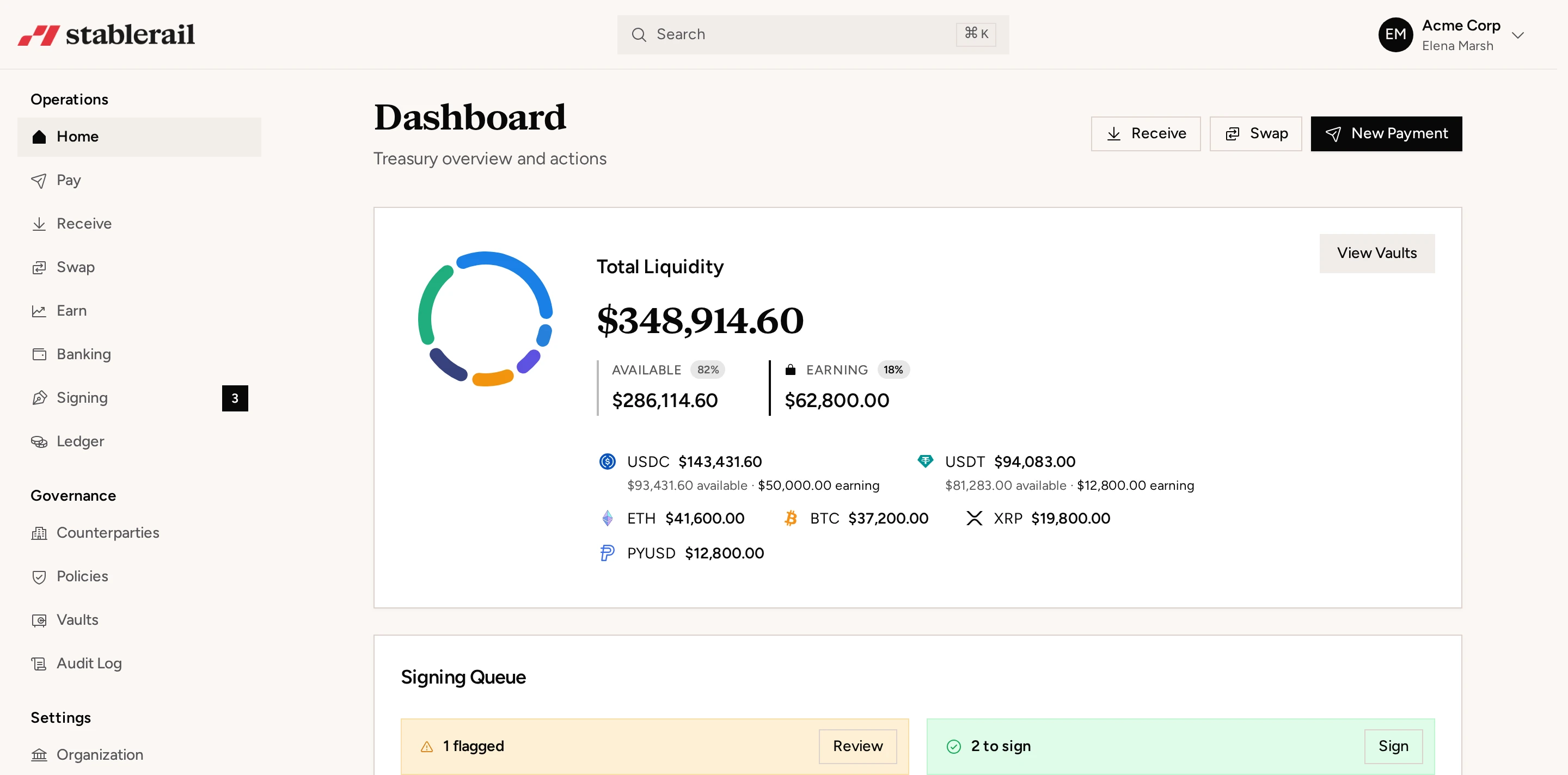
Use approved destination records and independently verify address changes through a channel other than the original request. Sanctions and address screening should occur before sending, with the result retained as evidence. A corporate treasury platform such as Stablerail can support approval and signing quorum, pre-send screening, fiat conversion and exportable audit evidence for a company’s own USDC or USDT funds.
7. Measurement and reporting
Define how finance calculates yield, fees and valuation. Separate realized yield from changes in asset value, promotional rewards and foreign-exchange effects. Reconcile provider records to wallet transactions, bank movements and the general ledger.
Operational monitoring may be weekly, management reporting monthly and board reporting quarterly. The board pack should show opening, closing and average balances; gross and net yield; liquidity by availability window; exposure against every limit; redemptions; exceptions; incidents; and material changes in providers or legal terms.
Prepare the approval pack
Give directors enough information to approve a controlled framework without asking them to operate it. The pack should contain:
- The proposed policy and controlled schedule of approved products.
- Current balances and a 13-week cash forecast.
- A venue comparison covering yield source, legal structure, fees and redemption.
- Concentration analysis by provider, strategy and stablecoin.
- At least one delayed-withdrawal or loss scenario.
- The authority matrix, signing quorum and emergency contacts.
- Accounting, tax, legal and disclosure conclusions where material.
A useful scenario asks what happens if a venue pauses withdrawals while stablecoin obligations continue. Show which balances remain accessible, how payments would be funded, when escalation occurs and whether the company would breach any policy or contractual obligation.
Record approval in the board minutes, including conditions and delegated limits. Retain the approved version, diligence files, transaction approvals, screening results, reconciliations and amendments so finance can reproduce the decision trail.
Review the policy when risk changes
Set a scheduled review date, but require an earlier review for a new venue, strategy or stablecoin; changed redemption or legal terms; entry into a new jurisdiction; a material treasury increase; an incident; or a change in the company’s cash needs.
The final test is simple: finance should be able to explain where funds are, how return is generated, when principal can be recovered, what could cause a loss and who has authority to act. When the policy answers those questions with measurable limits, board approval becomes a decision about controlled exposure rather than an open-ended request to take risk.
Frequently asked questions
What should a treasury yield policy include?
It should define eligible products, total and per-venue allocation limits, minimum immediately available liquidity, approval authority, signing requirements, withdrawal triggers and reporting. It should also state how yield, fees, valuation and policy breaches are measured.
How much USDC or USDT should a company put into yield products?
There is no universal safe percentage. The limit should follow the company’s cash forecast, payment obligations, loss tolerance, redemption timelines and access to alternative funding, with separate caps for each venue, strategy and stablecoin.
What information does a board need before approving stablecoin yield?
Directors need the yield source, legal structure, material risks, fees, redemption mechanics, concentration analysis and downside scenarios. They should also see a cash forecast, liquidity floor, authority matrix and evidence that legal, accounting, tax and compliance questions have been reviewed.
Should funds in a stablecoin yield product count as available liquidity?
Only if they can reliably be redeemed and converted into the currency needed within the policy’s required timeframe. Funds subject to notice periods, withdrawal gates, conversion steps or uncertain settlement should be classified as delayed rather than immediately available.
When should a company stop allocating to a yield product?
The policy should pause new allocations when liquidity falls below its floor, withdrawals are delayed, strategy terms materially change, principal is impaired or a legal, solvency, security or sanctions alert arises. It should assign a specific response and decision owner to each trigger.
Finance writers covering stablecoin treasury, payments, compliance, and risk controls.
More about the Stablerail team- Stablecoin treasury managementApprovals, limits, yield and reporting on one balance.
- Stablecoin payoutsBatch contractor and vendor payments with screening.
- USDT vs USDCWhich stablecoin your company should settle in.
- Stablecoin finance glossaryMPC, off-ramp, travel rule and the rest, in plain English.
- Product updatesEverything we ship, month by month.