
BVNK Competitors: Comparing Stablecoin Payments, Accounts, and Fiat Infrastructure
Compare BVNK alternatives by account structure, fiat rails, stablecoin conversion, payout coverage, custody, controls, APIs and customer eligibility.
The best BVNK competitor depends on the operating model. Finance teams managing company funds should compare treasury platforms; fintechs embedding customer flows need API-first infrastructure; USDC-focused institutions may prefer issuer access; and merchants may need payment processing. Evaluate each option by account ownership, fiat rails, conversion cost, payout coverage, custody, approvals, reconciliation, supported entities and the exact countries and networks required.
%22%20x1%3D%220%22%20y1%3D%220%22%20x2%3D%221%22%20y2%3D%221%22%3E%0A%20%20%20%20%20%20%20%20%3Cstop%20offset%3D%220%25%22%20stop-color%3D%22%232E0709%22%20%2F%3E%0A%20%20%20%20%20%20%20%20%3Cstop%20offset%3D%2250%25%22%20stop-color%3D%22%234A0F14%22%20%2F%3E%0A%20%20%20%20%20%20%20%20%3Cstop%20offset%3D%22100%25%22%20stop-color%3D%22%236B181C%22%20%2F%3E%0A%20%20%20%20%20%20%3C%2FlinearGradient%3E%0A%20%20%20%20%20%20%3CradialGradient%20id%3D%22glow%22%20cx%3D%221091%22%20cy%3D%22-320%22%20r%3D%22520%22%20gradientUnits%3D%22userSpaceOnUse%22%3E%0A%20%20%20%20%20%20%20%20%3Cstop%20offset%3D%220%25%22%20stop-color%3D%22%23FFB199%22%20stop-opacity%3D%220.45%22%20%2F%3E%0A%20%20%20%20%20%20%20%20%3Cstop%20offset%3D%2255%25%22%20stop-color%3D%22%23FFB199%22%20stop-opacity%3D%220.08%22%20%2F%3E%0A%20%20%20%20%20%20%20%20%3Cstop%20offset%3D%22100%25%22%20stop-color%3D%22%23FFB199%22%20stop-opacity%3D%220%22%20%2F%3E%0A%20%20%20%20%20%20%3C%2FradialGradient%3E%0A%20%20%20%20%20%20%3ClinearGradient%20id%3D%22glass%22%20x1%3D%220%22%20y1%3D%220%22%20x2%3D%221%22%20y2%3D%221%22%3E%0A%20%20%20%20%20%20%20%20%3Cstop%20offset%3D%220%25%22%20stop-color%3D%22%23F8D6D2%22%20stop-opacity%3D%220.26%22%20%2F%3E%0A%20%20%20%20%20%20%20%20%3Cstop%20offset%3D%22100%25%22%20stop-color%3D%22%23FFFFFF%22%20stop-opacity%3D%220.08%22%20%2F%3E%0A%20%20%20%20%20%20%3C%2FlinearGradient%3E%0A%20%20%20%20%20%20%3ClinearGradient%20id%3D%22accent%22%20x1%3D%220%22%20y1%3D%220%22%20x2%3D%221%22%20y2%3D%221%22%3E%0A%20%20%20%20%20%20%20%20%3Cstop%20offset%3D%220%25%22%20stop-color%3D%22%23FFB199%22%20%2F%3E%0A%20%20%20%20%20%20%20%20%3Cstop%20offset%3D%22100%25%22%20stop-color%3D%22%23E85D3A%22%20%2F%3E%0A%20%20%20%20%20%20%3C%2FlinearGradient%3E%0A%20%20%20%20%20%20%3Cfilter%20id%3D%22soft%22%3E%3CfeGaussianBlur%20stdDeviation%3D%2210%22%20%2F%3E%3C%2Ffilter%3E%0A%20%20%20%20%3C%2Fdefs%3E%0A%20%20%20%20%3Crect%20width%3D%221600%22%20height%3D%22900%22%20fill%3D%22url(%23bg)%22%20%2F%3E%0A%20%20%20%20%3Crect%20width%3D%221600%22%20height%3D%22900%22%20fill%3D%22url(%23glow)%22%20%2F%3E%0A%20%20%20%20%3Cline%20x1%3D%22932.1413009192233%22%20y1%3D%22531.0165204842522%22%20x2%3D%22676.0719021880471%22%20y2%3D%22517.2519633372219%22%20stroke%3D%22%23FFD2C8%22%20stroke-opacity%3D%220.5%22%20stroke-width%3D%223%22%2F%3E%3Cline%20x1%3D%22846.6129353425042%22%20y1%3D%22589.4138955009705%22%20x2%3D%22623.6214985930919%22%20y2%3D%22414.0747408992875%22%20stroke%3D%22%23FFD2C8%22%20stroke-opacity%3D%220.5%22%20stroke-width%3D%223%22%2F%3E%3Cline%20x1%3D%22747.5608838735492%22%20y1%3D%22583.0381114563666%22%20x2%3D%22700.4253693656016%22%20y2%3D%22324.76065740342165%22%20stroke%3D%22%23FFD2C8%22%20stroke-opacity%3D%220.5%22%20stroke-width%3D%223%22%2F%3E%3Cline%20x1%3D%22676.0719021880471%22%20y1%3D%22517.2519633372219%22%20x2%3D%22805.0156499169991%22%20y2%3D%22260.06621349557076%22%20stroke%3D%22%23FFD2C8%22%20stroke-opacity%3D%220.5%22%20stroke-width%3D%223%22%2F%3E%3Cline%20x1%3D%22623.6214985930919%22%20y1%3D%22414.0747408992875%22%20x2%3D%22935.8710818502936%22%20y2%3D%22296.4941397964534%22%20stroke%3D%22%23FFD2C8%22%20stroke-opacity%3D%220.5%22%20stroke-width%3D%223%22%2F%3E%3Cline%20x1%3D%22700.4253693656016%22%20y1%3D%22324.76065740342165%22%20x2%3D%221009.6782920158057%22%20y2%3D%22418.7108028652934%22%20stroke%3D%22%23FFD2C8%22%20stroke-opacity%3D%220.5%22%20stroke-width%3D%223%22%2F%3E%3Cline%20x1%3D%22805.0156499169991%22%20y1%3D%22260.06621349557076%22%20x2%3D%22932.1413009192233%22%20y2%3D%22531.0165204842522%22%20stroke%3D%22%23FFD2C8%22%20stroke-opacity%3D%220.5%22%20stroke-width%3D%223%22%2F%3E%3Cline%20x1%3D%22935.8710818502936%22%20y1%3D%22296.4941397964534%22%20x2%3D%22846.6129353425042%22%20y2%3D%22589.4138955009705%22%20stroke%3D%22%23FFD2C8%22%20stroke-opacity%3D%220.5%22%20stroke-width%3D%223%22%2F%3E%3Cline%20x1%3D%221009.6782920158057%22%20y1%3D%22418.7108028652934%22%20x2%3D%22747.5608838735492%22%20y2%3D%22583.0381114563666%22%20stroke%3D%22%23FFD2C8%22%20stroke-opacity%3D%220.5%22%20stroke-width%3D%223%22%2F%3E%3Ccircle%20cx%3D%22932.1413009192233%22%20cy%3D%22531.0165204842522%22%20r%3D%2218%22%20fill%3D%22url(%23glass)%22%20stroke%3D%22%23F4CDC5%22%20stroke-opacity%3D%220.6%22%2F%3E%3Ccircle%20cx%3D%22846.6129353425042%22%20cy%3D%22589.4138955009705%22%20r%3D%2218%22%20fill%3D%22url(%23glass)%22%20stroke%3D%22%23F4CDC5%22%20stroke-opacity%3D%220.6%22%2F%3E%3Ccircle%20cx%3D%22747.5608838735492%22%20cy%3D%22583.0381114563666%22%20r%3D%2218%22%20fill%3D%22url(%23glass)%22%20stroke%3D%22%23F4CDC5%22%20stroke-opacity%3D%220.6%22%2F%3E%3Ccircle%20cx%3D%22676.0719021880471%22%20cy%3D%22517.2519633372219%22%20r%3D%2218%22%20fill%3D%22url(%23glass)%22%20stroke%3D%22%23F4CDC5%22%20stroke-opacity%3D%220.6%22%2F%3E%3Ccircle%20cx%3D%22623.6214985930919%22%20cy%3D%22414.0747408992875%22%20r%3D%2218%22%20fill%3D%22url(%23glass)%22%20stroke%3D%22%23F4CDC5%22%20stroke-opacity%3D%220.6%22%2F%3E%3Ccircle%20cx%3D%22700.4253693656016%22%20cy%3D%22324.76065740342165%22%20r%3D%2218%22%20fill%3D%22url(%23glass)%22%20stroke%3D%22%23F4CDC5%22%20stroke-opacity%3D%220.6%22%2F%3E%3Ccircle%20cx%3D%22805.0156499169991%22%20cy%3D%22260.06621349557076%22%20r%3D%2218%22%20fill%3D%22url(%23glass)%22%20stroke%3D%22%23F4CDC5%22%20stroke-opacity%3D%220.6%22%2F%3E%3Ccircle%20cx%3D%22935.8710818502936%22%20cy%3D%22296.4941397964534%22%20r%3D%2218%22%20fill%3D%22url(%23glass)%22%20stroke%3D%22%23F4CDC5%22%20stroke-opacity%3D%220.6%22%2F%3E%3Ccircle%20cx%3D%221009.6782920158057%22%20cy%3D%22418.7108028652934%22%20r%3D%2228%22%20fill%3D%22url(%23accent)%22%20stroke%3D%22%23F4CDC5%22%20stroke-opacity%3D%220.6%22%2F%3E%3Ccircle%20cx%3D%22800%22%20cy%3D%22450%22%20r%3D%2248%22%20fill%3D%22url(%23accent)%22%2F%3E%0A%20%20%20%20%3Crect%20x%3D%2226%22%20y%3D%2226%22%20width%3D%221548%22%20height%3D%22848%22%20rx%3D%2218%22%20fill%3D%22none%22%20stroke%3D%22%23F2D0C8%22%20stroke-opacity%3D%220.12%22%2F%3E%0A%20%20%3C%2Fsvg%3E)
BVNK combines business accounts, fiat and stablecoin payments, conversion, wallets, payouts and APIs. Its competitors are not interchangeable: some provide an operating interface for corporate treasury, while others supply infrastructure that a fintech must integrate into its own product. The right comparison begins with the movement of funds, not the provider list.
Document who sends the money, who owns it, whether it must be held in fiat or stablecoins, which entity initiates payments, and how recipients are paid. A platform suitable for a company managing its own treasury may not support customer funds, and an embedded infrastructure provider may require substantially more engineering and operational work.
BVNK competitors at a glance
| Provider | Primary model | Typical fit | Key diligence question |
|---|---|---|---|
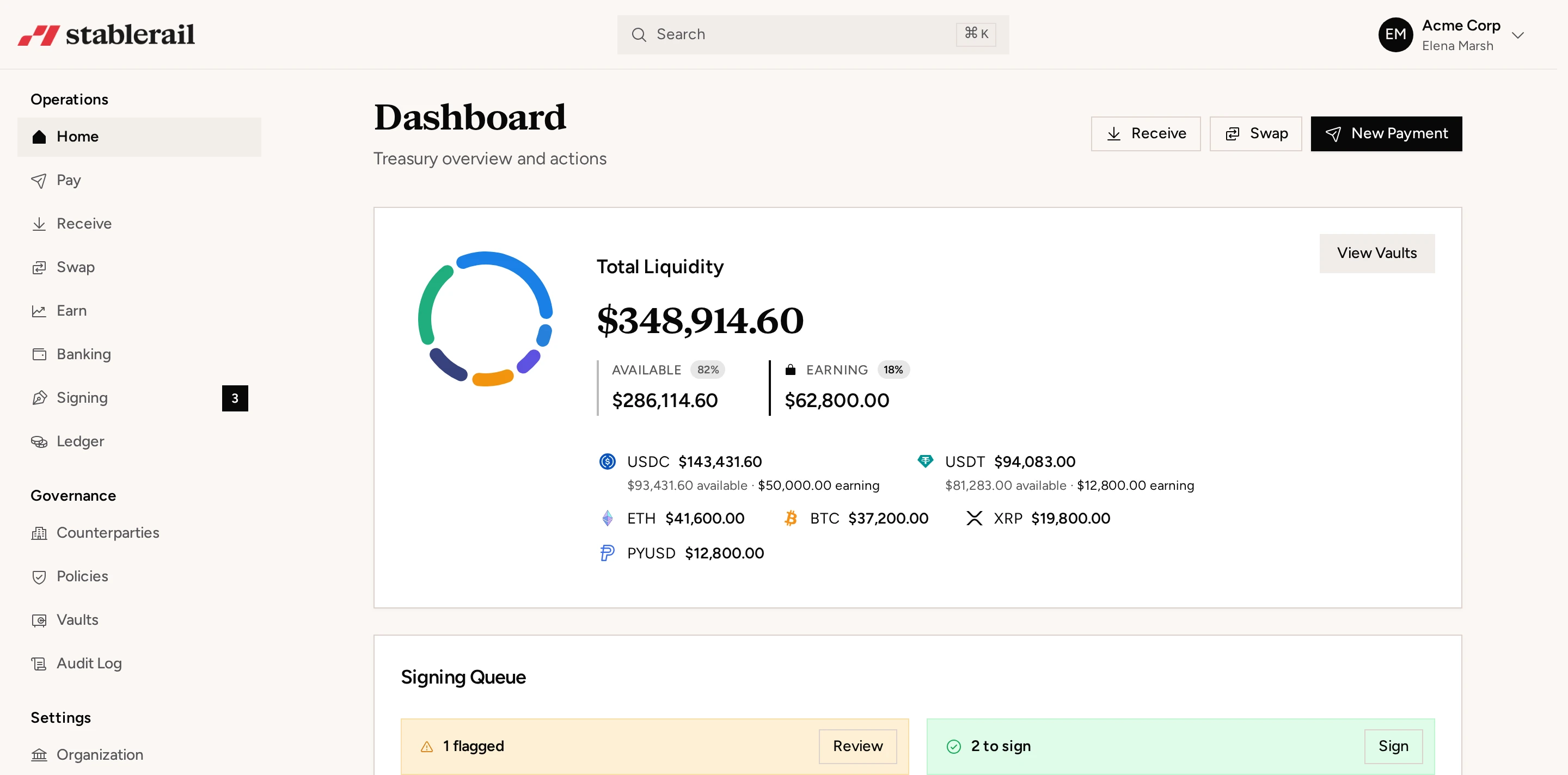
| Stablerail | Corporate stablecoin treasury | Finance teams managing their company’s own USDC or USDT, fiat conversion, cards and global payouts | Does its entity, currency and network coverage match the company’s actual treasury flows? |
| Bridge | API-first stablecoin infrastructure | Fintechs embedding collection, conversion and payout flows into a product | Which responsibilities remain with the integrating company? |
| Circle Mint | Issuer-operated USDC access | Eligible institutions primarily minting and redeeming USDC | Is direct USDC access sufficient, or are broader treasury and payment tools required? |
| Zero Hash | Embedded digital-asset infrastructure | Platforms adding crypto or stablecoin funding, trading, custody or payments | What integration, compliance and operational resources are needed? |
| Triple-A | Crypto and stablecoin payment processing | Merchants accepting payments or making supported payouts | Is payment acceptance more important than multi-currency treasury management? |
| Conduit | Cross-border B2B payment infrastructure | Businesses focused on selected international payment corridors | Are all required origin and destination corridors available to the relevant entity? |
| Fireblocks | Wallet and digital-asset infrastructure | Institutions building wallet, signing and transfer operations | Which fiat accounts, conversion services and banking rails must be sourced separately? |
This table is a shortlist, not a current coverage guarantee. Product availability can vary by incorporation country, operating entity, industry, currency, network and transaction type. Request written confirmation for the precise legal entity that will sign the agreement.
Start with the operating model
BVNK alternatives fall into four broad categories. Corporate treasury platforms help finance teams operate balances and payments. API-first providers let product teams embed stablecoin flows. Issuer accounts provide direct access to a particular stablecoin. Payment processors concentrate on collecting from customers or paying supported recipients.
The distinction matters because similar front-end actions can have different legal and operational structures. A dashboard showing a dollar balance could represent a bank account in the company’s name, a virtual account linked to a pooled account, an internal ledger claim, or stablecoins in a wallet. Finance teams should establish what the balance legally represents and who controls movement before comparing interface features.
Compare account ownership and fiat access
Ask providers to diagram the complete account structure. The diagram should identify the contracting entity, bank or safeguarding partner, named account holder, wallet controller and every intermediary involved in a payment. It should also show whether third parties can fund the account and whether payments can be made to third-party beneficiaries.
Account questions to resolve
- Are fiat details issued in the company’s legal name, or are they virtual details attached to a pooled account?
- Which currencies can be held without automatic conversion?
- Do the details support collections, payouts or both?
- Are payments from customers, affiliates, investors or marketplaces permitted?
- How are rejected transfers, recalls and refunds handled?
- What statements and balance confirmations are available for month-end close?
Do not infer account functionality from the presence of an IBAN or routing number. Confirm accepted sender types, beneficiary rules, reference-field requirements and whether the provider can return a transfer to its original source.
Evaluate fiat rails by corridor, not logo count
A provider may connect to SEPA, ACH, wire or SWIFT while offering only a subset to a particular customer. Timing also depends on submission cut-offs, weekends, compliance review, intermediary banks and the receiving institution.
| Rail | Common use | Operational issue to test |
|---|---|---|
| SEPA Credit Transfer | EUR payments | Cut-off times, returns and whether accounts are reachable as sender and beneficiary |
| SEPA Instant | Time-sensitive EUR payments | Participant reachability, transaction limits and weekend processing |
| ACH | Domestic USD collections and payments | Standard versus same-day support, return codes and settlement status |
| Fedwire | Time-sensitive or higher-value USD transfers | Daily cut-off, beneficiary data and fee treatment |
| Faster Payments, BACS or CHAPS | Domestic GBP flows | Which rail is selected, expected timing and payment limits |
| SWIFT | Cross-border fiat payments | Correspondent deductions, tracking, repair fees and beneficiary receipt |
Ask for the status lifecycle used by the provider. “Submitted” is not the same as accepted by the payment rail, settled or credited to the beneficiary. Reconciliation should preserve these distinctions.
Calculate the full on-ramp and off-ramp cost
An on-ramp converts fiat into a stablecoin; an off-ramp converts stablecoins back into fiat. The advertised conversion fee rarely represents the complete delivered cost. Spreads, bank charges, withdrawal fees and blockchain network fees can all affect the result.
Give each provider the same worked scenario, such as receiving EUR, converting it to USDC, transferring it on the required network and later paying USD to a bank account. Request an itemized quote showing the input amount, exchange rate, explicit fees, network costs and final amount delivered. Also ask whether the quote is firm or indicative and how long it remains valid.
Compare pricing at the transaction sizes and monthly volumes the business actually expects. Minimum fees can dominate small payouts, while spread and liquidity execution matter more for large conversions. The quote should also explain who absorbs fees when a fiat intermediary deducts charges.
Match payout support to real recipients
“Global payouts” can refer to bank transfers, wallet transfers or both. Build a one-month sample of actual beneficiary requests and rank them by country, currency, payment rail, stablecoin and blockchain network. This prevents broad marketing coverage from obscuring a missing critical corridor.
Network selection is particularly important. USDT on Tron is operationally different from USDT on Ethereum, and sending an asset on the wrong network can require manual recovery or result in loss. Confirm that the provider validates the combination of asset, network and destination address before submission.
For batch payments, test how the system handles one invalid beneficiary within a file, duplicate uploads, partial completion and retries. Determine whether each payout receives a unique reconciliation identifier that persists across approval, conversion, blockchain transfer and fiat settlement.
Assess custody, approvals and evidence
Custody determines who can authorize movement of stablecoins. In a custodial structure, the provider or its custody partner controls the operational keys. In a self-managed structure, the company controls signing, although external software may coordinate the process. Neither model removes the need for documented access, recovery and incident procedures.
For a corporate treasury workflow, test role separation between payment creators, reviewers and signers. Stablerail, for example, supports approvals and signing quorum, sanctions or address screening before a send, fiat conversion and exportable audit evidence for a company’s own funds. Other providers may allocate these controls differently between their interface, an API integration and external custody tooling.
Evidence should connect the payment request, beneficiary, approvals, conversion, transaction hash, fiat reference and final status. Finance teams should be able to export this record without relying on screenshots. Also establish what happens if an approver leaves, a signing device is lost or the provider interface is unavailable.
Compare API capability with finance operations
Bridge and Zero Hash are more relevant when stablecoin functionality will sit inside another product. Fireblocks may be considered when wallet and signing infrastructure is the central requirement. These options should be evaluated as implementation projects, not merely vendor subscriptions.
Engineering tests should cover idempotency, webhook retries, rate limits, sandbox fidelity, version changes and the representation of failed, reversed or returned transactions. Finance tests should cover ledger exports, payment references, fee decomposition, user permissions and manual exception handling. An elegant API does not compensate for incomplete month-end evidence.
Verify eligibility before a technical pilot
Payment coverage and customer eligibility are separate. A provider may pay beneficiaries in a country without onboarding companies incorporated there. Eligibility can also depend on ownership, industry, source of funds, expected volume, transaction purpose and counterparties.
Provide a complete profile early: incorporation documents, operating countries, beneficial owners, expected currencies, monthly flow ranges, typical transaction size and source and destination types. Ask the provider to identify unsupported activities or corridors in writing before engineering or migration work begins.
A practical selection checklist
- Map funds: document the sender, legal owner, currency, conversion, recipient and required settlement evidence for each flow.
- Confirm eligibility: obtain written approval for the exact corporate entity, industry and use case.
- Request matrices: compare currencies, fiat rails, stablecoins, networks, countries and transaction limits.
- Price identical scenarios: include spreads, transfer charges, network fees and the amount ultimately delivered.
- Run controlled tests: test successful payments, rejected beneficiaries, returns, duplicate submissions and reconciliation exports.
- Review controls: document custody, approval quorum, user access, address screening, recovery and offboarding.
- Check close readiness: confirm statements, transaction histories, fee records and audit evidence can be exported.
How to choose the right BVNK alternative
Choose based on the capability that is hardest to replace. A corporate finance team may prioritize controls, audit evidence and simple fiat-to-stablecoin operations. A fintech may prioritize APIs and an infrastructure model suited to embedded flows. A USDC-focused institution may value direct minting and redemption, while a merchant may care most about checkout and settlement.
Before committing, score providers against mandatory corridors and controls rather than total feature count. The strongest alternative is the one that supports the company’s legal entity, fund ownership model and real payment flows with acceptable cost, operational effort and evidence quality.
Frequently asked questions
What is the best alternative to BVNK?
There is no universal best alternative. Corporate treasury teams, fintechs embedding customer flows, merchants accepting stablecoins and institutions seeking direct USDC access require different account structures, controls and infrastructure.
Which BVNK competitors support stablecoin and fiat payments?
Potential alternatives include corporate treasury platforms, API-first providers such as Bridge, issuer access through Circle Mint, embedded infrastructure providers such as Zero Hash, and payment processors such as Triple-A. Exact fiat currencies, stablecoins, networks and countries depend on the customer entity and current provider coverage.
How should a CFO compare stablecoin payment providers?
Compare account ownership, fiat rails, full conversion cost, payout corridors, custody, approvals, address screening and reconciliation evidence. Use identical transaction scenarios and require written confirmation that the provider supports the company’s entity, industry and use case.
Is Circle Mint a direct replacement for BVNK?
Circle Mint may suit eligible institutions that primarily need direct USDC minting and redemption. It may not replace broader requirements for multi-stablecoin treasury, corporate cards, diverse payout workflows or consolidated fiat operations.
What costs should be included when comparing stablecoin on-ramps?
Include the conversion fee, exchange-rate spread, fiat collection and payout charges, blockchain network costs and any withdrawal or minimum fees. Compare the final amount delivered rather than relying only on a headline percentage.
Finance writers covering stablecoin treasury, payments, compliance, and risk controls.
More about the Stablerail team- Stablecoin treasury managementApprovals, limits, yield and reporting on one balance.
- Stablecoin payoutsBatch contractor and vendor payments with screening.
- USDT vs USDCWhich stablecoin your company should settle in.
- Stablecoin finance glossaryMPC, off-ramp, travel rule and the rest, in plain English.
- Product updatesEverything we ship, month by month.