
USDC Business Account: Setup, Controls and Treasury Reporting
A practical guide to selecting and setting up a USDC business account, including KYB, treasury structure, payment approvals, fiat conversion and month-end reconciliation.
A USDC business account should connect stablecoin balances with fiat funding, controlled payments and ledger-ready reporting. Before funding it, complete KYB, separate operating and reserve balances, assign preparer and approver roles, require signing quorum, screen destination addresses and test each network and conversion route. Finance teams should also capture transaction hashes, fees, approvals, bank references and exchange-rate evidence for reconciliation and audit support.
%22%20x1%3D%220%22%20y1%3D%220%22%20x2%3D%221%22%20y2%3D%221%22%3E%0A%20%20%20%20%20%20%20%20%3Cstop%20offset%3D%220%25%22%20stop-color%3D%22%23450B10%22%20%2F%3E%0A%20%20%20%20%20%20%20%20%3Cstop%20offset%3D%2250%25%22%20stop-color%3D%22%23681A1F%22%20%2F%3E%0A%20%20%20%20%20%20%20%20%3Cstop%20offset%3D%22100%25%22%20stop-color%3D%22%238A2A2D%22%20%2F%3E%0A%20%20%20%20%20%20%3C%2FlinearGradient%3E%0A%20%20%20%20%20%20%3CradialGradient%20id%3D%22glow%22%20cx%3D%22392%22%20cy%3D%22-413%22%20r%3D%22520%22%20gradientUnits%3D%22userSpaceOnUse%22%3E%0A%20%20%20%20%20%20%20%20%3Cstop%20offset%3D%220%25%22%20stop-color%3D%22%23FF7A59%22%20stop-opacity%3D%220.45%22%20%2F%3E%0A%20%20%20%20%20%20%20%20%3Cstop%20offset%3D%2255%25%22%20stop-color%3D%22%23FF7A59%22%20stop-opacity%3D%220.08%22%20%2F%3E%0A%20%20%20%20%20%20%20%20%3Cstop%20offset%3D%22100%25%22%20stop-color%3D%22%23FF7A59%22%20stop-opacity%3D%220%22%20%2F%3E%0A%20%20%20%20%20%20%3C%2FradialGradient%3E%0A%20%20%20%20%20%20%3ClinearGradient%20id%3D%22glass%22%20x1%3D%220%22%20y1%3D%220%22%20x2%3D%221%22%20y2%3D%221%22%3E%0A%20%20%20%20%20%20%20%20%3Cstop%20offset%3D%220%25%22%20stop-color%3D%22%23F8D6D2%22%20stop-opacity%3D%220.26%22%20%2F%3E%0A%20%20%20%20%20%20%20%20%3Cstop%20offset%3D%22100%25%22%20stop-color%3D%22%23FFFFFF%22%20stop-opacity%3D%220.08%22%20%2F%3E%0A%20%20%20%20%20%20%3C%2FlinearGradient%3E%0A%20%20%20%20%20%20%3ClinearGradient%20id%3D%22accent%22%20x1%3D%220%22%20y1%3D%220%22%20x2%3D%221%22%20y2%3D%221%22%3E%0A%20%20%20%20%20%20%20%20%3Cstop%20offset%3D%220%25%22%20stop-color%3D%22%23FF7A59%22%20%2F%3E%0A%20%20%20%20%20%20%20%20%3Cstop%20offset%3D%22100%25%22%20stop-color%3D%22%23C73128%22%20%2F%3E%0A%20%20%20%20%20%20%3C%2FlinearGradient%3E%0A%20%20%20%20%20%20%3Cfilter%20id%3D%22soft%22%3E%3CfeGaussianBlur%20stdDeviation%3D%2210%22%20%2F%3E%3C%2Ffilter%3E%0A%20%20%20%20%3C%2Fdefs%3E%0A%20%20%20%20%3Crect%20width%3D%221600%22%20height%3D%22900%22%20fill%3D%22url(%23bg)%22%20%2F%3E%0A%20%20%20%20%3Crect%20width%3D%221600%22%20height%3D%22900%22%20fill%3D%22url(%23glow)%22%20%2F%3E%0A%20%20%20%20%3Cline%20x1%3D%22200%22%20y1%3D%22250%22%20x2%3D%221400%22%20y2%3D%22250%22%20stroke%3D%22%23F4CDC5%22%20stroke-opacity%3D%220.12%22%2F%3E%3Cline%20x1%3D%22200%22%20y1%3D%22340%22%20x2%3D%221400%22%20y2%3D%22340%22%20stroke%3D%22%23F4CDC5%22%20stroke-opacity%3D%220.12%22%2F%3E%3Cline%20x1%3D%22200%22%20y1%3D%22430%22%20x2%3D%221400%22%20y2%3D%22430%22%20stroke%3D%22%23F4CDC5%22%20stroke-opacity%3D%220.12%22%2F%3E%3Cline%20x1%3D%22200%22%20y1%3D%22520%22%20x2%3D%221400%22%20y2%3D%22520%22%20stroke%3D%22%23F4CDC5%22%20stroke-opacity%3D%220.12%22%2F%3E%3Cline%20x1%3D%22200%22%20y1%3D%22610%22%20x2%3D%221400%22%20y2%3D%22610%22%20stroke%3D%22%23F4CDC5%22%20stroke-opacity%3D%220.12%22%2F%3E%3Cpolyline%20points%3D%22200%2C704%20350%2C526%20500%2C574%20650%2C545%20800%2C681%20950%2C698%201100%2C735%201250%2C670%201400%2C557%22%20fill%3D%22none%22%20stroke%3D%22url(%23accent)%22%20stroke-width%3D%2210%22%20stroke-linejoin%3D%22round%22%20stroke-linecap%3D%22round%22%2F%3E%3Ccircle%20cx%3D%22200%22%20cy%3D%22704%22%20r%3D%229%22%20fill%3D%22%23F8D6D2%22%2F%3E%3Ccircle%20cx%3D%22350%22%20cy%3D%22526%22%20r%3D%229%22%20fill%3D%22%23F8D6D2%22%2F%3E%3Ccircle%20cx%3D%22500%22%20cy%3D%22574%22%20r%3D%229%22%20fill%3D%22%23F8D6D2%22%2F%3E%3Ccircle%20cx%3D%22650%22%20cy%3D%22545%22%20r%3D%229%22%20fill%3D%22%23F8D6D2%22%2F%3E%3Ccircle%20cx%3D%22800%22%20cy%3D%22681%22%20r%3D%229%22%20fill%3D%22%23F8D6D2%22%2F%3E%3Ccircle%20cx%3D%22950%22%20cy%3D%22698%22%20r%3D%229%22%20fill%3D%22%23F8D6D2%22%2F%3E%3Ccircle%20cx%3D%221100%22%20cy%3D%22735%22%20r%3D%229%22%20fill%3D%22%23F8D6D2%22%2F%3E%3Ccircle%20cx%3D%221250%22%20cy%3D%22670%22%20r%3D%229%22%20fill%3D%22%23F8D6D2%22%2F%3E%3Ccircle%20cx%3D%221400%22%20cy%3D%22557%22%20r%3D%229%22%20fill%3D%22%23F8D6D2%22%2F%3E%0A%20%20%20%20%3Crect%20x%3D%2226%22%20y%3D%2226%22%20width%3D%221548%22%20height%3D%22848%22%20rx%3D%2218%22%20fill%3D%22none%22%20stroke%3D%22%23F2D0C8%22%20stroke-opacity%3D%220.12%22%2F%3E%0A%20%20%3C%2Fsvg%3E)
A USDC business account should connect stablecoin balances with fiat funding, controlled payments and ledger-ready reporting. Before funding it, complete KYB, separate operating and reserve balances, assign preparer and approver roles, require signing quorum, screen destination addresses and test each network and conversion route. Finance teams should also capture transaction hashes, fees, approvals, bank references and exchange-rate evidence for reconciliation and audit support.
What a USDC business account needs to do
A company wallet can receive and send USDC, but that alone does not make it suitable for finance operations. A business account should give the treasury team a controlled way to hold funds, convert between USDC and fiat, pay counterparties, document approvals and reconcile every movement with the general ledger.
USDC is issued by Circle, but searches for a Circle or USDC business account can lead to several different operating models. A company might use an issuer relationship, an exchange account, standalone wallets or a treasury platform. The right choice depends on whether the primary need is issuance and redemption, trading, custody, payments or an integrated operating workflow.
| Option | Best suited to | Finance advantages | Questions to resolve |
|---|---|---|---|
| Direct issuer access | Eligible companies focused on minting or redeeming USDC | Direct conversion workflow where available | Eligibility, supported banks, payment operations and internal approval controls |
| Exchange account | Companies trading or converting multiple digital assets | Market access and asset conversion | Asset segregation, withdrawal controls, bank connectivity and reporting detail |
| Standalone wallets | Technically capable teams that want direct wallet administration | Flexible network access and treasury structure | Key management, signing procedures, screening, fiat rails and evidence collection |
| Stablecoin business account | Finance teams combining USDC treasury, fiat and payments | One operational workflow for approvals, payouts, conversion and reporting | Supported jurisdictions, assets, networks, currencies, limits and account structure |
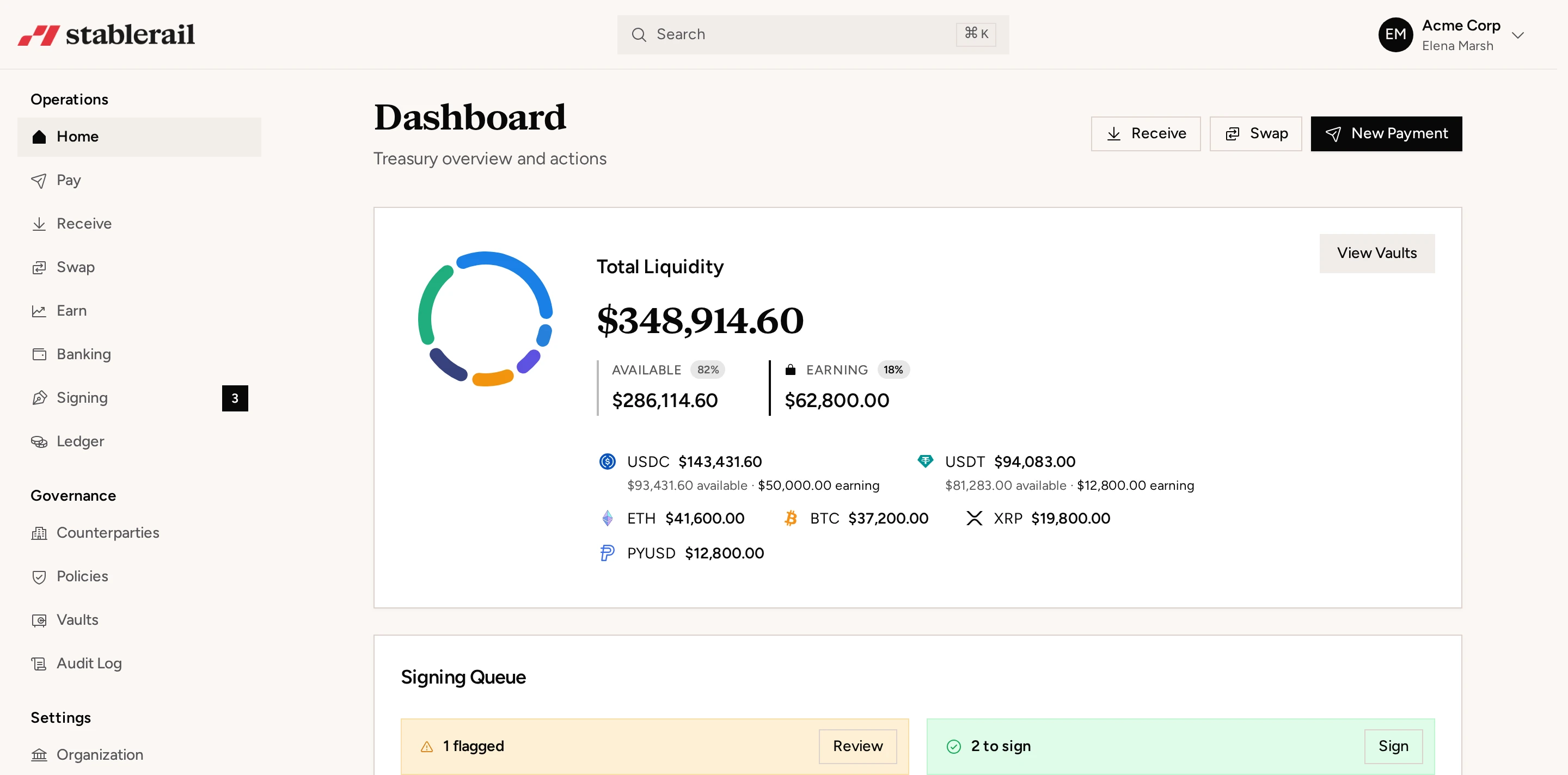
Stablerail provides one business account for USDC and USDT treasury, with approvals and signing quorum, sanctions and address screening before a send, corporate cards, global payouts, fiat off-ramp capabilities and exportable audit evidence. Companies should still confirm availability for their entity, jurisdiction, desired currencies and transaction profile during onboarding.
How to set up a USDC business account
1. Prepare for company verification
Opening a business account normally starts with know-your-business checks. The exact request varies according to jurisdiction, ownership, industry, counterparties and expected activity. A finance team should prepare a consistent package rather than submitting documents piecemeal.
- Certificate of incorporation or current registry extract
- Registered and operating addresses
- Articles of association or equivalent formation documents
- Director and beneficial-owner details
- Identity and address evidence for relevant individuals
- An ownership chart for multi-entity or layered structures
- A description of products, customers and payment flows
- Expected monthly fiat and stablecoin volumes
- Source-of-funds or source-of-wealth evidence when requested
Names, addresses and ownership percentages should agree across the application, corporate records and supporting evidence. Review time depends on both submission quality and the complexity of the business; no general onboarding time applies to every company.
2. Design the treasury structure
Define the balance structure before receiving material funds. A practical setup can separate day-to-day liquidity, vendor payments, payroll or contractor funds, customer receipts and longer-term reserves. Separation improves visibility and reduces the chance that a payment run draws from funds intended for another purpose.
Document which legal entity owns each balance or wallet. If several group companies use USDC, avoid treating one wallet as an undocumented pooled account. Intercompany transfers need an identified sender, recipient, purpose and accounting treatment, just as they would through a bank.
3. Assign roles and approvals
Stablecoin controls should mirror or strengthen the company’s bank-payment controls. The person who creates a payment should not be its only approver. Administrative access, beneficiary maintenance and transaction signing should also be separated where team size permits.
A signing quorum requires a defined number of authorised participants before a transaction can be released. For example, a two-person approval process prevents one user from moving funds alone. The appropriate quorum depends on team coverage, payment frequency and the need to handle absences without bypassing controls.
Controls to configure before funding
Blockchain transfers are generally irreversible after confirmation, so prevention matters more than recovery. Configure the following controls and record who approved the design:
- Separate duties: distinguish administrators, payment preparers, approvers and viewers.
- Set approval thresholds: require stronger review for high-value, unusual or first-time payments.
- Use signing quorum: prevent a single authorised user from releasing treasury funds alone.
- Review destinations: validate the wallet owner, asset, network and business purpose.
- Screen before sending: check destination addresses for sanctions exposure and relevant blockchain risk indicators.
- Test new routes: use a small transfer before sending a material amount to a new wallet or network.
- Protect changes: apply additional review when adding beneficiaries or changing payment instructions.
Address allowlists can add protection for recurring counterparties, but they do not replace ownership verification. An approved address can become inappropriate if a vendor changes wallets, an account is compromised or the underlying relationship ends. Review allowlists periodically and remove obsolete entries.
Choose networks, fiat rails and conversion routes
USDC exists across multiple blockchain networks. The sender and recipient must agree on the exact asset and network; the same-looking wallet address does not prove that the destination accepts USDC on the selected chain. Teams should also distinguish native USDC from bridged or wrapped representations because support, redemption routes and risk can differ.
For fiat legs, availability depends on the provider, account entity, currency and counterparty bank. The following timings describe common external rail characteristics, not guaranteed delivery periods.
| Rail | Currency | Common external timing | Typical treasury use |
|---|---|---|---|
| SEPA Instant | EUR | Seconds when both institutions participate | Urgent euro funding or withdrawal |
| SEPA Credit Transfer | EUR | Often by the next business day | Routine euro payments |
| ACH | USD | Timing varies by ACH service and submission window | Non-urgent US transfers |
| Fedwire | USD | Same-day processing subject to operating hours and cut-offs | Time-sensitive US transfers |
| Faster Payments | GBP | Often near real time | Routine UK payments |
| CHAPS | GBP | Same-day processing before applicable cut-offs | Urgent or high-value UK payments |
| Bacs Direct Credit | GBP | Three-day processing cycle | Scheduled payroll and supplier payments |
| SWIFT | Multiple | Varies with banks, currencies and intermediaries | Cross-border bank transfers |
Before converting fiat to USDC or off-ramping USDC to fiat, review the quoted rate, explicit fees, network costs, settlement route and expected amount received. Also confirm cut-off times, bank holidays, beneficiary requirements and transaction limits. A conversion quote and a blockchain transfer are separate records and may need separate ledger entries.
Funding and payment operations
A company may receive USDC from customers, exchanges, treasury counterparties or its own external wallets. For each inbound route, issue approved payment instructions that specify the asset, network and receiving address. Treat any request to change an address as a sensitive instruction and verify it through a separate communication channel.
For outbound payments, the approval screen or payment record should identify the legal payee, amount, asset, network, destination, fee, purpose and approval status. Batch payments require the same controls as individual transfers. Review duplicate records, unexpected address changes and exceptions before the batch is signed.
A transaction hash proves that an on-chain transaction occurred. It does not, by itself, prove who authorised it, why it was paid or which invoice it settled.
Treasury reporting and month-end reconciliation
USDC reporting must connect on-chain events with ordinary accounting records. For every receipt, payment or conversion, retain the timestamp, asset, network, amount, origin and destination addresses, transaction hash, network fee, payment purpose and internal reference. Where relevant, add the fiat amount, currency, conversion evidence, bank reference, preparer, approvers and screening result.
Reconcile each wallet or account separately using a roll-forward:
Opening balance + receipts − payments ± transfers and conversions − fees = closing balance.
First compare the recorded token balance with the relevant on-chain balance. Then investigate pending, failed or duplicated entries and transfers between company-controlled wallets. Internal transfers should appear on both sides of the reconciliation and should not be mistaken for revenue or expense.
Translate transactions into the company’s functional currency under a documented and consistently applied accounting policy. USDC is designed to track the US dollar, but that does not automatically determine its accounting classification, recognition or valuation under the company’s reporting framework. Confirm the treatment with the company’s accountant or auditor.
Stablerail can export audit evidence for stablecoin activity, while the accounting system should retain invoices, payroll files and other source documents. A shared internal reference across the payment record, bank or blockchain transaction and ledger entry makes sampling and audit testing materially easier.
Finance team launch checklist
- Complete KYB and confirm entity, industry and jurisdiction eligibility.
- Document expected fiat, USDC and cross-border payment flows.
- Confirm required currencies, bank rails, assets and blockchain networks.
- Separate operating liquidity, payment funds and reserves.
- Assign administrators, preparers, approvers and reporting users.
- Configure signing quorum, thresholds and destination controls.
- Test fiat funding, USDC receipt, conversion and a small outbound payment.
- Map transaction fields, fees and conversions to ledger accounts.
- Run a sample reconciliation and export the supporting evidence.
The account should not go fully live merely because it can receive USDC. It is ready when the finance team can explain who owns each balance, who can move it, how a destination is verified, how fiat conversion is documented and how every transaction reaches the general ledger.
Frequently asked questions
What is a USDC business account?
A USDC business account is an operating account that helps a company receive, hold, convert and pay with USDC while applying business controls. Unlike a basic wallet, it should support approvals, transaction evidence, fiat connectivity and reconciliation with the general ledger.
Can a business open a USDC account directly with Circle?
Eligible businesses may be able to access Circle services directly, subject to Circle’s current products, jurisdictions and onboarding requirements. Companies should compare direct issuer access with exchanges, standalone wallets and treasury platforms based on their need for conversions, payment approvals, fiat rails and reporting.
How should a company account for USDC?
The correct classification and valuation depend on the company’s reporting framework, facts and accounting policy. Finance teams should record acquisition or conversion evidence, network fees, transfers and period-end balances, then confirm the treatment with their accountant or auditor.
What controls should a USDC business account have?
Core controls include role separation, signing quorum, transaction thresholds, destination verification and sanctions or address screening before sending. Teams should also verify beneficiary changes independently and use a small test transaction for a new wallet or network.
How do you reconcile a USDC wallet at month end?
Start with the opening token balance, add receipts, subtract payments and fees, account for conversions and internal transfers, and compare the result with the closing on-chain balance. Match each movement to its transaction hash, purpose, approval history and ledger entry, investigating pending or unmatched items.
Finance writers covering stablecoin treasury, payments, compliance, and risk controls.
More about the Stablerail team- Stablecoin treasury managementApprovals, limits, yield and reporting on one balance.
- Stablecoin payoutsBatch contractor and vendor payments with screening.
- USDT vs USDCWhich stablecoin your company should settle in.
- Stablecoin finance glossaryMPC, off-ramp, travel rule and the rest, in plain English.
- Product updatesEverything we ship, month by month.