
How to Pay Vendors in USDC or USDT: A Practical Guide
A practical accounts payable workflow for sending USDC or USDT to vendors, from wallet verification and approvals to batch payouts, remittance evidence and reconciliation.
To pay a vendor in USDC or USDT, collect the exact token, blockchain network, wallet address and any memo or tag; verify the instructions through a trusted channel; screen and approve the address; and match the payment to an authorized invoice. After signing, retain the transaction hash, confirmation status, exchange rate, fees and approval history so accounts payable can reconcile the invoice and support an audit.
%22%20x1%3D%220%22%20y1%3D%220%22%20x2%3D%221%22%20y2%3D%221%22%3E%0A%20%20%20%20%20%20%20%20%3Cstop%20offset%3D%220%25%22%20stop-color%3D%22%233E090D%22%20%2F%3E%0A%20%20%20%20%20%20%20%20%3Cstop%20offset%3D%2250%25%22%20stop-color%3D%22%235C1218%22%20%2F%3E%0A%20%20%20%20%20%20%20%20%3Cstop%20offset%3D%22100%25%22%20stop-color%3D%22%237B1F22%22%20%2F%3E%0A%20%20%20%20%20%20%3C%2FlinearGradient%3E%0A%20%20%20%20%20%20%3CradialGradient%20id%3D%22glow%22%20cx%3D%22715%22%20cy%3D%22163%22%20r%3D%22520%22%20gradientUnits%3D%22userSpaceOnUse%22%3E%0A%20%20%20%20%20%20%20%20%3Cstop%20offset%3D%220%25%22%20stop-color%3D%22%23FF8E72%22%20stop-opacity%3D%220.45%22%20%2F%3E%0A%20%20%20%20%20%20%20%20%3Cstop%20offset%3D%2255%25%22%20stop-color%3D%22%23FF8E72%22%20stop-opacity%3D%220.08%22%20%2F%3E%0A%20%20%20%20%20%20%20%20%3Cstop%20offset%3D%22100%25%22%20stop-color%3D%22%23FF8E72%22%20stop-opacity%3D%220%22%20%2F%3E%0A%20%20%20%20%20%20%3C%2FradialGradient%3E%0A%20%20%20%20%20%20%3ClinearGradient%20id%3D%22glass%22%20x1%3D%220%22%20y1%3D%220%22%20x2%3D%221%22%20y2%3D%221%22%3E%0A%20%20%20%20%20%20%20%20%3Cstop%20offset%3D%220%25%22%20stop-color%3D%22%23F8D6D2%22%20stop-opacity%3D%220.26%22%20%2F%3E%0A%20%20%20%20%20%20%20%20%3Cstop%20offset%3D%22100%25%22%20stop-color%3D%22%23FFFFFF%22%20stop-opacity%3D%220.08%22%20%2F%3E%0A%20%20%20%20%20%20%3C%2FlinearGradient%3E%0A%20%20%20%20%20%20%3ClinearGradient%20id%3D%22accent%22%20x1%3D%220%22%20y1%3D%220%22%20x2%3D%221%22%20y2%3D%221%22%3E%0A%20%20%20%20%20%20%20%20%3Cstop%20offset%3D%220%25%22%20stop-color%3D%22%23FF8E72%22%20%2F%3E%0A%20%20%20%20%20%20%20%20%3Cstop%20offset%3D%22100%25%22%20stop-color%3D%22%23D94030%22%20%2F%3E%0A%20%20%20%20%20%20%3C%2FlinearGradient%3E%0A%20%20%20%20%20%20%3Cfilter%20id%3D%22soft%22%3E%3CfeGaussianBlur%20stdDeviation%3D%2210%22%20%2F%3E%3C%2Ffilter%3E%0A%20%20%20%20%3C%2Fdefs%3E%0A%20%20%20%20%3Crect%20width%3D%221600%22%20height%3D%22900%22%20fill%3D%22url(%23bg)%22%20%2F%3E%0A%20%20%20%20%3Crect%20width%3D%221600%22%20height%3D%22900%22%20fill%3D%22url(%23glow)%22%20%2F%3E%0A%20%20%20%20%3Cline%20x1%3D%22200%22%20y1%3D%22250%22%20x2%3D%221400%22%20y2%3D%22250%22%20stroke%3D%22%23F4CDC5%22%20stroke-opacity%3D%220.12%22%2F%3E%3Cline%20x1%3D%22200%22%20y1%3D%22340%22%20x2%3D%221400%22%20y2%3D%22340%22%20stroke%3D%22%23F4CDC5%22%20stroke-opacity%3D%220.12%22%2F%3E%3Cline%20x1%3D%22200%22%20y1%3D%22430%22%20x2%3D%221400%22%20y2%3D%22430%22%20stroke%3D%22%23F4CDC5%22%20stroke-opacity%3D%220.12%22%2F%3E%3Cline%20x1%3D%22200%22%20y1%3D%22520%22%20x2%3D%221400%22%20y2%3D%22520%22%20stroke%3D%22%23F4CDC5%22%20stroke-opacity%3D%220.12%22%2F%3E%3Cline%20x1%3D%22200%22%20y1%3D%22610%22%20x2%3D%221400%22%20y2%3D%22610%22%20stroke%3D%22%23F4CDC5%22%20stroke-opacity%3D%220.12%22%2F%3E%3Cpolyline%20points%3D%22200%2C285%20350%2C334%20500%2C410%20650%2C384%20800%2C416%20950%2C385%201100%2C486%201250%2C359%201400%2C413%22%20fill%3D%22none%22%20stroke%3D%22url(%23accent)%22%20stroke-width%3D%2210%22%20stroke-linejoin%3D%22round%22%20stroke-linecap%3D%22round%22%2F%3E%3Ccircle%20cx%3D%22200%22%20cy%3D%22285%22%20r%3D%229%22%20fill%3D%22%23F8D6D2%22%2F%3E%3Ccircle%20cx%3D%22350%22%20cy%3D%22334%22%20r%3D%229%22%20fill%3D%22%23F8D6D2%22%2F%3E%3Ccircle%20cx%3D%22500%22%20cy%3D%22410%22%20r%3D%229%22%20fill%3D%22%23F8D6D2%22%2F%3E%3Ccircle%20cx%3D%22650%22%20cy%3D%22384%22%20r%3D%229%22%20fill%3D%22%23F8D6D2%22%2F%3E%3Ccircle%20cx%3D%22800%22%20cy%3D%22416%22%20r%3D%229%22%20fill%3D%22%23F8D6D2%22%2F%3E%3Ccircle%20cx%3D%22950%22%20cy%3D%22385%22%20r%3D%229%22%20fill%3D%22%23F8D6D2%22%2F%3E%3Ccircle%20cx%3D%221100%22%20cy%3D%22486%22%20r%3D%229%22%20fill%3D%22%23F8D6D2%22%2F%3E%3Ccircle%20cx%3D%221250%22%20cy%3D%22359%22%20r%3D%229%22%20fill%3D%22%23F8D6D2%22%2F%3E%3Ccircle%20cx%3D%221400%22%20cy%3D%22413%22%20r%3D%229%22%20fill%3D%22%23F8D6D2%22%2F%3E%0A%20%20%20%20%3Crect%20x%3D%2226%22%20y%3D%2226%22%20width%3D%221548%22%20height%3D%22848%22%20rx%3D%2218%22%20fill%3D%22none%22%20stroke%3D%22%23F2D0C8%22%20stroke-opacity%3D%220.12%22%2F%3E%0A%20%20%3C%2Fsvg%3E)
To pay a vendor in USDC or USDT, confirm the exact token, network, destination address and any required memo or tag before approving the invoice. Verify new or changed instructions through a known vendor contact, screen the address, and apply your normal payment controls. After sending, retain the transaction hash, confirmations, exchange rate, fees and approval history so the payment can be reconciled and audited.
1. Collect complete vendor payment instructions
A wallet address alone is not a complete payment instruction. USDC and USDT are issued or represented on multiple blockchains, and the recipient must support the specific combination you intend to send.
Collect the following through your approved vendor onboarding process or with each invoice:
- Vendor legal name: Match it to the vendor master and invoice.
- Invoice details: Record the invoice number, denomination, amount and due date.
- Stablecoin: Specify USDC or USDT, including whether the recipient requires a native rather than bridged version.
- Blockchain network: Record the full network name, not just a label such as “ERC-20.”
- Wallet address: Store it as a separate controlled field rather than inside invoice notes.
- Wallet provider: Ask whether the address is self-custodied or assigned by an exchange, custodian or payment provider.
- Memo, tag or reference: Some receiving platforms use an additional identifier to credit the correct account.
- Settlement expectation: Confirm whether the vendor considers the invoice paid at broadcast, network confirmation or credit to its platform account.
Do not reuse an address from an old email without checking that it remains valid. Changes to wallet instructions should receive the same scrutiny as changes to bank account details.
2. Choose the token and network together
The cheapest network is not automatically the best route. It must be supported by the vendor, your treasury wallet and any exchange or off-ramp involved. Your company also needs the correct asset on that network and, where applicable, enough of the network’s fee token to submit the transaction.
| Decision factor | What finance should verify | Risk if missed |
|---|---|---|
| USDC or USDT | The exact token the vendor can receive, account for and convert | The vendor may reject the payment or incur an unplanned conversion |
| Network | The deposit network is currently enabled for the destination wallet or platform | Funds may not be credited and recovery may require provider support |
| Native or bridged asset | The token contract or asset version expected by the recipient | A look-alike asset may arrive but remain unsupported |
| Transaction fee | The estimated network fee and the asset required to pay it | The payment may fail or remain unsigned because the fee balance is insufficient |
| Confirmation policy | The network status and number of confirmations required by the receiving platform | Treasury may mark an invoice paid before the vendor is credited |
| Treasury inventory | Available token balance on the selected network, not just the consolidated balance | Finance may need an additional conversion or transfer before paying |
Ethereum is widely supported, while networks such as Base, Arbitrum, Optimism, Polygon and Solana may have different fee and confirmation characteristics. Tron is also frequently used for USDT. Support varies by wallet and exchange, so confirm the route rather than relying on address format. An address that looks valid on more than one network does not prove that the recipient accepts deposits on each network.
3. Verify and screen the destination address
Stablecoin transfers generally cannot be recalled through a bank-style payment reversal. Address verification therefore belongs in both vendor onboarding and payment approval.
- Obtain the address through an approved channel.
- Verify new or changed instructions with a known vendor contact using independently held contact details.
- Compare the full address electronically and check visible leading and trailing characters during review.
- Confirm the token, network, asset version and any memo separately.
- Screen the address for sanctions exposure and other relevant risk indicators before sending.
- Add the verified destination to an allowlist with an approval record and effective date.
For a new destination or material payment, a small test transfer can confirm that the technical route works. It does not replace vendor identity checks, invoice approval or screening. Agree in advance whether the test amount will be deducted from the invoice balance.
4. Match the stablecoin payment to the invoice
Stablecoin payments should pass the same purchase-order, receiving, budget, tax and duplicate-invoice controls as bank payments. Accounts payable should be able to trace the proposed transfer back to an approved obligation before treasury signs it.
If an invoice is denominated in US dollars, document whether the parties treat one unit of USDC or USDT as one dollar for settlement or use an observed conversion value. For invoices in EUR, GBP or another currency, define the rate source, observation time and party bearing conversion costs or price movement.
Store the invoice currency, source rate, timestamp, calculated token quantity and rounding treatment. If approval and execution occur at different times, specify whether the amount is fixed at approval or recalculated immediately before payment.
5. Create, review and approve the payout
The payment record should display the vendor, invoice, token, network, address, amount, due date, fee estimate and conversion details before signing. Separating preparation, approval and signing reduces the risk that one person can create and release an unauthorized payment.
Approval and signing are related but distinct. An invoice may be approved in the accounts payable system while the blockchain transaction still requires authorized signers. A signing quorum requires the designated number of participants to authorize the transfer before funds move.
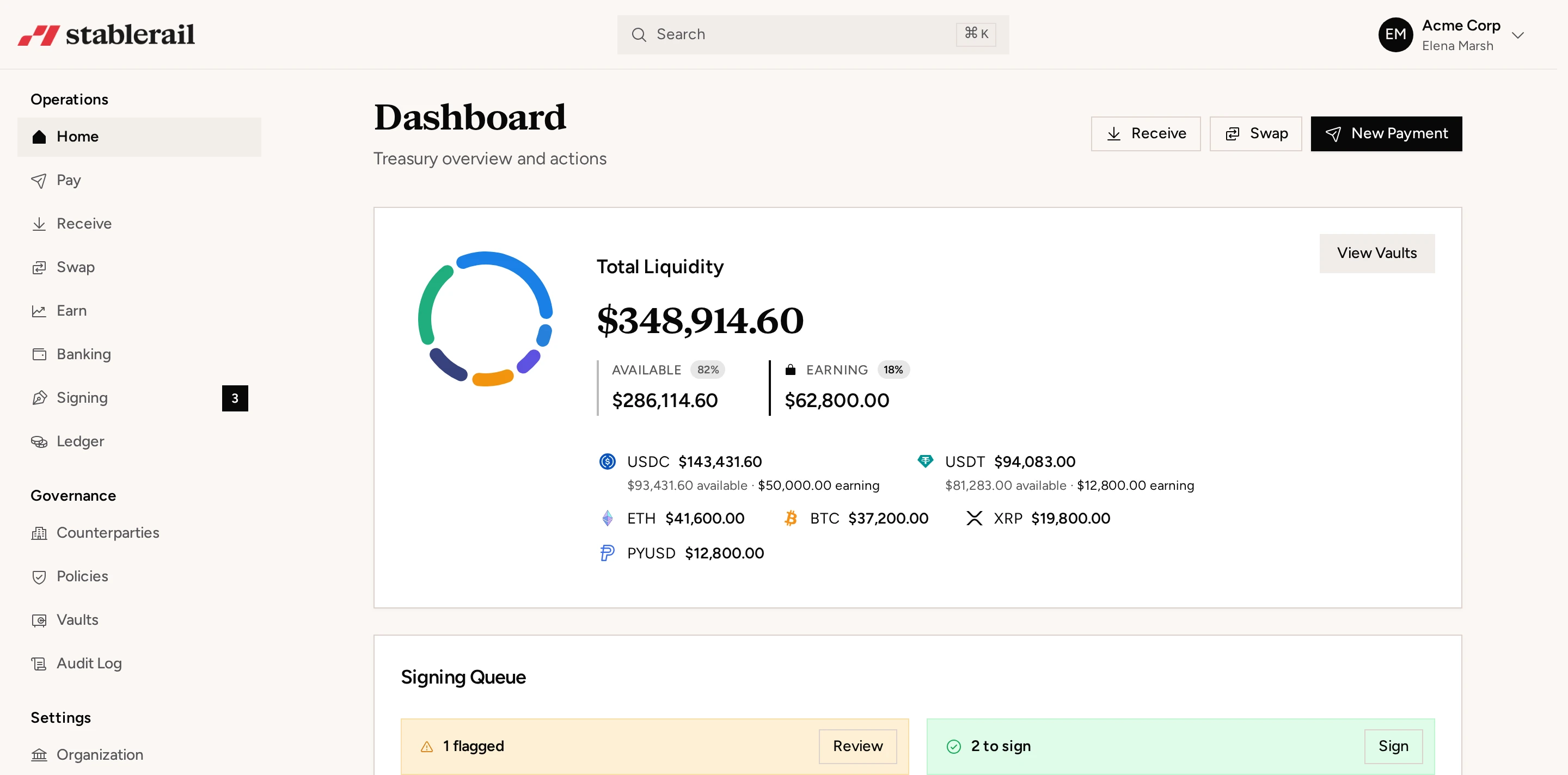
Stablerail supports corporate USDC and USDT treasury workflows with approvals and signing quorum, sanctions and address screening before send, and exportable audit evidence. Finance teams should configure approval levels to reflect their own materiality thresholds, first-payment controls and segregation-of-duties policy.
Immediately before signing, verify:
- The vendor and invoice match the payment record.
- The token amount and invoice conversion are correct.
- The destination is approved for the selected network.
- The address screening result is current.
- Token and network-fee balances are sufficient.
- The displayed transaction has not changed since approval.
6. Decide between individual and batch payouts
An individual payout is appropriate for a first-time vendor, urgent invoice or transaction requiring additional review. Batch processing is more efficient for scheduled payment runs, but each row must retain its own vendor, invoice, token, network, destination and amount.
| Method | Best suited to | Key control |
|---|---|---|
| Individual payout | New vendors, exceptions and urgent invoices | Review the complete transaction immediately before signing |
| Batch payout | Recurring contractor or supplier payment runs | Validate every row, totals by token and network, and exception handling before approval |
| Test then balance | New addresses or high-consequence routes | Confirm receipt before releasing the remaining approved amount |
For batches, reconcile the imported row count and aggregate amount to the approved payment register. Identify invalid addresses, duplicate invoices, unsupported networks and insufficient balances before signing. After execution, preserve a result for every row rather than treating the batch as a single undifferentiated payment.
7. Confirm settlement and share remittance evidence
After broadcast, capture the transaction hash, token, network, amount, destination, timestamp and status. The hash lets both parties locate the transaction on an appropriate blockchain explorer, but it does not by itself prove that the correct invoice was authorized or that a custodial platform credited the vendor.
Send a remittance notice containing the invoice number, payment amount, stablecoin, network, transaction hash or explorer link, payment date and accounts payable contact. Avoid describing a merely submitted transaction as settled. Wait for network confirmation and, when the destination is an exchange or payment provider, any additional crediting process required by that provider.
8. Reconcile the invoice, treasury records and blockchain
Post the payment against the correct invoice using the transaction hash as an external reference. Record the accounting value under the company’s approved accounting policy, along with the exchange rate, blockchain fee, platform fee and conversion charge where applicable.
Reconcile three sources: the accounts payable ledger, the treasury transaction record and the on-chain transaction. Investigate differences caused by test payments, partial settlement, rounding, conversion timing, deducted fees, failed transactions or payments that reached the network but were not credited by the recipient’s platform.
The audit evidence should include the invoice approval, vendor instructions, address verification, screening result, transaction approval and signing history, hash, final status, rate evidence, fees and remittance notice. Retention should follow the company’s normal accounting and recordkeeping policy.
What if the vendor wants fiat instead?
The vendor does not necessarily need to receive stablecoins. Treasury can convert USDC or USDT and initiate a fiat payout through an available banking route, subject to beneficiary onboarding, corridor support and eligibility requirements. Depending on the destination, routes may include ACH or wire payments for USD, SEPA for EUR, domestic UK rails for GBP, or SWIFT for cross-border transfers.
Before approval, compare the quoted conversion rate, disclosed fees, beneficiary details, expected delivery path and party responsible for intermediary deductions. Stablerail supports fiat conversion and global payouts alongside corporate stablecoin treasury, allowing the company to use its own USDC or USDT while the vendor receives the invoice currency.
Vendor stablecoin payment checklist
- Approve the invoice under normal accounts payable controls.
- Capture the token, network, asset version, address and memo separately.
- Verify new or changed instructions through a trusted contact channel.
- Screen and approve the destination before send.
- Document the exchange-rate method and fees.
- Apply the required approvals and signing quorum.
- Confirm settlement and send a remittance notice.
- Reconcile the invoice, treasury record and on-chain transaction.
The core control is simple: treat a stablecoin address with the same discipline as bank details, while adding explicit checks for the token, blockchain network, asset version and on-chain confirmation.
Frequently asked questions
What information do I need to pay a vendor in USDC or USDT?
Collect the vendor’s legal name, invoice number, stablecoin, blockchain network, wallet address, asset version and any required memo or tag. You should also document the invoice currency, exchange-rate method, due date and whether the address belongs to the vendor or a custodial provider.
Can I send USDC or USDT to the wrong network?
Yes. A wallet address may appear valid on multiple networks even when the recipient supports deposits on only one of them. Confirm the exact token and deposit network with the vendor before sending because recovery may be difficult, delayed or unavailable.
Should we send a test payment before paying a vendor?
A small test transfer can be appropriate for a new address, unfamiliar route or material payment. It confirms that the technical route works, but it does not replace vendor verification, sanctions screening, invoice approval or confirmation that the vendor controls the destination.
What proof should we keep for a stablecoin vendor payment?
Retain the approved invoice, vendor payment instructions, address verification, screening result, approval and signing history, transaction hash, network status, exchange-rate evidence, fees and remittance notice. Together, these records connect the business obligation to the treasury authorization and on-chain transfer.
Can a vendor receive fiat if our treasury holds USDC or USDT?
Yes, if your payment provider supports conversion and the required banking corridor. Treasury can convert the stablecoin and send fiat to the vendor’s bank account, subject to onboarding, beneficiary checks, route availability, fees and eligibility requirements.
Finance writers covering stablecoin treasury, payments, compliance, and risk controls.
More about the Stablerail team- Stablecoin treasury managementApprovals, limits, yield and reporting on one balance.
- Stablecoin payoutsBatch contractor and vendor payments with screening.
- USDT vs USDCWhich stablecoin your company should settle in.
- Stablecoin finance glossaryMPC, off-ramp, travel rule and the rest, in plain English.
- Product updatesEverything we ship, month by month.