
How Stablecoin Orchestration Platforms Simplify Treasury Operations
A practical guide to comparing platforms that connect USDC and USDT treasury accounts with fiat rails, conversion, liquidity, approvals and global payouts.
%22%20x1%3D%220%22%20y1%3D%220%22%20x2%3D%221%22%20y2%3D%221%22%3E%0A%20%20%20%20%20%20%20%20%3Cstop%20offset%3D%220%25%22%20stop-color%3D%22%23450B10%22%20%2F%3E%0A%20%20%20%20%20%20%20%20%3Cstop%20offset%3D%2250%25%22%20stop-color%3D%22%23681A1F%22%20%2F%3E%0A%20%20%20%20%20%20%20%20%3Cstop%20offset%3D%22100%25%22%20stop-color%3D%22%238A2A2D%22%20%2F%3E%0A%20%20%20%20%20%20%3C%2FlinearGradient%3E%0A%20%20%20%20%20%20%3CradialGradient%20id%3D%22glow%22%20cx%3D%221022%22%20cy%3D%22-74%22%20r%3D%22520%22%20gradientUnits%3D%22userSpaceOnUse%22%3E%0A%20%20%20%20%20%20%20%20%3Cstop%20offset%3D%220%25%22%20stop-color%3D%22%23FF7A59%22%20stop-opacity%3D%220.45%22%20%2F%3E%0A%20%20%20%20%20%20%20%20%3Cstop%20offset%3D%2255%25%22%20stop-color%3D%22%23FF7A59%22%20stop-opacity%3D%220.08%22%20%2F%3E%0A%20%20%20%20%20%20%20%20%3Cstop%20offset%3D%22100%25%22%20stop-color%3D%22%23FF7A59%22%20stop-opacity%3D%220%22%20%2F%3E%0A%20%20%20%20%20%20%3C%2FradialGradient%3E%0A%20%20%20%20%20%20%3ClinearGradient%20id%3D%22glass%22%20x1%3D%220%22%20y1%3D%220%22%20x2%3D%221%22%20y2%3D%221%22%3E%0A%20%20%20%20%20%20%20%20%3Cstop%20offset%3D%220%25%22%20stop-color%3D%22%23F8D6D2%22%20stop-opacity%3D%220.26%22%20%2F%3E%0A%20%20%20%20%20%20%20%20%3Cstop%20offset%3D%22100%25%22%20stop-color%3D%22%23FFFFFF%22%20stop-opacity%3D%220.08%22%20%2F%3E%0A%20%20%20%20%20%20%3C%2FlinearGradient%3E%0A%20%20%20%20%20%20%3ClinearGradient%20id%3D%22accent%22%20x1%3D%220%22%20y1%3D%220%22%20x2%3D%221%22%20y2%3D%221%22%3E%0A%20%20%20%20%20%20%20%20%3Cstop%20offset%3D%220%25%22%20stop-color%3D%22%23FF7A59%22%20%2F%3E%0A%20%20%20%20%20%20%20%20%3Cstop%20offset%3D%22100%25%22%20stop-color%3D%22%23C73128%22%20%2F%3E%0A%20%20%20%20%20%20%3C%2FlinearGradient%3E%0A%20%20%20%20%20%20%3Cfilter%20id%3D%22soft%22%3E%3CfeGaussianBlur%20stdDeviation%3D%2210%22%20%2F%3E%3C%2Ffilter%3E%0A%20%20%20%20%3C%2Fdefs%3E%0A%20%20%20%20%3Crect%20width%3D%221600%22%20height%3D%22900%22%20fill%3D%22url(%23bg)%22%20%2F%3E%0A%20%20%20%20%3Crect%20width%3D%221600%22%20height%3D%22900%22%20fill%3D%22url(%23glow)%22%20%2F%3E%0A%20%20%20%20%0A%20%20%3Crect%20x%3D%22480%22%20y%3D%22200%22%20width%3D%22640%22%20height%3D%22500%22%20rx%3D%2232%22%20fill%3D%22url(%23glass)%22%20stroke%3D%22%23F4CDC5%22%20stroke-opacity%3D%220.6%22%20stroke-width%3D%223%22%2F%3E%0A%20%20%3Ccircle%20cx%3D%22800%22%20cy%3D%22450%22%20r%3D%22180%22%20fill%3D%22none%22%20stroke%3D%22%23F4CDC5%22%20stroke-opacity%3D%220.6%22%20stroke-width%3D%226%22%2F%3E%0A%20%20%3Ccircle%20cx%3D%22800%22%20cy%3D%22450%22%20r%3D%22130%22%20fill%3D%22url(%23glass)%22%20stroke%3D%22%23F4CDC5%22%20stroke-opacity%3D%220.5%22%2F%3E%0A%20%20%3Ccircle%20cx%3D%22800%22%20cy%3D%22450%22%20r%3D%2236%22%20fill%3D%22url(%23accent)%22%2F%3E%0A%20%20%3Crect%20x%3D%22966.8933947283417%22%20y%3D%22438.1074119229377%22%20width%3D%2216%22%20height%3D%2236%22%20rx%3D%223%22%20fill%3D%22%23F4CDC5%22%20opacity%3D%220.7%22%20transform%3D%22rotate(2%20974.8933947283417%20456.1074119229377)%22%2F%3E%3Crect%20x%3D%22911.3497130109372%22%20y%3D%22559.9868977833548%22%20width%3D%2216%22%20height%3D%2236%22%20rx%3D%223%22%20fill%3D%22%23F4CDC5%22%20opacity%3D%220.7%22%20transform%3D%22rotate(47%20919.3497130109372%20577.9868977833548)%22%2F%3E%3Crect%20x%3D%22785.8925880770623%22%20y%3D%22606.8933947283417%22%20width%3D%2216%22%20height%3D%2236%22%20rx%3D%223%22%20fill%3D%22%23F4CDC5%22%20opacity%3D%220.7%22%20transform%3D%22rotate(92%20793.8925880770623%20624.8933947283417)%22%2F%3E%3Crect%20x%3D%22664.0131022166452%22%20y%3D%22551.3497130109372%22%20width%3D%2216%22%20height%3D%2236%22%20rx%3D%223%22%20fill%3D%22%23F4CDC5%22%20opacity%3D%220.7%22%20transform%3D%22rotate(137%20672.0131022166452%20569.3497130109372)%22%2F%3E%3Crect%20x%3D%22617.1066052716583%22%20y%3D%22425.8925880770623%22%20width%3D%2216%22%20height%3D%2236%22%20rx%3D%223%22%20fill%3D%22%23F4CDC5%22%20opacity%3D%220.7%22%20transform%3D%22rotate(182%20625.1066052716583%20443.8925880770623)%22%2F%3E%3Crect%20x%3D%22672.6502869890627%22%20y%3D%22304.0131022166452%22%20width%3D%2216%22%20height%3D%2236%22%20rx%3D%223%22%20fill%3D%22%23F4CDC5%22%20opacity%3D%220.7%22%20transform%3D%22rotate(227%20680.6502869890627%20322.0131022166452)%22%2F%3E%3Crect%20x%3D%22798.1074119229377%22%20y%3D%22257.1066052716583%22%20width%3D%2216%22%20height%3D%2236%22%20rx%3D%223%22%20fill%3D%22%23F4CDC5%22%20opacity%3D%220.7%22%20transform%3D%22rotate(272%20806.1074119229377%20275.1066052716583)%22%2F%3E%3Crect%20x%3D%22919.9868977833548%22%20y%3D%22312.6502869890628%22%20width%3D%2216%22%20height%3D%2236%22%20rx%3D%223%22%20fill%3D%22%23F4CDC5%22%20opacity%3D%220.7%22%20transform%3D%22rotate(317%20927.9868977833548%20330.6502869890628)%22%2F%3E%0A%0A%20%20%20%20%3Crect%20x%3D%2226%22%20y%3D%2226%22%20width%3D%221548%22%20height%3D%22848%22%20rx%3D%2218%22%20fill%3D%22none%22%20stroke%3D%22%23F2D0C8%22%20stroke-opacity%3D%220.12%22%2F%3E%0A%20%20%3C%2Fsvg%3E)
Stablecoin treasury often starts simply: a wallet holding USDC or USDT, an exchange account and a bank account. Complexity increases when a company needs to fund wallets from multiple currencies, pay recipients on different networks, manage liquidity and produce evidence for accounting and audit.
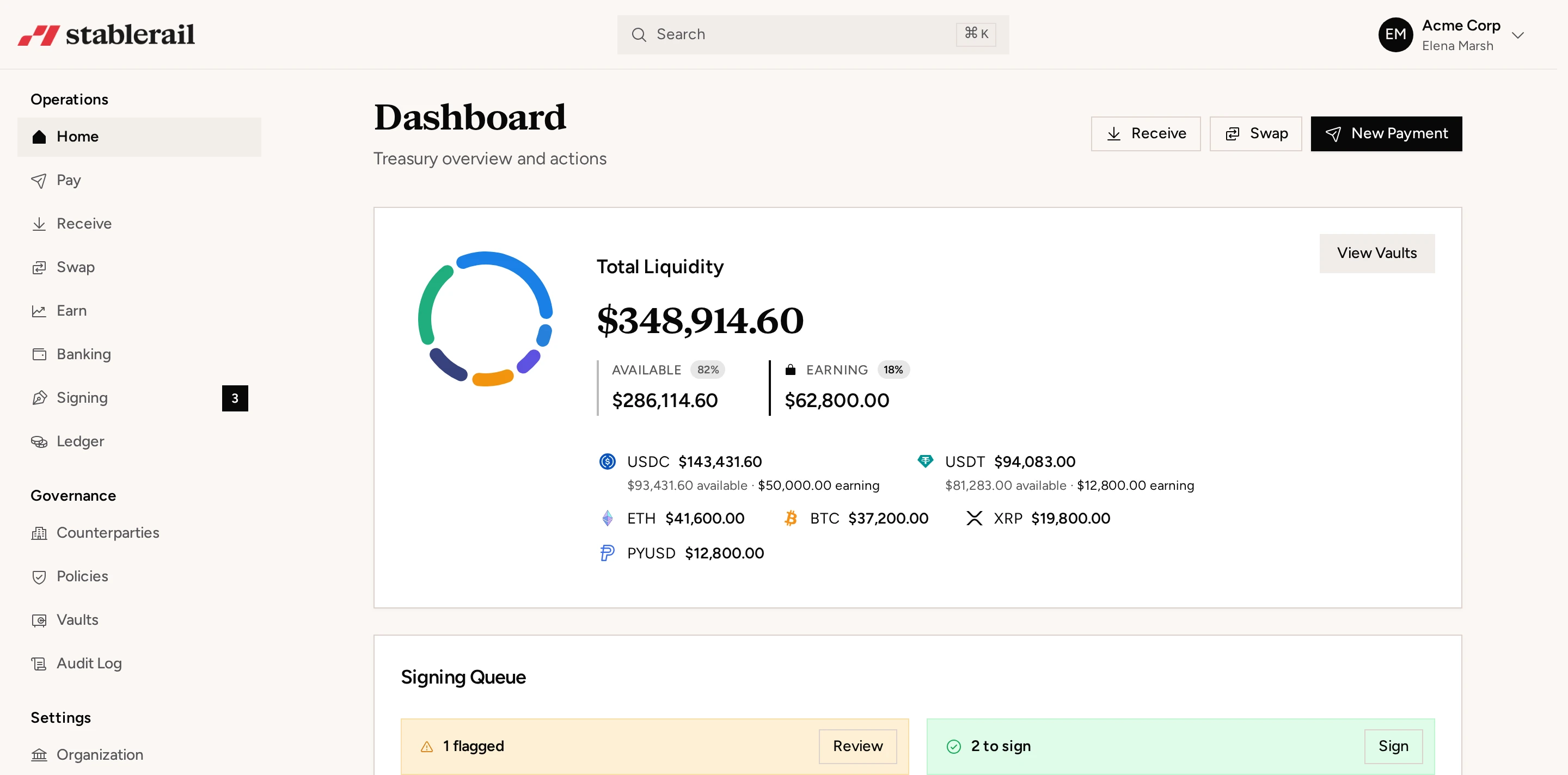
A stablecoin orchestration platform brings those activities into one operating layer. It coordinates fiat accounts, stablecoin vaults, conversion, payouts and approval workflows so treasury teams do not have to move manually between banks, exchanges, wallets and spreadsheets.
The practical value is not merely having another dashboard. It is having a repeatable path from incoming fiat or stablecoins to the correct treasury balance, conversion route and final recipient—with fees, timing, limits and transaction evidence visible along the way.
What a stablecoin orchestration platform coordinates
| Capability | What treasury teams should expect | Questions to ask |
|---|---|---|
| Stablecoin accounts | Business vaults for USDC and USDT across supported networks | Who controls the keys? Which chains and tokens are supported? |
| Fiat rails | EUR, USD and GBP accounts connected to domestic and international payment systems | Are accounts held in the company’s name? What are the cut-off times? |
| Conversion | On- and off-ramps between fiat and stablecoins | What is the spread, service fee, network fee and minimum amount? |
| Liquidity | Access to the inventory needed to complete conversions and payouts | Are quotes firm? How long are they valid? What happens for large orders? |
| Payouts | Single or batch payments to wallets, bank accounts, vendors or contractors | Which currencies, countries and networks are available? |
| Controls | Approvals, limits, allowlists, screening and an audit log | Can rules vary by entity, user, amount and destination? |
For example, Stablerail combines self-custodial MPC vaults with fiat accounts and payment rails. MPC, or multi-party computation, divides signing authority so no single person or device holds the complete private key. Quorum signing then requires the configured number of approvers before funds can move.
How the end-to-end workflow works
Example 1: EUR to USDC for supplier payouts
A European business can fund a EUR balance through SEPA or SEPA Instant, request a EUR-to-USDC conversion and distribute the USDC to approved supplier wallets.
- Fund: Send EUR to a virtual IBAN or designated business account.
- Reconcile: Match the incoming transfer using its sender, reference and amount.
- Quote: Review the exchange rate, platform charge, spread and any network fee before execution.
- Convert: Exchange the EUR balance for USDC on the required network.
- Approve: Apply the company’s amount limits and signer quorum.
- Pay: Send individual or batch payouts and export the transaction records.
SEPA credit transfers commonly arrive by the next business day. SEPA Instant is designed to settle within seconds and operates around the clock, but availability and transaction limits depend on participating institutions. Blockchain delivery also depends on the selected network, congestion and recipient requirements.
Example 2: USDT to international fiat
A company receiving USDT on Tron might need to pay a contractor in USD or GBP. The platform screens the source wallet, credits the supported USDT balance, converts the amount and sends the payout through an appropriate fiat rail.
USD payments may use ACH or Fedwire. ACH generally costs less but can take one to three business days, although same-day processing may be available before cut-off. Fedwire usually settles on the same business day during operating hours. GBP options include Faster Payments, CHAPS and BACS; Faster Payments often arrives within seconds or minutes, CHAPS is typically same-day, and BACS normally follows a three-business-day cycle.
For cross-border bank payments, SWIFT can take one to five business days because intermediary and recipient banks may perform additional processing. These are indicative rail timings, not delivery guarantees.
Networks, routing and liquidity
USDC and USDT exist on multiple blockchains. A recipient asking for USDT on Tron cannot automatically receive USDT sent on Ethereum. Sending the correct token on the wrong network can delay recovery or permanently lose funds.
An orchestration platform should make the token and network explicit before approval. Stablerail supports payouts across Ethereum, Base, Arbitrum, Polygon, Tron, BNB Chain, Optimism and Solana, subject to the availability of the chosen stablecoin and corridor. Finance teams can use stablecoin payouts for vendor and contractor batches rather than preparing each wallet transfer separately.
Liquidity matters when moving larger amounts or operating near payroll and supplier deadlines. Evaluate whether the platform shows an executable quote, its expiry time and the amount available at that price. Published corridor pricing should distinguish:
- the fiat-to-stablecoin or stablecoin-to-fiat exchange rate;
- any conversion spread or service charge;
- domestic or international bank transfer fees;
- blockchain network fees, sometimes called gas;
- intermediary bank or recipient-side deductions.
Compare the amount delivered, not just the headline conversion rate. A narrow spread can still produce a worse result if withdrawal, network or correspondent bank charges are added later.
Integrations and treasury records
At minimum, finance teams need downloadable transaction data containing the entity, asset, amount, fee, exchange rate, sender, recipient, timestamp, blockchain transaction hash and approval history. API access becomes important when payment instructions originate in an ERP, payroll system or accounts payable workflow.
Check whether the platform supports idempotency, which prevents an API retry from creating a duplicate payment. Webhooks or status notifications should distinguish between created, awaiting approval, submitted, confirmed, failed and returned transactions. Batch-level and payment-level records are both useful for reconciliation.
Payment links and invoice collection can also route incoming stablecoins into the same treasury workflow. Teams collecting from customers can review stablecoin payment acceptance alongside payout requirements.
Controls that support daily operations
Controls should reduce payment risk without forcing every routine transfer through the same process. Useful features include approval limits by amount, quorum signing, approved-address allowlists, sanctions and wallet screening, and a tamper-evident audit log.
Before activation, expect know-your-business checks covering the legal entity, beneficial owners, directors, operating activity, expected volumes and source of funds. Eligibility may vary by jurisdiction and industry. A provider should explain required documents and restrictions before the treasury team designs a workflow around a corridor that may not be available.
How to compare platforms
- Coverage: Confirm currencies, countries, stablecoins, networks and fiat rails for both funding and withdrawal.
- Custody model: Determine who controls assets and how access is recovered if a signer leaves.
- Pricing: Request all-in examples for representative corridors and transaction sizes.
- Timing: Record funding cut-offs, quote validity, expected settlement and weekend availability.
- Limits: Check per-transaction, daily and monthly limits, plus any higher-limit review process.
- Liquidity: Test whether normal payroll or supplier volumes can execute without splitting orders unexpectedly.
- Operations: Review batch uploads, APIs, payment statuses, failure handling and reconciliation exports.
- Evidence: Confirm that approvals, screening results, fees and transaction references can be exported for audit.
A useful pilot follows one real corridor from beginning to end—for example, EUR received by SEPA, converted to USDC and paid on Base. Measure the delivered amount, elapsed time, manual steps and quality of the accounting evidence. Repeat with an off-ramp, such as USDT to USD through Fedwire or ACH.
The best stablecoin orchestration setup is the one that fits the company’s actual currencies, networks, approval model and payment deadlines. Treasury teams can then manage USDC, USDT, fiat rails, liquidity and payouts as one operating process rather than a collection of disconnected accounts.
Finance writers covering stablecoin treasury, payments, compliance, and risk controls.
More about the Stablerail team- Stablecoin treasury managementApprovals, limits, yield and reporting on one balance.
- Stablecoin payoutsBatch contractor and vendor payments with screening.
- USDT vs USDCWhich stablecoin your company should settle in.
- Stablecoin finance glossaryMPC, off-ramp, travel rule and the rest, in plain English.
- Product updatesEverything we ship, month by month.