
How to Reconcile Stablecoin Payments Across Multiple Wallets
A practical monthly close process for reconciling USDC and USDT across wallets, chains, payouts and fiat conversions—including common mismatches and evidence to retain.
%22%20x1%3D%220%22%20y1%3D%220%22%20x2%3D%221%22%20y2%3D%221%22%3E%0A%20%20%20%20%20%20%20%20%3Cstop%20offset%3D%220%25%22%20stop-color%3D%22%23450B10%22%20%2F%3E%0A%20%20%20%20%20%20%20%20%3Cstop%20offset%3D%2250%25%22%20stop-color%3D%22%23681A1F%22%20%2F%3E%0A%20%20%20%20%20%20%20%20%3Cstop%20offset%3D%22100%25%22%20stop-color%3D%22%238A2A2D%22%20%2F%3E%0A%20%20%20%20%20%20%3C%2FlinearGradient%3E%0A%20%20%20%20%20%20%3CradialGradient%20id%3D%22glow%22%20cx%3D%22512%22%20cy%3D%22-181%22%20r%3D%22520%22%20gradientUnits%3D%22userSpaceOnUse%22%3E%0A%20%20%20%20%20%20%20%20%3Cstop%20offset%3D%220%25%22%20stop-color%3D%22%23FF7A59%22%20stop-opacity%3D%220.45%22%20%2F%3E%0A%20%20%20%20%20%20%20%20%3Cstop%20offset%3D%2255%25%22%20stop-color%3D%22%23FF7A59%22%20stop-opacity%3D%220.08%22%20%2F%3E%0A%20%20%20%20%20%20%20%20%3Cstop%20offset%3D%22100%25%22%20stop-color%3D%22%23FF7A59%22%20stop-opacity%3D%220%22%20%2F%3E%0A%20%20%20%20%20%20%3C%2FradialGradient%3E%0A%20%20%20%20%20%20%3ClinearGradient%20id%3D%22glass%22%20x1%3D%220%22%20y1%3D%220%22%20x2%3D%221%22%20y2%3D%221%22%3E%0A%20%20%20%20%20%20%20%20%3Cstop%20offset%3D%220%25%22%20stop-color%3D%22%23F8D6D2%22%20stop-opacity%3D%220.26%22%20%2F%3E%0A%20%20%20%20%20%20%20%20%3Cstop%20offset%3D%22100%25%22%20stop-color%3D%22%23FFFFFF%22%20stop-opacity%3D%220.08%22%20%2F%3E%0A%20%20%20%20%20%20%3C%2FlinearGradient%3E%0A%20%20%20%20%20%20%3ClinearGradient%20id%3D%22accent%22%20x1%3D%220%22%20y1%3D%220%22%20x2%3D%221%22%20y2%3D%221%22%3E%0A%20%20%20%20%20%20%20%20%3Cstop%20offset%3D%220%25%22%20stop-color%3D%22%23FF7A59%22%20%2F%3E%0A%20%20%20%20%20%20%20%20%3Cstop%20offset%3D%22100%25%22%20stop-color%3D%22%23C73128%22%20%2F%3E%0A%20%20%20%20%20%20%3C%2FlinearGradient%3E%0A%20%20%20%20%20%20%3Cfilter%20id%3D%22soft%22%3E%3CfeGaussianBlur%20stdDeviation%3D%2210%22%20%2F%3E%3C%2Ffilter%3E%0A%20%20%20%20%3C%2Fdefs%3E%0A%20%20%20%20%3Crect%20width%3D%221600%22%20height%3D%22900%22%20fill%3D%22url(%23bg)%22%20%2F%3E%0A%20%20%20%20%3Crect%20width%3D%221600%22%20height%3D%22900%22%20fill%3D%22url(%23glow)%22%20%2F%3E%0A%20%20%20%20%3Crect%20x%3D%22280%22%20y%3D%22200%22%20width%3D%22536%22%20height%3D%2244%22%20rx%3D%226%22%20fill%3D%22url(%23glass)%22%20stroke%3D%22%23F4CDC5%22%20stroke-opacity%3D%220.35%22%2F%3E%0A%20%20%20%20%20%20%3Ccircle%20cx%3D%22250%22%20cy%3D%22222%22%20r%3D%2210%22%20fill%3D%22%23F8D6D2%22%20opacity%3D%220.4%22%2F%3E%3Crect%20x%3D%22280%22%20y%3D%22270%22%20width%3D%22618%22%20height%3D%2244%22%20rx%3D%226%22%20fill%3D%22url(%23glass)%22%20stroke%3D%22%23F4CDC5%22%20stroke-opacity%3D%220.35%22%2F%3E%0A%20%20%20%20%20%20%3Ccircle%20cx%3D%22250%22%20cy%3D%22292%22%20r%3D%2210%22%20fill%3D%22%23F8D6D2%22%20opacity%3D%220.4%22%2F%3E%3Crect%20x%3D%22280%22%20y%3D%22340%22%20width%3D%22659%22%20height%3D%2244%22%20rx%3D%226%22%20fill%3D%22url(%23glass)%22%20stroke%3D%22%23F4CDC5%22%20stroke-opacity%3D%220.35%22%2F%3E%0A%20%20%20%20%20%20%3Ccircle%20cx%3D%22250%22%20cy%3D%22362%22%20r%3D%2210%22%20fill%3D%22url(%23accent)%22%20opacity%3D%221%22%2F%3E%3Crect%20x%3D%22280%22%20y%3D%22410%22%20width%3D%22679%22%20height%3D%2244%22%20rx%3D%226%22%20fill%3D%22url(%23glass)%22%20stroke%3D%22%23F4CDC5%22%20stroke-opacity%3D%220.35%22%2F%3E%0A%20%20%20%20%20%20%3Ccircle%20cx%3D%22250%22%20cy%3D%22432%22%20r%3D%2210%22%20fill%3D%22url(%23accent)%22%20opacity%3D%221%22%2F%3E%3Crect%20x%3D%22280%22%20y%3D%22480%22%20width%3D%22539%22%20height%3D%2244%22%20rx%3D%226%22%20fill%3D%22url(%23glass)%22%20stroke%3D%22%23F4CDC5%22%20stroke-opacity%3D%220.35%22%2F%3E%0A%20%20%20%20%20%20%3Ccircle%20cx%3D%22250%22%20cy%3D%22502%22%20r%3D%2210%22%20fill%3D%22url(%23accent)%22%20opacity%3D%221%22%2F%3E%3Crect%20x%3D%22280%22%20y%3D%22550%22%20width%3D%22619%22%20height%3D%2244%22%20rx%3D%226%22%20fill%3D%22url(%23glass)%22%20stroke%3D%22%23F4CDC5%22%20stroke-opacity%3D%220.35%22%2F%3E%0A%20%20%20%20%20%20%3Ccircle%20cx%3D%22250%22%20cy%3D%22572%22%20r%3D%2210%22%20fill%3D%22url(%23accent)%22%20opacity%3D%221%22%2F%3E%3Crect%20x%3D%22280%22%20y%3D%22620%22%20width%3D%22509%22%20height%3D%2244%22%20rx%3D%226%22%20fill%3D%22url(%23glass)%22%20stroke%3D%22%23F4CDC5%22%20stroke-opacity%3D%220.35%22%2F%3E%0A%20%20%20%20%20%20%3Ccircle%20cx%3D%22250%22%20cy%3D%22642%22%20r%3D%2210%22%20fill%3D%22url(%23accent)%22%20opacity%3D%221%22%2F%3E%3Crect%20x%3D%22280%22%20y%3D%22690%22%20width%3D%22454%22%20height%3D%2244%22%20rx%3D%226%22%20fill%3D%22url(%23glass)%22%20stroke%3D%22%23F4CDC5%22%20stroke-opacity%3D%220.35%22%2F%3E%0A%20%20%20%20%20%20%3Ccircle%20cx%3D%22250%22%20cy%3D%22712%22%20r%3D%2210%22%20fill%3D%22%23F8D6D2%22%20opacity%3D%220.4%22%2F%3E%3Crect%20x%3D%22200%22%20y%3D%22170%22%20width%3D%221200%22%20height%3D%22600%22%20rx%3D%2220%22%20fill%3D%22none%22%20stroke%3D%22%23F4CDC5%22%20stroke-opacity%3D%220.3%22%2F%3E%0A%20%20%20%20%3Crect%20x%3D%2226%22%20y%3D%2226%22%20width%3D%221548%22%20height%3D%22848%22%20rx%3D%2218%22%20fill%3D%22none%22%20stroke%3D%22%23F2D0C8%22%20stroke-opacity%3D%220.12%22%2F%3E%0A%20%20%3C%2Fsvg%3E)
Stablecoin reconciliation becomes more complicated when USDC or USDT moves across several wallets, blockchains and payment workflows. The blockchain records every transaction, but it does not explain whether a transfer was a vendor payment, an internal treasury movement, a conversion or a refund.
A reliable monthly treasury close therefore needs two records: the on-chain transaction history and the company’s operational ledger. The objective is to prove the closing balance of each wallet, classify every movement and eliminate internal transfers without losing the associated network fees.
Define the close scope before collecting data
Start with a wallet register covering every address the company controls or uses. Include self-custodial vaults, payout wallets, operational wallets, exchange accounts and wallets used for payroll or payment collection.
For each wallet, record:
- The wallet name, address, owner and business purpose.
- The blockchain, such as Ethereum, Base, Arbitrum, Polygon, Tron, BNB Chain, Optimism or Solana.
- Approved token contracts for USDC and USDT.
- The native token used for network fees, such as ETH, TRX, BNB, POL or SOL.
- Whether the wallet is active, dormant or awaiting closure.
- The accounting entity and general ledger account assigned to it.
Token contract addresses matter. A wallet may display assets with similar names even though they are different contracts. Native USDC and a bridged version of USDC should not automatically be treated as the same instrument.
Set one cutoff policy
Use a documented cutoff, such as 23:59:59 UTC on the final calendar day of the month. For every blockchain, retain the first finalized block after that time and its block number or slot. This makes the closing snapshot reproducible.
Do not use the time a payment was entered or approved as the accounting cutoff. Use the finalized on-chain timestamp for stablecoin transfers. Keep initiated but unconfirmed payments in a pending schedule rather than the closing on-chain balance.
Fiat-to-stablecoin conversions need separate treatment. If fiat left a bank account before month-end but the stablecoins arrived afterward, record the movement according to the company’s accounting policy and keep the provider’s order and settlement records as evidence.
Build a normalized transaction ledger
Export transactions from the treasury platform, blockchain explorers or an indexing service. Normalize them into one ledger with one row per asset movement. At minimum, capture:
- Legal entity and wallet.
- Blockchain and token contract.
- Transaction hash and finalized timestamp.
- Sending and receiving addresses.
- Token quantity and decimal precision.
- Network fee, including the native asset used to pay it.
- Payment reference, invoice, employee or vendor ID.
- Classification and review status.
USDC and USDT commonly use six decimal places, but the ledger should read precision from the token contract or trusted asset metadata rather than assume it. Store full precision even if financial reports display only two decimal places.
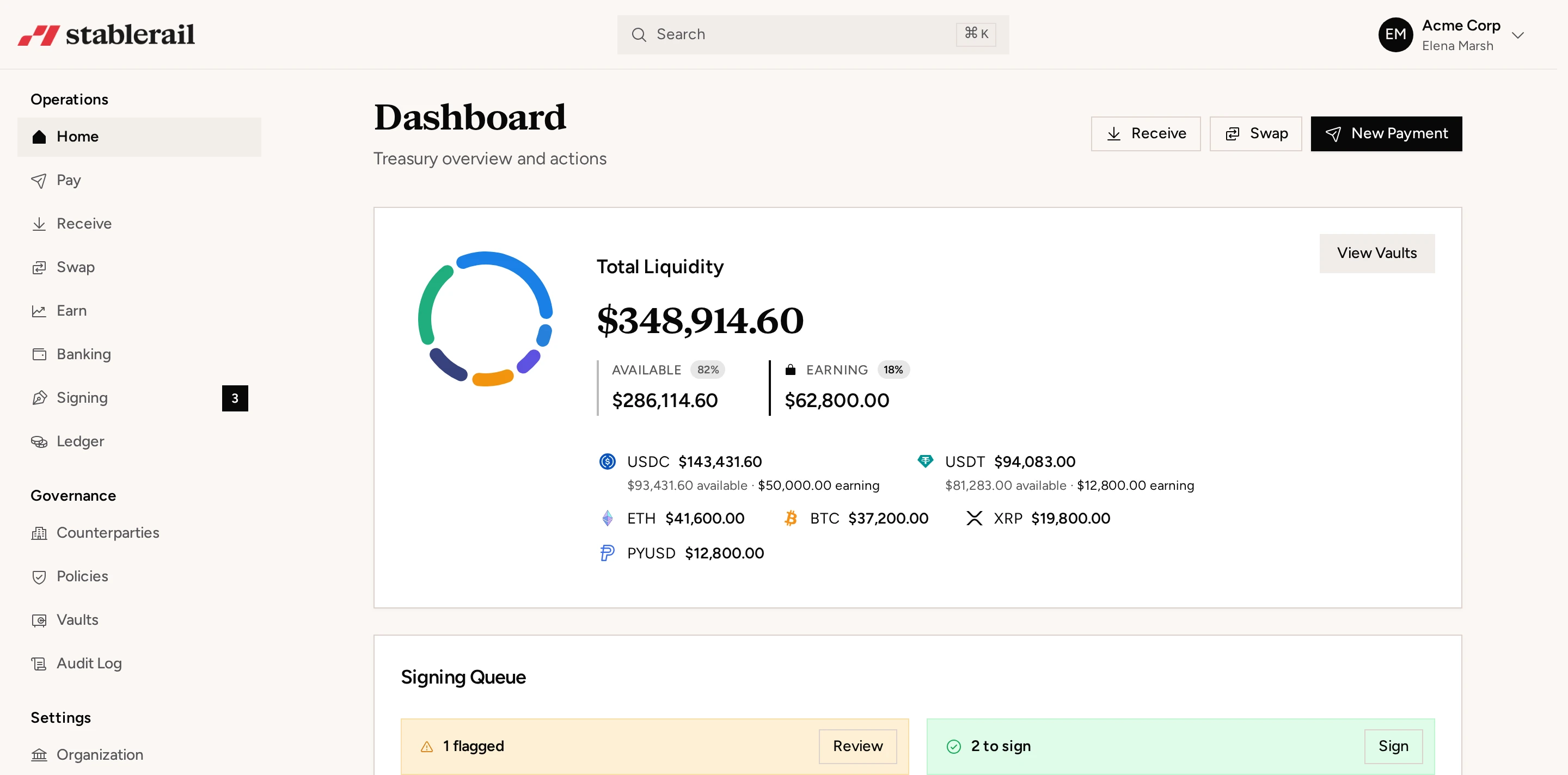
A corporate treasury platform can consolidate self-custodial wallets, approvals, payouts and supporting records. Stablerail uses MPC vaults and quorum signing for corporate USDC and USDT, while its audit log and evidence records can support the close. Payment data from batch stablecoin payouts should be exported alongside the blockchain activity.
Classify each movement
Every transaction should fall into a defined category. Typical categories include:
- Customer receipt: stablecoins received for an invoice or payment link.
- Vendor or contractor payment: an external operating expense or payable settlement.
- Payroll: employee or contractor compensation.
- Internal transfer: movement between company-controlled wallets.
- On-ramp or off-ramp: conversion between fiat and stablecoins.
- Bridge: movement of value between blockchains.
- Refund or return: reversal of a previous receipt or payment.
- Network fee: blockchain fee paid in the chain’s native token.
- Unidentified: activity requiring investigation before close approval.
Apply the classification at transaction or transfer-event level. A single transaction can contain multiple token movements, and a batch payment can send funds to many recipients under one transaction hash.
Reconcile wallet by wallet
For each wallet and token, use the following quantity reconciliation:
Opening balance + external receipts − external payments + internal transfers in − internal transfers out = closing on-chain balance.
Reconcile token units before applying a fiat value. This separates quantity errors from valuation differences. Then consolidate balances across wallets and eliminate internal transfers at group or entity level.
Network fees require their own reconciliation. Sending 10,000 USDC normally reduces the stablecoin balance by 10,000 USDC, while the gas fee reduces ETH, TRX, SOL or another native-token balance. If a provider deducts a service fee from the stablecoin amount, split the gross payment and fee using the quote or settlement statement rather than inferring the fee from the recipient’s receipt.
Match operational records to blockchain activity
Exact one-to-one matching is not always possible. Use a hierarchy of identifiers:
- Transaction hash and blockchain.
- Recipient address and token contract.
- Exact token amount.
- Finalized timestamp within a defined tolerance.
- Invoice, payout or payroll reference.
For batch payments, match the individual transfer events inside the transaction to each beneficiary. For payment links and customer collections, retain the payer address, invoice reference and settlement transaction. Teams using stablecoin payroll should reconcile the approved payroll file to the individual transfers shown in the payroll payment record.
Common reconciliation mismatches
| Mismatch | Likely cause | Close action |
|---|---|---|
| Ledger payment has no completed transaction | Rejected approval, insufficient gas or pending transaction | Move it to the pending schedule and confirm whether it should be retried |
| Same transfer appears twice | Explorer and platform exports were combined without deduplication | Deduplicate using blockchain, transaction hash, log index and token contract |
| Recipient amount differs from the invoice | Fee deducted from principal, rounding or partial payment | Split principal, fee and residual payable |
| Wallet balances agree but consolidated balances do not | Internal transfer recorded as both income and expense | Eliminate both legs while retaining any network or bridge fee |
| Transfer exists on the wrong network | Recipient address was valid on multiple EVM chains | Confirm chain, recoverability and accounting treatment; do not match by address alone |
| Bridge withdrawal has not arrived | Bridge processing spans the month-end cutoff | Record an in-transit asset supported by source and destination transaction evidence |
| Book value differs from token quantity | Different exchange rate or valuation timestamp | Apply the approved month-end pricing source consistently |
Value balances and post the close
After quantities reconcile, translate each balance into the company’s functional currency. A stablecoin’s name does not guarantee a constant value of exactly one US dollar. Document the pricing source, timestamp and treatment of any difference between market value and the accounting carrying amount.
Post stablecoin balances, native gas-token balances, fees, realized conversion differences and any month-end revaluation required by the company’s accounting policy. On-ramp and off-ramp records should show the gross fiat amount, stablecoin amount, provider fee, exchange rate and settlement date.
Retain a repeatable evidence pack
The monthly evidence pack should contain the wallet register, cutoff blocks, opening and closing balance reports, normalized transaction ledger, exception list, fiat conversion statements, approval records and sign-off. Preserve transaction hashes as evidence, but do not rely only on links to public explorers; exported records are easier to retain and review consistently.
Use separate preparer and reviewer steps. The reviewer should verify all unidentified movements, material fees, bridge transactions, new wallet addresses and changes to the approved token list. Wallet screening can also help investigate unknown counterparties; Stablerail’s wallet checker is one available starting point.
A good multi-wallet close does not require every payment to be manually traced from scratch. It requires a complete wallet inventory, a reproducible cutoff, structured transaction data and clear rules for internal transfers, fees and in-transit funds. Once those foundations are in place, stablecoin reconciliation can follow the same disciplined monthly process as bank and payment-account reconciliation.
Finance writers covering stablecoin treasury, payments, compliance, and risk controls.
More about the Stablerail team- Stablecoin treasury managementApprovals, limits, yield and reporting on one balance.
- Stablecoin payoutsBatch contractor and vendor payments with screening.
- USDT vs USDCWhich stablecoin your company should settle in.
- Stablecoin finance glossaryMPC, off-ramp, travel rule and the rest, in plain English.
- Product updatesEverything we ship, month by month.