
Opening a Stablecoin Business Account: KYB Documents and Timelines
A practical guide to stablecoin business account onboarding, including KYB documents, ownership evidence, activity profiles, timelines and common delays.
Opening a stablecoin business account typically requires formation records, current registry documents, an ownership chart, identity and address evidence for controllers, proof of business activity, and source-of-funds records. A straightforward company with complete documents may clear KYB within several business days, while regulated, trust-owned or multi-layer structures can take weeks. Timelines depend on jurisdiction, ownership complexity, business model and follow-up questions.
%22%20x1%3D%220%22%20y1%3D%220%22%20x2%3D%221%22%20y2%3D%221%22%3E%0A%20%20%20%20%20%20%20%20%3Cstop%20offset%3D%220%25%22%20stop-color%3D%22%23450B10%22%20%2F%3E%0A%20%20%20%20%20%20%20%20%3Cstop%20offset%3D%2250%25%22%20stop-color%3D%22%23681A1F%22%20%2F%3E%0A%20%20%20%20%20%20%20%20%3Cstop%20offset%3D%22100%25%22%20stop-color%3D%22%238A2A2D%22%20%2F%3E%0A%20%20%20%20%20%20%3C%2FlinearGradient%3E%0A%20%20%20%20%20%20%3CradialGradient%20id%3D%22glow%22%20cx%3D%221117%22%20cy%3D%22363%22%20r%3D%22520%22%20gradientUnits%3D%22userSpaceOnUse%22%3E%0A%20%20%20%20%20%20%20%20%3Cstop%20offset%3D%220%25%22%20stop-color%3D%22%23FF7A59%22%20stop-opacity%3D%220.45%22%20%2F%3E%0A%20%20%20%20%20%20%20%20%3Cstop%20offset%3D%2255%25%22%20stop-color%3D%22%23FF7A59%22%20stop-opacity%3D%220.08%22%20%2F%3E%0A%20%20%20%20%20%20%20%20%3Cstop%20offset%3D%22100%25%22%20stop-color%3D%22%23FF7A59%22%20stop-opacity%3D%220%22%20%2F%3E%0A%20%20%20%20%20%20%3C%2FradialGradient%3E%0A%20%20%20%20%20%20%3ClinearGradient%20id%3D%22glass%22%20x1%3D%220%22%20y1%3D%220%22%20x2%3D%221%22%20y2%3D%221%22%3E%0A%20%20%20%20%20%20%20%20%3Cstop%20offset%3D%220%25%22%20stop-color%3D%22%23F8D6D2%22%20stop-opacity%3D%220.26%22%20%2F%3E%0A%20%20%20%20%20%20%20%20%3Cstop%20offset%3D%22100%25%22%20stop-color%3D%22%23FFFFFF%22%20stop-opacity%3D%220.08%22%20%2F%3E%0A%20%20%20%20%20%20%3C%2FlinearGradient%3E%0A%20%20%20%20%20%20%3ClinearGradient%20id%3D%22accent%22%20x1%3D%220%22%20y1%3D%220%22%20x2%3D%221%22%20y2%3D%221%22%3E%0A%20%20%20%20%20%20%20%20%3Cstop%20offset%3D%220%25%22%20stop-color%3D%22%23FF7A59%22%20%2F%3E%0A%20%20%20%20%20%20%20%20%3Cstop%20offset%3D%22100%25%22%20stop-color%3D%22%23C73128%22%20%2F%3E%0A%20%20%20%20%20%20%3C%2FlinearGradient%3E%0A%20%20%20%20%20%20%3Cfilter%20id%3D%22soft%22%3E%3CfeGaussianBlur%20stdDeviation%3D%2210%22%20%2F%3E%3C%2Ffilter%3E%0A%20%20%20%20%3C%2Fdefs%3E%0A%20%20%20%20%3Crect%20width%3D%221600%22%20height%3D%22900%22%20fill%3D%22url(%23bg)%22%20%2F%3E%0A%20%20%20%20%3Crect%20width%3D%221600%22%20height%3D%22900%22%20fill%3D%22url(%23glow)%22%20%2F%3E%0A%20%20%20%20%0A%20%20%3Crect%20x%3D%22480%22%20y%3D%22200%22%20width%3D%22640%22%20height%3D%22500%22%20rx%3D%2232%22%20fill%3D%22url(%23glass)%22%20stroke%3D%22%23F4CDC5%22%20stroke-opacity%3D%220.6%22%20stroke-width%3D%223%22%2F%3E%0A%20%20%3Ccircle%20cx%3D%22800%22%20cy%3D%22450%22%20r%3D%22180%22%20fill%3D%22none%22%20stroke%3D%22%23F4CDC5%22%20stroke-opacity%3D%220.6%22%20stroke-width%3D%226%22%2F%3E%0A%20%20%3Ccircle%20cx%3D%22800%22%20cy%3D%22450%22%20r%3D%22130%22%20fill%3D%22url(%23glass)%22%20stroke%3D%22%23F4CDC5%22%20stroke-opacity%3D%220.5%22%2F%3E%0A%20%20%3Ccircle%20cx%3D%22800%22%20cy%3D%22450%22%20r%3D%2236%22%20fill%3D%22url(%23accent)%22%2F%3E%0A%20%20%3Crect%20x%3D%22965.6955765372313%22%20y%3D%22453.3271350959008%22%20width%3D%2216%22%20height%3D%2236%22%20rx%3D%223%22%20fill%3D%22%23F4CDC5%22%20opacity%3D%220.7%22%20transform%3D%22rotate(7%20973.6955765372313%20471.3271350959008)%22%2F%3E%3Crect%20x%3D%22899.7407581819903%22%20y%3D%22569.9018818811763%22%20width%3D%2216%22%20height%3D%2236%22%20rx%3D%223%22%20fill%3D%22%23F4CDC5%22%20opacity%3D%220.7%22%20transform%3D%22rotate(52%20907.7407581819903%20587.9018818811763)%22%2F%3E%3Crect%20x%3D%22770.6728649040992%22%20y%3D%22605.6955765372313%22%20width%3D%2216%22%20height%3D%2236%22%20rx%3D%223%22%20fill%3D%22%23F4CDC5%22%20opacity%3D%220.7%22%20transform%3D%22rotate(97%20778.6728649040992%20623.6955765372313)%22%2F%3E%3Crect%20x%3D%22654.0981181188237%22%20y%3D%22539.7407581819903%22%20width%3D%2216%22%20height%3D%2236%22%20rx%3D%223%22%20fill%3D%22%23F4CDC5%22%20opacity%3D%220.7%22%20transform%3D%22rotate(142%20662.0981181188237%20557.7407581819903)%22%2F%3E%3Crect%20x%3D%22618.3044234627687%22%20y%3D%22410.67286490409913%22%20width%3D%2216%22%20height%3D%2236%22%20rx%3D%223%22%20fill%3D%22%23F4CDC5%22%20opacity%3D%220.7%22%20transform%3D%22rotate(187%20626.3044234627687%20428.67286490409913)%22%2F%3E%3Crect%20x%3D%22684.2592418180099%22%20y%3D%22294.09811811882366%22%20width%3D%2216%22%20height%3D%2236%22%20rx%3D%223%22%20fill%3D%22%23F4CDC5%22%20opacity%3D%220.7%22%20transform%3D%22rotate(232%20692.2592418180099%20312.09811811882366)%22%2F%3E%3Crect%20x%3D%22813.3271350959009%22%20y%3D%22258.3044234627687%22%20width%3D%2216%22%20height%3D%2236%22%20rx%3D%223%22%20fill%3D%22%23F4CDC5%22%20opacity%3D%220.7%22%20transform%3D%22rotate(277%20821.3271350959009%20276.3044234627687)%22%2F%3E%3Crect%20x%3D%22929.9018818811762%22%20y%3D%22324.2592418180097%22%20width%3D%2216%22%20height%3D%2236%22%20rx%3D%223%22%20fill%3D%22%23F4CDC5%22%20opacity%3D%220.7%22%20transform%3D%22rotate(322%20937.9018818811762%20342.2592418180097)%22%2F%3E%0A%0A%20%20%20%20%3Crect%20x%3D%2226%22%20y%3D%2226%22%20width%3D%221548%22%20height%3D%22848%22%20rx%3D%2218%22%20fill%3D%22none%22%20stroke%3D%22%23F2D0C8%22%20stroke-opacity%3D%220.12%22%2F%3E%0A%20%20%3C%2Fsvg%3E)
Opening a stablecoin business account typically requires formation records, current registry documents, an ownership chart, identity and address evidence for relevant individuals, proof of commercial activity, and source-of-funds records. Straightforward companies may complete KYB within several business days, while regulated, trust-owned or multi-layer structures can take weeks. Preparing consistent evidence before applying is the most effective way to avoid delays.
What KYB means for a stablecoin business account
Know Your Business, or KYB, verifies that a company exists, is active and is controlled by identifiable people. A provider generally needs to understand the entity's legal structure, directors, ultimate beneficial owners, operating model, source of funds and expected account activity.
KYB is different from KYC. KYB applies to the legal entity; KYC verifies the individuals connected to it. During business onboarding, KYC may be required for directors, ultimate beneficial owners, account administrators and other people who exercise control.
Ownership thresholds vary by provider, jurisdiction and risk profile. A person who owns or controls 25% or more is commonly treated as a UBO, but providers may apply a lower threshold or request information about additional shareholders. Ownership is not limited to economic interests: voting rights, board appointment powers, veto rights or control through another arrangement can also matter.
Account approval may be separate from the activation of particular services. A company could clear core KYB but still face additional eligibility checks for a fiat account, conversion corridor, payment rail, network or jurisdiction. Finance teams should therefore ask which capabilities are available at initial approval and which require a separate review.
Core KYB documents to prepare
The exact request depends on the entity and jurisdiction, but most applicants should prepare the following categories:
- Formation evidence: Certificate of incorporation, registration certificate or the local equivalent.
- Current company record: A recent registry extract, certificate of incumbency or good-standing document showing the entity's current status and registered details.
- Constitutional documents: Articles of association, bylaws, operating agreement or partnership agreement.
- Ownership evidence: Shareholder register, capitalization table and a signed ownership chart tracing every ownership layer to individual UBOs or controllers.
- Management and authority records: Director register, board resolution, power of attorney or other evidence identifying who may open and operate the account.
- Address evidence: Proof of the operating address where it differs from the registered office, such as a lease, bank statement or accepted utility document.
- Tax information: Tax identification number and applicable VAT, GST or sales-tax registrations.
- Identity and residential address evidence: Valid identity documents and accepted address records for relevant directors, UBOs, controllers and account administrators.
- Business evidence: A functioning website, customer or supplier contracts, invoices, financial statements, processor statements or other records demonstrating genuine operations.
- Source-of-funds evidence: Bank statements, investment agreements, loan documents, audited accounts or transaction records showing how the company's treasury was accumulated.
Documents must be complete, legible and internally consistent. Depending on the issuing country and provider, foreign-language records may need certified translations. Some documents may also need to be recently issued, notarized or apostilled. Confirm those requirements before paying for certification because acceptable formats vary.
Additional documents by entity type
| Entity type | Likely additional evidence | Main review focus |
|---|---|---|
| Private company or LLC | Shareholder register, cap table, operating agreement and director register | Direct and indirect owners, voting rights and authorized users |
| Partnership | Partnership agreement, partner register and managing-partner authority | Each partner's ownership, liability and authority |
| Sole proprietorship | Business and tax registrations, trading-name evidence and invoices | Separation of personal and business activity |
| Public company | Listing evidence, annual report and corporate authorization | Listed status, significant controllers and authorized representatives |
| Nonprofit or foundation | Charter, governing-body register, funding records and program description | Controllers, major funding sources, beneficiaries and use of funds |
| Trust-owned company | Trust deed or certified extract and details of relevant trust parties | Trustees, settlors, protectors, beneficiaries and control rights |
| Regulated financial or crypto business | Licences or registrations, compliance procedures and a flow-of-funds diagram | Regulatory scope, customer-fund handling and geographic exposure |
A multi-layer ownership structure does not automatically prevent approval, but every layer must be evidenced. If the applicant is owned through holding companies and a trust, the chart should trace the chain from the applicant through each intermediate entity to the individuals who ultimately own or control it. Percentages should reconcile at every level.
Describe the expected stablecoin activity precisely
KYB is not only a document check. The provider also needs to understand how the account will be used and whether the activity is consistent with the company's business model. Applicants are commonly asked to describe:
- Why the company needs USDC, USDT or both.
- Expected monthly fiat and stablecoin volumes.
- Typical transaction sizes and frequency.
- Customer, supplier, employee and contractor locations.
- Expected fiat currencies, banking rails and blockchain networks.
- Whether funds belong to the company or its customers.
- How revenue is earned and how the treasury was funded.
- Whether the company expects inbound funds, outbound payments, conversion or all three.
Use supportable operating estimates rather than broad descriptions. For example, “approximately 40 monthly USDC contractor payments averaging $2,000 on Base” communicates the asset, purpose, frequency, size and network. “International payments” does not.
Forecasts can change, especially for growing companies. However, activity that materially exceeds the declared profile, involves new corridors or changes from corporate funds to customer funds may trigger additional questions. Treasury teams should retain the assumptions used in the application and update the provider when the operating model changes materially.
Realistic onboarding timelines
No single timeline applies to every applicant. The ranges below are planning estimates rather than guaranteed service levels. Review time is influenced by document quality, jurisdiction, industry, ownership layers, regulatory status and the speed of the applicant's responses.
| Stage | Typical planning range | What commonly affects it |
|---|---|---|
| Document preparation | 1–3 business days | Availability of current registry, ownership and identity records |
| Application completion | 30–90 minutes | Number of entities, UBOs, directors and account users |
| Initial KYB review | 2–5 business days | Jurisdiction, industry and completeness of the submission |
| Follow-up review | 2–10 or more business days | Missing evidence, translations and source-of-funds questions |
| Complex or regulated structure | 2–6 weeks | Licensing checks, trusts, multiple ownership layers or higher-risk corridors |
A simple operating company with clear owners and current records may complete the process in several business days. A regulated crypto company, trust-owned entity or multinational group should budget more time. Banking, payment or conversion partners may perform their own reviews before particular fiat rails become available, so “account approved” and “all services active” may not occur on the same date.
Why applications are delayed or declined
Many delays result from incomplete or contradictory evidence rather than fundamental ineligibility. Frequent issues include:
- Ownership percentages that do not total correctly or conflict across records.
- Intermediate holding companies omitted from the ownership chart.
- Expired identity documents or cropped, blurred and incomplete scans.
- Company names, addresses or incorporation dates that differ between the application and official records.
- A website that does not clearly explain the product, customers or revenue model.
- Volume estimates unsupported by contracts, invoices or financial records.
- Insufficient evidence for investment proceeds, token sales, loans or other funding sources.
- Nominee directors or shareholders without an explanation of the underlying controller.
- Unclear treatment of customer funds or missing regulatory permissions.
An application may be declined if the jurisdiction or industry is unsupported, ownership cannot be verified, required licences are absent, or sanctions and wallet-screening concerns cannot be resolved. Providers may also decline businesses whose stated activity is inconsistent with their legal permissions or available evidence.
Pre-submission checklist for finance teams
- Create one indexed folder for company, ownership, identity, operating and financial evidence.
- Prepare a one-page chart showing every legal entity, individual owner, controller and ownership percentage.
- Reconcile names, addresses, dates and percentages against official records.
- Write a short flow-of-funds explanation covering the original source, conversion steps, custody and onward payments.
- List expected currencies, stablecoins, networks, corridors, monthly volumes and transaction sizes.
- Explain recent ownership changes, dormant entities, nominees or unusual funding events upfront.
- Confirm who will administer the account and who will approve or sign transactions.
- Submit follow-up evidence as one complete, clearly labelled package rather than across multiple email threads.
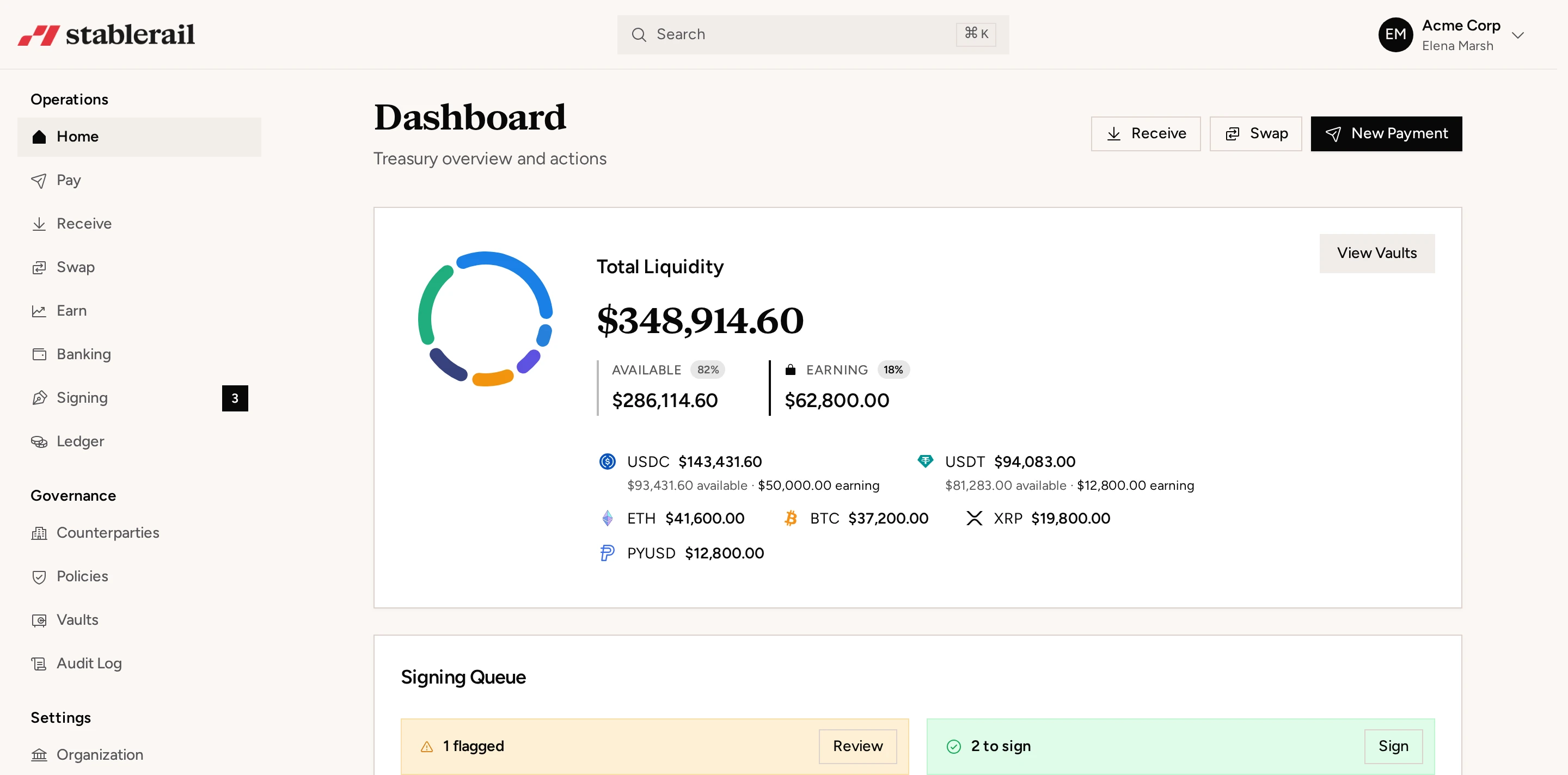
Operational controls should be considered during onboarding, not after approval. For example, Stablerail combines a business account for USDC and USDT with approvals and signing quorum, sanctions and address screening before send, corporate cards, global payouts, fiat off-ramp capabilities and exportable audit evidence. Whatever provider is selected, finance teams should map account access, transaction approval and evidence retention to their treasury control framework before moving funds.
Frequently asked questions
What documents are needed to open a stablecoin business account?
Most providers request formation and registry records, constitutional documents, an ownership chart, identity and address evidence for relevant individuals, and proof of business activity. You should also expect to provide source-of-funds evidence and a description of projected fiat and stablecoin transactions.
How long does stablecoin business account KYB take?
A straightforward company with complete documents may clear initial KYB within several business days. Regulated businesses, trust-owned companies and groups with multiple ownership layers can take several weeks, particularly when translations, licensing checks or source-of-funds reviews are required.
Who must complete KYC during a business account application?
KYC is commonly required for ultimate beneficial owners, directors, account administrators and people who exercise control over the company. The exact ownership threshold and list of individuals depend on the provider, jurisdiction and risk profile.
Can a crypto company open a stablecoin business account?
Potentially, but eligibility depends on the business model, jurisdictions, regulatory permissions and handling of customer funds. A regulated or crypto-native company should be ready to provide licences or registrations, compliance procedures and a detailed flow-of-funds diagram.
Why would a stablecoin business account application be rejected?
Common reasons include unsupported jurisdictions or industries, unverifiable ownership, missing regulatory permissions and unresolved sanctions or wallet-screening concerns. Applications may also fail when the stated business activity conflicts with the company's documents, funding evidence or legal permissions.
Finance writers covering stablecoin treasury, payments, compliance, and risk controls.
More about the Stablerail team- Stablecoin treasury managementApprovals, limits, yield and reporting on one balance.
- Stablecoin payoutsBatch contractor and vendor payments with screening.
- USDT vs USDCWhich stablecoin your company should settle in.
- Stablecoin finance glossaryMPC, off-ramp, travel rule and the rest, in plain English.
- Product updatesEverything we ship, month by month.