
Building a Multi-Signature Approval Flow for Crypto Payouts
A practical guide to designing multi-sig payout approvals, including thresholds, signer roles, batch controls, wallet checks and evidence for finance teams paying in USDC or USDT.
%22%20x1%3D%220%22%20y1%3D%220%22%20x2%3D%221%22%20y2%3D%221%22%3E%0A%20%20%20%20%20%20%20%20%3Cstop%20offset%3D%220%25%22%20stop-color%3D%22%232A0608%22%20%2F%3E%0A%20%20%20%20%20%20%20%20%3Cstop%20offset%3D%2250%25%22%20stop-color%3D%22%23420D12%22%20%2F%3E%0A%20%20%20%20%20%20%20%20%3Cstop%20offset%3D%22100%25%22%20stop-color%3D%22%23621619%22%20%2F%3E%0A%20%20%20%20%20%20%3C%2FlinearGradient%3E%0A%20%20%20%20%20%20%3CradialGradient%20id%3D%22glow%22%20cx%3D%22784%22%20cy%3D%22-39%22%20r%3D%22520%22%20gradientUnits%3D%22userSpaceOnUse%22%3E%0A%20%20%20%20%20%20%20%20%3Cstop%20offset%3D%220%25%22%20stop-color%3D%22%23FF9577%22%20stop-opacity%3D%220.45%22%20%2F%3E%0A%20%20%20%20%20%20%20%20%3Cstop%20offset%3D%2255%25%22%20stop-color%3D%22%23FF9577%22%20stop-opacity%3D%220.08%22%20%2F%3E%0A%20%20%20%20%20%20%20%20%3Cstop%20offset%3D%22100%25%22%20stop-color%3D%22%23FF9577%22%20stop-opacity%3D%220%22%20%2F%3E%0A%20%20%20%20%20%20%3C%2FradialGradient%3E%0A%20%20%20%20%20%20%3ClinearGradient%20id%3D%22glass%22%20x1%3D%220%22%20y1%3D%220%22%20x2%3D%221%22%20y2%3D%221%22%3E%0A%20%20%20%20%20%20%20%20%3Cstop%20offset%3D%220%25%22%20stop-color%3D%22%23F8D6D2%22%20stop-opacity%3D%220.26%22%20%2F%3E%0A%20%20%20%20%20%20%20%20%3Cstop%20offset%3D%22100%25%22%20stop-color%3D%22%23FFFFFF%22%20stop-opacity%3D%220.08%22%20%2F%3E%0A%20%20%20%20%20%20%3C%2FlinearGradient%3E%0A%20%20%20%20%20%20%3ClinearGradient%20id%3D%22accent%22%20x1%3D%220%22%20y1%3D%220%22%20x2%3D%221%22%20y2%3D%221%22%3E%0A%20%20%20%20%20%20%20%20%3Cstop%20offset%3D%220%25%22%20stop-color%3D%22%23FF9577%22%20%2F%3E%0A%20%20%20%20%20%20%20%20%3Cstop%20offset%3D%22100%25%22%20stop-color%3D%22%23D03B2D%22%20%2F%3E%0A%20%20%20%20%20%20%3C%2FlinearGradient%3E%0A%20%20%20%20%20%20%3Cfilter%20id%3D%22soft%22%3E%3CfeGaussianBlur%20stdDeviation%3D%2210%22%20%2F%3E%3C%2Ffilter%3E%0A%20%20%20%20%3C%2Fdefs%3E%0A%20%20%20%20%3Crect%20width%3D%221600%22%20height%3D%22900%22%20fill%3D%22url(%23bg)%22%20%2F%3E%0A%20%20%20%20%3Crect%20width%3D%221600%22%20height%3D%22900%22%20fill%3D%22url(%23glow)%22%20%2F%3E%0A%20%20%20%20%3Cpolygon%20points%3D%22800%2C370%20869.282032302755%2C410%20869.282032302755%2C490%20800%2C530%20730.717967697245%2C490%20730.717967697245%2C410%22%20fill%3D%22none%22%20stroke%3D%22%23F4CDC5%22%20stroke-opacity%3D%220.3%22%2F%3E%3Cpolygon%20points%3D%22800%2C300%20929.9038105676658%2C375%20929.9038105676658%2C525%20800%2C600%20670.0961894323342%2C525%20670.0961894323342%2C375%22%20fill%3D%22none%22%20stroke%3D%22%23F4CDC5%22%20stroke-opacity%3D%220.3%22%2F%3E%3Cpolygon%20points%3D%22800%2C230%20990.5255888325764%2C340%20990.5255888325765%2C560%20800%2C670%20609.4744111674236%2C560.0000000000001%20609.4744111674236%2C340%22%20fill%3D%22none%22%20stroke%3D%22%23F4CDC5%22%20stroke-opacity%3D%220.3%22%2F%3E%3Cpolygon%20points%3D%22800%2C160%201051.1473670974872%2C305%201051.1473670974872%2C595%20800%2C740%20548.8526329025128%2C595.0000000000001%20548.8526329025128%2C305%22%20fill%3D%22none%22%20stroke%3D%22%23F4CDC5%22%20stroke-opacity%3D%220.3%22%2F%3E%3Cpolygon%20points%3D%22800%2C422%20754.1006535994247%2C476.5%20852.8275496308507%2C480.5%20800%2C405%20745.4403995615804%2C481.5%20722.0577136594005%2C405%22%20fill%3D%22url(%23accent)%22%20fill-opacity%3D%220.55%22%20stroke%3D%22url(%23accent)%22%20stroke-width%3D%224%22%2F%3E%0A%20%20%20%20%3Crect%20x%3D%2226%22%20y%3D%2226%22%20width%3D%221548%22%20height%3D%22848%22%20rx%3D%2218%22%20fill%3D%22none%22%20stroke%3D%22%23F2D0C8%22%20stroke-opacity%3D%220.12%22%2F%3E%0A%20%20%3C%2Fsvg%3E)
A crypto payout workflow should answer four operational questions: who can create a payment, who must approve it, when additional approval is required, and what evidence is retained after execution.
For finance teams paying vendors, contractors or employees in USDC or USDT, the objective is not to add signatures to every action. It is to prevent one person from creating and releasing a material or misdirected payment while keeping routine batches moving.
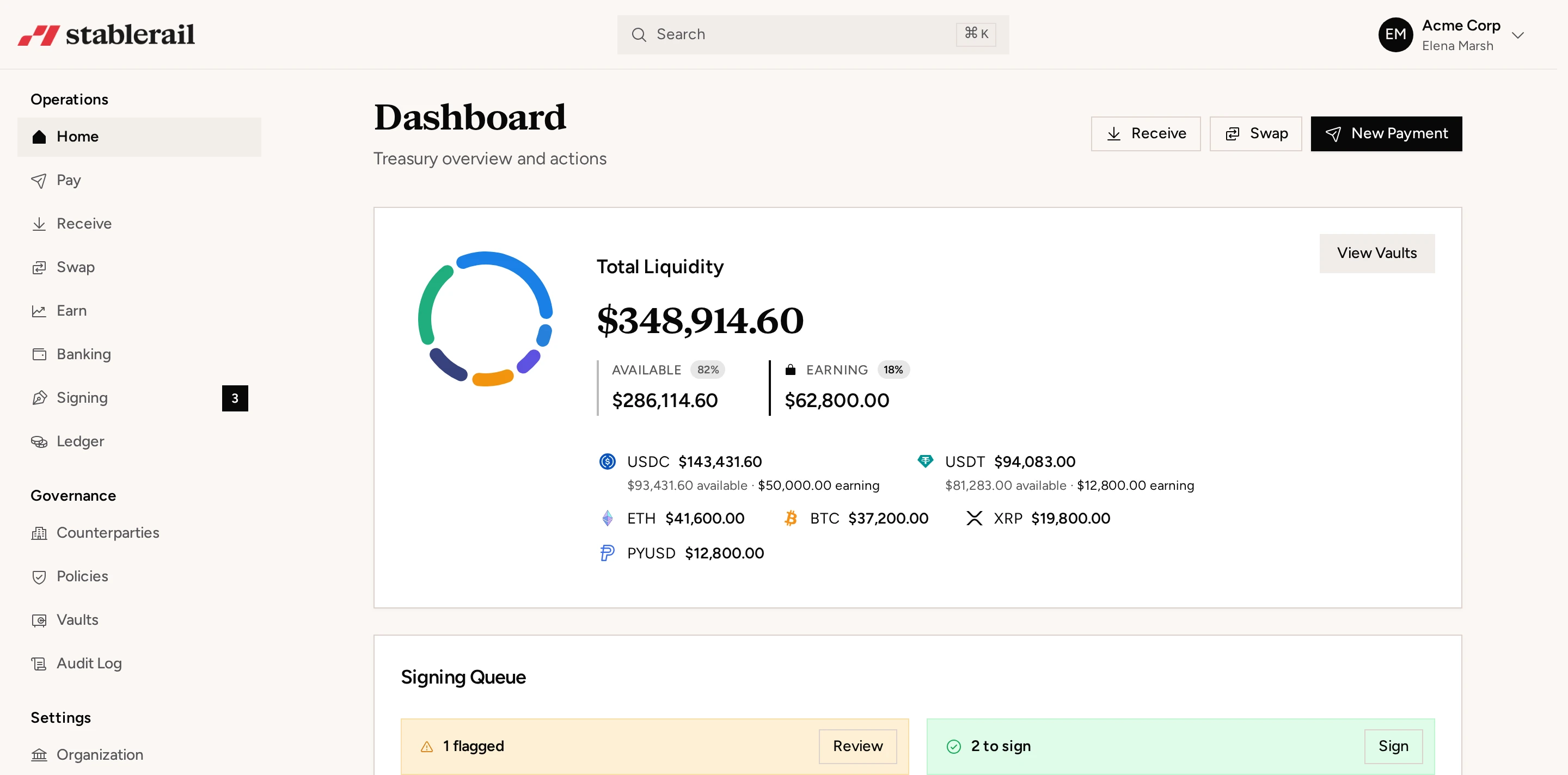
Stablerail uses self-custodial MPC vaults with quorum signing. MPC, or multi-party computation, distributes signing authority so that no single participant holds the complete private key. Teams may refer to this setup as multi-sig, although it differs technically from an onchain multi-signature smart contract. The practical outcome is similar: a payout proceeds only when the required signer quorum is reached.
How a crypto payout moves from draft to settlement
A typical payout should pass through the following steps:
- Create: An operator uploads a batch or enters the recipient, amount, asset, network and payment reference.
- Validate: The system checks required fields, available treasury balance, address format and whether the destination is allowlisted.
- Screen: Sanctions and wallet screening identify prohibited or higher-risk destinations before release.
- Approve: The payout is routed to the signers required by the company’s policy.
- Sign and broadcast: Once the MPC quorum is met, the transaction is signed and submitted to the selected blockchain.
- Confirm: The transaction hash, status, recipient details, approvals and timestamps are recorded in the audit log.
Blockchain settlement begins only after the final approval. Solana and some lower-cost networks may confirm in seconds under normal conditions, while Ethereum transactions may take several minutes or longer when the network is congested. Finance teams should avoid promising an exact arrival time and should distinguish between internal approval time and blockchain confirmation time.
Stablerail supports payouts across Ethereum, Base, Arbitrum, Polygon, Tron, BNB Chain, Optimism and Solana. The recipient address must support both the selected asset and network. Sending USDT to a valid-looking address on the wrong network can still result in lost or difficult-to-recover funds.
Separate payout roles
A clear division of responsibilities is more useful than simply requiring more approvers. Start with four roles, even if one person holds more than one role in a small team.
| Role | Typical responsibilities | Should not do alone |
|---|---|---|
| Requester | Creates a payout or uploads a batch and attaches the invoice or payroll file | Approve and release their own payout |
| Reviewer | Checks beneficiary, amount, asset, network and supporting document | Change payment details after approval |
| Signer | Provides an MPC approval when the policy requires their authority | Approve an unexplained or materially changed batch |
| Administrator | Manages users, limits, allowlists and signer recovery | Add a recipient and immediately pay it without independent review |
For day-to-day operations, use named roles rather than routing every payout to the CFO. A treasury manager and controller can handle ordinary payments, while the CFO joins only for high-value or exceptional transactions.
Choose thresholds based on risk
There are two related thresholds to configure: the signing quorum for the vault and the approval rule for a payout. For example, a vault may require two authorised signers, while company policy determines which two people are eligible for a particular amount.
The following structure is illustrative, not a Stablerail default:
| Payout condition | Example approval rule | Additional check |
|---|---|---|
| Up to $10,000 to an allowlisted wallet | Two approvals from treasury operations | Invoice or approved payment file |
| $10,001 to $100,000 | Treasury reviewer plus controller | Beneficiary and network recheck |
| Above $100,000 | Controller plus CFO or delegated executive | Documented purpose and liquidity check |
| Any new or changed wallet | Independent recipient approval before payout | Out-of-band address verification |
| Any non-allowlisted destination | Elevated approval or block | Wallet screening and exception reason |
Set thresholds using your normal payment size, not arbitrary round numbers. If most contractor payments are between $1,000 and $3,000, a $10,000 threshold may work. If ordinary supplier invoices are $75,000, the same threshold would send nearly every payment to senior management and create approval fatigue.
Also decide whether thresholds apply per payment, per batch, per recipient per day, or across the full day. A per-transaction rule alone can be bypassed unintentionally by splitting one obligation into several smaller transfers.
Design batch payout approvals carefully
Batch payments reduce manual work for payroll, contractor runs and accounts payable. They also concentrate risk: one approved file may contain hundreds of recipients.
A useful batch review screen should show:
- Total batch amount and number of recipients
- Amount by asset, such as USDC and USDT
- Amount by network
- New, changed or non-allowlisted wallets
- Duplicate addresses or duplicate payment references
- Rejected rows and screening exceptions
- Estimated network fees where available
Any material edit after approval should invalidate the existing approvals. Changing an address, amount, asset or network creates a different payment instruction and should send the item back through review.
For recurring operations, templates can reduce errors, but they should not make beneficiary changes invisible. Highlight differences from the previous batch, especially changed wallet addresses and unusually large amounts. Teams running contractor or payroll batches can learn more about operational options on the crypto payroll page or review broader stablecoin payout capabilities.
Control new wallet addresses
Recipient setup is often the highest-risk step. An approver can review an invoice accurately and still send funds to an address inserted through email compromise.
Use an allowlist for known beneficiary wallets and require separate approval to add or change an address. Verify new details through a channel independent of the original request, such as a call to a known contact. A small test payment can confirm access, but it does not prove that the wallet belongs to the intended legal entity.
Record the asset and network with the address. “USDT wallet” is not specific enough because USDT exists on multiple networks. The approved record should state, for example, USDT on Tron or USDC on Base.
Plan for signer absence and emergencies
A two-of-two flow fails if either signer is unavailable. A two-of-three quorum usually provides better continuity while still preventing unilateral release. The third signer should be a genuine recovery option, not a shared account or device.
Document what happens when a signer leaves, loses access or is unavailable during an urgent payout. Recovery should require verified identity, administrator action and a recorded reason. Changes to signer membership and approval limits should appear in the audit log.
Do not weaken the main policy for emergencies. Create a separate emergency path with a narrow purpose, senior approval and retrospective review.
Retain evidence for reconciliation and audit
Each completed payout should retain the original instruction, supporting documents, screening result, approver identities, approval timestamps, vault used, asset, network, destination, transaction hash and final status.
This evidence helps finance match blockchain transfers to invoices and explain why a payment was released. It also makes failed or delayed transfers easier to investigate. Stablerail’s audit logs and evidence packs are designed to bring these records together without requiring finance teams to reconstruct the process from wallet interfaces and chat messages.
A practical starting policy
Begin with a two-of-three signer quorum, separate requester and approver roles, allowlisted recipient wallets, and stepped payout approvals based on amount. Add a higher rule for new destinations and make any payment edit restart approval.
Run the workflow with a small internal test before the first production batch. Confirm that approvers can identify the asset and network, rejected rows are visible, signer absence does not block the treasury, and the final transaction evidence can be exported for reconciliation. For implementation questions, consult the Stablerail help centre.
Finance writers covering stablecoin treasury, payments, compliance, and risk controls.
More about the Stablerail team- Stablecoin treasury managementApprovals, limits, yield and reporting on one balance.
- Stablecoin payoutsBatch contractor and vendor payments with screening.
- USDT vs USDCWhich stablecoin your company should settle in.
- Stablecoin finance glossaryMPC, off-ramp, travel rule and the rest, in plain English.
- Product updatesEverything we ship, month by month.