
Multi-Rail Treasury: Running Fiat and Stablecoin Side by Side
A practical operating model for managing fiat and stablecoin together, selecting payment rails, setting liquidity buffers and avoiding stranded funds.
A multi-rail treasury manages fiat and stablecoins as complementary settlement options. Finance teams forecast obligations by currency, asset, network and date, then hold enough liquidity on each rail to make approved payments without unnecessary conversions. The operating model must also track pending funds, network fees, bank cut-offs, recipient requirements, approval controls and evidence needed for reconciliation and audit.
%22%20x1%3D%220%22%20y1%3D%220%22%20x2%3D%221%22%20y2%3D%221%22%3E%0A%20%20%20%20%20%20%20%20%3Cstop%20offset%3D%220%25%22%20stop-color%3D%22%23360A0E%22%20%2F%3E%0A%20%20%20%20%20%20%20%20%3Cstop%20offset%3D%2250%25%22%20stop-color%3D%22%23551217%22%20%2F%3E%0A%20%20%20%20%20%20%20%20%3Cstop%20offset%3D%22100%25%22%20stop-color%3D%22%237A1D20%22%20%2F%3E%0A%20%20%20%20%20%20%3C%2FlinearGradient%3E%0A%20%20%20%20%20%20%3CradialGradient%20id%3D%22glow%22%20cx%3D%22893%22%20cy%3D%2243%22%20r%3D%22520%22%20gradientUnits%3D%22userSpaceOnUse%22%3E%0A%20%20%20%20%20%20%20%20%3Cstop%20offset%3D%220%25%22%20stop-color%3D%22%23FFA587%22%20stop-opacity%3D%220.45%22%20%2F%3E%0A%20%20%20%20%20%20%20%20%3Cstop%20offset%3D%2255%25%22%20stop-color%3D%22%23FFA587%22%20stop-opacity%3D%220.08%22%20%2F%3E%0A%20%20%20%20%20%20%20%20%3Cstop%20offset%3D%22100%25%22%20stop-color%3D%22%23FFA587%22%20stop-opacity%3D%220%22%20%2F%3E%0A%20%20%20%20%20%20%3C%2FradialGradient%3E%0A%20%20%20%20%20%20%3ClinearGradient%20id%3D%22glass%22%20x1%3D%220%22%20y1%3D%220%22%20x2%3D%221%22%20y2%3D%221%22%3E%0A%20%20%20%20%20%20%20%20%3Cstop%20offset%3D%220%25%22%20stop-color%3D%22%23F8D6D2%22%20stop-opacity%3D%220.26%22%20%2F%3E%0A%20%20%20%20%20%20%20%20%3Cstop%20offset%3D%22100%25%22%20stop-color%3D%22%23FFFFFF%22%20stop-opacity%3D%220.08%22%20%2F%3E%0A%20%20%20%20%20%20%3C%2FlinearGradient%3E%0A%20%20%20%20%20%20%3ClinearGradient%20id%3D%22accent%22%20x1%3D%220%22%20y1%3D%220%22%20x2%3D%221%22%20y2%3D%221%22%3E%0A%20%20%20%20%20%20%20%20%3Cstop%20offset%3D%220%25%22%20stop-color%3D%22%23FFA587%22%20%2F%3E%0A%20%20%20%20%20%20%20%20%3Cstop%20offset%3D%22100%25%22%20stop-color%3D%22%23DC4A38%22%20%2F%3E%0A%20%20%20%20%20%20%3C%2FlinearGradient%3E%0A%20%20%20%20%20%20%3Cfilter%20id%3D%22soft%22%3E%3CfeGaussianBlur%20stdDeviation%3D%2210%22%20%2F%3E%3C%2Ffilter%3E%0A%20%20%20%20%3C%2Fdefs%3E%0A%20%20%20%20%3Crect%20width%3D%221600%22%20height%3D%22900%22%20fill%3D%22url(%23bg)%22%20%2F%3E%0A%20%20%20%20%3Crect%20width%3D%221600%22%20height%3D%22900%22%20fill%3D%22url(%23glow)%22%20%2F%3E%0A%20%20%20%20%3Crect%20x%3D%22260%22%20y%3D%22500%22%20width%3D%22100%22%20height%3D%22153%22%20rx%3D%226%22%20fill%3D%22url(%23glass)%22%20stroke%3D%22%23F4CDC5%22%20stroke-opacity%3D%220.4%22%2F%3E%3Crect%20x%3D%22420%22%20y%3D%22653%22%20width%3D%22100%22%20height%3D%22136%22%20rx%3D%226%22%20fill%3D%22url(%23glass)%22%20stroke%3D%22%23F4CDC5%22%20stroke-opacity%3D%220.4%22%2F%3E%3Crect%20x%3D%22580%22%20y%3D%22789%22%20width%3D%22100%22%20height%3D%22267%22%20rx%3D%226%22%20fill%3D%22url(%23glass)%22%20stroke%3D%22%23F4CDC5%22%20stroke-opacity%3D%220.4%22%2F%3E%3Crect%20x%3D%22740%22%20y%3D%221056%22%20width%3D%22100%22%20height%3D%22300%22%20rx%3D%226%22%20fill%3D%22url(%23glass)%22%20stroke%3D%22%23F4CDC5%22%20stroke-opacity%3D%220.4%22%2F%3E%3Crect%20x%3D%22900%22%20y%3D%221356%22%20width%3D%22100%22%20height%3D%22218%22%20rx%3D%226%22%20fill%3D%22url(%23glass)%22%20stroke%3D%22%23F4CDC5%22%20stroke-opacity%3D%220.4%22%2F%3E%3Crect%20x%3D%221060%22%20y%3D%221574%22%20width%3D%22100%22%20height%3D%22197%22%20rx%3D%226%22%20fill%3D%22url(%23glass)%22%20stroke%3D%22%23F4CDC5%22%20stroke-opacity%3D%220.4%22%2F%3E%3Crect%20x%3D%221220%22%20y%3D%221771%22%20width%3D%22100%22%20height%3D%22237%22%20rx%3D%226%22%20fill%3D%22url(%23glass)%22%20stroke%3D%22%23F4CDC5%22%20stroke-opacity%3D%220.4%22%2F%3E%3Cline%20x1%3D%22240%22%20y1%3D%22720%22%20x2%3D%221400%22%20y2%3D%22720%22%20stroke%3D%22%23F0BBAF%22%20stroke-opacity%3D%220.4%22%20stroke-width%3D%223%22%2F%3E%0A%20%20%20%20%3Crect%20x%3D%2226%22%20y%3D%2226%22%20width%3D%221548%22%20height%3D%22848%22%20rx%3D%2218%22%20fill%3D%22none%22%20stroke%3D%22%23F2D0C8%22%20stroke-opacity%3D%220.12%22%2F%3E%0A%20%20%3C%2Fsvg%3E)
A multi-rail treasury lets a finance team hold fiat and stablecoins, then choose the appropriate payment rail for each obligation. EUR may arrive through a virtual IBAN, a contractor may be paid in USDC, and a supplier invoice may leave by SWIFT. The goal is not to move every available dollar onchain. It is to keep usable liquidity where upcoming payments require it while minimizing repeated conversions, idle balances and funds stranded on the wrong network.
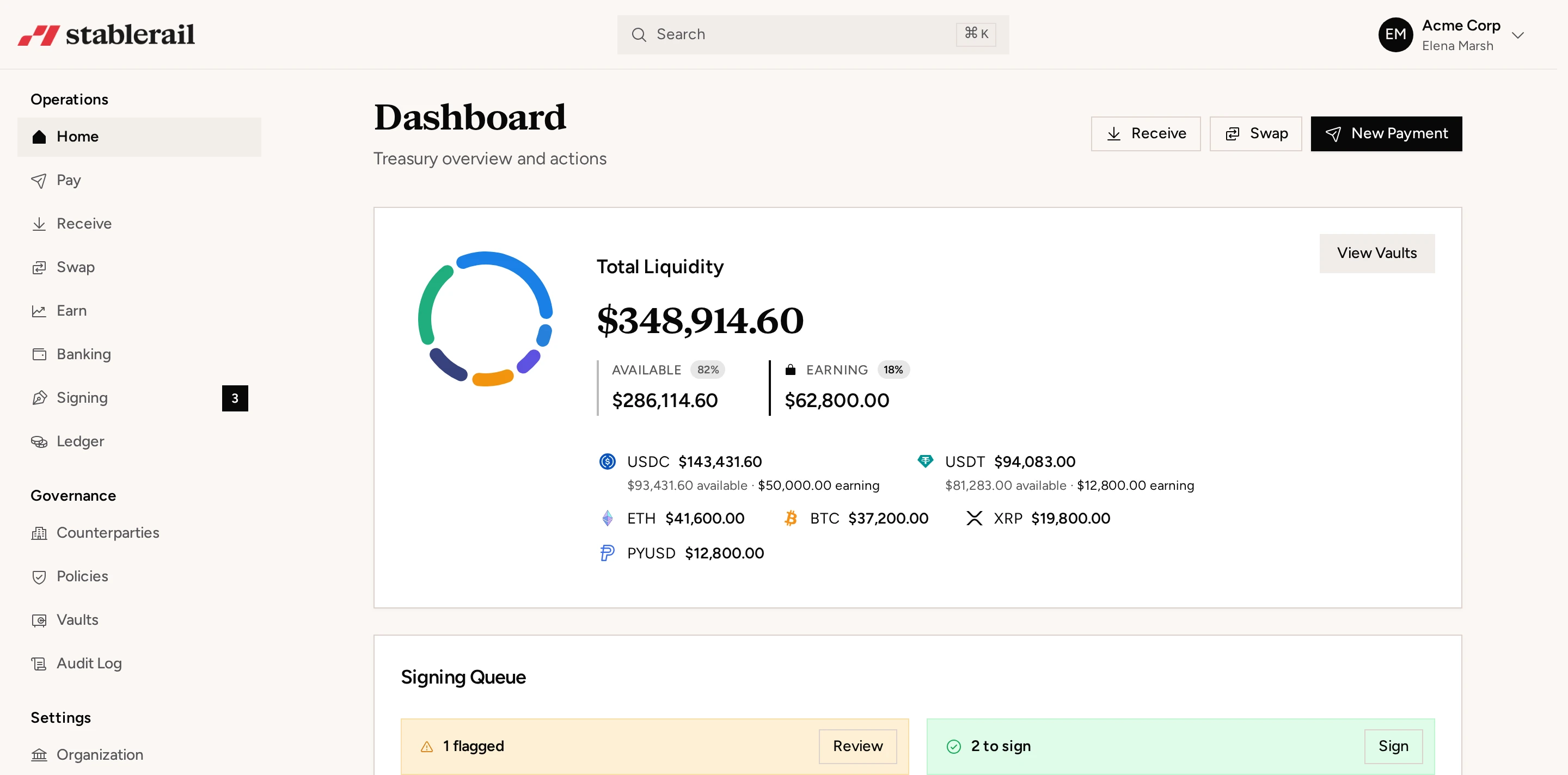
This model requires more than a consolidated dashboard. Treasury must know what is available now, what is still in transit, which obligations can only be paid through a bank, and which recipients are ready to accept a specific stablecoin on a specific blockchain. Stablerail brings USDC and USDT treasury operations into one business account with approvals and signing quorum, pre-send sanctions and address screening, global payouts, corporate cards, fiat off-ramp and exportable audit evidence.
What “one balance” means in practice
Fiat and stablecoins do not literally sit in one account. Fiat is recorded within banking infrastructure, while stablecoins are associated with blockchain addresses. A practical multi-rail setup provides one operating view across these separate locations and a controlled process for moving value between them.
Finance teams should distinguish three liquidity states:
- Available fiat: USD, EUR, GBP or other currencies that can be used for bank payments, payroll, taxes and operating expenses.
- Available stablecoins: USDC or USDT that can be signed and transferred on the required network, with enough native token or another supported fee mechanism to pay transaction costs.
- Funds in transit: Bank transfers, blockchain transactions and on/off-ramp conversions that have started but are not yet available for another payment.
Do not count pending funds as spendable cash. A bank transfer can be delayed by a cut-off or compliance review, while a blockchain transaction can remain unconfirmed or arrive on a network that the intended off-ramp does not support. The treasury ledger should preserve the original amount, fees, conversion rate where applicable, status, counterparty and settlement reference.
How to choose the payment rail
Select the rail according to the recipient’s requirements, settlement deadline, total route cost and failure modes. The lowest visible transaction fee is not necessarily the lowest total cost: conversion spreads or fees, intermediary bank charges, blockchain fees and exception handling all matter.
| Rail | Best suited to | Availability and timing | Key checks before sending |
|---|---|---|---|
| SEPA | Routine EUR payments | Generally processed on business days; timing depends on institutions and cut-offs | Beneficiary details, cut-off, payment reference and recipient bank participation |
| SEPA Instant | Urgent eligible EUR payments | Designed for near-real-time processing at participating institutions | Bank participation, applicable limits, beneficiary details and exception handling |
| ACH | Routine USD collections and payments | Processed in bank-defined windows rather than continuously | Settlement date, return risk, cut-offs, account details and available balance |
| Fedwire | Time-sensitive USD bank payments | Same-day processing during operating hours when instructions meet cut-offs | Banking hours, fees, final beneficiary information and approval deadline |
| Faster Payments, BACS or CHAPS | Domestic GBP payments with different urgency and value profiles | Ranges from near-real-time to scheduled business-day processing | Participant eligibility, cut-off, value constraints and bank charges |
| SWIFT | Cross-border fiat where local or direct rails are unavailable | Timing varies with intermediary banks, currencies, holidays and reviews | Intermediary fees, FX, payment purpose, beneficiary data and local requirements |
| Stablecoin transfer | Recipients that accept USDC or USDT, including payments outside banking hours | Broadcast can occur 24/7; usable settlement depends on network confirmation and recipient policy | Exact token, contract, network, address, screening result, transaction fee and off-ramp readiness |
These are operating characteristics, not guarantees. Availability can change by institution, corridor, jurisdiction, transaction size, network conditions and compliance review. For urgent payments, confirm the complete route before relying on a quoted settlement window.
Decide where funds should sit
Start with upcoming obligations rather than a fixed target percentage for stablecoins. Maintain a rolling cash schedule that maps inflows and outflows by legal entity, currency, asset, network, due date and required payment rail.
Keep fiat for fiat-only liabilities
Taxes, payroll providers, card settlements, landlords and many suppliers still require bank payments. Converting cash needed for those obligations into stablecoins adds another conversion, additional records and a risk that the off-ramp will not complete before the bank payment is due.
Keep stablecoins for known onchain needs
USDC or USDT can be appropriate for vendors, contractors and counterparties that are operationally ready to receive them. Stablecoins may also help when a payment must be initiated outside banking hours, but 24/7 blockchain transfer does not make every downstream fiat off-ramp available 24/7.
Set an operating floor for each material rail
Define minimum balances from forecast obligations and replenishment time. A team making USDT payments on Tron, for example, needs the correct USDT representation on Tron and a way to cover network fees. USDT on Ethereum cannot be sent directly to a Tron address as though both balances were interchangeable; changing networks requires a supported exchange, bridge, issuer process or other conversion route, each with separate risk and evidence.
A useful buffer covers approved and likely payments over the chosen forecast period without creating excessive idle or concentrated balances. Review floors when payment volume, recipient behavior, banking access or network usage changes.
When to convert between fiat and stablecoins
Conversion should follow a payment need or documented treasury rule, not habit. Common triggers include:
- Forecast trigger: Convert enough to cover approved onchain payments due within the treasury forecast window.
- Minimum-balance trigger: Replenish a fiat, stablecoin or fee balance when it falls below its operating floor.
- Concentration trigger: Sweep or convert excess value when exposure to one currency, stablecoin, provider or network exceeds an internal limit.
- Timing trigger: Convert before a bank cut-off, holiday or weekend requirement, allowing time for review and settlement.
Compare the whole route before execution. Paying a EUR invoice by SEPA may avoid conversion entirely. Paying a stablecoin-ready recipient could avoid a chain of correspondent banks. For each option, compare the source balance, conversion step, payment fee, expected availability, recipient acceptance, reversal or recovery options and accounting evidence.
Complete company verification and test corridor availability before treating an on/off-ramp as emergency liquidity. Eligibility, limits, documentation and supported destinations can depend on the company, transaction and jurisdiction.
Avoid stranded liquidity and routing errors
Liquidity is stranded when the company owns it but cannot use it for the next obligation without another conversion, approval or delay. Reduce that risk with a few operating rules:
- Record the exact asset and network in every stablecoin payment instruction; “send USDT” is incomplete.
- Confirm the destination address and network using an independent source, especially after a beneficiary requests a change.
- Screen the address before signing and investigate material changes in beneficiary behavior.
- Maintain the required transaction-fee balance or confirm how fees will be charged.
- Accept incoming stablecoins only on supported asset and network combinations.
- Check the off-ramp path before accepting funds that will soon be needed as fiat.
- Avoid spreading small balances across unnecessary networks, which increases reconciliation and transfer work.
For fiat receipts, virtual account details and structured payment references can improve allocation. For stablecoin receipts, provide written instructions that identify the token, network and address. A correct blockchain address on the wrong network may still lead to an operationally difficult or unrecoverable transfer.
Controls and evidence for finance teams
Multi-rail access should not mean informal execution. Separate payment creation from approval, require signing quorum where appropriate, and apply approval thresholds based on the company’s risk framework. Beneficiary allowlists can help with recurring payments, but changes should still receive independent review.
Reconciliation must connect the commercial obligation to the movement of value. Retain the invoice or payout file, approvals, bank reference or blockchain transaction hash, token and network, fees, conversion record, screening result and final status. Stablerail can export audit evidence across its stablecoin treasury workflows, helping finance teams support accounting and month-end review without relying only on screenshots or chat messages.
A daily multi-rail treasury checklist
- Review available and pending balances by entity, fiat currency, stablecoin and network.
- Match approved payments in the forecast window to the rails they require.
- Identify balances below operating floors and material excess concentrations.
- Compare complete route cost and timing before converting or sending.
- Verify beneficiary instructions, approvals, screening and signing quorum.
- Reconcile bank references, transaction hashes, conversion records and fees.
- Export and retain evidence for accounting, audit and exception review.
Build the treasury around obligations, not rails
Fiat and stablecoins are not competing systems; they are settlement options with different operating hours, acceptance constraints, costs and failure modes. A resilient multi-rail treasury keeps funds close to their expected use, converts against forecast demand and limits unnecessary movement between currencies and networks.
The strongest operating model gives finance one reliable view without pretending that every balance is interchangeable. It shows what is available, what is pending, what each obligation requires and what evidence supports every movement. That is what allows treasury to gain flexibility from multiple rails without losing liquidity control.
Frequently asked questions
What is a multi-rail treasury?
A multi-rail treasury manages money across more than one settlement system, such as bank accounts and stablecoin networks. Finance teams choose the rail for each payment based on currency, recipient requirements, timing, cost and risk.
How much treasury cash should a company hold in stablecoins?
There is no universal target percentage. Hold enough to cover forecast onchain obligations and an appropriate operating buffer, while keeping fiat available for taxes, payroll and suppliers that require bank payments.
Can USDC or USDT on one network be sent to another network?
Not directly as if the networks shared one ledger. Moving a stablecoin between networks generally requires a supported exchange, bridge, issuer process or other conversion route, so treasury must confirm support, fees, timing and evidence before sending.
How should stablecoin transactions be reconciled for accounting?
Link each transaction to its invoice or payout record, approvals, wallet addresses, asset, network, transaction hash, fees and any conversion record. Also preserve screening results and final settlement status so reviewers can trace the obligation from authorization through completion.
What are the biggest risks in a multi-rail treasury?
Common risks include holding funds on the wrong network, counting pending transfers as available, missing bank cut-offs, lacking native tokens for transaction fees and relying on an unsupported off-ramp. Approval separation, signing quorum, address screening and disciplined reconciliation help reduce these risks.
Finance writers covering stablecoin treasury, payments, compliance, and risk controls.
More about the Stablerail team- Stablecoin treasury managementApprovals, limits, yield and reporting on one balance.
- Stablecoin payoutsBatch contractor and vendor payments with screening.
- USDT vs USDCWhich stablecoin your company should settle in.
- Stablecoin finance glossaryMPC, off-ramp, travel rule and the rest, in plain English.
- Product updatesEverything we ship, month by month.