
How to Manage Business Expenses with Stablecoins and Corporate Cards
A practical finance guide to funding corporate cards with USDC or USDT, setting spend controls, collecting receipts and reconciling card activity to treasury.
To manage business expenses with stablecoins, connect a USDC or USDT treasury balance to corporate cards, then apply the same controls used for bank-funded spending: named card ownership, transaction limits, approval thresholds, receipt collection and accounting mappings. Finance must also reconcile card settlements, conversion costs and refunds to the underlying stablecoin movements while verifying the correct asset and blockchain network for every treasury transfer.
%22%20x1%3D%220%22%20y1%3D%220%22%20x2%3D%221%22%20y2%3D%221%22%3E%0A%20%20%20%20%20%20%20%20%3Cstop%20offset%3D%220%25%22%20stop-color%3D%22%23360A0E%22%20%2F%3E%0A%20%20%20%20%20%20%20%20%3Cstop%20offset%3D%2250%25%22%20stop-color%3D%22%23551217%22%20%2F%3E%0A%20%20%20%20%20%20%20%20%3Cstop%20offset%3D%22100%25%22%20stop-color%3D%22%237A1D20%22%20%2F%3E%0A%20%20%20%20%20%20%3C%2FlinearGradient%3E%0A%20%20%20%20%20%20%3CradialGradient%20id%3D%22glow%22%20cx%3D%221348%22%20cy%3D%22328%22%20r%3D%22520%22%20gradientUnits%3D%22userSpaceOnUse%22%3E%0A%20%20%20%20%20%20%20%20%3Cstop%20offset%3D%220%25%22%20stop-color%3D%22%23FFA587%22%20stop-opacity%3D%220.45%22%20%2F%3E%0A%20%20%20%20%20%20%20%20%3Cstop%20offset%3D%2255%25%22%20stop-color%3D%22%23FFA587%22%20stop-opacity%3D%220.08%22%20%2F%3E%0A%20%20%20%20%20%20%20%20%3Cstop%20offset%3D%22100%25%22%20stop-color%3D%22%23FFA587%22%20stop-opacity%3D%220%22%20%2F%3E%0A%20%20%20%20%20%20%3C%2FradialGradient%3E%0A%20%20%20%20%20%20%3ClinearGradient%20id%3D%22glass%22%20x1%3D%220%22%20y1%3D%220%22%20x2%3D%221%22%20y2%3D%221%22%3E%0A%20%20%20%20%20%20%20%20%3Cstop%20offset%3D%220%25%22%20stop-color%3D%22%23F8D6D2%22%20stop-opacity%3D%220.26%22%20%2F%3E%0A%20%20%20%20%20%20%20%20%3Cstop%20offset%3D%22100%25%22%20stop-color%3D%22%23FFFFFF%22%20stop-opacity%3D%220.08%22%20%2F%3E%0A%20%20%20%20%20%20%3C%2FlinearGradient%3E%0A%20%20%20%20%20%20%3ClinearGradient%20id%3D%22accent%22%20x1%3D%220%22%20y1%3D%220%22%20x2%3D%221%22%20y2%3D%221%22%3E%0A%20%20%20%20%20%20%20%20%3Cstop%20offset%3D%220%25%22%20stop-color%3D%22%23FFA587%22%20%2F%3E%0A%20%20%20%20%20%20%20%20%3Cstop%20offset%3D%22100%25%22%20stop-color%3D%22%23DC4A38%22%20%2F%3E%0A%20%20%20%20%20%20%3C%2FlinearGradient%3E%0A%20%20%20%20%20%20%3Cfilter%20id%3D%22soft%22%3E%3CfeGaussianBlur%20stdDeviation%3D%2210%22%20%2F%3E%3C%2Ffilter%3E%0A%20%20%20%20%3C%2Fdefs%3E%0A%20%20%20%20%3Crect%20width%3D%221600%22%20height%3D%22900%22%20fill%3D%22url(%23bg)%22%20%2F%3E%0A%20%20%20%20%3Crect%20width%3D%221600%22%20height%3D%22900%22%20fill%3D%22url(%23glow)%22%20%2F%3E%0A%20%20%20%20%3Crect%20x%3D%22240%22%20y%3D%22240%22%20width%3D%22360%22%20height%3D%22420%22%20rx%3D%2220%22%20fill%3D%22url(%23glass)%22%20stroke%3D%22%23F4CDC5%22%20stroke-opacity%3D%220.55%22%2F%3E%0A%20%20%20%20%20%20%3Crect%20x%3D%22270%22%20y%3D%22290%22%20width%3D%22160%22%20height%3D%2218%22%20rx%3D%224%22%20fill%3D%22%23F8D6D2%22%20opacity%3D%220.6%22%2F%3E%0A%20%20%20%20%20%20%3Crect%20x%3D%22270%22%20y%3D%22370%22%20width%3D%22260%22%20height%3D%2248%22%20rx%3D%226%22%20fill%3D%22%23F8D6D2%22%20opacity%3D%220.8%22%2F%3E%0A%20%20%20%20%20%20%3Cpolyline%20points%3D%22270%2C590%20330%2C560%20390%2C580%20450%2C520%20510%2C540%20570%2C490%22%20fill%3D%22none%22%20stroke%3D%22%23FF8E72%22%20stroke-width%3D%225%22%2F%3E%3Crect%20x%3D%22640%22%20y%3D%22240%22%20width%3D%22360%22%20height%3D%22420%22%20rx%3D%2220%22%20fill%3D%22url(%23accent)%22%20stroke%3D%22%23F4CDC5%22%20stroke-opacity%3D%220.55%22%2F%3E%0A%20%20%20%20%20%20%3Crect%20x%3D%22670%22%20y%3D%22290%22%20width%3D%22160%22%20height%3D%2218%22%20rx%3D%224%22%20fill%3D%22%23F8D6D2%22%20opacity%3D%220.6%22%2F%3E%0A%20%20%20%20%20%20%3Crect%20x%3D%22670%22%20y%3D%22370%22%20width%3D%22260%22%20height%3D%2248%22%20rx%3D%226%22%20fill%3D%22%23F8D6D2%22%20opacity%3D%220.95%22%2F%3E%0A%20%20%20%20%20%20%3Cpolyline%20points%3D%22670%2C590%20730%2C560%20790%2C580%20850%2C520%20910%2C540%20970%2C490%22%20fill%3D%22none%22%20stroke%3D%22%23FFF1ED%22%20stroke-width%3D%225%22%2F%3E%3Crect%20x%3D%221040%22%20y%3D%22240%22%20width%3D%22360%22%20height%3D%22420%22%20rx%3D%2220%22%20fill%3D%22url(%23glass)%22%20stroke%3D%22%23F4CDC5%22%20stroke-opacity%3D%220.55%22%2F%3E%0A%20%20%20%20%20%20%3Crect%20x%3D%221070%22%20y%3D%22290%22%20width%3D%22160%22%20height%3D%2218%22%20rx%3D%224%22%20fill%3D%22%23F8D6D2%22%20opacity%3D%220.6%22%2F%3E%0A%20%20%20%20%20%20%3Crect%20x%3D%221070%22%20y%3D%22370%22%20width%3D%22260%22%20height%3D%2248%22%20rx%3D%226%22%20fill%3D%22%23F8D6D2%22%20opacity%3D%220.8%22%2F%3E%0A%20%20%20%20%20%20%3Cpolyline%20points%3D%221070%2C590%201130%2C560%201190%2C580%201250%2C520%201310%2C540%201370%2C490%22%20fill%3D%22none%22%20stroke%3D%22%23FF8E72%22%20stroke-width%3D%225%22%2F%3E%0A%20%20%20%20%3Crect%20x%3D%2226%22%20y%3D%2226%22%20width%3D%221548%22%20height%3D%22848%22%20rx%3D%2218%22%20fill%3D%22none%22%20stroke%3D%22%23F2D0C8%22%20stroke-opacity%3D%220.12%22%2F%3E%0A%20%20%3C%2Fsvg%3E)
Stablecoin-funded corporate cards let a business hold USDC or USDT while employees pay for software, travel, advertising and other operating costs through familiar card rails. The merchant normally receives a supported fiat currency, not stablecoins. Finance therefore needs to control both sides of the workflow: the on-chain treasury movement that funds spending and the card transactions that create expenses.
A sound programme should make every transaction attributable to a person, team, vendor and legal entity. It should also preserve the receipt, approval, settlement amount, conversion cost and related treasury entry so the expense can be reconstructed during close or an audit.
How stablecoin-funded corporate cards work
The precise funding model depends on the card provider. A business may convert stablecoins into a card balance in advance, maintain funded spending capacity, or settle card activity through another supported arrangement. Finance should understand when stablecoins leave treasury, when conversion occurs and when the card transaction becomes final.
A typical operating flow is:
- The business deposits USDC or USDT using a supported blockchain network.
- Finance allocates funds or spending capacity to the card programme.
- Administrators issue virtual or physical cards to employees, teams or specific vendors.
- Cardholders pay merchants through standard card rails.
- The provider records authorisations, posted transactions, refunds, fees and currency conversions.
- Finance exports the activity and reconciles it to treasury movements and the general ledger.
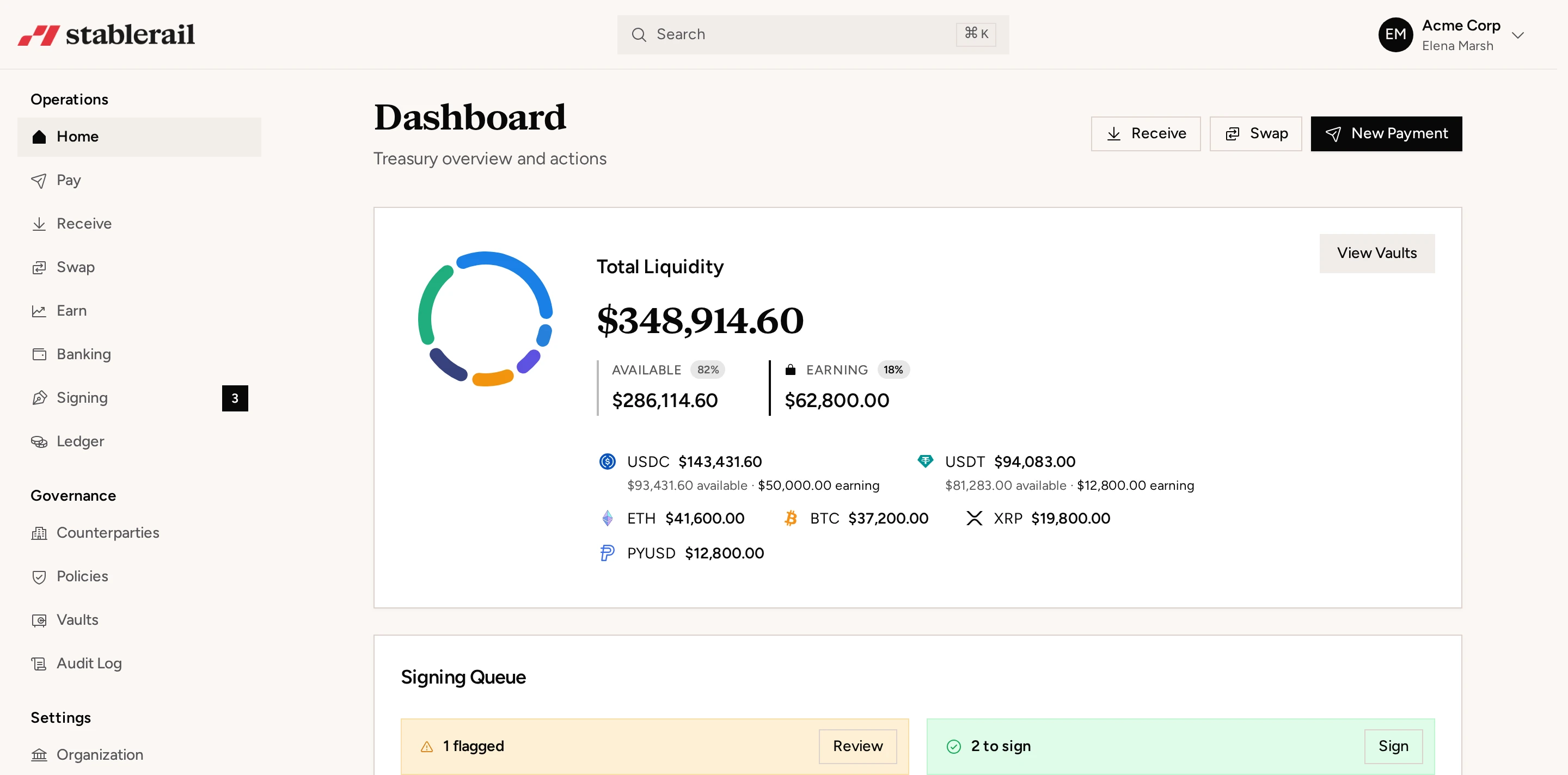
With Stablerail, a company can manage USDC or USDT treasury and corporate cards through one business account. Finance teams can also retain exportable audit evidence, while treasury transfers can use approvals, signing quorum and sanctions or address screening before funds are sent.
Confirm the asset, network and settlement mechanics
A stablecoin ticker is not enough to identify a deposit. USDC on Ethereum, Base and Solana represents different operational routes, even where the issuer and reference asset are the same. Sending a supported stablecoin over an unsupported network, or sending a different token with a similar ticker, can delay access to funds or make recovery difficult.
Before transferring treasury funds, independently verify the asset, blockchain network and deposit address. Use a controlled address-book process and consider a small test transfer when an address or network is new. The approver should review the destination and network rather than relying only on a transaction value.
Finance should also document the card's base currency, supported transaction currencies, conversion methodology and applicable card, funding and foreign-exchange fees. These factors determine the treasury cost of a purchase and explain why a merchant receipt may not equal the amount deducted from the card balance.
Choose a card structure for each expense type
Not every employee needs a permanent physical card. Dedicated virtual cards can isolate recurring vendors and projects, while physical cards are more appropriate when employees must pay in person. The narrower the card's purpose, the easier it is to set a useful limit and identify unexpected activity.
| Expense | Suggested card structure | Primary controls | Reconciliation treatment |
|---|---|---|---|
| Recurring software | Dedicated virtual card for each material vendor | Monthly limit, named owner and merchant restriction where supported | Default to the relevant software account and cost centre |
| Digital advertising | Virtual card assigned to a campaign or marketing team | Daily or monthly cap, campaign budget and escalation threshold | Capture campaign, entity and advertising platform |
| Business travel | Physical card or temporary virtual card | Trip dates, total budget and permitted travel categories | Split airfare, lodging, meals and local transport |
| General team costs | Named employee card | Per-transaction and monthly limits | Require business purpose and department for each purchase |
| One-off vendor purchase | Single-purpose virtual card | Low limit and closure after the transaction settles | Match to the approved request, invoice and project |
Vendor-specific virtual cards also reduce the disruption caused by replacing a card. If credentials held by one supplier are compromised or a subscription must be cancelled, finance can freeze or replace that card without changing payment details for unrelated vendors.
Set controls before issuing cards
A written expense policy explains acceptable use, but product settings should enforce the policy wherever the card programme supports them. Controls should follow the expected purpose and value of spending rather than the cardholder's seniority.
- Per-transaction limits: cap the value of an individual purchase.
- Periodic limits: restrict total spending over a day, month, trip or project.
- Merchant controls: permit or block merchant category codes, known as MCCs, where available.
- Approval thresholds: route material, unusual or out-of-budget requests to a manager or finance.
- Named ownership: assign every card to an employee, team, vendor or cost centre.
- Lifecycle controls: freeze or close cards when an employee leaves, a trip ends or a project is completed.
MCC controls are useful but not conclusive. A merchant may be assigned a broad or unexpected category, so finance should not treat an allowed MCC as proof of a valid business purpose. High-value purchases still need a documented request, invoice or contract where appropriate.
Separate authorisation, approval and evidence
Card authorisation means the transaction passed the card programme's technical checks. It does not prove that the expense was within budget, properly approved or supported by a valid document.
For each transaction, require an itemised receipt or supplier invoice, business purpose, legal entity, department or project, accounting category and approver where the policy requires one. Set a short submission deadline and review missing evidence throughout the month instead of allowing exceptions to accumulate at close.
Approvals should be proportionate. Routine spending within an approved budget can follow a lighter process, while purchases above a departmental threshold or outside the card's normal purpose can be escalated. Repeated missing receipts or policy breaches can trigger a lower limit, a temporary freeze or card closure.
An on-chain transaction hash proves that a transfer occurred. It does not establish the business purpose of a card purchase or replace a merchant receipt, invoice and approval record.
Handle reimbursements as a separate workflow
Employees may use personal funds when a card is unavailable or a merchant does not accept it. Record these payments as reimbursement claims rather than importing them as card activity. The employee should provide proof of payment, the original receipt, the business purpose and the requested repayment currency.
Finance can repay an approved claim through an appropriate fiat or stablecoin rail, subject to company policy and local requirements. Before paying stablecoins, confirm that the recipient agrees to the asset and network and verify the destination address through the company's approved process. Keep reimbursements separate from payroll unless the applicable accounting, tax and employment treatment supports combining them.
Map card activity to treasury and accounting records
Assign each card a default legal entity, owner and cost centre. A dedicated hosting card may also default to cloud infrastructure, while a travel card usually requires the cardholder or finance team to divide the transaction among airfare, accommodation, meals and transport.
Retain the merchant's original transaction amount and currency, card settlement amount and currency, conversion rate or charge where reported, card fees, and the amount deducted from the funded balance. Record fees and conversion differences separately rather than embedding them in the employee's expense category.
The accounting treatment of stablecoins and any gain, loss or conversion difference depends on the company's accounting framework, functional currency and documented policy. Finance should apply that policy consistently to deposits, conversions, card funding, refunds and withdrawals rather than assuming that a stablecoin's target value eliminates accounting differences.
Reconcile cards at month-end
Card reconciliation should connect three records: card activity, the account or processor balance, and the underlying USDC, USDT or fiat treasury movements. Timing differences are common because an authorisation can remain pending, expire or settle for a different amount.
Hotels, fuel stations and car rental companies may place temporary holds above the final charge. Keep pending authorisations separate from posted expenses, and apply the company's accounting policy to settled liabilities and cut-off.
- Export all card activity for the period, including stable transaction identifiers.
- Separate posted, pending, reversed, declined and refunded transactions.
- Match posted purchases to receipts, business purposes and required approvals.
- Assign the correct entity, cost centre, project and general ledger account.
- Record card fees and conversion differences separately.
- Match card funding and settlement entries to stablecoin or fiat treasury movements.
- Investigate duplicates, missing evidence and activity associated with former employees.
- Reconcile closing card and funding balances to the platform records and general ledger.
Refunds should be linked to the original purchase even if exchange rates or fees cause the returned amount to differ. Preserve both records and document the difference rather than netting unrelated transactions together.
Finance launch checklist
- Define eligible entities, employees and business purposes.
- Confirm supported stablecoins, networks, card currencies and funding mechanics.
- Document card, conversion and foreign-exchange charges.
- Choose card types, owners, limits and approval thresholds.
- Set receipt deadlines and required accounting fields.
- Define reimbursement currencies and destination-verification steps.
- Assign owners for weekly exception review and month-end reconciliation.
- Test card freezing, employee offboarding and virtual-card closure.
- Verify that transaction, approval and treasury evidence can be exported and retained.
The strongest setup is not simply a card funded by stablecoins. It is a controlled operating process that links every purchase to an owner, purpose, approval, receipt, accounting entry and treasury movement. That structure gives employees practical spending access while allowing finance to manage USDC or USDT with the discipline expected of a conventional corporate card programme.
Frequently asked questions
Can a business fund corporate cards with USDC or USDT?
Yes, if the card programme supports funding or spending capacity from those stablecoins and the selected blockchain network. The provider generally converts or settles funds into a supported fiat currency, so the merchant usually receives fiat through standard card rails rather than USDC or USDT.
Do merchants need to accept stablecoins for a stablecoin-funded card to work?
No. The employee pays through the card network, and the merchant receives a currency supported by its acquiring arrangement. Finance should still check the card's supported currencies, conversion methodology and fees before using it internationally.
How should stablecoin corporate card transactions be reconciled?
Match each posted card transaction to its receipt, business purpose, approval and accounting category. Then reconcile card funding, settlements, refunds, fees and conversion differences to the relevant USDC, USDT or fiat treasury movements and the general ledger.
What controls should finance set on corporate cards?
Use named card ownership, per-transaction and periodic limits, approval thresholds, merchant controls where supported, and clear freeze or closure procedures. Limits should reflect the card's expected purpose and budget rather than only the employee's job title.
What happens if USDC or USDT is sent on the wrong network?
The funds may not be credited automatically, and recovery can be difficult or unavailable. Before sending, verify the exact stablecoin, supported network and deposit address, and consider a small test transfer for a new destination.
Finance writers covering stablecoin treasury, payments, compliance, and risk controls.
More about the Stablerail team- Stablecoin treasury managementApprovals, limits, yield and reporting on one balance.
- Stablecoin payoutsBatch contractor and vendor payments with screening.
- USDT vs USDCWhich stablecoin your company should settle in.
- Stablecoin finance glossaryMPC, off-ramp, travel rule and the rest, in plain English.
- Product updatesEverything we ship, month by month.