
How Stablecoin Payments Work: Accounts, On-Ramps, Payouts, and Settlement
A practical guide to business stablecoin payments, covering accounts, fiat on-ramps, token and network selection, approvals, settlement, reconciliation, and off-ramps.
Stablecoin payments move USDC or USDT between blockchain addresses instead of bank accounts. A business funds a fiat or stablecoin account, converts through an on-ramp if needed, verifies the recipient’s token and network, approves and sends the transaction, waits for blockchain confirmation, and reconciles the transaction hash and fees. If the recipient needs conventional currency, an off-ramp converts the stablecoin and pays out through a bank rail.
%22%20x1%3D%220%22%20y1%3D%220%22%20x2%3D%221%22%20y2%3D%221%22%3E%0A%20%20%20%20%20%20%20%20%3Cstop%20offset%3D%220%25%22%20stop-color%3D%22%23360A0E%22%20%2F%3E%0A%20%20%20%20%20%20%20%20%3Cstop%20offset%3D%2250%25%22%20stop-color%3D%22%23551217%22%20%2F%3E%0A%20%20%20%20%20%20%20%20%3Cstop%20offset%3D%22100%25%22%20stop-color%3D%22%237A1D20%22%20%2F%3E%0A%20%20%20%20%20%20%3C%2FlinearGradient%3E%0A%20%20%20%20%20%20%3CradialGradient%20id%3D%22glow%22%20cx%3D%22463%22%20cy%3D%22547%22%20r%3D%22520%22%20gradientUnits%3D%22userSpaceOnUse%22%3E%0A%20%20%20%20%20%20%20%20%3Cstop%20offset%3D%220%25%22%20stop-color%3D%22%23FFA587%22%20stop-opacity%3D%220.45%22%20%2F%3E%0A%20%20%20%20%20%20%20%20%3Cstop%20offset%3D%2255%25%22%20stop-color%3D%22%23FFA587%22%20stop-opacity%3D%220.08%22%20%2F%3E%0A%20%20%20%20%20%20%20%20%3Cstop%20offset%3D%22100%25%22%20stop-color%3D%22%23FFA587%22%20stop-opacity%3D%220%22%20%2F%3E%0A%20%20%20%20%20%20%3C%2FradialGradient%3E%0A%20%20%20%20%20%20%3ClinearGradient%20id%3D%22glass%22%20x1%3D%220%22%20y1%3D%220%22%20x2%3D%221%22%20y2%3D%221%22%3E%0A%20%20%20%20%20%20%20%20%3Cstop%20offset%3D%220%25%22%20stop-color%3D%22%23F8D6D2%22%20stop-opacity%3D%220.26%22%20%2F%3E%0A%20%20%20%20%20%20%20%20%3Cstop%20offset%3D%22100%25%22%20stop-color%3D%22%23FFFFFF%22%20stop-opacity%3D%220.08%22%20%2F%3E%0A%20%20%20%20%20%20%3C%2FlinearGradient%3E%0A%20%20%20%20%20%20%3ClinearGradient%20id%3D%22accent%22%20x1%3D%220%22%20y1%3D%220%22%20x2%3D%221%22%20y2%3D%221%22%3E%0A%20%20%20%20%20%20%20%20%3Cstop%20offset%3D%220%25%22%20stop-color%3D%22%23FFA587%22%20%2F%3E%0A%20%20%20%20%20%20%20%20%3Cstop%20offset%3D%22100%25%22%20stop-color%3D%22%23DC4A38%22%20%2F%3E%0A%20%20%20%20%20%20%3C%2FlinearGradient%3E%0A%20%20%20%20%20%20%3Cfilter%20id%3D%22soft%22%3E%3CfeGaussianBlur%20stdDeviation%3D%2210%22%20%2F%3E%3C%2Ffilter%3E%0A%20%20%20%20%3C%2Fdefs%3E%0A%20%20%20%20%3Crect%20width%3D%221600%22%20height%3D%22900%22%20fill%3D%22url(%23bg)%22%20%2F%3E%0A%20%20%20%20%3Crect%20width%3D%221600%22%20height%3D%22900%22%20fill%3D%22url(%23glow)%22%20%2F%3E%0A%20%20%20%20%3Crect%20x%3D%22340%22%20y%3D%22220%22%20width%3D%22118%22%20height%3D%22108%22%20rx%3D%2210%22%20fill%3D%22url(%23accent)%22%20fill-opacity%3D%220.9%22%20stroke%3D%22%23F4CDC5%22%20stroke-opacity%3D%220.4%22%2F%3E%3Crect%20x%3D%22480%22%20y%3D%22220%22%20width%3D%22118%22%20height%3D%22108%22%20rx%3D%2210%22%20fill%3D%22url(%23accent)%22%20fill-opacity%3D%220.9%22%20stroke%3D%22%23F4CDC5%22%20stroke-opacity%3D%220.4%22%2F%3E%3Crect%20x%3D%22620%22%20y%3D%22220%22%20width%3D%22118%22%20height%3D%22108%22%20rx%3D%2210%22%20fill%3D%22url(%23glass)%22%20fill-opacity%3D%221%22%20stroke%3D%22%23F4CDC5%22%20stroke-opacity%3D%220.4%22%2F%3E%3Crect%20x%3D%22760%22%20y%3D%22220%22%20width%3D%22118%22%20height%3D%22108%22%20rx%3D%2210%22%20fill%3D%22url(%23accent)%22%20fill-opacity%3D%220.9%22%20stroke%3D%22%23F4CDC5%22%20stroke-opacity%3D%220.4%22%2F%3E%3Crect%20x%3D%22900%22%20y%3D%22220%22%20width%3D%22118%22%20height%3D%22108%22%20rx%3D%2210%22%20fill%3D%22url(%23accent)%22%20fill-opacity%3D%220.9%22%20stroke%3D%22%23F4CDC5%22%20stroke-opacity%3D%220.4%22%2F%3E%3Crect%20x%3D%221040%22%20y%3D%22220%22%20width%3D%22118%22%20height%3D%22108%22%20rx%3D%2210%22%20fill%3D%22url(%23accent)%22%20fill-opacity%3D%220.9%22%20stroke%3D%22%23F4CDC5%22%20stroke-opacity%3D%220.4%22%2F%3E%3Crect%20x%3D%221180%22%20y%3D%22220%22%20width%3D%22118%22%20height%3D%22108%22%20rx%3D%2210%22%20fill%3D%22url(%23glass)%22%20fill-opacity%3D%221%22%20stroke%3D%22%23F4CDC5%22%20stroke-opacity%3D%220.4%22%2F%3E%3Crect%20x%3D%22340%22%20y%3D%22350%22%20width%3D%22118%22%20height%3D%22108%22%20rx%3D%2210%22%20fill%3D%22url(%23glass)%22%20fill-opacity%3D%221%22%20stroke%3D%22%23F4CDC5%22%20stroke-opacity%3D%220.4%22%2F%3E%3Crect%20x%3D%22480%22%20y%3D%22350%22%20width%3D%22118%22%20height%3D%22108%22%20rx%3D%2210%22%20fill%3D%22url(%23accent)%22%20fill-opacity%3D%220.9%22%20stroke%3D%22%23F4CDC5%22%20stroke-opacity%3D%220.4%22%2F%3E%3Crect%20x%3D%22620%22%20y%3D%22350%22%20width%3D%22118%22%20height%3D%22108%22%20rx%3D%2210%22%20fill%3D%22url(%23glass)%22%20fill-opacity%3D%221%22%20stroke%3D%22%23F4CDC5%22%20stroke-opacity%3D%220.4%22%2F%3E%3Crect%20x%3D%22760%22%20y%3D%22350%22%20width%3D%22118%22%20height%3D%22108%22%20rx%3D%2210%22%20fill%3D%22url(%23glass)%22%20fill-opacity%3D%221%22%20stroke%3D%22%23F4CDC5%22%20stroke-opacity%3D%220.4%22%2F%3E%3Crect%20x%3D%22900%22%20y%3D%22350%22%20width%3D%22118%22%20height%3D%22108%22%20rx%3D%2210%22%20fill%3D%22url(%23accent)%22%20fill-opacity%3D%220.9%22%20stroke%3D%22%23F4CDC5%22%20stroke-opacity%3D%220.4%22%2F%3E%3Crect%20x%3D%221040%22%20y%3D%22350%22%20width%3D%22118%22%20height%3D%22108%22%20rx%3D%2210%22%20fill%3D%22url(%23accent)%22%20fill-opacity%3D%220.9%22%20stroke%3D%22%23F4CDC5%22%20stroke-opacity%3D%220.4%22%2F%3E%3Crect%20x%3D%221180%22%20y%3D%22350%22%20width%3D%22118%22%20height%3D%22108%22%20rx%3D%2210%22%20fill%3D%22url(%23accent)%22%20fill-opacity%3D%220.9%22%20stroke%3D%22%23F4CDC5%22%20stroke-opacity%3D%220.4%22%2F%3E%3Crect%20x%3D%22340%22%20y%3D%22480%22%20width%3D%22118%22%20height%3D%22108%22%20rx%3D%2210%22%20fill%3D%22url(%23glass)%22%20fill-opacity%3D%221%22%20stroke%3D%22%23F4CDC5%22%20stroke-opacity%3D%220.4%22%2F%3E%3Crect%20x%3D%22480%22%20y%3D%22480%22%20width%3D%22118%22%20height%3D%22108%22%20rx%3D%2210%22%20fill%3D%22url(%23glass)%22%20fill-opacity%3D%221%22%20stroke%3D%22%23F4CDC5%22%20stroke-opacity%3D%220.4%22%2F%3E%3Crect%20x%3D%22620%22%20y%3D%22480%22%20width%3D%22118%22%20height%3D%22108%22%20rx%3D%2210%22%20fill%3D%22url(%23accent)%22%20fill-opacity%3D%220.9%22%20stroke%3D%22%23F4CDC5%22%20stroke-opacity%3D%220.4%22%2F%3E%3Crect%20x%3D%22760%22%20y%3D%22480%22%20width%3D%22118%22%20height%3D%22108%22%20rx%3D%2210%22%20fill%3D%22url(%23accent)%22%20fill-opacity%3D%220.9%22%20stroke%3D%22%23F4CDC5%22%20stroke-opacity%3D%220.4%22%2F%3E%3Crect%20x%3D%22900%22%20y%3D%22480%22%20width%3D%22118%22%20height%3D%22108%22%20rx%3D%2210%22%20fill%3D%22url(%23accent)%22%20fill-opacity%3D%220.9%22%20stroke%3D%22%23F4CDC5%22%20stroke-opacity%3D%220.4%22%2F%3E%3Crect%20x%3D%221040%22%20y%3D%22480%22%20width%3D%22118%22%20height%3D%22108%22%20rx%3D%2210%22%20fill%3D%22url(%23glass)%22%20fill-opacity%3D%221%22%20stroke%3D%22%23F4CDC5%22%20stroke-opacity%3D%220.4%22%2F%3E%3Crect%20x%3D%221180%22%20y%3D%22480%22%20width%3D%22118%22%20height%3D%22108%22%20rx%3D%2210%22%20fill%3D%22url(%23accent)%22%20fill-opacity%3D%220.9%22%20stroke%3D%22%23F4CDC5%22%20stroke-opacity%3D%220.4%22%2F%3E%3Crect%20x%3D%22340%22%20y%3D%22610%22%20width%3D%22118%22%20height%3D%22108%22%20rx%3D%2210%22%20fill%3D%22url(%23accent)%22%20fill-opacity%3D%220.9%22%20stroke%3D%22%23F4CDC5%22%20stroke-opacity%3D%220.4%22%2F%3E%3Crect%20x%3D%22480%22%20y%3D%22610%22%20width%3D%22118%22%20height%3D%22108%22%20rx%3D%2210%22%20fill%3D%22url(%23glass)%22%20fill-opacity%3D%221%22%20stroke%3D%22%23F4CDC5%22%20stroke-opacity%3D%220.4%22%2F%3E%3Crect%20x%3D%22620%22%20y%3D%22610%22%20width%3D%22118%22%20height%3D%22108%22%20rx%3D%2210%22%20fill%3D%22url(%23accent)%22%20fill-opacity%3D%220.9%22%20stroke%3D%22%23F4CDC5%22%20stroke-opacity%3D%220.4%22%2F%3E%3Crect%20x%3D%22760%22%20y%3D%22610%22%20width%3D%22118%22%20height%3D%22108%22%20rx%3D%2210%22%20fill%3D%22url(%23accent)%22%20fill-opacity%3D%220.9%22%20stroke%3D%22%23F4CDC5%22%20stroke-opacity%3D%220.4%22%2F%3E%3Crect%20x%3D%22900%22%20y%3D%22610%22%20width%3D%22118%22%20height%3D%22108%22%20rx%3D%2210%22%20fill%3D%22url(%23accent)%22%20fill-opacity%3D%220.9%22%20stroke%3D%22%23F4CDC5%22%20stroke-opacity%3D%220.4%22%2F%3E%3Crect%20x%3D%221040%22%20y%3D%22610%22%20width%3D%22118%22%20height%3D%22108%22%20rx%3D%2210%22%20fill%3D%22url(%23glass)%22%20fill-opacity%3D%221%22%20stroke%3D%22%23F4CDC5%22%20stroke-opacity%3D%220.4%22%2F%3E%3Crect%20x%3D%221180%22%20y%3D%22610%22%20width%3D%22118%22%20height%3D%22108%22%20rx%3D%2210%22%20fill%3D%22url(%23accent)%22%20fill-opacity%3D%220.9%22%20stroke%3D%22%23F4CDC5%22%20stroke-opacity%3D%220.4%22%2F%3E%0A%20%20%20%20%3Crect%20x%3D%2226%22%20y%3D%2226%22%20width%3D%221548%22%20height%3D%22848%22%20rx%3D%2218%22%20fill%3D%22none%22%20stroke%3D%22%23F2D0C8%22%20stroke-opacity%3D%220.12%22%2F%3E%0A%20%20%3C%2Fsvg%3E)
Stablecoin payments move USDC or USDT between blockchain addresses instead of bank accounts. The business process remains familiar: fund an account, verify the beneficiary, approve the payment, confirm settlement, and reconcile it. The main operational difference is that the finance team must control not only the amount and recipient, but also the token, blockchain network, wallet address, transaction fees, and route into or out of fiat currency.
The end-to-end stablecoin payment flow
A typical outbound payment begins with either fiat money or an existing stablecoin balance. If the company starts with fiat, an on-ramp converts it into USDC or USDT. The business then sends the stablecoin over a network supported by the recipient. After the blockchain confirms the transaction, the recipient can retain the stablecoin or convert it into fiat through an off-ramp.
- Fund the account: Transfer fiat through a bank rail or deposit USDC or USDT from an approved wallet.
- Convert if required: Use an on-ramp to exchange the fiat balance for the selected stablecoin.
- Set up the beneficiary: Record and verify the recipient’s wallet address, token, network, and payment details.
- Approve the instruction: Apply payment limits, segregation of duties, and the required signing quorum.
- Send the transaction: Sign and broadcast it to the selected blockchain.
- Confirm settlement: Track the transaction until it is confirmed on-chain and credited by the recipient’s provider.
- Reconcile: Match the transaction hash, amount, fees, invoice, approvals, and accounting entries.
Inbound payments reverse this flow. A customer sends stablecoins to a company-controlled receiving address. Finance verifies the transfer on-chain, matches it to an invoice or customer reference, and decides whether to retain the stablecoin or off-ramp it into fiat.
Accounts, rails, and payment components
A complete setup normally combines fiat accounts or bank connections, stablecoin balances, an on-ramp, supported blockchain networks, payout controls, and an off-ramp. These components can come from one provider or several integrated providers.
| Component | What it does | Finance control to verify |
|---|---|---|
| Fiat account or bank rail | Receives or sends USD, EUR, GBP, or another conventional currency | Account ownership, supported currencies, cut-off times, limits, and beneficiary requirements |
| On-ramp | Converts fiat into USDC or USDT | Quoted rate, spread or fee, quote expiry, delivered amount, and source-of-funds requirements |
| Stablecoin account or wallet | Holds and transfers stablecoins | Custody model, user access, signing quorum, recovery process, and network support |
| Blockchain network | Records and settles the token transfer | Recipient support, token contract, fee asset, confirmation policy, and operational reliability |
| Off-ramp | Converts stablecoins into fiat and initiates a bank payout | Destination currency, bank rail, conversion cost, payout status, and account-name checks |
| Accounting evidence | Connects the payment to the ledger and underlying obligation | Transaction hash, approvals, invoice, exchange rate, fees, timestamps, and wallet records |
Bank-rail timing remains relevant. ACH, SEPA, Faster Payments, wire transfers, and SWIFT each have their own operating hours, cut-offs, reviews, and intermediary-bank dependencies. A fast blockchain transfer cannot remove a delay that occurs before the on-ramp is funded or after an off-ramp initiates a bank payout.
Companies must also complete know-your-business checks before most business accounts and conversion services are activated. Providers commonly request incorporation records, ownership and director information, business activities, expected transaction volumes, operating jurisdictions, and evidence concerning the source of funds.
How the on-ramp works
An on-ramp exchanges fiat money for a stablecoin. For example, a business may fund an account in euros, request a quote for USDC, approve the conversion, and then use the resulting USDC balance for a vendor payment.
Review the total delivered amount rather than looking only at the headline exchange rate. The complete cost can include the sending bank’s fee, intermediary-bank deductions, the provider’s conversion fee or spread, a corridor-specific charge, and the blockchain fee for the eventual transfer. Quotes may also expire, particularly when the conversion crosses currencies rather than moving directly between US dollars and a dollar-denominated stablecoin.
USDC and USDT are designed to track the US dollar, but finance teams should not assume every conversion will deliver exactly one dollar per token. Fees, spreads, market conditions, banking costs, and the chosen payout currency can all affect the final amount.
Match the stablecoin, network, and address
USDC and USDT are issued on multiple blockchains. The recipient’s wallet address by itself is not sufficient payment information. Before sending, confirm the exact token, network, address, and, where relevant, token contract supported by the recipient’s wallet, exchange, or off-ramp.
| Decision | What to confirm | Failure risk |
|---|---|---|
| Stablecoin | Whether the recipient expects USDC or USDT | The recipient may not support or credit the token received |
| Network | The specific blockchain accepted for deposits | A valid on-chain transfer may not appear in the recipient’s account |
| Address | The complete address through an independent channel | Blockchain transfers generally cannot be reversed after settlement |
| Token contract | That the asset is the supported official token rather than a lookalike or unsupported bridged version | The recipient may reject the deposit or require manual recovery |
| Minimum and fees | Deposit minimums, withdrawal rules, network fees, and who bears them | The recipient may receive less than expected or fail to credit a small payment |
A small test transfer is sensible for a new or changed beneficiary, especially for a material payment. The recipient should confirm that the test was credited, not merely that it appeared on a block explorer, before the main amount is released.
Network cost should not be the only selection criterion. A lower-fee network is unsuitable if the recipient, exchange, accounting process, or off-ramp cannot support it. The finance team should maintain an approved list of token-and-network combinations rather than allowing employees to select any available route.
Approve and execute the payment
Stablecoin payments should follow the same segregation-of-duties principles as bank payments. The person creating a beneficiary or payment should not be able to release a material transaction alone. Approval requirements can vary by amount, entity, currency, or payment type, but the rule must be documented and consistently applied.
Before sending, check:
- The legal beneficiary, invoice, business purpose, and due date.
- The wallet address through a trusted source independent of the payment request.
- The exact stablecoin, network, amount, and invoice currency.
- The conversion quote, network fee, and amount the recipient should receive.
- The required approvers and signing quorum.
- Sanctions and address-screening results, noting that screening does not prove ownership of an address.
- Whether the address is new, changed, or included on an approved allowlist.
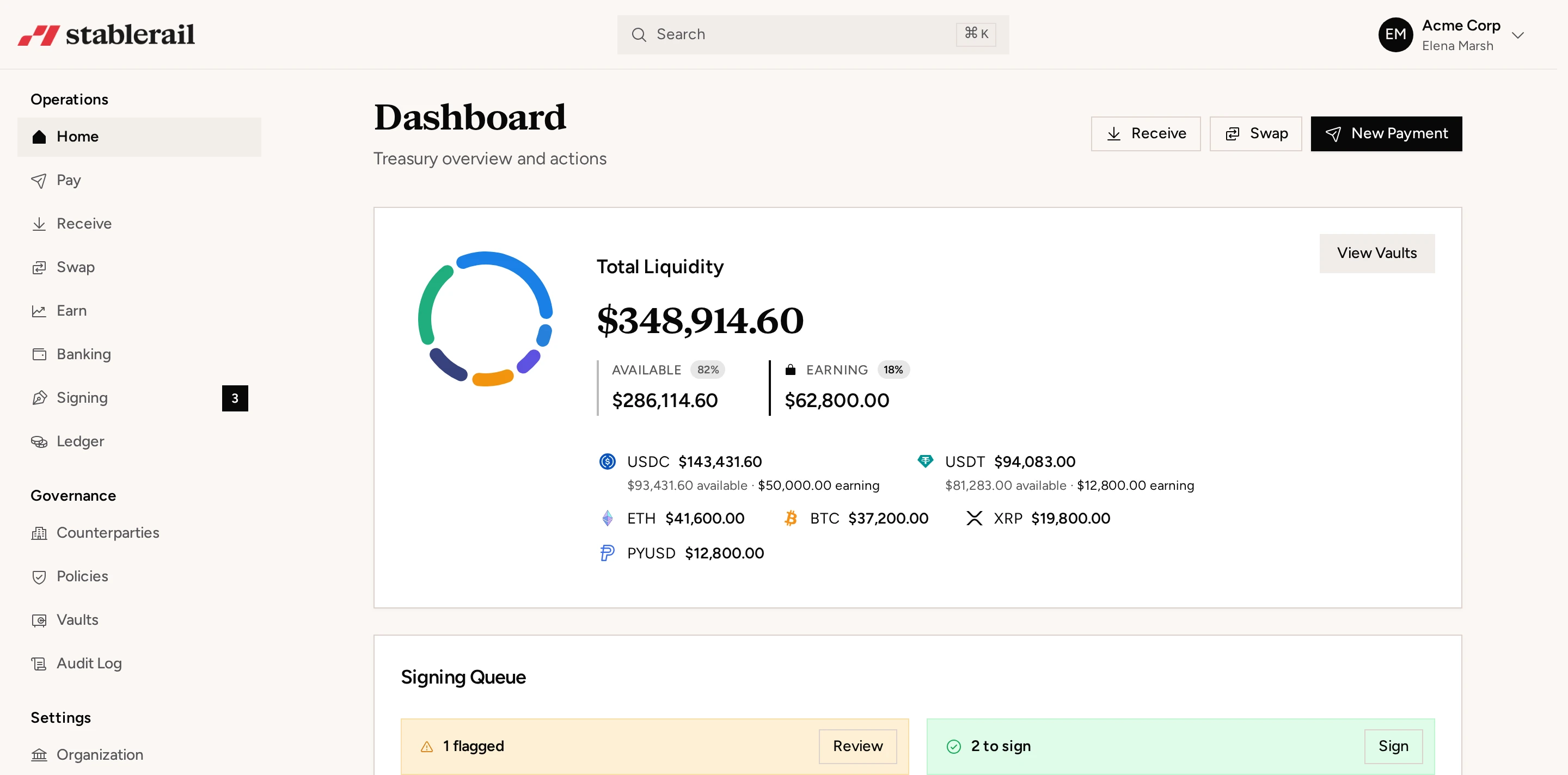
Stablerail brings USDC and USDT treasury operations into one business account, with approvals and signing quorum, sanctions and address screening before send, corporate cards, global payouts, and fiat off-ramp capabilities. Whatever operating stack is used, access should be limited by role and removed promptly when responsibilities change.
What settlement actually means
Submitting a transaction does not necessarily mean the recipient can use the money. Finance teams should distinguish three operational statuses:
- Submitted: The transaction has been signed and broadcast to the network.
- Confirmed on-chain: The network has included the transaction and it has reached the required confirmation threshold.
- Credited: The recipient’s wallet, exchange, or payment provider has recognised the deposit and made it available.
Blockchain confirmation may occur before the recipient credits the account. A provider may wait for additional confirmations, perform compliance checks, or manually review an unsupported or unusual deposit. For this reason, the transaction hash is evidence of the on-chain transfer but not always evidence that the beneficiary’s account has been credited.
Stablecoin transfers generally do not offer the chargeback process associated with cards or certain bank debits. If funds are sent to the wrong address or over an unsupported network, recovery depends on the recipient or wallet operator and may be impossible.
Reconcile the transaction and its fees
Every blockchain transaction has a transaction hash that can be reviewed using an appropriate block explorer. The accounting record should retain the hash alongside the beneficiary, invoice, legal entity, token, network, gross amount, exchange rate, fiat carrying value, fee, approval history, wallet addresses, and timestamps.
Record the payment and network fee separately. Depending on the network and account setup, the fee may be paid in a blockchain’s native asset rather than deducted from USDC or USDT. Some hosted services abstract this process and charge the fee separately. Either mechanism can create an accounting entry distinct from the underlying vendor payment.
For inbound transactions, do not rely on a customer screenshot. Verify the destination address, token contract, amount, network, transaction status, and sender information available to the business. Then match the transfer to an invoice or customer reference. Exportable audit evidence, including records of who created, approved, and executed a payment, can support month-end close; this is also available within Stablerail.
Off-ramp stablecoins when fiat is required
An off-ramp converts USDC or USDT into fiat and sends the proceeds to a bank account. The business selects the source token, amount, destination currency, bank account, and payout rail, then reviews and approves the quote.
Off-ramp timing has two parts: conversion and bank delivery. The stablecoin conversion may complete before the resulting ACH, SEPA, wire, SWIFT, or other bank payment reaches the beneficiary. Weekends, cut-off times, beneficiary checks, intermediary institutions, and compliance reviews can still affect delivery.
Before accepting stablecoins from customers, define a treasury policy for retaining or converting them. The decision should reflect near-term fiat obligations, approved liquidity buffers, conversion costs, counterparty exposure, currency exposure, and the company’s accounting and tax treatment. Finance should also identify the bank account and payout rail that will be used if stablecoin liquidity must be converted quickly.
Finance-team implementation checklist
- Document approved stablecoins, networks, wallets, providers, and bank accounts.
- Define beneficiary verification, test-transfer, allowlist, and address-change procedures.
- Set maker-checker approvals, signing quorum, payment limits, and access reviews.
- Confirm how quotes, conversion fees, network fees, and native gas assets are recorded.
- Track submitted, confirmed, credited, failed, and off-ramped transactions separately.
- Export transaction hashes, approvals, invoices, screening results, and exchange-rate evidence for close.
- Test the full path from fiat funding to recipient credit and back to fiat before scaling volume.
Frequently asked questions
How does a business send a stablecoin payment?
The business funds a stablecoin balance directly or converts fiat through an on-ramp, then enters the recipient’s wallet address, token, network, and amount. After the required approvals and screening, it signs and broadcasts the transaction, monitors confirmation, and reconciles the transaction hash and fees.
What is the difference between an on-ramp and an off-ramp?
An on-ramp converts fiat currency into a stablecoin such as USDC or USDT. An off-ramp converts the stablecoin back into fiat and usually delivers the proceeds through a bank rail such as ACH, SEPA, or wire transfer.
How long does a stablecoin payment take to settle?
Blockchain confirmation can occur quickly, but the exact time depends on the network and its conditions. The recipient’s exchange or payment provider may take longer to credit the deposit because it may require additional confirmations or compliance review.
What happens if USDC or USDT is sent over the wrong network?
The transaction may be valid on-chain but unsupported by the recipient’s wallet or exchange. Recovery may require manual intervention by the recipient’s provider and is not guaranteed, so finance teams should verify the token and network and use a test transfer for new beneficiaries.
How should stablecoin payments be reconciled?
Match each payment to its transaction hash, beneficiary, invoice, token, network, amount, exchange rate, approvals, and timestamps. Record network fees separately where appropriate, especially when they are paid in a native blockchain asset rather than deducted from the stablecoin.
Finance writers covering stablecoin treasury, payments, compliance, and risk controls.
More about the Stablerail team- Stablecoin treasury managementApprovals, limits, yield and reporting on one balance.
- Stablecoin payoutsBatch contractor and vendor payments with screening.
- USDT vs USDCWhich stablecoin your company should settle in.
- Stablecoin finance glossaryMPC, off-ramp, travel rule and the rest, in plain English.
- Product updatesEverything we ship, month by month.