
How Sanctions Screening Works for Stablecoin Payments
Learn how to screen customers, counterparties, wallets and transactions before moving USDC or USDT—and how to handle alerts, monitor exposure and retain audit evidence.
Sanctions screening for stablecoin payments should verify the customer, counterparty, wallet and transaction before funds move, then monitor for later changes. Effective controls combine name and ownership checks with network-specific blockchain analytics, approval holds and documented escalation. Because confirmed USDC and USDT transfers are generally irreversible, unresolved alerts should stop execution until reviewers determine whether to release, reject, block or otherwise restrict the payment.
%22%20x1%3D%220%22%20y1%3D%220%22%20x2%3D%221%22%20y2%3D%221%22%3E%0A%20%20%20%20%20%20%20%20%3Cstop%20offset%3D%220%25%22%20stop-color%3D%22%232A0608%22%20%2F%3E%0A%20%20%20%20%20%20%20%20%3Cstop%20offset%3D%2250%25%22%20stop-color%3D%22%23420D12%22%20%2F%3E%0A%20%20%20%20%20%20%20%20%3Cstop%20offset%3D%22100%25%22%20stop-color%3D%22%23621619%22%20%2F%3E%0A%20%20%20%20%20%20%3C%2FlinearGradient%3E%0A%20%20%20%20%20%20%3CradialGradient%20id%3D%22glow%22%20cx%3D%221149%22%20cy%3D%22465%22%20r%3D%22520%22%20gradientUnits%3D%22userSpaceOnUse%22%3E%0A%20%20%20%20%20%20%20%20%3Cstop%20offset%3D%220%25%22%20stop-color%3D%22%23FF9577%22%20stop-opacity%3D%220.45%22%20%2F%3E%0A%20%20%20%20%20%20%20%20%3Cstop%20offset%3D%2255%25%22%20stop-color%3D%22%23FF9577%22%20stop-opacity%3D%220.08%22%20%2F%3E%0A%20%20%20%20%20%20%20%20%3Cstop%20offset%3D%22100%25%22%20stop-color%3D%22%23FF9577%22%20stop-opacity%3D%220%22%20%2F%3E%0A%20%20%20%20%20%20%3C%2FradialGradient%3E%0A%20%20%20%20%20%20%3ClinearGradient%20id%3D%22glass%22%20x1%3D%220%22%20y1%3D%220%22%20x2%3D%221%22%20y2%3D%221%22%3E%0A%20%20%20%20%20%20%20%20%3Cstop%20offset%3D%220%25%22%20stop-color%3D%22%23F8D6D2%22%20stop-opacity%3D%220.26%22%20%2F%3E%0A%20%20%20%20%20%20%20%20%3Cstop%20offset%3D%22100%25%22%20stop-color%3D%22%23FFFFFF%22%20stop-opacity%3D%220.08%22%20%2F%3E%0A%20%20%20%20%20%20%3C%2FlinearGradient%3E%0A%20%20%20%20%20%20%3ClinearGradient%20id%3D%22accent%22%20x1%3D%220%22%20y1%3D%220%22%20x2%3D%221%22%20y2%3D%221%22%3E%0A%20%20%20%20%20%20%20%20%3Cstop%20offset%3D%220%25%22%20stop-color%3D%22%23FF9577%22%20%2F%3E%0A%20%20%20%20%20%20%20%20%3Cstop%20offset%3D%22100%25%22%20stop-color%3D%22%23D03B2D%22%20%2F%3E%0A%20%20%20%20%20%20%3C%2FlinearGradient%3E%0A%20%20%20%20%20%20%3Cfilter%20id%3D%22soft%22%3E%3CfeGaussianBlur%20stdDeviation%3D%2210%22%20%2F%3E%3C%2Ffilter%3E%0A%20%20%20%20%3C%2Fdefs%3E%0A%20%20%20%20%3Crect%20width%3D%221600%22%20height%3D%22900%22%20fill%3D%22url(%23bg)%22%20%2F%3E%0A%20%20%20%20%3Crect%20width%3D%221600%22%20height%3D%22900%22%20fill%3D%22url(%23glow)%22%20%2F%3E%0A%20%20%20%20%3Cpath%20d%3D%22M%20800%20210%20A%20240%20240%200%200%201%201040%20450%20L%20930%20450%20A%20130%20130%200%200%200%20800%20320%20Z%22%20fill%3D%22url(%23glass)%22%20stroke%3D%22%23F4CDC5%22%20stroke-opacity%3D%220.4%22%2F%3E%3Cpath%20d%3D%22M%201040%20450%20A%20240%20240%200%200%201%20653.897257037907%20640.4048016698964%20L%20720.8610142288663%20553.1359342378605%20A%20130%20130%200%200%200%20930%20450%20Z%22%20fill%3D%22url(%23accent)%22%20stroke%3D%22%23F4CDC5%22%20stroke-opacity%3D%220.4%22%2F%3E%3Cpath%20d%3D%22M%20653.897257037907%20640.4048016698964%20A%20240%20240%200%200%201%20564.6115327032246%20403.1783227161293%20L%20672.4979135475801%20424.6382581379034%20A%20130%20130%200%200%200%20720.8610142288663%20553.1359342378605%20Z%22%20fill%3D%22url(%23glass)%22%20stroke%3D%22%23F4CDC5%22%20stroke-opacity%3D%220.4%22%2F%3E%3Cpath%20d%3D%22M%20564.6115327032246%20403.1783227161293%20A%20240%20240%200%200%201%20800%20210%20L%20800%20320%20A%20130%20130%200%200%200%20672.4979135475801%20424.6382581379034%20Z%22%20fill%3D%22url(%23glass)%22%20stroke%3D%22%23F4CDC5%22%20stroke-opacity%3D%220.4%22%2F%3E%0A%20%20%20%20%3Crect%20x%3D%2226%22%20y%3D%2226%22%20width%3D%221548%22%20height%3D%22848%22%20rx%3D%2218%22%20fill%3D%22none%22%20stroke%3D%22%23F2D0C8%22%20stroke-opacity%3D%220.12%22%2F%3E%0A%20%20%3C%2Fsvg%3E)
Sanctions screening for stablecoin payments is not a single wallet lookup. A defensible process identifies the people and entities involved, checks ownership, analyzes the relevant blockchain address and evaluates the payment in context. Screening must occur while the transfer can still be held. Post-transaction monitoring remains important, but it cannot reliably recover USDC or USDT after an irreversible on-chain transfer.
The four levels of stablecoin sanctions screening
| Level | What to check | When to check | Typical evidence |
|---|---|---|---|
| Customer | Legal entity, beneficial owners, directors and authorized users | At onboarding, after material changes and when relevant lists change | KYB records, identifiers, ownership documents and screening results |
| Counterparty | Vendor, contractor, customer or other beneficiary, including relevant ownership | When added and before a payment when information or risk may have changed | Legal name, country, registration details, invoice and wallet ownership evidence |
| Wallet | Direct designation and direct or indirect exposure to attributed addresses | Before approval or execution and through ongoing monitoring | Address, network, screening timestamp, exposure path and provider result |
| Transaction | Asset, amount, network, source or destination, purpose and behavioral signals | Before broadcast and after confirmation | Approval record, transaction hash, alert disposition and supporting documents |
1. Screen the customer and its ownership
Customer screening begins during know-your-business review. Compare the entity’s legal name, aliases, registration details, beneficial owners, directors and authorized users with the sanctions lists applicable to the business. Depending on jurisdiction and nexus, these may include lists maintained by the US Office of Foreign Assets Control, the United Nations, the European Union and the United Kingdom.
Name matching needs to account for aliases, transliterations, abbreviations and spelling variations. A similar name is an alert, not proof of a match. Reviewers should compare additional identifiers such as registration number, date of birth, nationality, address and ownership before making a decision.
Ownership rules also matter. Under OFAC’s 50 Percent Rule, an entity is generally treated as blocked when one or more blocked persons own, directly or indirectly and in aggregate, 50% or more of it—even if the entity does not appear by name on the Specially Designated Nationals list. Other sanctions regimes may apply different ownership or control tests, so the policy should identify which rules govern each payment route.
2. Identify and screen the real counterparty
A legitimate sender can still pay a restricted beneficiary. Counterparty screening should cover the legal person receiving or sending the funds, rather than only the trading name shown on an invoice. Collect enough information to distinguish the party: typically its legal name, country, registration number and relevant ownership details. For an individual, use appropriate identifiers permitted by applicable privacy rules.
Finance teams should also establish why the nominated wallet belongs to, or is validly controlled for the benefit of, that counterparty. An email stating that an address belongs to an exchange, employee or payment processor is not conclusive. Depending on risk, evidence might include a signed wallet message, a verified instruction through an established contact channel, an exchange account record or contractual documentation explaining the payment route.
3. Screen the wallet on the correct network
Wallet screening checks whether an address is directly designated and whether blockchain analytics links it to attributed activity. Relevant labels may include sanctioned entities, theft, ransomware, scams, darknet markets and mixing services. Those non-sanctions labels can inform risk, but they are not automatically legal prohibitions.
Analytics results commonly distinguish direct exposure from indirect exposure through intermediary addresses. Review the amount, proportion, transaction distance, recency and attribution confidence. A direct transfer from a designated address is materially different from remote exposure routed through a large service that processes funds for many unrelated users.
The network must be explicit. The same hexadecimal address can exist across multiple EVM-compatible networks, but its transaction history and exposure may differ on Ethereum, Base, Arbitrum, Polygon, BNB Chain or Optimism. Tron and Solana use different address and transaction models. Screening coverage should therefore match every network on which the treasury actually sends or receives stablecoins.
A wallet risk score is a decision aid, not a legal conclusion. The underlying address, attribution, transaction path and applicable sanctions rule should drive the decision.
4. Evaluate the complete transaction
Transaction monitoring adds business context that an address check cannot provide. Signals may include a first payment to a new wallet, an amount inconsistent with the invoice, repeated transfers just below an approval threshold, rapid movement across networks or a route that does not fit the counterparty’s business.
Monitoring should cover inbound as well as outbound activity. A company can receive stablecoins from an unknown or high-risk source without initiating the transfer. Small unsolicited deposits, sometimes described as dusting, should be recorded and assessed rather than automatically causing the entire treasury wallet to be classified as sanctioned.
Pre-transaction screening workflow
- Create and verify the beneficiary. Record its legal identity, payment purpose and supporting documents.
- Validate the payment instruction. Confirm the address, asset and network through a trusted channel.
- Screen names and ownership. Check the counterparty and relevant owners against applicable lists.
- Screen the wallet close to execution. Capture the network, timestamp, result and underlying exposure details.
- Apply approvals and signing quorum. Keep the payment pending until all required checks and approvers are complete.
- Broadcast and reconcile. Retain the transaction hash, confirmation status and accounting reference.
- Monitor for later changes. Re-screen when sanctions lists, ownership information or analytics labels change.
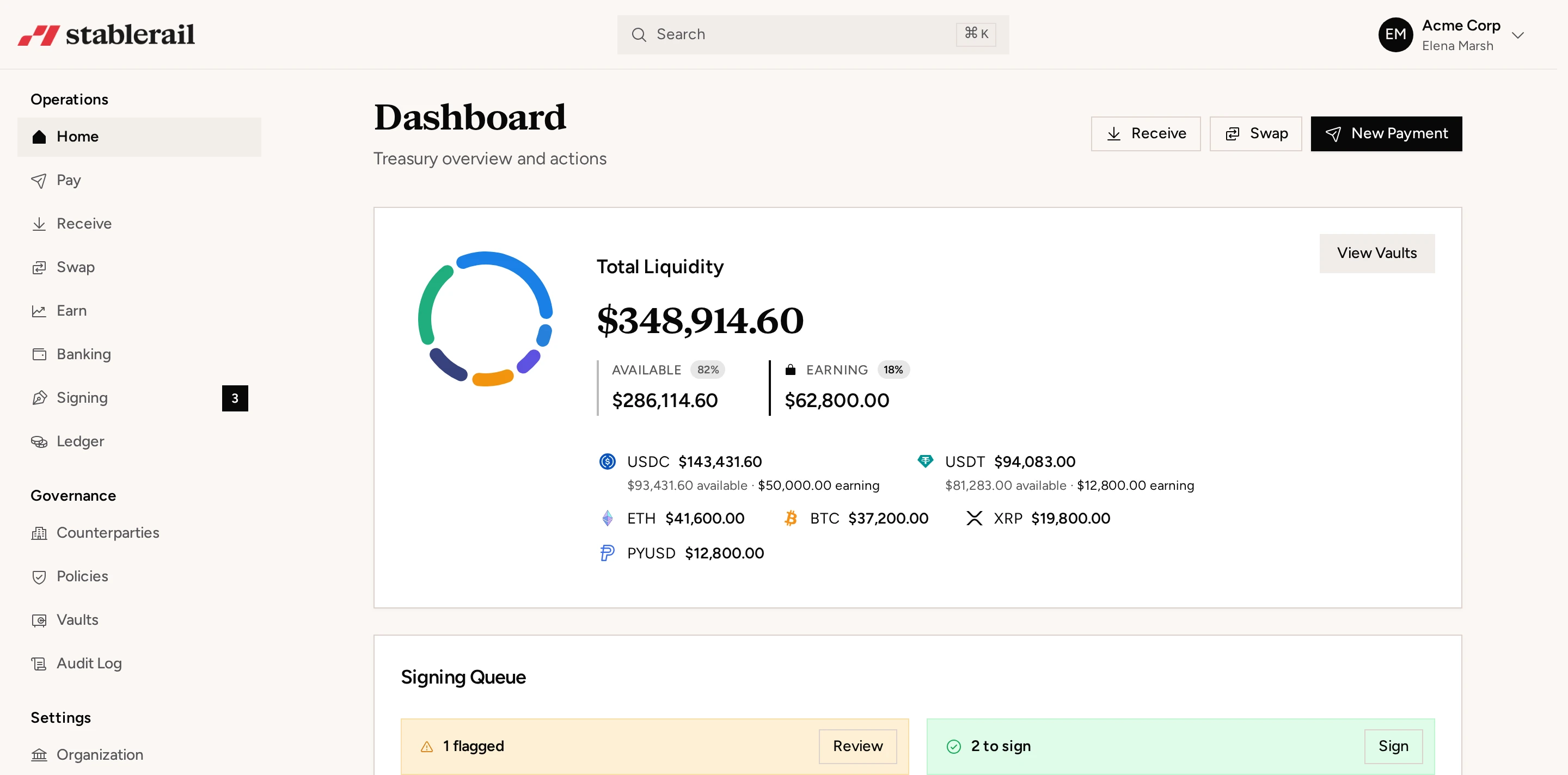
Screening only when a beneficiary is first added creates a control gap. A wallet cleared months earlier may since have transacted with newly designated or newly attributed addresses. Higher-risk payments should be screened immediately before signing or broadcast, when the business can still stop them. A stablecoin treasury account such as Stablerail can place sanctions and address screening before send alongside approvals, signing quorum and exportable audit evidence.
How to set risk-based decision rules
| Finding | Default operational response | Reviewer focus |
|---|---|---|
| Potential direct designation match | Hold and escalate immediately | Address, network, official listing and applicable legal nexus |
| Possible name or ownership match | Hold for identity review | Identifiers, aggregate ownership and control under the relevant regime |
| Material direct on-chain exposure | Hold for enhanced review | Source, amount, timing, attribution and commercial explanation |
| Limited indirect exposure | Apply policy threshold and document the decision | Distance, proportion, intermediary type, recency and provider confidence |
| New or changed wallet instruction | Reverify through an independent channel | Ownership, fraud risk, asset and network |
| No alert and expected activity | Proceed through normal approvals | Evidence that required checks completed before execution |
Policies should separate clear legal prohibitions from indicators requiring investigation. Relevant factors include designation status, ownership, exposure type, value, recency, transaction distance, counterparty location, payment purpose and deviation from normal activity. Thresholds should state when a payment is stopped automatically, when manual review is required and who may approve release.
Handling false positives and escalation
False positives are common in name screening because unrelated people and companies can share similar names. The reviewer should compare reliable identifiers and document why the alert is or is not a match. Familiarity with the customer is not sufficient evidence to clear it.
Wallet alerts also require scrutiny. Analytics providers can use different attribution methods, exposure models and update schedules. Review the actual path, dates, values, network and label confidence rather than relying solely on a color or composite score. A material or ambiguous case may justify a second data source or specialist legal review.
Keep an unresolved payment pending. The case record should show the alert, evidence considered, reviewer, decision, rationale and person who authorized release or restriction. This makes the control reproducible for auditors, banking partners and regulators.
Rejecting, blocking and freezing are different actions
The required response depends on the sanctions program, parties, jurisdiction and whether the business possesses or controls the relevant property. Under OFAC rules, a US person may be required to block property in which a blocked person has an interest. Other prohibited transactions may need to be rejected rather than blocked. Businesses outside the United States can still face obligations arising from their location, personnel, counterparties, banking relationships or another US nexus.
A self-custodial company generally cannot freeze someone else’s external wallet. It can stop its own outbound transfer and restrict or segregate property it controls. Stablecoin issuers may possess separate smart-contract capabilities, but a payer should not assume that an issuer will freeze or recover assets on request.
OFAC generally requires initial reports of blocked property and rejected transactions within 10 business days. Its recordkeeping rules generally require relevant records to be retained for 10 years, subject to the effective rules and facts involved. Teams should consult the current OFAC program information and obtain sanctions counsel for a potential match rather than treating workflow guidance as a legal determination.
Evidence to retain
- Customer, beneficial-owner and counterparty identifiers.
- Wallet address, asset, network and evidence connecting the wallet to the beneficiary.
- Screening timestamps, results, list or data-source version and relevant exposure paths.
- Invoices, contracts and payment-purpose records.
- Alert notes, escalation decisions, approvals and signing records.
- Transaction hash, confirmation data and accounting reconciliation.
- Copies of any blocking, rejection or other reports submitted to authorities.
Stablerail supports this evidence chain with pre-send sanctions and address screening, approval and signing-quorum records, and exportable audit evidence for USDC and USDT payments. Whatever system is used, evidence should be searchable by counterparty, wallet and transaction rather than scattered across chat messages and spreadsheets.
Blockchain analytics is necessary, but not sufficient
Blockchain analytics can show connections between known addresses and on-chain funds. It cannot reliably identify every person controlling a wallet, prove the commercial purpose of a transfer or reveal all off-chain ownership arrangements. Effective sanctions screening combines analytics with KYB, counterparty verification, payment documentation, approvals and legal escalation.
The practical objective is not to eliminate every alert. It is to make the decision before funds move, apply the correct rule consistently and preserve enough evidence for another reviewer to understand exactly why the payment was released or stopped.
Frequently asked questions
Do stablecoin wallets need to be screened before every payment?
A wallet should be screened close enough to execution that the result reflects current sanctions lists and blockchain labels. Re-screening is especially important for new, changed, high-value or higher-risk payment instructions because a previously cleared address can acquire new exposure.
What is the difference between sanctions screening and wallet screening?
Sanctions screening checks people, entities, ownership and designated addresses against applicable restrictions. Wallet screening uses blockchain data to assess direct and indirect links to attributed activity; it supports the legal analysis but does not replace identity and ownership checks.
Does indirect exposure to a sanctioned wallet make a stablecoin payment prohibited?
Not automatically. Reviewers should consider transaction distance, amount, proportion, recency, intermediary type and attribution confidence, then apply the relevant sanctions rules. A direct designation or ownership match requires different treatment from limited remote exposure.
Can a company recover USDC or USDT after sending it to a sanctioned address?
A confirmed blockchain transfer is generally irreversible for the sender. An issuer may have separate smart-contract capabilities in some circumstances, but businesses should not assume that funds will be frozen or returned. Screening and escalation should therefore occur before signing or broadcasting the transaction.
What records should be kept for stablecoin sanctions screening?
Retain party identifiers, ownership information, wallet and network details, screening timestamps and results, exposure paths, supporting invoices, reviewer notes, approvals and the transaction hash. Records should also show why an alert was cleared, escalated, rejected or blocked and who authorized the decision.
Finance writers covering stablecoin treasury, payments, compliance, and risk controls.
More about the Stablerail team- Stablecoin treasury managementApprovals, limits, yield and reporting on one balance.
- Stablecoin payoutsBatch contractor and vendor payments with screening.
- USDT vs USDCWhich stablecoin your company should settle in.
- Stablecoin finance glossaryMPC, off-ramp, travel rule and the rest, in plain English.
- Product updatesEverything we ship, month by month.