
Fiat on-ramp for companies: funding a stablecoin balance by bank transfer
A practical guide to funding company USDC or USDT balances by bank transfer, covering payment rails, conversion, network selection, controls and reconciliation.
A company can fund a USDC or USDT balance by sending fiat from its approved corporate bank account to the on-ramp’s designated account. Once the payment is received and matched, the provider converts the fiat and credits stablecoins on the selected blockchain network. To avoid delays, verify the beneficiary details, payment reference, sending entity, conversion terms, token and network before initiating the transfer.
%22%20x1%3D%220%22%20y1%3D%220%22%20x2%3D%221%22%20y2%3D%221%22%3E%0A%20%20%20%20%20%20%20%20%3Cstop%20offset%3D%220%25%22%20stop-color%3D%22%23450B10%22%20%2F%3E%0A%20%20%20%20%20%20%20%20%3Cstop%20offset%3D%2250%25%22%20stop-color%3D%22%23681A1F%22%20%2F%3E%0A%20%20%20%20%20%20%20%20%3Cstop%20offset%3D%22100%25%22%20stop-color%3D%22%238A2A2D%22%20%2F%3E%0A%20%20%20%20%20%20%3C%2FlinearGradient%3E%0A%20%20%20%20%20%20%3CradialGradient%20id%3D%22glow%22%20cx%3D%221167%22%20cy%3D%22241%22%20r%3D%22520%22%20gradientUnits%3D%22userSpaceOnUse%22%3E%0A%20%20%20%20%20%20%20%20%3Cstop%20offset%3D%220%25%22%20stop-color%3D%22%23FF7A59%22%20stop-opacity%3D%220.45%22%20%2F%3E%0A%20%20%20%20%20%20%20%20%3Cstop%20offset%3D%2255%25%22%20stop-color%3D%22%23FF7A59%22%20stop-opacity%3D%220.08%22%20%2F%3E%0A%20%20%20%20%20%20%20%20%3Cstop%20offset%3D%22100%25%22%20stop-color%3D%22%23FF7A59%22%20stop-opacity%3D%220%22%20%2F%3E%0A%20%20%20%20%20%20%3C%2FradialGradient%3E%0A%20%20%20%20%20%20%3ClinearGradient%20id%3D%22glass%22%20x1%3D%220%22%20y1%3D%220%22%20x2%3D%221%22%20y2%3D%221%22%3E%0A%20%20%20%20%20%20%20%20%3Cstop%20offset%3D%220%25%22%20stop-color%3D%22%23F8D6D2%22%20stop-opacity%3D%220.26%22%20%2F%3E%0A%20%20%20%20%20%20%20%20%3Cstop%20offset%3D%22100%25%22%20stop-color%3D%22%23FFFFFF%22%20stop-opacity%3D%220.08%22%20%2F%3E%0A%20%20%20%20%20%20%3C%2FlinearGradient%3E%0A%20%20%20%20%20%20%3ClinearGradient%20id%3D%22accent%22%20x1%3D%220%22%20y1%3D%220%22%20x2%3D%221%22%20y2%3D%221%22%3E%0A%20%20%20%20%20%20%20%20%3Cstop%20offset%3D%220%25%22%20stop-color%3D%22%23FF7A59%22%20%2F%3E%0A%20%20%20%20%20%20%20%20%3Cstop%20offset%3D%22100%25%22%20stop-color%3D%22%23C73128%22%20%2F%3E%0A%20%20%20%20%20%20%3C%2FlinearGradient%3E%0A%20%20%20%20%20%20%3Cfilter%20id%3D%22soft%22%3E%3CfeGaussianBlur%20stdDeviation%3D%2210%22%20%2F%3E%3C%2Ffilter%3E%0A%20%20%20%20%3C%2Fdefs%3E%0A%20%20%20%20%3Crect%20width%3D%221600%22%20height%3D%22900%22%20fill%3D%22url(%23bg)%22%20%2F%3E%0A%20%20%20%20%3Crect%20width%3D%221600%22%20height%3D%22900%22%20fill%3D%22url(%23glow)%22%20%2F%3E%0A%20%20%20%20%0A%20%20%20%20%3Cpath%20d%3D%22M%20500%20600%20A%20300%20300%200%200%201%201100%20600%22%20fill%3D%22none%22%20stroke%3D%22url(%23glass)%22%20stroke-width%3D%2260%22%2F%3E%0A%20%20%20%20%3Cpath%20d%3D%22M%20500%20600%20A%20300%20300%200%200%201%20936.197149921864%20332.6980427434897%22%20fill%3D%22none%22%20stroke%3D%22url(%23accent)%22%20stroke-width%3D%2260%22%20stroke-linecap%3D%22round%22%2F%3E%0A%20%20%20%20%3Ccircle%20cx%3D%22800%22%20cy%3D%22600%22%20r%3D%2232%22%20fill%3D%22%233E090D%22%20stroke%3D%22url(%23accent)%22%20stroke-width%3D%226%22%2F%3E%0A%20%20%20%20%3Cline%20x1%3D%22800%22%20y1%3D%22600%22%20x2%3D%22908.9577199374912%22%20y2%3D%22386.15843419479177%22%20stroke%3D%22%23FFF1ED%22%20stroke-width%3D%2210%22%20stroke-linecap%3D%22round%22%2F%3E%0A%20%20%0A%20%20%20%20%3Crect%20x%3D%2226%22%20y%3D%2226%22%20width%3D%221548%22%20height%3D%22848%22%20rx%3D%2218%22%20fill%3D%22none%22%20stroke%3D%22%23F2D0C8%22%20stroke-opacity%3D%220.12%22%2F%3E%0A%20%20%3C%2Fsvg%3E)
A company funds a stablecoin balance by sending fiat from its approved corporate bank account to the account details supplied by its on-ramp provider. The provider identifies the payment, converts the received amount into USDC or USDT, and credits the tokens to the selected balance or wallet on the chosen blockchain. Accurate sender details, references, pricing terms and network selection are essential because the bank transfer and token settlement are separate events.
How bank-to-stablecoin funding works
A fiat on-ramp connects conventional bank payment rails with stablecoin settlement. For a finance team, the process should be treated as three linked but separately reconcilable stages:
- Fiat receipt: The company sends EUR, USD or another supported currency using the funding instructions assigned to its business account.
- Conversion: The provider exchanges the amount received for USDC or USDT using the applicable quoted rate, spread and fee schedule.
- Stablecoin settlement: The resulting tokens are credited to a business balance, custodial wallet or self-custodial vault on the selected network.
A bank showing a payment as sent does not mean the receiving institution has received and matched it. Similarly, the fiat may have arrived while compliance review, conversion or blockchain settlement remains pending. Treasury teams should track each status independently rather than treating the process as one transaction.
Where a self-custodial MPC vault is used, multi-party computation divides signing authority rather than relying on one private key. A signing quorum can require multiple approved people or devices to authorize a later outgoing transaction. This control affects how the stablecoins can be moved after funding; it does not accelerate the incoming bank payment.
Choose the right bank transfer rail
The appropriate rail depends on the sending currency, bank location, urgency, amount and availability under the company’s account setup. The timings below are common market expectations, not guaranteed delivery windows. Cut-off times, weekends, holidays, intermediary banks and compliance reviews can extend them.
| Rail | Currency | Typical timing | Best use | Finance control |
|---|---|---|---|---|
| SEPA | EUR | Usually same or next business day | Routine euro funding within the SEPA area | Verify the IBAN, beneficiary name and required reference |
| SEPA Instant | EUR | Often seconds when both banks and the payment are eligible | Urgent euro funding | Confirm both banks support the service and check transaction limits |
| ACH | USD | Commonly one to three business days | Lower-urgency domestic US funding | Allow for bank processing and possible return windows |
| Fedwire | USD | Typically the same business day if submitted before cut-off | Urgent or higher-value domestic US transfers | Use current wire instructions and obtain the bank’s transaction identifier |
| SWIFT | Multiple currencies | Often one to five business days | Cross-border funding when a local rail is unavailable | Account for correspondents, possible fee deductions and MT103 tracing |
Do not send one currency to instructions issued for another. Sending USD to EUR-only details, for example, can cause a return or an unplanned conversion by a bank or intermediary. Local account details may also have different eligibility rules from SWIFT instructions.
Step by step: fund a company USDC or USDT balance
1. Complete business onboarding
The company must normally complete know-your-business checks before receiving funding instructions. The review can cover the legal entity, directors, beneficial owners, business activity, expected payment patterns and source of funds.
Common documents include a certificate of incorporation or registry extract, constitutional documents, ownership records, identification for relevant directors and beneficial owners, proof of operating address, and evidence supporting larger or unusual transfers. Eligibility varies by jurisdiction, industry and banking partner, so complete onboarding before instructing a material payment.
2. Select the fiat currency and funding details
Open or select the balance for the currency being sent. Depending on the setup, the company may receive local account details, a virtual IBAN or SWIFT instructions. Copy the beneficiary name, bank address, account number or IBAN, routing code and reference exactly as displayed.
Use the latest instructions rather than a saved template without checking it. Banking partners and account details can change, and a payment sent to outdated instructions may require manual investigation or be returned.
3. Confirm the stablecoin and blockchain network
Select USDC or USDT and confirm the destination network before conversion. Available token-network combinations are provider-specific and may include networks such as Ethereum, Base, Arbitrum, Polygon, Solana or Tron.
The network is not merely a display preference. USDC on Ethereum and USDC on Base are distinct token balances on separate networks. The chosen network must be compatible with the company’s wallet infrastructure and with any exchange, vendor, payroll partner or payout recipient that will receive the funds. Moving assets to another network later may require an exchange, bridge or additional transaction, each introducing cost and operational risk.
4. Review pricing and expected proceeds
Before sending fiat, review the published corridor pricing or obtain a quote. The finance approver should check:
- The conversion rate and its validity period
- Any spread, on-ramp fee or transaction charge
- Sending-bank and correspondent-bank fees
- Minimum and maximum funding amounts
- Whether blockchain network fees are included or charged separately
- The estimated net amount of USDC or USDT to be credited
A stablecoin targeting one US dollar does not guarantee that one unit of fiat will always produce one token. Net proceeds can differ because of the quote, spread, explicit fees, intermediary deductions and the amount actually received. If a quote expires before the bank payment arrives, the conversion may require a new rate.
5. Send from the approved company bank account
Initiate the payment from an account held in the onboarded company’s legal name. Enter the required reference without abbreviating it or adding unrelated text. Retain the bank confirmation showing the sender, beneficiary, amount, currency, date, reference and transaction identifier.
Payments from a founder, employee, customer, affiliate or another group company may be held or returned unless third-party funding is explicitly supported and documented. Even when two entities share owners, they remain separate legal senders for payment matching and compliance purposes.
6. Track receipt, conversion and token settlement
Monitor the transfer until all three stages are complete. The activity record should distinguish the incoming bank payment, the conversion and the stablecoin credit. For blockchain settlement, retain the token, network, receiving address, amount and transaction hash where available.
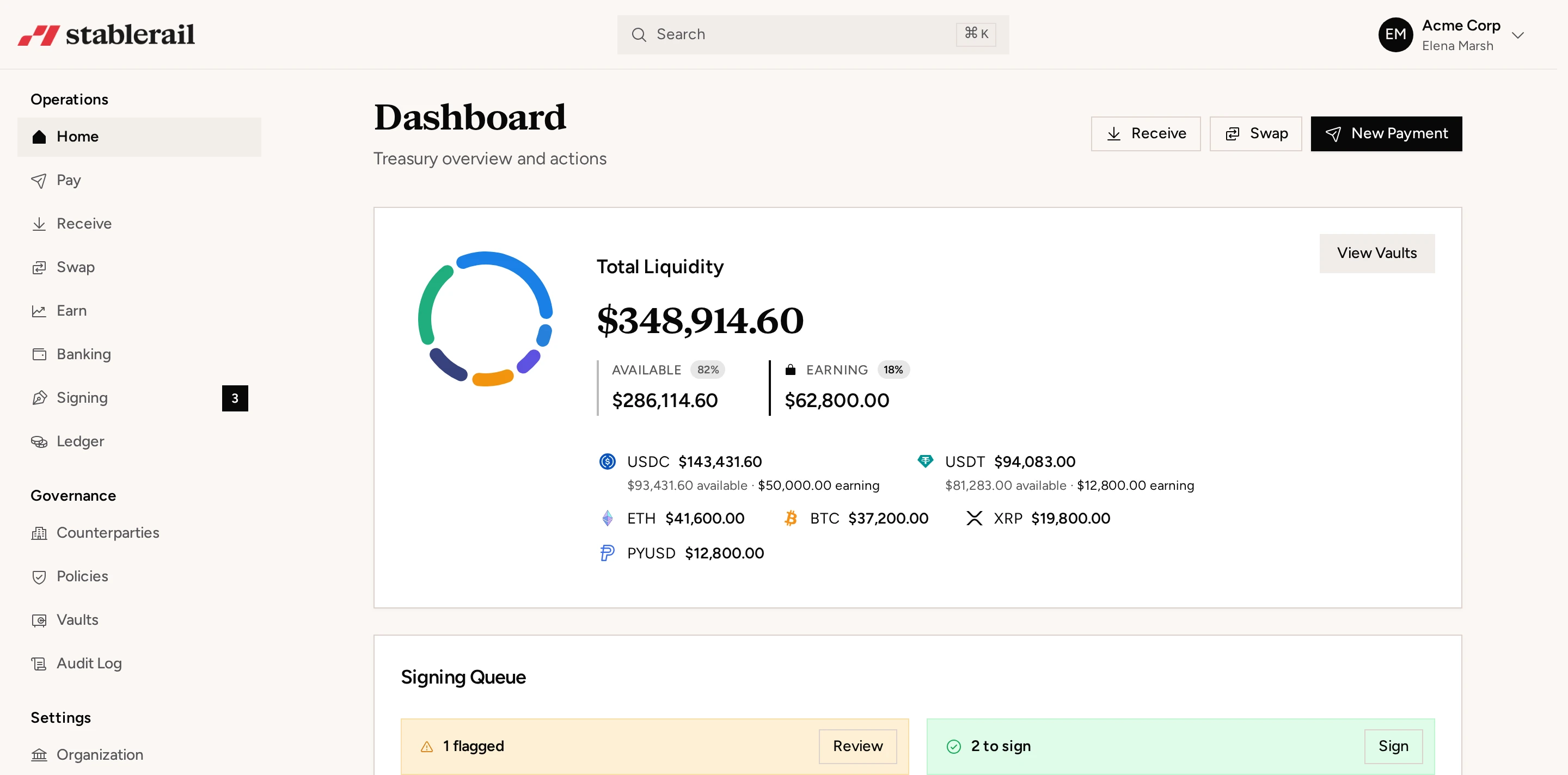
Do not schedule an onward payment based only on the sending bank’s confirmation. Verify that the correct token has been credited on the correct network and that it is available under the company’s approval process. A platform such as Stablerail can combine USDC and USDT treasury balances with approval quorums, address screening before send, global payouts, fiat off-ramp and exportable audit evidence.
Why a fiat on-ramp transfer may be delayed or returned
| Issue | What happens | How to prevent or resolve it |
|---|---|---|
| Sender-name mismatch | The payment cannot be linked cleanly to the onboarded entity | Send from the approved corporate account and provide evidence of any legal-name variation |
| Missing or incorrect reference | Automatic allocation fails | Provide the bank receipt and payment identifier for manual matching |
| Wrong currency or rail | The receiving details reject the payment or an intermediary converts it | Confirm the currency and rail before sending |
| Third-party payment | The transfer is reviewed or returned | Use the onboarded entity’s account unless third-party funding has been approved |
| Compliance review | Conversion pauses while evidence is requested | Prepare invoices, contracts, bank statements and source-of-funds records |
| Expired quote | The expected conversion terms are no longer available | Check quote validity against the bank rail’s likely arrival time |
| Unsupported token-network pair | Settlement cannot proceed as instructed | Verify support before initiating the fiat transfer |
Bank cut-offs, holidays and account or rail limits can also delay a transfer even when the instructions are correct. For a late SWIFT payment, ask the sending bank for the MT103 message. This provides payment-routing information that the receiving institution can use to trace the transfer.
Reconcile the funding transaction
Finance teams should preserve evidence from both the banking and blockchain sides. The reconciliation package should include the bank payment confirmation, amount received, conversion timestamp, rate, fees, stablecoin amount, network, receiving address and transaction record.
The accounting treatment depends on the company’s policies and applicable reporting framework, but the ledger should avoid hiding fees or exchange differences inside the stablecoin balance. Record the fiat outflow, stablecoin asset received and transaction costs in a way that allows the conversion to be reconstructed. Investigate differences between the amount sent and received, particularly where correspondent banks may have deducted charges.
Pre-transfer checklist for finance teams
- Confirm the sending account belongs to the onboarded legal entity.
- Use current instructions for the correct fiat currency and payment rail.
- Check bank cut-offs, holidays, transfer limits and likely arrival time.
- Enter the beneficiary details and payment reference exactly.
- Approve the rate, fees, quote expiry and expected net proceeds.
- Verify the stablecoin, blockchain network and destination balance.
- Retain the bank receipt and source-of-funds support.
- Confirm token settlement before scheduling payouts, trades or transfers.
A reliable fiat on-ramp is primarily a controlled payment and reconciliation process. When the legal entity, bank rail, payment reference, conversion terms and destination network are confirmed before money moves, bank-to-stablecoin funding becomes repeatable treasury activity rather than an exception that finance must investigate after the fact.
Frequently asked questions
How can a company buy USDC with a bank transfer?
The company sends USD, EUR or another supported fiat currency from its approved corporate bank account to the on-ramp’s designated funding details. After the payment is received and matched, the provider converts it and credits USDC on the selected blockchain network.
How long does a bank transfer to a stablecoin account take?
Timing depends on the rail and whether the payment needs review. SEPA and Fedwire can arrive within the same business day in eligible cases, while ACH and SWIFT commonly take longer; cut-offs, holidays, intermediaries and compliance checks can extend any estimate.
Can a founder or customer fund a company stablecoin account?
A payment from a founder, customer, affiliate or other third party may be held or returned because the sender does not match the onboarded company. Use a bank account in the company’s legal name unless the provider has explicitly approved and documented third-party funding.
What information is needed to trace a delayed fiat on-ramp transfer?
Provide the bank receipt, sending account name, beneficiary, amount, currency, date, payment reference and bank transaction identifier. For a SWIFT transfer, request the MT103 message from the sending bank so the payment route can be traced.
Should a company choose USDC or USDT before sending the bank transfer?
Yes. The finance team should confirm both the stablecoin and its blockchain network before conversion because availability, fees and recipient compatibility can differ. Choosing the wrong network may require an additional transfer, exchange or bridge before the funds can be used.
Finance writers covering stablecoin treasury, payments, compliance, and risk controls.
More about the Stablerail team- Stablecoin treasury managementApprovals, limits, yield and reporting on one balance.
- Stablecoin payoutsBatch contractor and vendor payments with screening.
- USDT vs USDCWhich stablecoin your company should settle in.
- Stablecoin finance glossaryMPC, off-ramp, travel rule and the rest, in plain English.
- Product updatesEverything we ship, month by month.