
How to Compare Sanctions Screening Tools for Crypto Payments
A practical framework for comparing crypto sanctions screening tools by network coverage, attribution quality, alert precision, payment controls, evidence and cost.
Compare crypto sanctions screening tools against the payments your company actually makes. Verify exact network and token coverage, sanctions sources, attribution methods, pre-payment response times, alert precision, review controls and exportable evidence. Then run the same representative wallet set through each provider. The best choice is the tool that produces timely, explainable and auditable decisions without creating an unmanageable review queue.

The best sanctions screening tool for crypto payments is not necessarily the provider with the most chains, data or risk categories. It is the one that can determine whether your company should send to or receive from a specific wallet under its policy and legal obligations—and provide enough evidence to explain that decision later.
Requirements vary by payment flow. A company paying vendors in USDC on Base has different needs from one receiving USDT on Tron or transferring funds among exchanges and self-custodial wallets. Compare providers against those actual networks, counterparties, transaction volumes and review procedures rather than relying on a generic feature list.
Define where screening fits into the payment workflow
Start by documenting when a wallet is checked, who reviews the result and what happens when the tool is unavailable. Screening should be connected to payment controls rather than treated as a separate dashboard search.
A typical outbound workflow is:
- Collect the beneficiary wallet, intended network, legal name and payment purpose through a controlled channel.
- Validate that the address is usable on the selected network. For EVM-compatible networks, address format alone may not identify the intended chain.
- Screen the wallet before approving it as a beneficiary or adding it to an allowlist.
- Screen it again immediately before execution if the earlier result may be stale or attribution has changed.
- Approve, hold, reject or escalate the payment according to documented thresholds.
- Confirm that the signed transaction uses the screened address, network and token contract.
- Retain the result, supporting data, reviewer decision, approvals and transaction hash.
Inbound screening is different because the transaction may already be on-chain. A company can screen the originating wallet before crediting the funds internally, converting them or using them for another payment. Continuing monitoring can identify later transactions or attribution changes, but the company must define what action is possible after settlement.
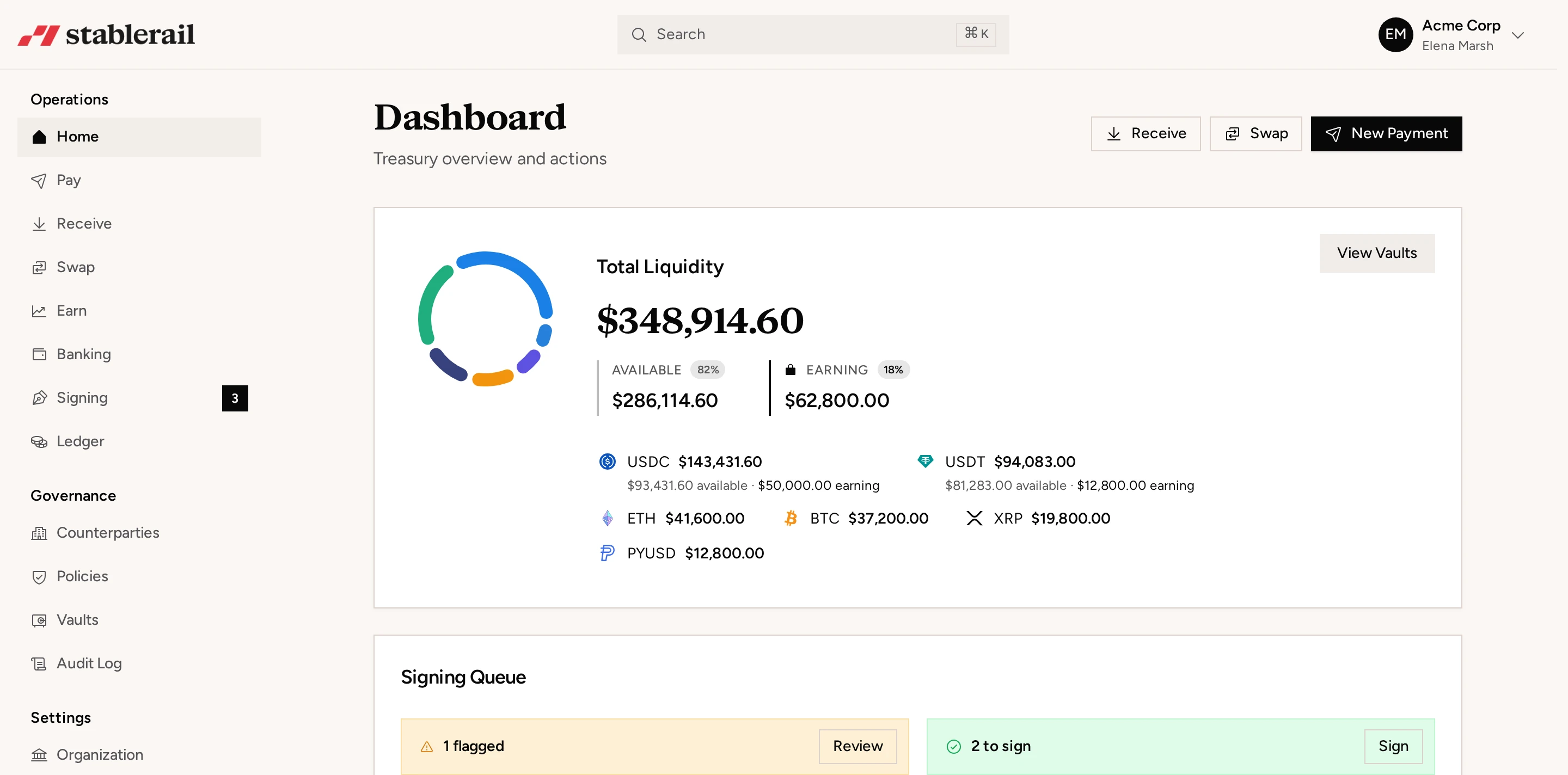
Platforms such as Stablerail can place sanctions and address screening alongside allowlists, signing quorum, approvals, stablecoin payouts and exportable audit evidence for a company managing its own USDC or USDT. A standalone data provider may offer deeper investigation features but require the finance team to build the payment holds, permissions and evidence workflow separately.
Crypto sanctions screening comparison criteria
| Criterion | What to verify | Warning sign |
|---|---|---|
| Sanctions sources | Named lists, update process and treatment of ownership or control rules applicable to the company | Claims of global coverage without a list-by-list explanation |
| Wallet attribution | Direct matches, indirect exposure, named entities, confidence and supporting transaction paths | A risk score with no source or explanation |
| Payment-time screening | Pre-send checks, response behavior, retries, rate limits and outage handling | Batch screening that cannot support a payment decision |
| Network coverage | Exact chains, token contracts, address types, bridges and smart-contract activity used by the company | A large chain count dominated by irrelevant networks |
| Alert precision | Thresholds for category, value, percentage, age and transaction hops | Every indirect connection receives the same severity |
| Review controls | Case ownership, comments, escalation states, permissions and decision history | Payment operators can clear their own alerts without oversight |
| Evidence | Timestamp, result, list or data version, exposure path, policy threshold and reviewer action | Results exist only as a current dashboard view |
| Total cost | Charges for checks, monitoring, users, chains, cases, lookbacks and retries | Low entry pricing with undefined usage charges |
Examine sanctions coverage and attribution separately
Ask each provider to identify the sanctions sources it covers, such as lists maintained by the US Office of Foreign Assets Control, the United Nations, the European Union and the UK. The required scope depends on the company’s entities, jurisdictions and counterparties, so legal or compliance advisers should determine which lists and ownership or control rules apply.
List coverage is only the first layer. Confirm how quickly an update reaches the screening engine, whether monitored wallets are rechecked and whether the provider distinguishes among:
- An address explicitly identified by a sanctions authority.
- An address attributed directly to a named sanctioned entity.
- An address inferred to belong to that entity through clustering.
- A wallet with direct or indirect transactional exposure to the address.
Those findings are not equivalent. A listed address is different from a wallet that received funds several transactions removed from a flagged service. The interface and exported evidence should preserve that distinction.
Understand direct and indirect exposure
Direct exposure generally means the wallet transacted with an identified address or entity. Indirect exposure means the connection passes through one or more intermediate wallets. Providers can disagree because they use different attribution data, clustering methods, time windows, transaction-hop limits and treatments of bridges, swaps or cross-chain activity.
Do not compare a single risk score in isolation. For every alert, ask whether the tool shows:
- The risk category and named entity behind the result.
- Whether attribution is confirmed, inferred or obtained from another source.
- The relevant transaction path and number of hops.
- The value and percentage of exposure.
- The date of the activity and whether age affects severity.
- How mixers, exchanges, bridges and token swaps are represented.
A finance reviewer should be able to understand the reason for an alert without reverse-engineering an undocumented score. The tool does not need to reveal proprietary models, but it should expose enough facts to support a consistent payment decision.
Test false positives against company policy
A highly sensitive tool may detect more remote exposure while creating an unmanageable queue. A less sensitive configuration can reduce reviews but miss activity the company intends to escalate. The objective is not to identify a universally correct score; it is to determine whether the tool applies the company’s thresholds consistently.
Build a test set that reflects real counterparties, including exchanges, custodians, vendors, contractors, payment processors and self-custodial wallets across every required network. Include wallets that were previously approved, rejected or escalated. Record clear results, actionable alerts, unexplained matches and disagreements between vendors.
Useful configuration options include separate thresholds based on risk category, direct versus indirect exposure, percentage, value, age and hop count. Reviewers should also be able to record why an alert was cleared, rejected or escalated.
Verify network coverage at the token level
Never treat “supported chains” as a sufficient answer. Confirm the exact network, token contract and transaction type used in production. USDC or USDT support on one chain does not establish support for the same asset on another.
For each payment rail, test normal transfers, contract interactions and any bridges or exchanges used operationally. Verify how the provider handles network-specific address formats and EVM addresses that look identical across multiple chains. Screening the right hexadecimal address on the wrong chain can return an irrelevant history.
Also distinguish a one-time wallet lookup from transaction monitoring. Monitoring may alert on new activity or later attribution changes, but teams should ask how quickly alerts appear, whether historical transactions are rescored and what evidence is retained from the original decision.
Assess reliability and failure handling
Payment-time screening depends on more than an average response time. Review documented rate limits, timeout behavior, error codes, retry guidance, maintenance procedures and any contractual availability terms. Test these behaviors rather than relying solely on a sales demonstration.
Decide in advance what happens if the screening service is unavailable. A fail-closed workflow holds the payment until screening succeeds. A fail-open workflow permits execution and creates a retrospective review. That decision should be approved, documented and proportionate to the company’s obligations; it should not be an accidental consequence of integration behavior.
Require usable review records and audit evidence
A screening result becomes operationally useful when it can be assigned, reviewed and retained. Compare case ownership, comments, attachments, escalation states, permissions and approval history. Segregation of duties matters when the person preparing a payment should not also clear its alert and authorize execution.
An evidence record should contain the wallet, network, token, screening timestamp, provider result, applicable threshold, relevant attribution or exposure path, reviewer decision, payment approvals and final transaction status. Confirm whether evidence can be exported in a durable format and whether the original result remains available after the provider updates its data.
Compare total operating cost, not only licence price
Pricing can be based on API calls, addresses, transactions, monitored wallets, users, cases, networks or historical lookbacks. Ask whether repeat screening, retries, duplicate addresses, test environments and continuing monitoring generate additional charges.
Model cost using expected payment volume and workflow design. A wallet may be checked when it is onboarded, when bank or vendor details change, immediately before payment and continuously afterward. Include the staff time required to investigate alerts: a cheaper subscription can cost more overall if it generates substantially more manual cases.
Run a controlled vendor pilot
Use the same wallet set, thresholds and test scenarios for every shortlisted provider. A practical evaluation checklist is:
- Confirm applicable sanctions sources and required networks.
- Test representative low-risk, escalated and known high-risk addresses.
- Compare alert explanations, exposure paths and attribution confidence.
- Measure review volume and time needed to reach a decision.
- Test timeouts, retries, unavailable-service behavior and list updates.
- Export evidence and confirm that another reviewer can reconstruct the decision.
- Calculate subscription, usage and internal review costs under expected volume.
The final decision should document why the selected tool fits the company’s payment corridors, networks, risk policy and review capacity. A defensible comparison does not declare one provider universally superior. It demonstrates which provider produces timely, explainable and auditable decisions for the crypto payments the company actually makes.
Frequently asked questions
What is the difference between wallet screening and transaction monitoring?
Wallet screening evaluates an address at a specific point in time, often before a payment is approved or sent. Transaction monitoring watches for new activity or later attribution changes and generates alerts according to configured rules. Many treasury workflows need both, but they serve different operational purposes.
Should a crypto payment be screened more than once?
A beneficiary wallet is commonly screened during onboarding or allowlisting and again immediately before payment. Re-screening matters because sanctions lists, provider attribution and the wallet’s transaction history can change after the initial review.
How do you measure false positives in a crypto screening tool?
Run a representative set of company counterparties through each tool using the same policy thresholds. Record how many results are clear, actionable or unexplained, then review vendor disagreements manually. The relevant measure is the review burden and decision quality under your policy, not the lowest risk score.
What evidence should be retained for a screened crypto payment?
Retain the wallet, network, token, screening timestamp, provider result, applicable threshold, supporting exposure path and reviewer decision. Link that evidence to the payment approvals, final status and transaction hash so another reviewer can reconstruct what happened.
What happens if a sanctions screening service is unavailable?
The company should make an explicit fail-closed or fail-open decision. Failing closed holds the payment until screening succeeds, while failing open allows execution and requires retrospective review. The choice should be documented and approved rather than left to default integration behavior.
Finance writers covering stablecoin treasury, payments, compliance, and risk controls.
More about the Stablerail team- Stablecoin treasury managementApprovals, limits, yield and reporting on one balance.
- Stablecoin payoutsBatch contractor and vendor payments with screening.
- USDT vs USDCWhich stablecoin your company should settle in.
- Stablecoin finance glossaryMPC, off-ramp, travel rule and the rest, in plain English.
- Product updatesEverything we ship, month by month.