
How to Choose Stablecoin Reconciliation Tools for Treasury
A practical framework for evaluating stablecoin reconciliation tools across wallets, chains, fiat settlement, exception handling, accounting exports and audit evidence.
Choose a stablecoin reconciliation tool by testing it against your actual USDC and USDT flows, not a generic feature list. It should match wallet activity to invoices, payouts, conversions and bank settlements; separate principal, fees and exchange-rate differences; track exceptions; prevent duplicate postings; and export complete audit evidence. Confirm coverage for every legal entity, wallet, blockchain, banking rail and accounting field your treasury uses.
%22%20x1%3D%220%22%20y1%3D%220%22%20x2%3D%221%22%20y2%3D%221%22%3E%0A%20%20%20%20%20%20%20%20%3Cstop%20offset%3D%220%25%22%20stop-color%3D%22%23360A0E%22%20%2F%3E%0A%20%20%20%20%20%20%20%20%3Cstop%20offset%3D%2250%25%22%20stop-color%3D%22%23551217%22%20%2F%3E%0A%20%20%20%20%20%20%20%20%3Cstop%20offset%3D%22100%25%22%20stop-color%3D%22%237A1D20%22%20%2F%3E%0A%20%20%20%20%20%20%3C%2FlinearGradient%3E%0A%20%20%20%20%20%20%3CradialGradient%20id%3D%22glow%22%20cx%3D%22803%22%20cy%3D%22118%22%20r%3D%22520%22%20gradientUnits%3D%22userSpaceOnUse%22%3E%0A%20%20%20%20%20%20%20%20%3Cstop%20offset%3D%220%25%22%20stop-color%3D%22%23FFA587%22%20stop-opacity%3D%220.45%22%20%2F%3E%0A%20%20%20%20%20%20%20%20%3Cstop%20offset%3D%2255%25%22%20stop-color%3D%22%23FFA587%22%20stop-opacity%3D%220.08%22%20%2F%3E%0A%20%20%20%20%20%20%20%20%3Cstop%20offset%3D%22100%25%22%20stop-color%3D%22%23FFA587%22%20stop-opacity%3D%220%22%20%2F%3E%0A%20%20%20%20%20%20%3C%2FradialGradient%3E%0A%20%20%20%20%20%20%3ClinearGradient%20id%3D%22glass%22%20x1%3D%220%22%20y1%3D%220%22%20x2%3D%221%22%20y2%3D%221%22%3E%0A%20%20%20%20%20%20%20%20%3Cstop%20offset%3D%220%25%22%20stop-color%3D%22%23F8D6D2%22%20stop-opacity%3D%220.26%22%20%2F%3E%0A%20%20%20%20%20%20%20%20%3Cstop%20offset%3D%22100%25%22%20stop-color%3D%22%23FFFFFF%22%20stop-opacity%3D%220.08%22%20%2F%3E%0A%20%20%20%20%20%20%3C%2FlinearGradient%3E%0A%20%20%20%20%20%20%3ClinearGradient%20id%3D%22accent%22%20x1%3D%220%22%20y1%3D%220%22%20x2%3D%221%22%20y2%3D%221%22%3E%0A%20%20%20%20%20%20%20%20%3Cstop%20offset%3D%220%25%22%20stop-color%3D%22%23FFA587%22%20%2F%3E%0A%20%20%20%20%20%20%20%20%3Cstop%20offset%3D%22100%25%22%20stop-color%3D%22%23DC4A38%22%20%2F%3E%0A%20%20%20%20%20%20%3C%2FlinearGradient%3E%0A%20%20%20%20%20%20%3Cfilter%20id%3D%22soft%22%3E%3CfeGaussianBlur%20stdDeviation%3D%2210%22%20%2F%3E%3C%2Ffilter%3E%0A%20%20%20%20%3C%2Fdefs%3E%0A%20%20%20%20%3Crect%20width%3D%221600%22%20height%3D%22900%22%20fill%3D%22url(%23bg)%22%20%2F%3E%0A%20%20%20%20%3Crect%20width%3D%221600%22%20height%3D%22900%22%20fill%3D%22url(%23glow)%22%20%2F%3E%0A%20%20%20%20%3Crect%20x%3D%22260%22%20y%3D%22407%22%20width%3D%22100%22%20height%3D%2293%22%20rx%3D%226%22%20fill%3D%22url(%23accent)%22%20stroke%3D%22%23F4CDC5%22%20stroke-opacity%3D%220.4%22%2F%3E%3Crect%20x%3D%22420%22%20y%3D%22407%22%20width%3D%22100%22%20height%3D%2295%22%20rx%3D%226%22%20fill%3D%22url(%23glass)%22%20stroke%3D%22%23F4CDC5%22%20stroke-opacity%3D%220.4%22%2F%3E%3Crect%20x%3D%22580%22%20y%3D%22454%22%20width%3D%22100%22%20height%3D%2248%22%20rx%3D%226%22%20fill%3D%22url(%23accent)%22%20stroke%3D%22%23F4CDC5%22%20stroke-opacity%3D%220.4%22%2F%3E%3Crect%20x%3D%22740%22%20y%3D%22454%22%20width%3D%22100%22%20height%3D%22106%22%20rx%3D%226%22%20fill%3D%22url(%23glass)%22%20stroke%3D%22%23F4CDC5%22%20stroke-opacity%3D%220.4%22%2F%3E%3Crect%20x%3D%22900%22%20y%3D%22469%22%20width%3D%22100%22%20height%3D%2291%22%20rx%3D%226%22%20fill%3D%22url(%23accent)%22%20stroke%3D%22%23F4CDC5%22%20stroke-opacity%3D%220.4%22%2F%3E%3Crect%20x%3D%221060%22%20y%3D%22469%22%20width%3D%22100%22%20height%3D%2295%22%20rx%3D%226%22%20fill%3D%22url(%23glass)%22%20stroke%3D%22%23F4CDC5%22%20stroke-opacity%3D%220.4%22%2F%3E%3Crect%20x%3D%221220%22%20y%3D%22564%22%20width%3D%22100%22%20height%3D%2277%22%20rx%3D%226%22%20fill%3D%22url(%23glass)%22%20stroke%3D%22%23F4CDC5%22%20stroke-opacity%3D%220.4%22%2F%3E%3Cline%20x1%3D%22240%22%20y1%3D%22720%22%20x2%3D%221400%22%20y2%3D%22720%22%20stroke%3D%22%23F0BBAF%22%20stroke-opacity%3D%220.4%22%20stroke-width%3D%223%22%2F%3E%0A%20%20%20%20%3Crect%20x%3D%2226%22%20y%3D%2226%22%20width%3D%221548%22%20height%3D%22848%22%20rx%3D%2218%22%20fill%3D%22none%22%20stroke%3D%22%23F2D0C8%22%20stroke-opacity%3D%220.12%22%2F%3E%0A%20%20%3C%2Fsvg%3E)
Stablecoin reconciliation matches on-chain activity to the commercial and accounting records behind it, including invoices, payouts, conversions, fees and bank settlements. A finance team should be able to start with a USDC or USDT transaction and identify its legal entity, purpose, counterparty, approval record, fiat impact and ledger treatment without assembling evidence from several spreadsheets.
The right tool must therefore cover more than blockchain data. It needs to connect wallet transactions to internal payment records, explain both legs of stablecoin-to-fiat conversions and produce exports that accounting can post without creating duplicates. The most reliable selection process begins with transaction flows and exceptions rather than a provider's feature list.
Map the transactions you need to reconcile
Document each treasury flow before comparing tools. For every flow, record the systems involved, identifiers created, expected accounting treatment and team responsible for resolving differences. This exposes integration requirements that a high-level product demonstration may miss.
| Transaction flow | Records to match | Common exception | Required outcome |
|---|---|---|---|
| Customer payment | Invoice, customer record, wallet transfer and payment reference | Incorrect amount, asset or network | Apply the receipt to the correct customer and invoice |
| Vendor or payroll payout | Approved instruction, batch record, recipient and transaction hash | Failed transfer, duplicate instruction or invalid destination | Track each recipient separately and post only completed payments |
| Stablecoin-to-fiat conversion | Trade record, stablecoin delivery, rate, fees and bank credit | Fiat settles on a later date or for a different net amount | Link the blockchain and bank legs without closing the trade early |
| Fiat-to-stablecoin conversion | Bank debit, conversion record, fees and wallet receipt | Received tokens differ from the original instruction | Explain the difference through rate, spread and fees |
| Internal treasury transfer | Sending wallet, receiving wallet and transaction hash | Movement is classified as revenue or expense | Identify both wallets as company-controlled and eliminate the internal flow |
| Network or service fee | Transaction, fee asset, provider charge and ledger account | Fee is omitted or combined with principal | Post each cost to the appropriate account |
A company receiving customer funds on Base and paying contractors on Tron has different requirements from one holding USDC in a single Ethereum wallet. Use the map to define mandatory integrations, fields and test cases before discussing optional features.
Require multi-wallet and multi-chain visibility
A reconciliation system should provide one view across operating wallets, reserve wallets, deposit addresses and treasury accounts. It must support the chains the business actually uses and preserve differences in transaction references, fee assets, token contracts and confirmation models.
Each normalized transaction record should retain:
- Legal entity, account and wallet name.
- Blockchain network and transaction hash or signature.
- Sending and receiving addresses.
- Token contract, asset and amount.
- Network fee and the asset used to pay it.
- Block timestamp, ingestion timestamp and current status.
- Linked invoice, payout, conversion or internal transfer.
- Counterparty and source-system identifiers.
Normalization should make reporting consistent without removing the underlying blockchain evidence. Finance may want a standard table, but operations must still be able to follow the original transaction reference when investigating an exception. Confirm network coverage explicitly; the labels “USDC” and “USDT” do not identify the chain, contract or fee mechanics.
Review transaction status handling
“Sent” is not a sufficient status. A useful tool separates the business instruction from the blockchain transaction and from the final reconciliation result.
- Created: The instruction exists but has not been signed or broadcast.
- Pending approval: One or more required approvals remain outstanding.
- Broadcast: The transaction has been submitted to the network.
- Pending confirmation: The transaction is visible but has not reached the chosen threshold.
- Confirmed: The configured confirmation threshold has been met.
- Failed or dropped: The transfer did not complete and may need replacement.
- Reconciled: The confirmed movement has been matched to its business record and accounting entry.
Confirmation behavior varies by network and conditions. The system should display the applicable threshold and timestamps rather than imply a universal settlement time. It should also link replacement transactions to the original instruction so that retries are not counted as additional expenses.
Test matching rules and exception management
Automated matching should combine several attributes rather than relying on amount alone. Relevant fields include asset, network, wallet address, transaction reference, counterparty, expected amount and a defined timing window.
Test whether the tool can handle one invoice paid through several transfers, one transfer covering several invoices, partial payments, overpayments, batch payouts, amounts received net of fees and internal transfers. It should also recognize duplicate source records and replacement transactions.
Configurable tolerances can be useful, but every tolerance should have a documented purpose. A timing window may accommodate delayed bank settlement, while an amount tolerance may account for an explicitly identified fee. Neither should silently write off an unexplained difference.
Exceptions need a queue with an owner, reason, age, materiality and resolution note. Treasury should be able to filter unresolved items by entity, wallet, network and transaction type. A downloadable transaction file is not an exception-management process.
Connect stablecoin activity to fiat settlement
An on-ramp or off-ramp usually has at least two legs. Selling USDC for EUR, for example, involves stablecoin delivery and a separate bank credit. Depending on the currencies and counterparties, the fiat movement may use rails such as SEPA, ACH, Fedwire, Faster Payments or SWIFT.
The reconciliation record should link both legs and retain the bank reference, rail, currency, gross amount, fees, initiation time, value date and settlement status. It must distinguish an executed conversion from completed fiat settlement. Cut-off times, weekends, intermediary banks and compliance reviews can affect the fiat leg, so the tool should report actual timestamps rather than infer that the bank payment settled when the blockchain transaction confirmed.
Preserve rates, spreads and fees separately
Each conversion record should show the currency pair, direction, gross amount, quoted rate, execution rate, rate timestamp, explicit fees and net proceeds. An apparent variance may contain market movement, conversion spread, service charge, blockchain fee and bank fee. Combining these into one unexplained line makes review and accounting harder.
Historical rate records should not be silently overwritten after posting. Corrections should create a traceable version or adjustment with the reason, author and timestamp retained.
Inspect accounting exports before buying
Test accounting exports with representative data rather than relying on a demonstration. Request the actual CSV layout and, if relevant, API documentation. Confirm that exports include entity, ledger account, wallet, counterparty, asset, fiat value, transaction date, value date, fee, network, transaction hash and source-document reference.
The system should support separate ledger mappings for principal, network fees, conversion charges, bank fees, realized differences and internal transfers. Stablecoin classification and valuation depend on the company's accounting policy and jurisdiction, so a tool should permit configurable mappings instead of imposing one universal treatment.
Test idempotency as well. Exporting or importing the same period twice should not create duplicate journal entries. Stable export IDs, posting statuses and reversal references allow finance to identify what has already reached the general ledger.
Demand reproducible audit evidence
An audit-ready evidence pack should connect each material movement to its source, approval history and accounting outcome. Useful evidence includes wallet addresses, transaction hash, invoice or payout instruction, conversion details, bank settlement reference, approval events and exception-resolution notes.
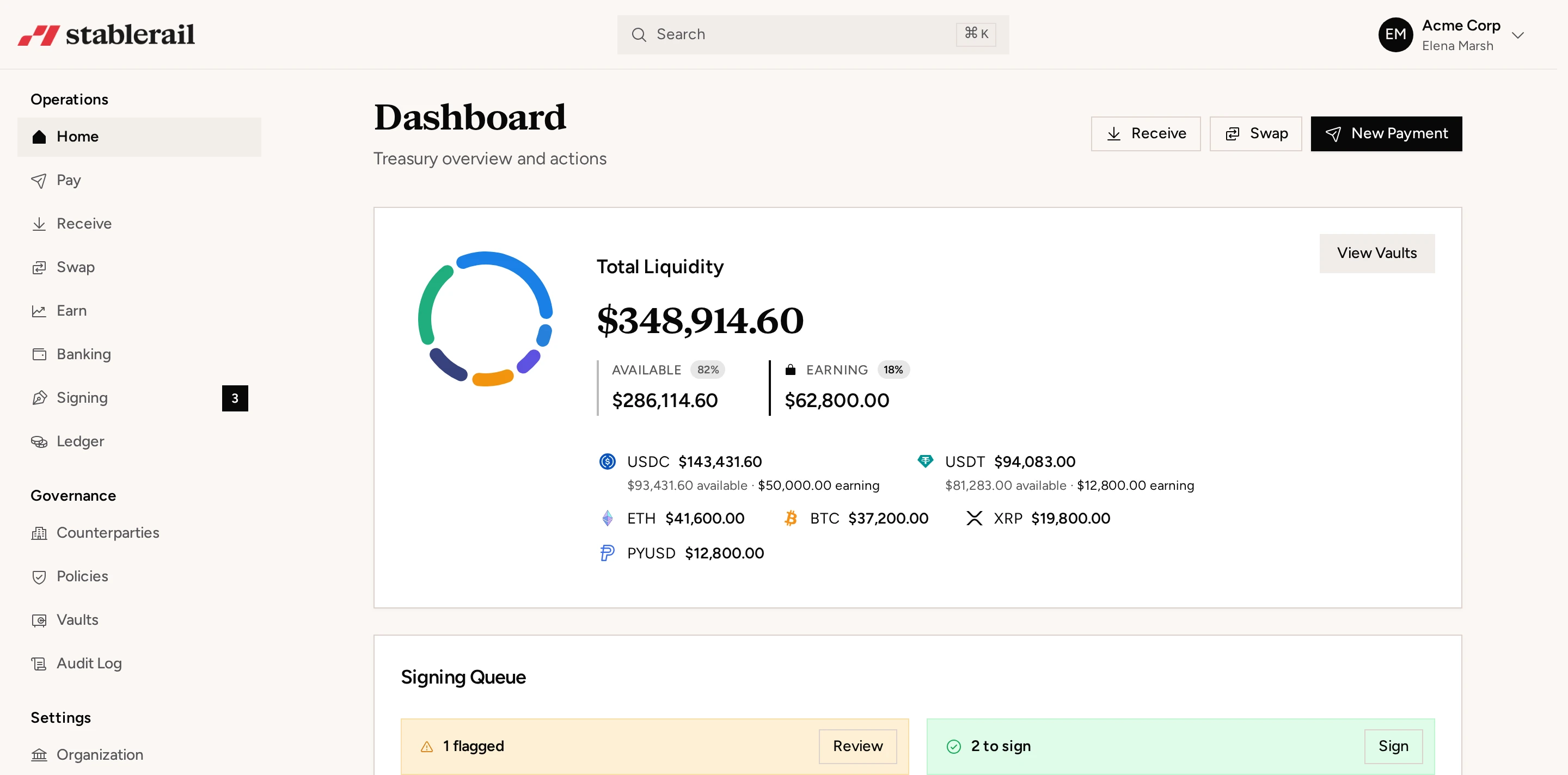
For self-custodial accounts, evidence should show which approval and signing quorum applied without exposing private signing material. Screening results may also be relevant where addresses are checked before a transfer. Stablerail, for example, combines approvals and signing quorum, sanctions and address screening before send, global payouts, fiat off-ramp and exportable audit evidence in one business account for USDC and USDT treasury.
Ask how long records remain available, which roles can export them and whether an auditor can reproduce a report using read-only access. Also verify that changes to counterparties, wallet labels or accounting mappings leave a history rather than rewriting prior evidence.
Run a controlled evaluation
Use a test set that reflects normal activity and failure conditions. The provider should demonstrate the full path from instruction to accounting export, not just a wallet dashboard.
- Include an incoming payment, batch payout, internal transfer, failed transaction, replacement, conversion, network fee and fiat settlement.
- Confirm that every item is assigned to the correct legal entity, wallet, purpose and counterparty.
- Reconcile the blockchain and fiat legs using original references and timestamps.
- Resolve exceptions and verify that ownership, notes and evidence remain visible.
- Export the period twice and confirm that stable identifiers prevent duplicate postings.
- Produce an evidence pack and test whether a reviewer can trace each journal line back to its source.
The best stablecoin reconciliation tool is the one that can explain the entire economic event: why a transaction occurred, who approved it, what moved on-chain, what settled through the banking system, which fees and rates applied, how exceptions were resolved and what reached the ledger. A polished blockchain feed is useful, but it is not sufficient for treasury control or financial close.
Frequently asked questions
What is stablecoin reconciliation?
Stablecoin reconciliation is the process of matching USDC, USDT or other on-chain movements to invoices, payouts, conversions, fees, bank settlements and accounting entries. The result should explain the transaction's purpose, counterparty, approval history and ledger treatment.
What should a stablecoin reconciliation tool track?
It should track the legal entity, wallet, blockchain, transaction reference, addresses, token contract, amount, fees, timestamps and confirmation status. It should also link each movement to its commercial record, fiat settlement, approval evidence and accounting export.
How do you reconcile a stablecoin-to-fiat conversion?
Match the stablecoin delivery to the conversion record and then to the resulting bank credit. Preserve the exchange rate, gross and net amounts, blockchain fee, conversion charge, bank reference, value date and settlement status so differences can be explained.
How can finance prevent duplicate stablecoin journal entries?
Use stable export IDs and posting statuses, and require exports or API operations to be idempotent. Replacement blockchain transactions should remain linked to the original business instruction rather than being treated as separate expenses.
Can stablecoin reconciliation be done with blockchain data alone?
No. Blockchain data proves that an on-chain movement occurred, but it does not by itself explain the invoice, payout purpose, legal entity, approval, conversion terms, bank settlement or accounting treatment. Reconciliation must connect on-chain evidence with internal and fiat records.
Finance writers covering stablecoin treasury, payments, compliance, and risk controls.
More about the Stablerail team- Stablecoin treasury managementApprovals, limits, yield and reporting on one balance.
- Stablecoin payoutsBatch contractor and vendor payments with screening.
- USDT vs USDCWhich stablecoin your company should settle in.
- Stablecoin finance glossaryMPC, off-ramp, travel rule and the rest, in plain English.
- Product updatesEverything we ship, month by month.