
How to Choose Crypto Treasury Management Software for an Enterprise
A practical enterprise checklist for evaluating stablecoin custody, fiat rails, conversions, payouts, permissions, reporting, integrations, security and support.
Choose crypto treasury management software by testing it against your company’s real money flows, not its feature list. Confirm exact stablecoin and network support, who controls funds, approval and recovery procedures, fiat access by legal entity, total conversion costs, payout controls, sanctions screening and audit evidence. Before committing material funds, run a controlled pilot covering deposits, conversions, approvals, payments, failures, reconciliation and signer recovery.

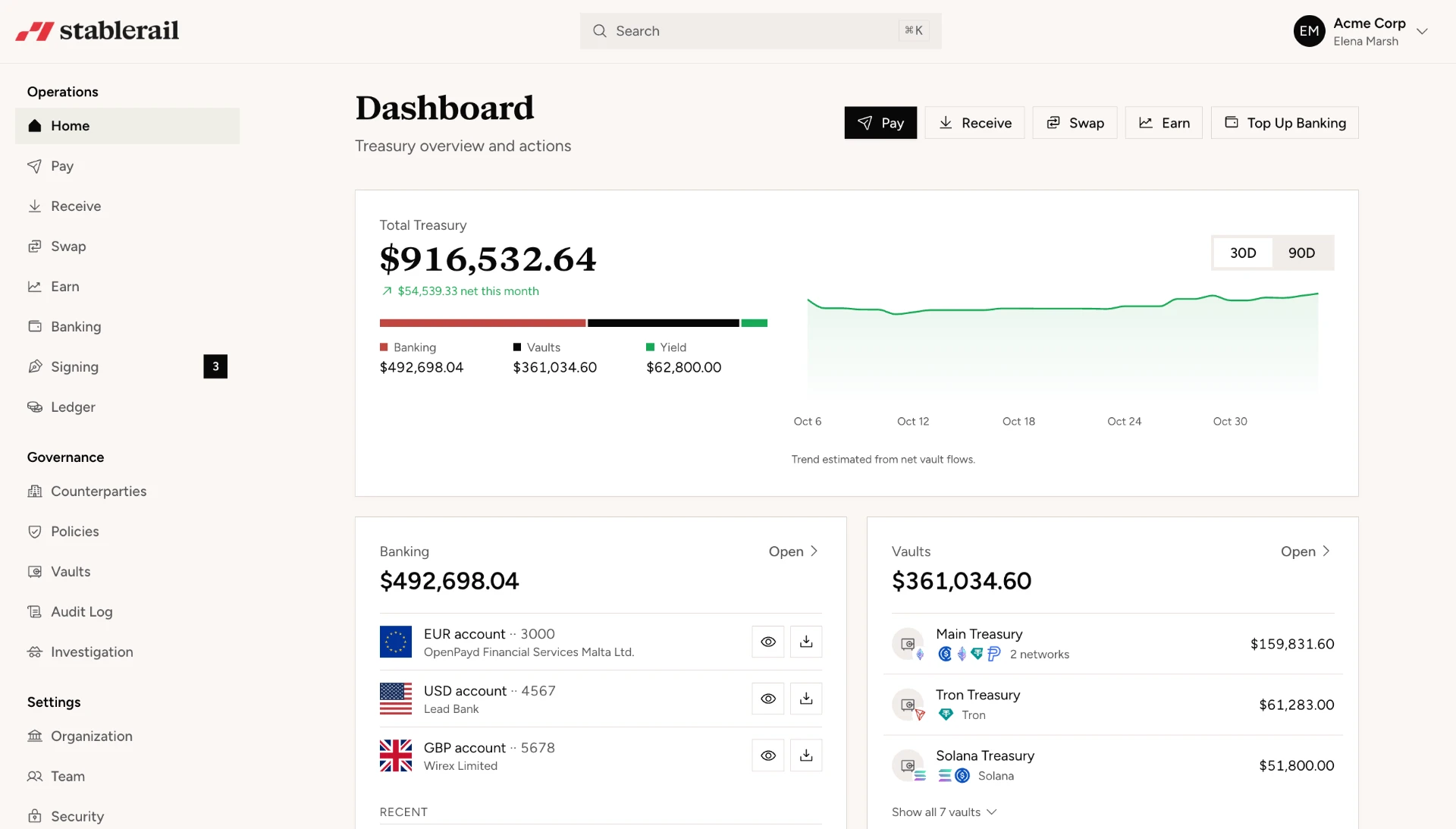
Choosing crypto treasury management software is not simply a wallet comparison. An enterprise treasury needs to receive, hold, convert and pay company funds while preserving approval authority, transaction evidence and access to fiat banking rails.
The evaluation should begin with actual workflows: which entities own the funds, which currencies and networks they use, how quickly money must move, and who can approve each transaction. Product demonstrations should then reproduce those workflows using realistic amounts, users and counterparties.
1. Define the required assets and networks
Start with a list of stablecoins, networks and legal entities. USDC on Ethereum is operationally different from USDC on Base or Solana. The token may track the same currency, but wallet addresses, fees, settlement speeds and counterparty support vary.
Stablerail supports corporate USDC and USDT treasury activity across Ethereum, Base, Arbitrum, Polygon, Tron, BNB Chain, Optimism and Solana. Enterprises should still confirm the exact token and network combination required. “USDT support,” for example, does not necessarily mean that every USDT network is available.
- Record the token contract and network for every asset.
- Check whether deposits are detected automatically and how many confirmations are required before funds become available.
- Confirm how network fees are funded, estimated and reported.
- Ask what happens if a sender uses an unsupported token or network.
- Test whether balances can be separated by entity, department or operating purpose.
A good platform should also make the network explicit before approval. Sending to a valid address on the wrong network can result in delayed or unrecoverable funds.
2. Examine the stablecoin custody model
Stablecoin custody determines who controls transaction signing. In a self-custodial model, the company retains authority over its wallets rather than transferring funds into a pooled account controlled solely by the provider.
Stablerail uses self-custodial multi-party computation, or MPC, vaults with quorum signing. MPC divides the cryptographic signing process among multiple key shares. A quorum policy can require, for example, two authorised approvals before a transaction is signed, without reconstructing one complete private key in a single place.
Do not stop at the term “MPC.” Ask the provider to document:
- Who holds each key share and whether the provider can move funds independently.
- How many signers can be configured and which approval quorums are supported.
- How devices, users and replacement signers are enrolled.
- What recovery looks like if a signer leaves or loses access.
- Whether the business can export transaction records and retain access during a service disruption.
Run a recovery exercise before funding the vault with a material balance. Recovery procedures that exist only in documentation may fail when people, devices or corporate records have changed.
3. Map fiat connectivity and settlement times
Crypto treasury management software should connect stablecoin balances to the fiat rails the business actually uses. Evaluate account ownership, available currencies, beneficiary requirements, cut-off times and return handling—not just the presence of a “bank transfer” button.
| Rail | Typical timing | Primary use |
|---|---|---|
| SEPA Instant | Usually seconds, 24/7 where supported | Urgent EUR transfers |
| SEPA | Commonly same or next business day | Standard EUR payments |
| ACH | Often 1–3 business days | Routine USD collections and payments |
| Fedwire | Same business day before applicable cut-offs | Time-sensitive USD transfers |
| SWIFT | Often 1–5 business days | Cross-border bank payments |
| Faster Payments | Usually seconds or minutes | UK GBP payments |
| CHAPS | Same business day before cut-off | High-value GBP payments |
| BACS | Typically three working days | Scheduled GBP payments |
These are general rail expectations, not guaranteed delivery times. Intermediary banks, compliance reviews, local holidays and recipient-bank processing can extend settlement.
Stablerail provides EUR, USD and GBP connectivity through relevant rails, including virtual IBANs and multi-currency balances. During evaluation, confirm which services are available to each legal entity because onboarding depends on jurisdiction, industry and KYB eligibility.
4. Compare conversions using the delivered amount
An on-ramp converts fiat into stablecoins; an off-ramp converts stablecoins into fiat. Compare providers using a fixed scenario, such as converting €100,000 into USDC and paying it to a wallet on Base.
The quote should disclose the input amount, exchange rate, platform fee, network fee, output amount and quote expiry. Stablerail publishes corridor pricing, but the applicable price should still be checked for the specific currency, stablecoin, network, size and destination.
Ask whether conversions settle from existing balances or require a separate transfer. Also test what happens when a quote expires, a bank transfer arrives short, or a stablecoin deposit is received after the quoted window.
5. Test payouts from file to reconciliation
Enterprise treasury software should handle the full payout cycle rather than merely broadcast a blockchain transaction. Stablerail supports batch vendor and contractor payments, payroll, invoices and payment links. See the stablecoin payouts workflow for relevant use cases.
Use a test batch containing different amounts, networks and exception cases. Evaluate:
- CSV or API input validation before approval.
- Duplicate-payment detection and beneficiary allowlists.
- Batch approval without obscuring individual recipients.
- Status tracking from submitted to confirmed, failed or returned.
- Exportable transaction hashes, fees, timestamps and references.
- A safe process for retrying failed items without repaying successful ones.
If payroll is in scope, review privacy, cut-off management and employee wallet collection separately. A dedicated crypto payroll workflow may be preferable to a generic bulk transfer.
6. Verify permissions and treasury controls
Treasury controls should match the company’s delegation policy. Look for role-based access, approval limits, quorum signing, beneficiary allowlists and separation between creating and approving a payment.
Test whether rules can vary by entity, asset, amount or destination. Confirm that sanctions and wallet screening results are recorded, exceptions require a documented decision, and policy changes appear in an immutable audit log.
Corporate cards should be evaluated under the same framework. Stablerail offers virtual and physical cards funded from treasury balances, with spending limits and merchant category code controls. Check issuance eligibility, supported regions, funding mechanics, foreign-exchange treatment and how card transactions reconcile against the treasury ledger.
7. Review reporting and integrations
Finance teams need records that connect bank transfers, conversions and blockchain transactions. Export a sample month and confirm that each movement includes its entity, account or wallet, asset, network, gross amount, fees, fiat value, counterparty, approvers, timestamps and external references.
For integrations, inspect API documentation, authentication, webhooks, rate limits, idempotency and sandbox coverage. Idempotency means the same API request can be retried without accidentally creating a duplicate payment. Ask how data maps into the company’s ERP, accounting system and reconciliation process.
Evidence packs should combine approval history, screening results, transaction details and supporting documents in a form that finance teams can provide to auditors or internal reviewers.
8. Assess security and operational support
Request architecture and incident-response documentation appropriate to the procurement review. Examine user authentication, device management, encryption, key-share recovery, change controls, monitoring and notification procedures. Avoid treating a certification or questionnaire as a substitute for testing the actual fund-movement process.
Operational support matters most when a payment is delayed or an approver loses access. Establish support hours, escalation routes, severity definitions and who handles issues involving banking partners or blockchains. The help centre can indicate whether routine operating procedures are documented, but enterprise buyers should also validate escalation paths directly.
Enterprise evaluation checklist
- Assets: Exact USDC and USDT network combinations are documented.
- Custody: MPC ownership, quorum rules and recovery have been tested.
- Fiat: Required accounts, currencies, rails, cut-offs and return processes are available.
- Conversions: Quotes disclose rates, fees, network costs and delivered amounts.
- Payouts: Batch creation, approvals, exceptions and reconciliation work end to end.
- Permissions: Roles, limits, allowlists and policy changes match internal authority.
- Reporting: Finance can export a complete audit trail and evidence pack.
- Integrations: APIs, webhooks and accounting exports handle retries safely.
- Security: Recovery and incident procedures have named owners and test evidence.
- Support: Escalation coverage fits the company’s payment schedule and regions.
The best enterprise treasury platform is the one that completes the company’s real operating cycle: receive funds, safeguard them, convert at a visible cost, approve payments, settle through the required rail and produce usable records. Score those workflows with evidence from a sandbox or controlled pilot before making a procurement decision.
Frequently asked questions
What is crypto treasury management software?
Crypto treasury management software helps a company hold, convert and move digital assets while applying finance controls such as permissions, approvals and transaction records. Enterprise platforms may also connect stablecoin balances with fiat conversion, payouts, cards and accounting evidence.
How should a CFO compare stablecoin custody options?
Compare who controls each key or key share, whether the provider can move funds alone, how signing quorum works and what happens when a signer leaves or loses a device. The review should also cover backup, recovery and the process for moving funds away from the provider.
What controls should enterprise crypto treasury software have?
Look for role separation, quorum approvals, controlled beneficiary changes, transaction limits, address screening and durable audit logs. Test the controls with preparer, approver, administrator and read-only roles rather than relying only on product documentation.
How do companies calculate the cost of converting fiat to stablecoins?
Compare the final stablecoin amount delivered after the exchange-rate spread, platform charges, banking costs and blockchain fees. Also review quote expiry, settlement time, transaction limits and whether liquidity or pricing changes outside local banking hours.
How do you test crypto treasury software before implementation?
Run a small end-to-end pilot covering funding, conversion, approvals, payouts, failed transactions, signer recovery and accounting export. Record actual costs, timing, manual steps and the evidence retained for each workflow.
Finance writers covering stablecoin treasury, payments, compliance, and risk controls.
More about the Stablerail team- Stablecoin treasury managementApprovals, limits, yield and reporting on one balance.
- Stablecoin payoutsBatch contractor and vendor payments with screening.
- USDT vs USDCWhich stablecoin your company should settle in.
- Stablecoin finance glossaryMPC, off-ramp, travel rule and the rest, in plain English.
- Product updatesEverything we ship, month by month.