
What a Business Fiat Account Gives You Alongside Stablecoins
A business fiat account connects bank transfers with stablecoin treasury operations, helping finance teams collect USD or EUR, pay fiat-only suppliers and reconcile conversions.
A business fiat account alongside stablecoins lets a company receive and hold currencies such as USD or EUR, pay counterparties through bank rails, and convert funds to or from USDC or USDT. It closes the operational gap between on-chain treasury and obligations that still require fiat, while giving finance teams clearer beneficiary records, approvals, reconciliation data and supporting evidence than a fragmented bank-and-exchange workflow.
%22%20x1%3D%220%22%20y1%3D%220%22%20x2%3D%221%22%20y2%3D%221%22%3E%0A%20%20%20%20%20%20%20%20%3Cstop%20offset%3D%220%25%22%20stop-color%3D%22%233E090D%22%20%2F%3E%0A%20%20%20%20%20%20%20%20%3Cstop%20offset%3D%2250%25%22%20stop-color%3D%22%235C1218%22%20%2F%3E%0A%20%20%20%20%20%20%20%20%3Cstop%20offset%3D%22100%25%22%20stop-color%3D%22%237B1F22%22%20%2F%3E%0A%20%20%20%20%20%20%3C%2FlinearGradient%3E%0A%20%20%20%20%20%20%3CradialGradient%20id%3D%22glow%22%20cx%3D%22465%22%20cy%3D%22-209%22%20r%3D%22520%22%20gradientUnits%3D%22userSpaceOnUse%22%3E%0A%20%20%20%20%20%20%20%20%3Cstop%20offset%3D%220%25%22%20stop-color%3D%22%23FF8E72%22%20stop-opacity%3D%220.45%22%20%2F%3E%0A%20%20%20%20%20%20%20%20%3Cstop%20offset%3D%2255%25%22%20stop-color%3D%22%23FF8E72%22%20stop-opacity%3D%220.08%22%20%2F%3E%0A%20%20%20%20%20%20%20%20%3Cstop%20offset%3D%22100%25%22%20stop-color%3D%22%23FF8E72%22%20stop-opacity%3D%220%22%20%2F%3E%0A%20%20%20%20%20%20%3C%2FradialGradient%3E%0A%20%20%20%20%20%20%3ClinearGradient%20id%3D%22glass%22%20x1%3D%220%22%20y1%3D%220%22%20x2%3D%221%22%20y2%3D%221%22%3E%0A%20%20%20%20%20%20%20%20%3Cstop%20offset%3D%220%25%22%20stop-color%3D%22%23F8D6D2%22%20stop-opacity%3D%220.26%22%20%2F%3E%0A%20%20%20%20%20%20%20%20%3Cstop%20offset%3D%22100%25%22%20stop-color%3D%22%23FFFFFF%22%20stop-opacity%3D%220.08%22%20%2F%3E%0A%20%20%20%20%20%20%3C%2FlinearGradient%3E%0A%20%20%20%20%20%20%3ClinearGradient%20id%3D%22accent%22%20x1%3D%220%22%20y1%3D%220%22%20x2%3D%221%22%20y2%3D%221%22%3E%0A%20%20%20%20%20%20%20%20%3Cstop%20offset%3D%220%25%22%20stop-color%3D%22%23FF8E72%22%20%2F%3E%0A%20%20%20%20%20%20%20%20%3Cstop%20offset%3D%22100%25%22%20stop-color%3D%22%23D94030%22%20%2F%3E%0A%20%20%20%20%20%20%3C%2FlinearGradient%3E%0A%20%20%20%20%20%20%3Cfilter%20id%3D%22soft%22%3E%3CfeGaussianBlur%20stdDeviation%3D%2210%22%20%2F%3E%3C%2Ffilter%3E%0A%20%20%20%20%3C%2Fdefs%3E%0A%20%20%20%20%3Crect%20width%3D%221600%22%20height%3D%22900%22%20fill%3D%22url(%23bg)%22%20%2F%3E%0A%20%20%20%20%3Crect%20width%3D%221600%22%20height%3D%22900%22%20fill%3D%22url(%23glow)%22%20%2F%3E%0A%20%20%20%20%3Crect%20x%3D%22340%22%20y%3D%22220%22%20width%3D%22118%22%20height%3D%22108%22%20rx%3D%2210%22%20fill%3D%22url(%23accent)%22%20fill-opacity%3D%220.9%22%20stroke%3D%22%23F4CDC5%22%20stroke-opacity%3D%220.4%22%2F%3E%3Crect%20x%3D%22480%22%20y%3D%22220%22%20width%3D%22118%22%20height%3D%22108%22%20rx%3D%2210%22%20fill%3D%22url(%23glass)%22%20fill-opacity%3D%221%22%20stroke%3D%22%23F4CDC5%22%20stroke-opacity%3D%220.4%22%2F%3E%3Crect%20x%3D%22620%22%20y%3D%22220%22%20width%3D%22118%22%20height%3D%22108%22%20rx%3D%2210%22%20fill%3D%22url(%23accent)%22%20fill-opacity%3D%220.9%22%20stroke%3D%22%23F4CDC5%22%20stroke-opacity%3D%220.4%22%2F%3E%3Crect%20x%3D%22760%22%20y%3D%22220%22%20width%3D%22118%22%20height%3D%22108%22%20rx%3D%2210%22%20fill%3D%22url(%23accent)%22%20fill-opacity%3D%220.9%22%20stroke%3D%22%23F4CDC5%22%20stroke-opacity%3D%220.4%22%2F%3E%3Crect%20x%3D%22900%22%20y%3D%22220%22%20width%3D%22118%22%20height%3D%22108%22%20rx%3D%2210%22%20fill%3D%22url(%23accent)%22%20fill-opacity%3D%220.9%22%20stroke%3D%22%23F4CDC5%22%20stroke-opacity%3D%220.4%22%2F%3E%3Crect%20x%3D%221040%22%20y%3D%22220%22%20width%3D%22118%22%20height%3D%22108%22%20rx%3D%2210%22%20fill%3D%22url(%23accent)%22%20fill-opacity%3D%220.9%22%20stroke%3D%22%23F4CDC5%22%20stroke-opacity%3D%220.4%22%2F%3E%3Crect%20x%3D%221180%22%20y%3D%22220%22%20width%3D%22118%22%20height%3D%22108%22%20rx%3D%2210%22%20fill%3D%22url(%23glass)%22%20fill-opacity%3D%221%22%20stroke%3D%22%23F4CDC5%22%20stroke-opacity%3D%220.4%22%2F%3E%3Crect%20x%3D%22340%22%20y%3D%22350%22%20width%3D%22118%22%20height%3D%22108%22%20rx%3D%2210%22%20fill%3D%22url(%23glass)%22%20fill-opacity%3D%221%22%20stroke%3D%22%23F4CDC5%22%20stroke-opacity%3D%220.4%22%2F%3E%3Crect%20x%3D%22480%22%20y%3D%22350%22%20width%3D%22118%22%20height%3D%22108%22%20rx%3D%2210%22%20fill%3D%22url(%23accent)%22%20fill-opacity%3D%220.9%22%20stroke%3D%22%23F4CDC5%22%20stroke-opacity%3D%220.4%22%2F%3E%3Crect%20x%3D%22620%22%20y%3D%22350%22%20width%3D%22118%22%20height%3D%22108%22%20rx%3D%2210%22%20fill%3D%22url(%23glass)%22%20fill-opacity%3D%221%22%20stroke%3D%22%23F4CDC5%22%20stroke-opacity%3D%220.4%22%2F%3E%3Crect%20x%3D%22760%22%20y%3D%22350%22%20width%3D%22118%22%20height%3D%22108%22%20rx%3D%2210%22%20fill%3D%22url(%23accent)%22%20fill-opacity%3D%220.9%22%20stroke%3D%22%23F4CDC5%22%20stroke-opacity%3D%220.4%22%2F%3E%3Crect%20x%3D%22900%22%20y%3D%22350%22%20width%3D%22118%22%20height%3D%22108%22%20rx%3D%2210%22%20fill%3D%22url(%23accent)%22%20fill-opacity%3D%220.9%22%20stroke%3D%22%23F4CDC5%22%20stroke-opacity%3D%220.4%22%2F%3E%3Crect%20x%3D%221040%22%20y%3D%22350%22%20width%3D%22118%22%20height%3D%22108%22%20rx%3D%2210%22%20fill%3D%22url(%23accent)%22%20fill-opacity%3D%220.9%22%20stroke%3D%22%23F4CDC5%22%20stroke-opacity%3D%220.4%22%2F%3E%3Crect%20x%3D%221180%22%20y%3D%22350%22%20width%3D%22118%22%20height%3D%22108%22%20rx%3D%2210%22%20fill%3D%22url(%23accent)%22%20fill-opacity%3D%220.9%22%20stroke%3D%22%23F4CDC5%22%20stroke-opacity%3D%220.4%22%2F%3E%3Crect%20x%3D%22340%22%20y%3D%22480%22%20width%3D%22118%22%20height%3D%22108%22%20rx%3D%2210%22%20fill%3D%22url(%23accent)%22%20fill-opacity%3D%220.9%22%20stroke%3D%22%23F4CDC5%22%20stroke-opacity%3D%220.4%22%2F%3E%3Crect%20x%3D%22480%22%20y%3D%22480%22%20width%3D%22118%22%20height%3D%22108%22%20rx%3D%2210%22%20fill%3D%22url(%23glass)%22%20fill-opacity%3D%221%22%20stroke%3D%22%23F4CDC5%22%20stroke-opacity%3D%220.4%22%2F%3E%3Crect%20x%3D%22620%22%20y%3D%22480%22%20width%3D%22118%22%20height%3D%22108%22%20rx%3D%2210%22%20fill%3D%22url(%23glass)%22%20fill-opacity%3D%221%22%20stroke%3D%22%23F4CDC5%22%20stroke-opacity%3D%220.4%22%2F%3E%3Crect%20x%3D%22760%22%20y%3D%22480%22%20width%3D%22118%22%20height%3D%22108%22%20rx%3D%2210%22%20fill%3D%22url(%23glass)%22%20fill-opacity%3D%221%22%20stroke%3D%22%23F4CDC5%22%20stroke-opacity%3D%220.4%22%2F%3E%3Crect%20x%3D%22900%22%20y%3D%22480%22%20width%3D%22118%22%20height%3D%22108%22%20rx%3D%2210%22%20fill%3D%22url(%23accent)%22%20fill-opacity%3D%220.9%22%20stroke%3D%22%23F4CDC5%22%20stroke-opacity%3D%220.4%22%2F%3E%3Crect%20x%3D%221040%22%20y%3D%22480%22%20width%3D%22118%22%20height%3D%22108%22%20rx%3D%2210%22%20fill%3D%22url(%23glass)%22%20fill-opacity%3D%221%22%20stroke%3D%22%23F4CDC5%22%20stroke-opacity%3D%220.4%22%2F%3E%3Crect%20x%3D%221180%22%20y%3D%22480%22%20width%3D%22118%22%20height%3D%22108%22%20rx%3D%2210%22%20fill%3D%22url(%23glass)%22%20fill-opacity%3D%221%22%20stroke%3D%22%23F4CDC5%22%20stroke-opacity%3D%220.4%22%2F%3E%3Crect%20x%3D%22340%22%20y%3D%22610%22%20width%3D%22118%22%20height%3D%22108%22%20rx%3D%2210%22%20fill%3D%22url(%23accent)%22%20fill-opacity%3D%220.9%22%20stroke%3D%22%23F4CDC5%22%20stroke-opacity%3D%220.4%22%2F%3E%3Crect%20x%3D%22480%22%20y%3D%22610%22%20width%3D%22118%22%20height%3D%22108%22%20rx%3D%2210%22%20fill%3D%22url(%23accent)%22%20fill-opacity%3D%220.9%22%20stroke%3D%22%23F4CDC5%22%20stroke-opacity%3D%220.4%22%2F%3E%3Crect%20x%3D%22620%22%20y%3D%22610%22%20width%3D%22118%22%20height%3D%22108%22%20rx%3D%2210%22%20fill%3D%22url(%23accent)%22%20fill-opacity%3D%220.9%22%20stroke%3D%22%23F4CDC5%22%20stroke-opacity%3D%220.4%22%2F%3E%3Crect%20x%3D%22760%22%20y%3D%22610%22%20width%3D%22118%22%20height%3D%22108%22%20rx%3D%2210%22%20fill%3D%22url(%23accent)%22%20fill-opacity%3D%220.9%22%20stroke%3D%22%23F4CDC5%22%20stroke-opacity%3D%220.4%22%2F%3E%3Crect%20x%3D%22900%22%20y%3D%22610%22%20width%3D%22118%22%20height%3D%22108%22%20rx%3D%2210%22%20fill%3D%22url(%23glass)%22%20fill-opacity%3D%221%22%20stroke%3D%22%23F4CDC5%22%20stroke-opacity%3D%220.4%22%2F%3E%3Crect%20x%3D%221040%22%20y%3D%22610%22%20width%3D%22118%22%20height%3D%22108%22%20rx%3D%2210%22%20fill%3D%22url(%23glass)%22%20fill-opacity%3D%221%22%20stroke%3D%22%23F4CDC5%22%20stroke-opacity%3D%220.4%22%2F%3E%3Crect%20x%3D%221180%22%20y%3D%22610%22%20width%3D%22118%22%20height%3D%22108%22%20rx%3D%2210%22%20fill%3D%22url(%23accent)%22%20fill-opacity%3D%220.9%22%20stroke%3D%22%23F4CDC5%22%20stroke-opacity%3D%220.4%22%2F%3E%0A%20%20%20%20%3Crect%20x%3D%2226%22%20y%3D%2226%22%20width%3D%221548%22%20height%3D%22848%22%20rx%3D%2218%22%20fill%3D%22none%22%20stroke%3D%22%23F2D0C8%22%20stroke-opacity%3D%220.12%22%2F%3E%0A%20%20%3C%2Fsvg%3E)
A business fiat account gives a stablecoin company access to conventional payment rails without treating banking and on-chain treasury as separate operations. Customers can pay invoices by bank transfer, suppliers can receive their required currency, and the finance team can move between fiat and USDC or USDT with a documented conversion record.
This matters because stablecoins do not eliminate fiat obligations. Payroll, taxes, insurance, rent and many supplier invoices still settle through domestic bank networks. The practical goal is therefore not to replace fiat completely, but to connect fiat receipts and payments to the company’s stablecoin treasury with appropriate controls.
What a business fiat account provides
After know-your-business checks and eligibility approval, a provider may issue account details associated with the verified company. Depending on the provider, currency and jurisdiction, these can include USD details for ACH or wire transfers and a EUR IBAN for SEPA payments.
Finance teams should confirm the legal structure behind the details. “Named” details generally mean the verified business appears as the beneficiary, but they do not necessarily mean the company has a directly opened bank account in every country. The account may be provided through a banking or payment institution partner, and customer funds may be held under a safeguarding, custodial or pooled-account arrangement. Ask who legally holds the funds, which terms apply and whether the details support payments to and from third parties.
The main operating functions are:
- Receive customer payments: Add company USD or EUR details to invoices so customers can use familiar bank rails.
- Hold fiat balances: Retain currency for near-term payroll, taxes and supplier expenses instead of converting every receipt immediately.
- Pay fiat-only counterparties: Send funds to vendors, employees or other approved beneficiaries that cannot accept stablecoins.
- Convert funds: Move between supported fiat currencies and USDC or USDT through an on-ramp or off-ramp.
- Reconcile activity: Connect incoming transfers, outgoing payments, conversion records and on-chain transaction identifiers to the accounting ledger.
How the main fiat payment rails compare
The correct payment rail depends on currency, destination, urgency, counterparty requirements and provider support. Timings are indicative, not guarantees: cut-off times, weekends, holidays, compliance reviews, intermediary banks and beneficiary-bank processing can all affect delivery.
| Rail | Best suited to | Typical processing pattern | Finance control to prioritise |
|---|---|---|---|
| ACH | Routine domestic USD receipts and payments | Often one to three business days, depending on submission type and provider | Monitor returns and avoid treating a recent credit as irrevocable |
| Fedwire | Urgent domestic USD payments | Generally same business day when accepted before cut-off | Independently verify beneficiary instructions because wires are difficult to recover |
| SEPA Credit Transfer | Standard EUR transfers within the SEPA area | Commonly delivered by the next business day | Validate the IBAN, beneficiary name and remittance reference |
| SEPA Instant | Urgent EUR transfers between participating institutions | Designed for processing within seconds, at any time | Check provider availability, transaction limits and beneficiary details before release |
| SWIFT | Cross-border payments outside a domestic or regional scheme | Often takes several business days | Confirm correspondent fees, required payment purpose and intermediary-bank details |
| Faster Payments, BACS or CHAPS | Domestic GBP collections, scheduled payments or urgent transfers | Varies by scheme: near-real-time, scheduled or same-day | Select the rail based on urgency, value, provider limits and cut-off time |
A quoted arrival time is not the same as final settlement certainty. For example, ACH entries can be returned under applicable network rules, while a receiving bank can delay a transfer for additional review. Treasury policies should distinguish between a payment appearing in an interface and funds being available for onward conversion or withdrawal.
Receiving customer bank transfers
A fiat account allows a customer to pay by bank transfer even when the recipient company ultimately keeps part of its treasury in stablecoins. The invoice should state the beneficiary’s exact legal name, currency, account or IBAN details, bank identifier where required and a unique payment reference.
- Issue the invoice with details for the correct currency and payment rail.
- Ask the customer to pay from an account held in its own name where possible.
- Match the payer name, amount, currency and reference to the open receivable.
- Investigate overpayments, short payments and unexpected third-party senders before allocating funds.
- Retain the receipt in fiat or approve a conversion to USDC or USDT.
- Attach the bank transaction and any conversion record to the accounting entry.
Unique invoice references reduce manual work when many customers pay into the same currency account. Where a provider offers virtual account details, separate details may also help attribute receipts to customers, entities or business units. Finance should still understand whether those details create separate legal accounts or are simply identifiers feeding one underlying balance.
Paying suppliers that cannot accept stablecoins
A supplier may require USD by ACH or wire, EUR to an IBAN, or another currency through a local or cross-border rail. A connected fiat account lets the treasury team convert the required USDC or USDT and initiate the bank payment without manually routing assets through an unrelated exchange and bank account.
Before releasing a supplier payment, verify:
- The supplier’s legal beneficiary name, address and account ownership.
- The routing number, account number, IBAN, BIC or intermediary details required for the selected rail.
- The invoice currency, due date and remittance reference.
- Whether sending, correspondent or receiving-bank fees may reduce the delivered amount.
- The applicable cut-off time and holidays in both sending and receiving markets.
- Whether the payment requires an invoice, contract or documented payment purpose.
Changes to beneficiary details require particular caution. Do not approve replacement instructions solely because they arrived from a familiar email address. Verify them through a previously established contact method, separate beneficiary creation from payment approval, and require additional approval for first payments or material changes.
Converting between fiat and stablecoins
The conversion layer connects bank balances to on-chain liquidity. A company might receive EUR through an IBAN, convert it to USDC and pay contractors on-chain. In the other direction, it might sell USDT for USD and send the proceeds to a supplier through a domestic wire.
Review the executable quote rather than comparing only a headline exchange rate. The quote or confirmation should identify the asset sold, asset received, exchange rate, spread or fee, quote expiry, settlement destination and expected availability. For stablecoin delivery, it must also specify the token and blockchain network. USDC or USDT on one network is operationally different from the same ticker on another network.
Before approving a conversion, answer these questions:
- Is the beneficiary fiat account or wallet owned by the verified company?
- Are the stablecoin contract and destination network supported?
- What exact net amount will arrive after fees or spread?
- When can the proceeds be withdrawn or used for another payment?
- What transaction ID, statement or trade confirmation will support reconciliation?
Pricing and availability can differ by currency, token, network, size and corridor. Teams should use the live transaction quote and provider terms rather than assume that every USD, EUR, USDC and USDT route has identical economics.
Controls and accounting evidence
Combining fiat and stablecoins in one workflow does not remove the need for segregation of duties. The person entering beneficiary details should not be able to create and release a material payment alone. Use role-based access, approval thresholds and signing quorum, and review user permissions when employees change roles or leave.
For stablecoin sends, screen sanctions exposure and destination addresses before execution. Store the screening result with the approval, wallet address, network, token amount and on-chain transaction hash. For fiat payments, retain the invoice, beneficiary verification, approval history, bank confirmation and any supporting contract or payment-purpose documentation.
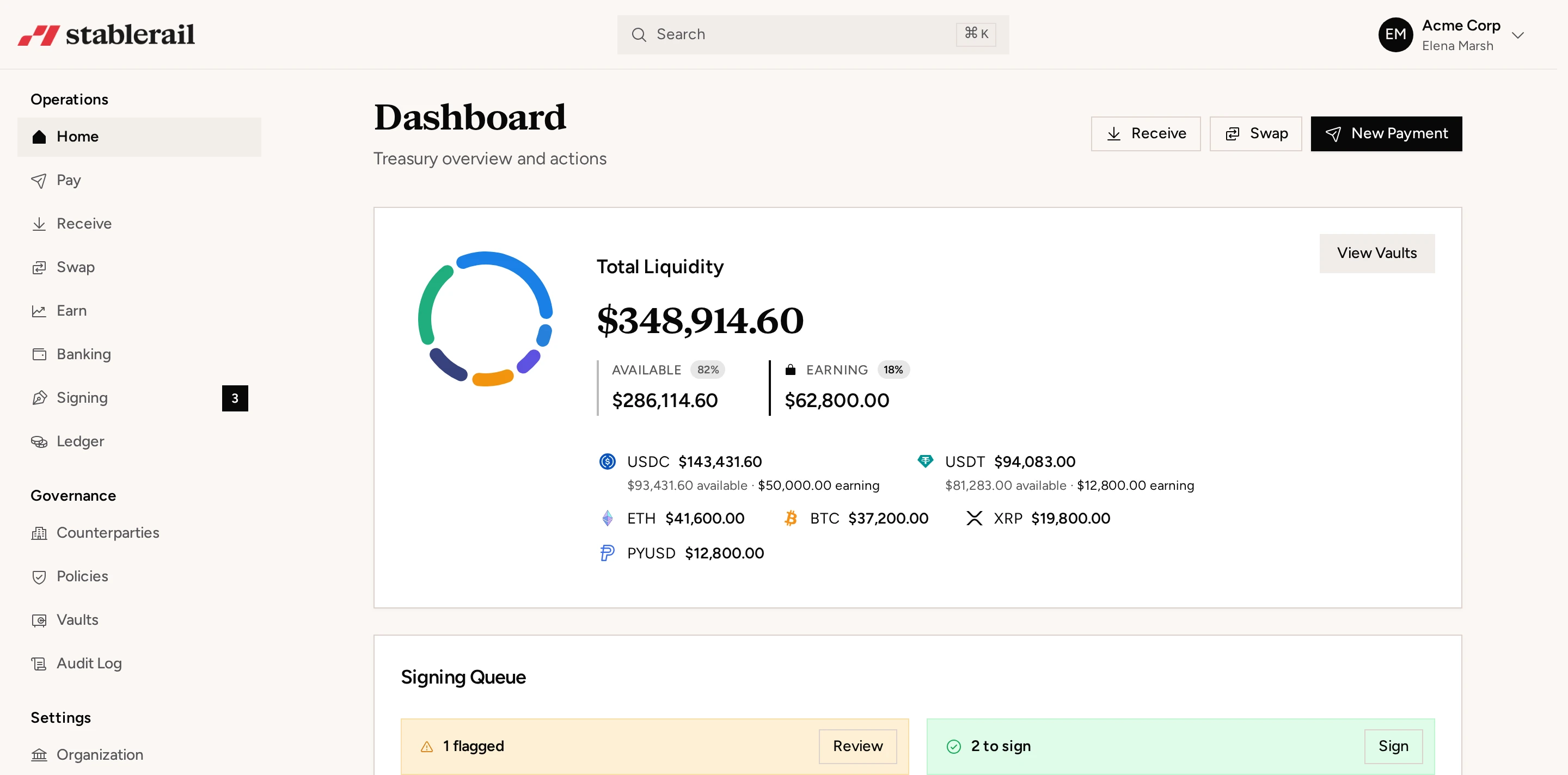
Stablerail brings USDC and USDT treasury, approvals and signing quorum, pre-send sanctions and address screening, global payouts, fiat off-ramp, corporate cards and exportable audit evidence into one business account. Regardless of provider, the finance team should confirm which functions are available for its entities, jurisdictions and transaction corridors.
What onboarding usually requires
Fiat account details are issued only after business verification and eligibility checks. Requirements vary with ownership, jurisdiction, industry and expected activity, but companies should prepare incorporation and registry records, operating addresses, director and beneficial-owner information, identity documents, a description of products and customers, expected currencies and volumes, and source-of-funds evidence where requested.
Provide a clear funds-flow explanation showing who pays the company, why funds are received, whether balances will be converted to stablecoins, which networks will be used and who the expected beneficiaries are. A precise operating description is more useful than broad labels such as “crypto payments.” Providers may later request invoices, contracts or transaction evidence when actual activity differs from the onboarding profile.
A practical treasury setup
Set a fiat liquidity floor based on near-term payroll, taxes, card settlement and fiat-only suppliers. Hold stablecoin working capital according to expected on-chain obligations, network availability and counterparty needs. Do not convert all receipts automatically unless the company has assessed timing, concentration, liquidity and operational risks.
A connected treasury is not simply a bank account beside a wallet. It is a controlled record of how value moved from an invoice to fiat, through a conversion, onto a specific network and eventually to an approved counterparty.
Reconcile fiat statements, conversion confirmations and blockchain transactions to the general ledger on a defined schedule. Record fees separately rather than netting unexplained differences into revenue or supplier expense. With clear account ownership, payment controls and exportable evidence, a business fiat account can make stablecoin treasury usable for the conventional financial obligations that companies still need to meet.
Frequently asked questions
Does a stablecoin business still need a fiat bank account?
Usually, yes. Customers, payroll providers, tax authorities and suppliers may require conventional bank transfers, so a fiat account provides the bridge between those obligations and a USDC or USDT treasury.
Can a business receive USD or EUR and convert it to USDC?
A provider may support USD or EUR account details and conversion into USDC, subject to entity eligibility, available corridors and transaction review. Confirm the executable rate, fees, settlement timing, token and blockchain network before approving the conversion.
What is the difference between a named account and a virtual account?
Named details identify the verified business as the payment beneficiary. Virtual details may be identifiers linked to an underlying pooled or master account, so finance teams should confirm legal account ownership, safeguarding or custody arrangements, and whether third-party payments are permitted.
How should a company account for fiat-to-stablecoin conversions?
Keep the bank transaction, conversion confirmation, fees, receiving wallet, blockchain network and transaction hash as one evidence chain. The precise accounting treatment depends on the applicable reporting framework and company policy, so it should be agreed with the company’s accountant or auditor.
How can finance teams reduce fraud when paying fiat suppliers?
Independently verify new or changed beneficiary details using a known contact channel. Separate beneficiary creation from payment approval, apply approval thresholds, and retain the invoice, verification record and payment confirmation.
Finance writers covering stablecoin treasury, payments, compliance, and risk controls.
More about the Stablerail team- Stablecoin treasury managementApprovals, limits, yield and reporting on one balance.
- Stablecoin payoutsBatch contractor and vendor payments with screening.
- USDT vs USDCWhich stablecoin your company should settle in.
- Stablecoin finance glossaryMPC, off-ramp, travel rule and the rest, in plain English.
- Product updatesEverything we ship, month by month.