
Best Tools for Monitoring Stablecoin Depeg, Redemption, and Liquidity Risk in Real Time
Compare tools for monitoring USDC and USDT price deviations, market liquidity, issuer reserves, redemption terms, on-chain flows, and counterparty exposure—with practical alert thresholds for treasury teams.

Stablecoin risk cannot be monitored with one price feed. A treasury team holding USDC or USDT needs to see whether a price deviation is isolated to one venue, supported by adequate liquidity, connected to unusual on-chain flows, or accompanied by a change in issuer redemption conditions.
The most reliable setup combines market data, decentralised exchange data, official issuer disclosures, blockchain analytics, and counterparty monitoring. Each source answers a different question, and each operates at a different speed.
Tool comparison at a glance
| Monitoring need | Representative tools | Best used for | Main limitation |
|---|---|---|---|
| Price deviations | TradingView, CoinGecko, Kaiko, Coin Metrics | Venue prices, composite prices, spreads, and alerts | Aggregated prices can hide stress on an individual venue |
| Exchange and DEX liquidity | Kaiko, Coin Metrics, DeFiLlama, GeckoTerminal | Order-book depth, pool liquidity, trading volume, and slippage | Quoted liquidity may disappear during volatile markets |
| Issuer reserves and attestations | Circle Transparency, Tether Transparency | Reserve composition, circulation, and assurance reports | Attestations are periodic rather than real time |
| Redemption conditions | Circle and Tether account documentation and terms | Eligibility, fees, minimums, timing, supported networks, and banking arrangements | Terms can change and may differ by entity or jurisdiction |
| On-chain flows | Etherscan, Tronscan, Solscan, Dune, Nansen, Arkham | Minting, burning, bridge activity, exchange inflows, and wallet concentration | Wallet labels are incomplete and sometimes uncertain |
| Counterparty and wallet risk | Chainalysis, TRM Labs, Nansen, Arkham | Sanctions screening, entity attribution, and exposure analysis | Screening does not prove a counterparty is solvent |
1. Price-deviation monitoring
TradingView is practical for configurable treasury alerts using individual market pairs such as USDC/USD, USDT/USD, USDC/USDT, and stablecoin-to-fiat pairs. CoinGecko is useful as a broad reference source, while Kaiko and Coin Metrics provide more structured market data and APIs for teams building internal dashboards.
Do not alert only on a global average. A composite price can remain close to $1 while one exchange has suspended withdrawals or developed a material discount. Track at least:
- The price on each venue where the company can actually trade.
- The median price across independent venues.
- USDC/USDT as well as each token against USD.
- Bid-ask spread and available size near $1.
- How long the deviation persists.
Illustrative thresholds might be a warning at a 25-basis-point deviation, equivalent to $0.9975 or $1.0025, and a critical alert at 100 basis points, equivalent to $0.99 or $1.01. These are starting points, not universal limits. Thresholds should reflect the company’s position size, transaction urgency, and ability to redeem directly.
2. Exchange and DEX liquidity monitoring
A stablecoin can show a price of $1 while offering too little liquidity to exit a corporate-sized position. Effective liquidity monitoring therefore measures executable depth, not just the last traded price.
Kaiko and Coin Metrics can support analysis of centralised exchange order books. For decentralised exchanges, DeFiLlama provides a broad view of protocol and pool liquidity, while GeckoTerminal shows pool-level pricing, volume, and transactions. Dune can be used to build custom dashboards across selected contracts and networks.
For each relevant route, monitor the expected slippage for realistic trade sizes—for example $100,000, $500,000, and $1 million—rather than relying on total value locked. Also separate liquidity by network. USDT liquidity on Tron does not automatically help a treasury holding USDT on Ethereum, particularly if bridges or exchange deposits are unavailable.
DEX pool composition matters too. A pool containing 90% of one stablecoin may indicate that traders are selling that asset into the pool. This imbalance can be more informative than headline pool value.
3. Issuer reserves, attestations, and redemption risk
Official issuer pages should be the primary source for reserve disclosures. Circle publishes USDC reserve and circulation information alongside periodic assurance reports. Tether publishes reserve information and assurance opinions for USDT. Treasury teams should archive these documents and record material changes in reserve composition, custodians, maturity, and report scope.
An attestation is not a real-time liquidity feed. It reports information for a specified date and does not guarantee that every holder can immediately redeem. Redemption risk also depends on operational conditions:
- Whether the company is eligible for a direct issuer account.
- KYB approval, jurisdiction, and industry restrictions.
- Current redemption minimums and fees.
- Supported token contracts and networks.
- Banking cut-off times and settlement calendars.
- Whether redemptions or transfers have been paused.
Review the current Circle and Tether terms directly rather than copying fee or minimum figures into a static policy. Direct redemption access should also be tested before a crisis. Completing KYB does not by itself confirm that a specific bank route or network will be available when needed.
4. On-chain flow monitoring
Block explorers such as Etherscan, Tronscan, and Solscan provide the closest view of confirmed blockchain activity. They are useful for validating token contracts, issuer mint and burn transactions, and transfers involving known treasury wallets.
Dune supports custom queries and dashboards. Nansen and Arkham add wallet labels that can help identify exchange deposits, issuer wallets, market makers, and large holders. Labels are useful but should not be treated as definitive; entities change addresses, and some classifications are inferred.
High-value signals include unusually large exchange inflows, rapid issuer burns, concentrated withdrawals from a major venue, bridge imbalances, and changes in supply by network. Always verify that a dashboard tracks the native USDC or USDT contract rather than a bridged or wrapped version.
5. Counterparty exposure
Stablecoin depeg risk is only one part of the problem. A treasury may also depend on an exchange, custodian, issuer, bank, liquidity provider, or bridge. Build an exposure register showing the value held with each counterparty and the routes that depend on it.
Chainalysis and TRM Labs provide enterprise wallet screening and exposure analysis. Nansen and Arkham can help monitor labelled counterparties and movements. Stablerail’s wallet checker can support address review where a finance team needs to assess wallet exposure before sending funds.
No wallet analytics tool can establish that an exchange or liquidity provider is solvent. Combine on-chain data with withdrawal status, legal entity information, contractual rights, financial disclosures, and internal concentration limits.
How to evaluate a monitoring tool
Alert latency
Determine whether the source updates by tick, second, minute, block, or reporting period. Market alerts may arrive within seconds, blockchain monitoring follows block confirmation, and issuer attestations may lag by weeks or months. “Real time” should not be applied to all three.
Data quality
Check exchange coverage, treatment of outliers, contract identification, historical uptime, and whether volume is verified or self-reported. Use at least two independent sources for critical price alerts.
API and export access
Confirm rate limits, historical depth, webhooks, service status, and whether data can be exported into the treasury system or evidence pack. A dashboard that cannot feed an operational workflow may still leave the team dependent on manual checks.
Configurable thresholds
Good treasury alerts should combine price, duration, spread, and liquidity. A brief deviation on one small venue should not trigger the same response as a persistent discount across several liquid markets.
Escalation workflows
Define who receives a warning, who can pause payments, and who approves an alternative route. A useful sequence is: notify the treasury operator, require confirmation from a second approver, stop non-essential payouts, verify redemption access, and compare executable on/off-ramp routes.
Connect monitoring to treasury execution
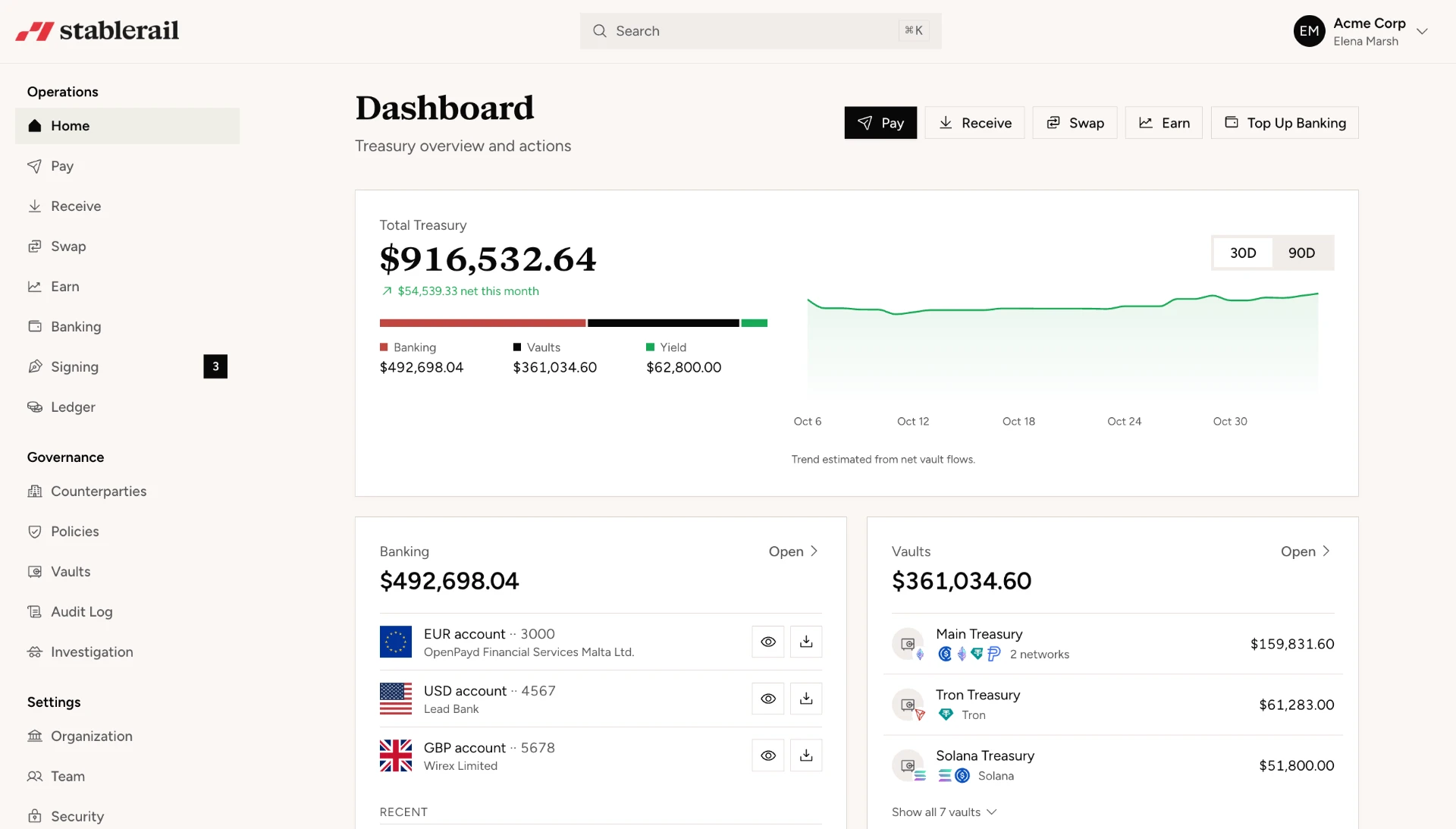
Alerts are only valuable if the team can act. Stablerail supports corporate USDC and USDT treasury operations using self-custodial MPC vaults, quorum signing, approval limits, allowlists, wallet screening, and audit logs. Finance teams can also compare published corridor pricing when moving between stablecoins and fiat through supported EUR, USD, GBP, and cross-border rails.
Maintain more than one tested exit route where possible: direct issuer redemption, an approved exchange or liquidity provider, and a fiat off-ramp. Record supported networks, fees, limits, banking cut-offs, and required approvals. For ongoing payment operations, see stablecoin payouts; for questions about supported routes and operational requirements, consult the help centre.
The best monitoring stack is not the one with the most dashboards. It is the one that detects a material change quickly, explains whether the company can still transact at the required size, and connects the alert to a tested decision and execution process.
Finance writers covering stablecoin treasury, payments, compliance, and risk controls.
More about the Stablerail team- Stablecoin treasury managementApprovals, limits, yield and reporting on one balance.
- Stablecoin payoutsBatch contractor and vendor payments with screening.
- USDT vs USDCWhich stablecoin your company should settle in.
- Stablecoin finance glossaryMPC, off-ramp, travel rule and the rest, in plain English.
- Product updatesEverything we ship, month by month.