
Best Bridge Alternatives for Stablecoin Infrastructure
Compare Bridge alternatives including BVNK, Circle, Zero Hash, Fireblocks, Airwallex and Stablerail by use case, custody, integration model, fiat access and treasury controls.
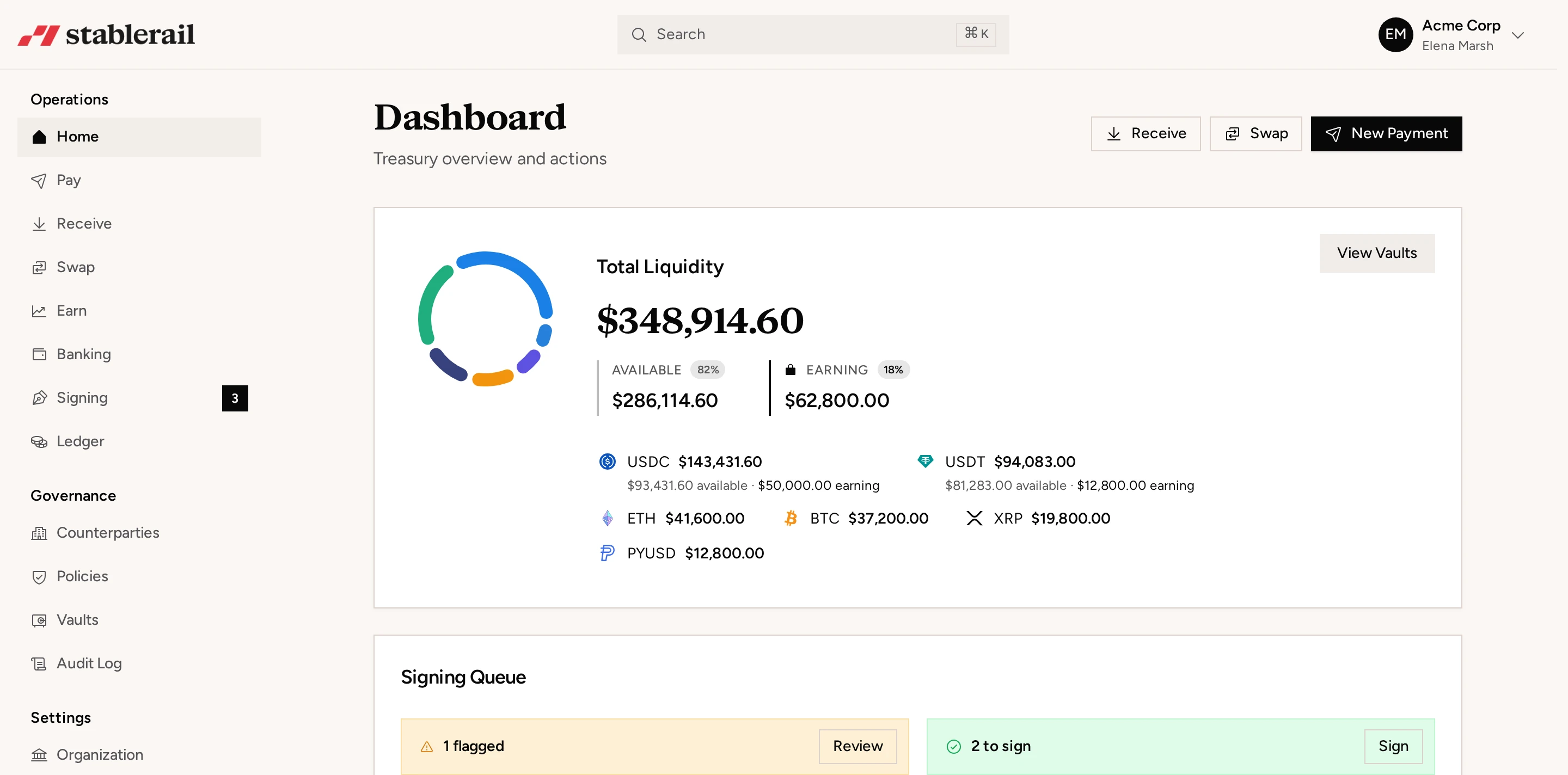
The best Bridge alternative depends on the operating model. BVNK and Zero Hash are candidates for embedding stablecoin payments into customer products; Circle suits USDC-focused infrastructure; Fireblocks supports configurable wallet operations; Airwallex is strongest for fiat-led global payments; and Stablerail is designed for finance teams managing their company’s own USDC or USDT, with approvals, payouts, conversion and audit evidence.

The best Bridge alternative depends first on whether the business is embedding stablecoin functionality for customers or managing its own corporate funds. Embedded products usually prioritize APIs, customer wallets, ledgers and regulatory coverage. Treasury teams instead need approvals, signing controls, fiat conversion, payouts, cards, reconciliation and evidence for auditors. No provider is the best choice for every operating model, country or payment corridor.
Bridge alternatives compared
Bridge provides infrastructure for moving between fiat currencies and stablecoins, particularly for businesses building payment products. Alternatives differ substantially: some provide regulated payment orchestration, some supply wallet infrastructure, and others operate as finance-team treasury platforms. Product availability can depend on the contracting entity, customer location, end-user location, asset, network and flow of funds.
| Provider | Primary scope | Delivery model | Typical fit | Main issue to verify |
|---|---|---|---|---|
| Stablerail | Corporate USDC and USDT treasury, conversion, cards and payouts | Finance operations platform for a company’s own funds | CFO and treasury teams seeking approvals, signing quorum, screening and audit evidence | Supported jurisdictions, currencies, networks and payout corridors |
| BVNK | Stablecoin collections, conversion, settlement and payouts | Enterprise APIs and operational interfaces | Merchants, payment companies and global businesses orchestrating stablecoin flows | Which entity or partner handles each part of the transaction |
| Circle | USDC issuance access, wallets and related network services | Institutional accounts and developer infrastructure | Businesses standardizing primarily on USDC | Eligibility, regional access and whether additional fiat or USDT providers are needed |
| Zero Hash | Embedded crypto and stablecoin infrastructure | Business-to-business-to-customer APIs | Fintechs adding stablecoin features to an end-user product | Ledger, custody, onboarding and regulatory responsibilities for the proposed flow |
| Fireblocks | Wallet operations, transaction controls and settlement connectivity | Infrastructure and APIs for customized digital-asset operations | Institutions assembling a multi-provider operating stack | Which separate providers supply banking, FX, liquidity and local payment rails |
| Airwallex | Multi-currency accounts, FX, cards, collections and global payouts | Business account platform and payment APIs | Companies with fiat-first international payment requirements | Whether the required stablecoin capability is available for each market and flow |
This comparison is a shortlist, not a statement that every product is available everywhere. Ask each provider to confirm the exact legal entity, countries, assets, networks and payment directions in writing before designing the integration.
Which alternative fits each operating model?
For managing the company’s own stablecoin treasury
A corporate treasury platform is appropriate when USDC or USDT belongs to the company and the finance team is responsible for safeguarding, approving and reconciling it. Stablerail supports approvals and signing quorum, sanctions and address screening before a send, fiat conversion, global payouts, corporate cards and exportable audit evidence.
This model is distinct from building wallets or payment accounts for thousands of customers. A treasury buyer should focus on who can initiate, approve and sign a transfer; how access is removed when an employee leaves; what happens when a signer is unavailable; and whether accounting can trace every bank and blockchain movement to a business purpose.
For enterprise payment orchestration
BVNK is a candidate when a business needs stablecoin collections, conversions, settlements or payouts without assembling each bank, liquidity venue and blockchain connection independently. Its API-led approach can fit merchants, payment companies and fintechs, but the commercial name on the contract does not by itself explain the flow of funds.
Request a diagram identifying who receives fiat, who holds stablecoins, who performs conversion and who sends the final payout. Also confirm whether the provider supports company funds, customer funds or both for the intended jurisdiction. Those are legally and operationally different models.
For a USDC-centered stack
Circle is a logical candidate for businesses that use USDC as their standard settlement asset and want infrastructure connected closely to the asset’s issuer. It can reduce the number of intermediaries in a USDC-focused design, subject to account eligibility and product availability.
The trade-off is scope. A company that needs USDT, multiple third-party stablecoins, broad local banking coverage or a complete treasury workspace may still require additional vendors. Model the resulting reconciliation and counterparty exposure rather than evaluating the USDC component in isolation.
For embedding stablecoins into a customer product
Zero Hash is closer to an infrastructure component for fintechs and platforms. Its model can support embedded crypto and stablecoin experiences while relevant entities provide parts of the operational and regulatory stack. The buyer still needs to document which party performs customer onboarding, maintains the ledger, holds assets and handles disputes or transaction failures.
This distinction matters because an API integration does not transfer every operational obligation to the provider. The platform may remain responsible for its user interface, internal ledger accuracy, customer communications, accounting treatment and controls around API credentials.
For customized wallet and settlement infrastructure
Fireblocks can fit institutions that want configurable wallet operations and connectivity across custodians, exchanges, liquidity providers and other counterparties. It offers more building-block flexibility than an all-in-one treasury product, but that flexibility can increase implementation and vendor-management work.
Determine whether fiat accounts, local rails, foreign exchange and compliance operations are included or supplied separately. A technically complete wallet workflow is not necessarily a complete payment workflow: a transfer can be signed correctly while the associated conversion, beneficiary review or accounting entry remains manual.
For fiat-first international finance
Airwallex is worth considering when multi-currency fiat accounts, foreign exchange, cards and international payouts are the primary requirements. It may be a better operational fit than specialized stablecoin infrastructure when stablecoins are only a funding or settlement method rather than the main treasury asset.
Do not infer stablecoin coverage from general digital-payment capabilities. Confirm whether the business can deposit stablecoins, convert them, hold the resulting balance and pay out stablecoins in each required market. The answers may differ by entity and product configuration.
Compare settlement time and total cost
An API response marked successful does not mean the beneficiary has final funds. Delivery depends on bank operating hours, scheme cut-offs, compliance review, liquidity, blockchain confirmation and the receiving institution’s own posting process.
| Rail | Typical operational timing | What can delay or reverse it |
|---|---|---|
| SEPA Instant | Usually seconds when both institutions support the scheme | Screening, participant support, account restrictions or transaction limits |
| SEPA Credit Transfer | Often same or next business day | Bank cut-offs, weekends, holidays and beneficiary-bank processing |
| ACH | Often one to three business days | Processing windows, returns and account-validation issues |
| Fedwire | Same business day within operating windows | Cut-offs, manual review or incorrect beneficiary details |
| Faster Payments | Often seconds or minutes | Participant controls, payment limits and fraud review |
| SWIFT | Commonly one to five business days | Intermediary banks, compliance checks, time zones and local clearing |
| Stablecoin transfer | Often seconds to minutes for network inclusion | Congestion, gas, recipient network support and the provider’s finality policy |
Request corridor-level pricing using realistic transaction sizes. Total cost can include account charges, payment fees, foreign-exchange spread, stablecoin conversion spread, blockchain gas, minimum fees, return charges and deductions by intermediary banks. Also price internal work: manual approvals, spreadsheet reconciliation and exception handling can outweigh a small difference in transaction fees.
Custody, licensing and control questions
Statements such as licensed infrastructure or institutional custody are not enough for procurement. A provider may rely on its own regulated entities, sponsor banks, payment institutions, custodians or local partners. Coverage must be evaluated for the specific transaction, not only at the group-company level.
- Funds: Are fiat and stablecoins held in the company’s name, for the benefit of customers, with a custodian or on an internal ledger?
- Control: Who can initiate, approve and sign, and what recovery process applies if credentials or signers are lost?
- Compliance: Which party screens the business, beneficiary, wallet address and transaction, and when can a payment be held?
- Geography: Which countries are enabled for onboarding, collection, conversion and payout rather than merely listed as sales coverage?
- Evidence: Can finance export statements, transaction records, wallet details, approval logs, conversion records and payment confirmations?
The right provider is the one whose legal flow of funds, operational controls and reconciliation evidence match the actual transaction—not the one with the longest feature list.
A practical selection checklist
- Classify the use case as embedded customer payments, corporate treasury or a combination that may require separate providers.
- Document every required country, currency, stablecoin, blockchain network and payment direction.
- Obtain a flow-of-funds diagram naming the responsible legal entity at each step.
- Test approvals, signer recovery, address screening, failed payments, refunds and bank returns.
- Compare all-in cost and beneficiary receipt time for representative corridors and transaction sizes.
- Run a reconciliation test from bank funding through conversion, blockchain transfer and accounting export.
- Review contracts for custody, service suspension, asset recovery, data access and termination procedures.
A controlled pilot should include normal payments and exceptions. Test an incorrect beneficiary, a rejected address, a delayed bank transfer, a returned fiat payment and a transaction requiring multiple approvals. The results will reveal more about operational fit than a standard product demonstration.
Frequently asked questions
What is the best alternative to Bridge for stablecoin payments?
There is no universal best alternative. BVNK and Zero Hash are oriented toward embedded payment use cases, Circle suits USDC-centered infrastructure, and Fireblocks fits institutions building customized wallet operations; corporate treasury teams should instead evaluate platforms designed to manage their own funds.
How should a company compare Bridge and its alternatives?
Compare the exact flow of funds, contracting entity, supported countries, fiat rails, stablecoins, networks, custody model and payout directions. Finance teams should also test approval controls, settlement timing, exception handling, reconciliation exports and total corridor-level cost.
Which Bridge alternative is suitable for corporate USDC or USDT treasury?
A company managing its own USDC or USDT should prioritize approvals, signing quorum, address screening, conversion, payouts and exportable audit evidence. This is a different requirement from an API platform that creates wallets or payment functionality for end customers.
Is a stablecoin API provider also a custodian?
Not necessarily. A provider may offer APIs while custody is supplied by another group entity, a bank, a qualified custodian or a technology partner, so buyers should request a legal flow-of-funds diagram and custody terms.
Are stablecoin payments faster than bank transfers?
Blockchain inclusion often occurs in seconds or minutes, but beneficiary access can still be delayed by compliance review, provider finality rules or off-ramp processing. Bank rails vary from near-instant schemes to multi-day cross-border transfers, so compare end-to-end receipt time rather than API response time.
Finance writers covering stablecoin treasury, payments, compliance, and risk controls.
More about the Stablerail team- Stablecoin treasury managementApprovals, limits, yield and reporting on one balance.
- Stablecoin payoutsBatch contractor and vendor payments with screening.
- USDT vs USDCWhich stablecoin your company should settle in.
- Stablecoin finance glossaryMPC, off-ramp, travel rule and the rest, in plain English.
- Product updatesEverything we ship, month by month.