
What a Crypto Regulation Tool Can—and Cannot—Do for Your Business
Learn what crypto regulation tools actually do, where their outputs stop, and how finance teams should evaluate KYB, wallet screening, monitoring and audit evidence systems.
A crypto regulation tool can track regulatory changes, verify businesses, screen blockchain addresses, monitor transactions and preserve evidence. It cannot determine conclusively whether your business is compliant, interpret every rule for your circumstances or prove that a flagged wallet is controlled by a prohibited party. Use each tool for a defined task, then apply legal analysis, written policy and accountable human review.
%22%20x1%3D%220%22%20y1%3D%220%22%20x2%3D%221%22%20y2%3D%221%22%3E%0A%20%20%20%20%20%20%20%20%3Cstop%20offset%3D%220%25%22%20stop-color%3D%22%23360A0E%22%20%2F%3E%0A%20%20%20%20%20%20%20%20%3Cstop%20offset%3D%2250%25%22%20stop-color%3D%22%23551217%22%20%2F%3E%0A%20%20%20%20%20%20%20%20%3Cstop%20offset%3D%22100%25%22%20stop-color%3D%22%237A1D20%22%20%2F%3E%0A%20%20%20%20%20%20%3C%2FlinearGradient%3E%0A%20%20%20%20%20%20%3CradialGradient%20id%3D%22glow%22%20cx%3D%22673%22%20cy%3D%22560%22%20r%3D%22520%22%20gradientUnits%3D%22userSpaceOnUse%22%3E%0A%20%20%20%20%20%20%20%20%3Cstop%20offset%3D%220%25%22%20stop-color%3D%22%23FFA587%22%20stop-opacity%3D%220.45%22%20%2F%3E%0A%20%20%20%20%20%20%20%20%3Cstop%20offset%3D%2255%25%22%20stop-color%3D%22%23FFA587%22%20stop-opacity%3D%220.08%22%20%2F%3E%0A%20%20%20%20%20%20%20%20%3Cstop%20offset%3D%22100%25%22%20stop-color%3D%22%23FFA587%22%20stop-opacity%3D%220%22%20%2F%3E%0A%20%20%20%20%20%20%3C%2FradialGradient%3E%0A%20%20%20%20%20%20%3ClinearGradient%20id%3D%22glass%22%20x1%3D%220%22%20y1%3D%220%22%20x2%3D%221%22%20y2%3D%221%22%3E%0A%20%20%20%20%20%20%20%20%3Cstop%20offset%3D%220%25%22%20stop-color%3D%22%23F8D6D2%22%20stop-opacity%3D%220.26%22%20%2F%3E%0A%20%20%20%20%20%20%20%20%3Cstop%20offset%3D%22100%25%22%20stop-color%3D%22%23FFFFFF%22%20stop-opacity%3D%220.08%22%20%2F%3E%0A%20%20%20%20%20%20%3C%2FlinearGradient%3E%0A%20%20%20%20%20%20%3ClinearGradient%20id%3D%22accent%22%20x1%3D%220%22%20y1%3D%220%22%20x2%3D%221%22%20y2%3D%221%22%3E%0A%20%20%20%20%20%20%20%20%3Cstop%20offset%3D%220%25%22%20stop-color%3D%22%23FFA587%22%20%2F%3E%0A%20%20%20%20%20%20%20%20%3Cstop%20offset%3D%22100%25%22%20stop-color%3D%22%23DC4A38%22%20%2F%3E%0A%20%20%20%20%20%20%3C%2FlinearGradient%3E%0A%20%20%20%20%20%20%3Cfilter%20id%3D%22soft%22%3E%3CfeGaussianBlur%20stdDeviation%3D%2210%22%20%2F%3E%3C%2Ffilter%3E%0A%20%20%20%20%3C%2Fdefs%3E%0A%20%20%20%20%3Crect%20width%3D%221600%22%20height%3D%22900%22%20fill%3D%22url(%23bg)%22%20%2F%3E%0A%20%20%20%20%3Crect%20width%3D%221600%22%20height%3D%22900%22%20fill%3D%22url(%23glow)%22%20%2F%3E%0A%20%20%20%20%3Crect%20x%3D%22260%22%20y%3D%22587%22%20width%3D%2292%22%20height%3D%22133%22%20rx%3D%228%22%20fill%3D%22url(%23glass)%22%20stroke%3D%22%23F4CDC5%22%20stroke-opacity%3D%220.45%22%2F%3E%3Crect%20x%3D%22400%22%20y%3D%22597%22%20width%3D%2292%22%20height%3D%22123%22%20rx%3D%228%22%20fill%3D%22url(%23glass)%22%20stroke%3D%22%23F4CDC5%22%20stroke-opacity%3D%220.45%22%2F%3E%3Crect%20x%3D%22540%22%20y%3D%22600%22%20width%3D%2292%22%20height%3D%22120%22%20rx%3D%228%22%20fill%3D%22url(%23glass)%22%20stroke%3D%22%23F4CDC5%22%20stroke-opacity%3D%220.45%22%2F%3E%3Crect%20x%3D%22680%22%20y%3D%22420%22%20width%3D%2292%22%20height%3D%22300%22%20rx%3D%228%22%20fill%3D%22url(%23glass)%22%20stroke%3D%22%23F4CDC5%22%20stroke-opacity%3D%220.45%22%2F%3E%3Crect%20x%3D%22820%22%20y%3D%22465%22%20width%3D%2292%22%20height%3D%22255%22%20rx%3D%228%22%20fill%3D%22url(%23glass)%22%20stroke%3D%22%23F4CDC5%22%20stroke-opacity%3D%220.45%22%2F%3E%3Crect%20x%3D%22960%22%20y%3D%22297%22%20width%3D%2292%22%20height%3D%22423%22%20rx%3D%228%22%20fill%3D%22url(%23accent)%22%20stroke%3D%22%23F4CDC5%22%20stroke-opacity%3D%220.45%22%2F%3E%3Crect%20x%3D%221100%22%20y%3D%22255%22%20width%3D%2292%22%20height%3D%22465%22%20rx%3D%228%22%20fill%3D%22url(%23glass)%22%20stroke%3D%22%23F4CDC5%22%20stroke-opacity%3D%220.45%22%2F%3E%3Crect%20x%3D%221240%22%20y%3D%22424%22%20width%3D%2292%22%20height%3D%22296%22%20rx%3D%228%22%20fill%3D%22url(%23glass)%22%20stroke%3D%22%23F4CDC5%22%20stroke-opacity%3D%220.45%22%2F%3E%3Cline%20x1%3D%22240%22%20y1%3D%22724%22%20x2%3D%221430%22%20y2%3D%22724%22%20stroke%3D%22%23F0BBAF%22%20stroke-opacity%3D%220.4%22%20stroke-width%3D%223%22%2F%3E%0A%20%20%20%20%3Crect%20x%3D%2226%22%20y%3D%2226%22%20width%3D%221548%22%20height%3D%22848%22%20rx%3D%2218%22%20fill%3D%22none%22%20stroke%3D%22%23F2D0C8%22%20stroke-opacity%3D%220.12%22%2F%3E%0A%20%20%3C%2Fsvg%3E)
A crypto regulation tool can track regulatory changes, verify businesses, screen blockchain addresses, monitor transactions and preserve evidence. It cannot determine conclusively whether your business is compliant, interpret every rule for your circumstances or prove that a flagged wallet is controlled by a prohibited party. The effective approach is to assign each tool a defined task and place accountable review around its output.
What is a crypto regulation tool?
“Crypto regulation tool” is an umbrella term, not a single software category. It may refer to regulatory intelligence, Know Your Business verification, sanctions screening, blockchain analytics, transaction monitoring, reporting software or evidence management.
The right category depends on the decision being made. A legal team assessing whether a stablecoin product can be offered in a country needs current laws, guidance and enforcement information. A treasury team sending USDC or USDT needs controls around counterparties, destination addresses, approvals and transaction records. Buying one system without separating those use cases can leave important gaps.
Start with a narrower question: Which decision must the tool support, in which jurisdiction, for which asset and network, and what evidence must be retained?
Crypto regulation tool categories compared
| Tool category | Primary job | Useful output | What it cannot decide |
|---|---|---|---|
| Regulatory intelligence | Tracks legislation, consultations, guidance and enforcement developments | Dated alerts, summaries, source links and jurisdiction comparisons | Whether a rule applies to the company’s exact product or facts |
| KYB and ownership verification | Checks company registration, directors and beneficial owners | Registry records, ownership data, documents and exception flags | Whether the complete business relationship is acceptable |
| Sanctions and address screening | Checks names, entities and blockchain addresses against sanctions and risk data | Potential matches, attribution data, exposure paths and risk indicators | Whether every match is accurate or the counterparty controls a risky address |
| Transaction monitoring | Reviews activity over time using rules, thresholds or behavioral patterns | Alerts, linked activity and investigation cases | Whether unusual behavior is unlawful or has an innocent explanation |
| Reporting software | Structures transaction and case data for internal or external reporting | Case reports, transaction exports and filing drafts | Which filings are legally required in every jurisdiction |
| Evidence management | Retains screening, approvals, documents and reviewer decisions | Audit logs, decision histories and exportable evidence packs | Whether the underlying policy or decision was legally correct |
How each tool fits into a compliance workflow
Regulatory intelligence identifies changes
Regulatory monitoring helps legal and compliance teams identify developments affecting authorization, customer eligibility, disclosures, reserves, marketing, safeguarding or reporting. A useful system lets reviewers filter by jurisdiction, activity and asset instead of receiving every announcement containing the word “crypto.”
An alert is the beginning of a review, not the conclusion. Counsel or another qualified owner must still determine whether the company falls within scope, when a requirement takes effect and which policies, contracts or operational processes need to change. The underlying source and publication date should remain available so reviewers can distinguish enacted rules from proposals or consultations.
KYB verifies the business behind a relationship
KYB systems commonly collect registration details, operating addresses, directors and beneficial ownership information. Depending on the relationship and jurisdiction, a review may also involve incorporation documents, ownership charts, proof of address, information about expected activity and identification for relevant individuals.
Automation can retrieve records and detect inconsistencies, but complex cases still require review. A registry may be incomplete, corporate ownership may cross several entities, and definitions of beneficial ownership vary. A successful registry match therefore confirms selected facts; it does not establish that the customer is acceptable under the company’s complete risk policy.
Wallet screening evaluates address-related risk
Blockchain address screening compares an address or transaction with sanctions information, attribution data and indicators of exposure to higher-risk services or activity. Finance teams can screen an address before a transfer is approved, when funds arrive and periodically after an address has been approved for reuse.
Asset and network coverage must be checked explicitly. Support for USDC on Ethereum does not necessarily imply support for USDC on Solana, USDT on Tron or another token-network combination. The team should also establish how smart contracts, bridges, exchanges and omnibus addresses are treated.
A match is a reason to review, not proof of misconduct. Direct exposure, indirect exposure and vendor attribution should not be treated as equivalent. Reviewers need the transaction path, attribution source, distance from the identified activity, relevant dates and the vendor’s confidence or classification.
Transaction monitoring evaluates behavior over time
Transaction monitoring looks beyond a single address check. It can identify activity such as sudden volume changes, rapid movement through several addresses, transfers inconsistent with the expected relationship or repeated interaction with categories the company treats as higher risk.
Rules must reflect the company’s customers and payment flows. A threshold copied from another business may create excessive alerts or miss relevant activity. Teams should document why each rule exists, who reviews the alert, what information resolves it and when escalation is required.
Reporting and evidence tools preserve the decision
Reporting software structures information, while evidence management records what happened. A complete case record may include the address screened, asset and network, result shown at the time, supporting documents, reviewer notes, approvals, timestamps and final disposition.
Point-in-time evidence is particularly important because wallet attribution and risk classifications can change. An export showing only the current rating may not explain why a payment was approved months earlier. Retention should therefore preserve both the original result and any later review, subject to the company’s legal and data-retention requirements.
What a crypto regulation tool cannot do
No product removes the need for accountable judgment. Software cannot reliably:
- Determine whether the company’s full business model requires authorization in every jurisdiction.
- Resolve ambiguous statutory definitions or conflicting regulatory guidance.
- Guarantee that company, beneficial-owner or wallet attribution data is complete.
- Prove that a wallet owner controls every address connected through a transaction path.
- Set the company’s risk appetite or decide which exceptions management should accept.
- Explain unusual activity without investigation and relevant counterparty context.
- Replace local legal advice, documented procedures, reviewer training or governance.
Be cautious when a vendor presents a single “pass” result as proof of compliance. A useful output explains what was checked, which sources were used, when the check occurred and why any alert was generated.
How to select the right tool
Map the movement of money and data before comparing vendors. Record where counterparties are incorporated, where services are offered, which fiat currencies are involved, which stablecoins and networks are used, and where information must be stored or exported.
Then assess products against operational criteria:
- Coverage: Confirm relevant jurisdictions, company registries, sanctions sources, stablecoins and blockchain networks.
- Data timing: Ask how list changes, attribution updates and corrections reach production screening.
- Explainability: Require source references, exposure paths, dates and enough context for an independent reviewer.
- Workflow: Test APIs, webhooks, case queues, escalation routes and approval handoffs.
- Access controls: Check roles, reviewer separation and the history of changes to cases or decisions.
- Data handling: Review storage locations, retention controls, subprocessors, deletion procedures and export formats.
- Resilience: Define what happens when the service or a required data source is unavailable.
- Commercial model: Identify whether charges depend on checks, transactions, monitored addresses, users, cases or minimum commitments.
Test representative cases before committing. Include straightforward businesses, layered ownership, clean addresses, known alert scenarios, previously reviewed wallets and activity that should trigger monitoring. Measure whether reviewers can understand and resolve the output, not merely how many alerts the system produces.
A practical implementation checklist
- Assign each tool a specific decision, owner and escalation path.
- Document the exact assets, networks, jurisdictions and counterparties in scope.
- Define when screening occurs: onboarding, before send, on receipt or periodically.
- Set criteria for clearing, escalating, rejecting or pausing a case.
- Require point-in-time evidence, reviewer notes and approval timestamps.
- Create a fallback for outages, such as pausing transfers or using manual review.
- Retest coverage and alert quality when products, networks or jurisdictions change.
Where treasury controls fit
Compliance data is most useful when connected to the payment decision. For example, pre-send screening should occur before final approval or signing, and the retained record should link the screened destination to the resulting transaction.
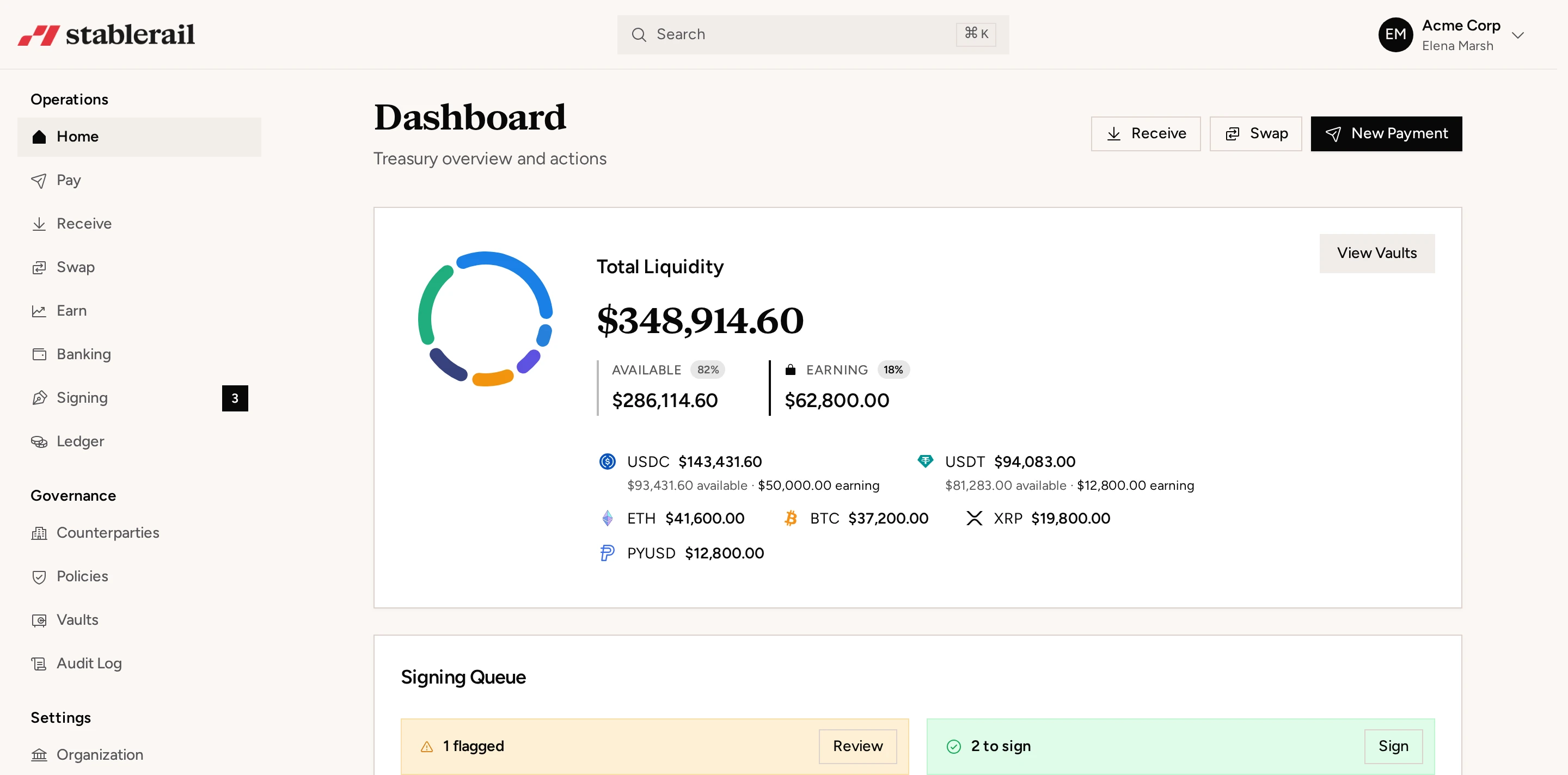
Stablerail provides one business account for stablecoin treasury involving USDC and USDT. Its operational capabilities include approvals and signing quorum, sanctions and address screening before send, corporate cards, global payouts, fiat off-ramp and exportable audit evidence. These controls support payment execution and recordkeeping, but they do not replace regulatory intelligence, legal interpretation or the company’s own risk decisions.
The practical conclusion
A crypto regulation tool works best when it has a narrow, testable purpose. Regulatory intelligence identifies changes; KYB verifies business information; screening surfaces address risk; monitoring detects unusual patterns; and evidence systems preserve what reviewers knew and decided.
None of those outputs independently proves compliance. A defensible operating model combines appropriate software with legal analysis, written policies, trained reviewers, clear escalation and named accountability for final decisions.
Frequently asked questions
What does a crypto regulation tool do?
A crypto regulation tool may track legal developments, verify businesses, screen blockchain addresses, monitor transactions or retain compliance evidence. The term covers several product categories, so the required tool depends on the specific decision and jurisdiction.
Can crypto compliance software guarantee regulatory compliance?
No. Software can organize data, identify potential risks and document decisions, but it cannot conclusively interpret every rule or determine whether an entire business model is compliant. Legal analysis and accountable human review remain necessary.
What is the difference between wallet screening and transaction monitoring?
Wallet screening evaluates an address or transfer against sanctions information, attribution data and risk indicators. Transaction monitoring examines behavior over time, such as unexpected volume changes or repeated interactions with categories the company considers higher risk.
Should stablecoin addresses be screened before every payment?
The screening schedule should follow the company’s risk policy, but pre-send screening helps identify new information before a transfer is approved. Teams should also consider screening on receipt and periodically rescreening addresses approved for reuse.
How should a company evaluate a crypto compliance vendor?
Check jurisdiction, asset and network coverage; data timing; explainability; workflow integration; access controls; retention; exports; resilience; and pricing mechanics. Test representative clean and alert-generating cases to determine whether reviewers can understand and resolve the results.
Finance writers covering stablecoin treasury, payments, compliance, and risk controls.
More about the Stablerail team- Stablecoin treasury managementApprovals, limits, yield and reporting on one balance.
- Stablecoin payoutsBatch contractor and vendor payments with screening.
- USDT vs USDCWhich stablecoin your company should settle in.
- Stablecoin finance glossaryMPC, off-ramp, travel rule and the rest, in plain English.
- Product updatesEverything we ship, month by month.