
How to Switch from an Exchange to a Business Stablecoin Account
A finance-led runbook for moving USDC or USDT from an exchange to a business stablecoin account without losing control of networks, approvals, liquidity or audit evidence.
To switch safely from an exchange to a business stablecoin account, configure the destination before withdrawing: complete KYB, confirm custody and approval controls, map every token-network pair, verify addresses, and test inbound, outbound and fiat routes. Move the main balance in reconciled tranches rather than one transfer. Preserve exchange records, document residual balances and confirm the new account produces the evidence finance needs for close and audit.
%22%20x1%3D%220%22%20y1%3D%220%22%20x2%3D%221%22%20y2%3D%221%22%3E%0A%20%20%20%20%20%20%20%20%3Cstop%20offset%3D%220%25%22%20stop-color%3D%22%232E0709%22%20%2F%3E%0A%20%20%20%20%20%20%20%20%3Cstop%20offset%3D%2250%25%22%20stop-color%3D%22%234A0F14%22%20%2F%3E%0A%20%20%20%20%20%20%20%20%3Cstop%20offset%3D%22100%25%22%20stop-color%3D%22%236B181C%22%20%2F%3E%0A%20%20%20%20%20%20%3C%2FlinearGradient%3E%0A%20%20%20%20%20%20%3CradialGradient%20id%3D%22glow%22%20cx%3D%22451%22%20cy%3D%22-60%22%20r%3D%22520%22%20gradientUnits%3D%22userSpaceOnUse%22%3E%0A%20%20%20%20%20%20%20%20%3Cstop%20offset%3D%220%25%22%20stop-color%3D%22%23FFB199%22%20stop-opacity%3D%220.45%22%20%2F%3E%0A%20%20%20%20%20%20%20%20%3Cstop%20offset%3D%2255%25%22%20stop-color%3D%22%23FFB199%22%20stop-opacity%3D%220.08%22%20%2F%3E%0A%20%20%20%20%20%20%20%20%3Cstop%20offset%3D%22100%25%22%20stop-color%3D%22%23FFB199%22%20stop-opacity%3D%220%22%20%2F%3E%0A%20%20%20%20%20%20%3C%2FradialGradient%3E%0A%20%20%20%20%20%20%3ClinearGradient%20id%3D%22glass%22%20x1%3D%220%22%20y1%3D%220%22%20x2%3D%221%22%20y2%3D%221%22%3E%0A%20%20%20%20%20%20%20%20%3Cstop%20offset%3D%220%25%22%20stop-color%3D%22%23F8D6D2%22%20stop-opacity%3D%220.26%22%20%2F%3E%0A%20%20%20%20%20%20%20%20%3Cstop%20offset%3D%22100%25%22%20stop-color%3D%22%23FFFFFF%22%20stop-opacity%3D%220.08%22%20%2F%3E%0A%20%20%20%20%20%20%3C%2FlinearGradient%3E%0A%20%20%20%20%20%20%3ClinearGradient%20id%3D%22accent%22%20x1%3D%220%22%20y1%3D%220%22%20x2%3D%221%22%20y2%3D%221%22%3E%0A%20%20%20%20%20%20%20%20%3Cstop%20offset%3D%220%25%22%20stop-color%3D%22%23FFB199%22%20%2F%3E%0A%20%20%20%20%20%20%20%20%3Cstop%20offset%3D%22100%25%22%20stop-color%3D%22%23E85D3A%22%20%2F%3E%0A%20%20%20%20%20%20%3C%2FlinearGradient%3E%0A%20%20%20%20%20%20%3Cfilter%20id%3D%22soft%22%3E%3CfeGaussianBlur%20stdDeviation%3D%2210%22%20%2F%3E%3C%2Ffilter%3E%0A%20%20%20%20%3C%2Fdefs%3E%0A%20%20%20%20%3Crect%20width%3D%221600%22%20height%3D%22900%22%20fill%3D%22url(%23bg)%22%20%2F%3E%0A%20%20%20%20%3Crect%20width%3D%221600%22%20height%3D%22900%22%20fill%3D%22url(%23glow)%22%20%2F%3E%0A%20%20%20%20%3Cline%20x1%3D%22932.1413009192233%22%20y1%3D%22531.0165204842522%22%20x2%3D%22747.5608838735492%22%20y2%3D%22583.0381114563666%22%20stroke%3D%22%23FFD2C8%22%20stroke-opacity%3D%220.5%22%20stroke-width%3D%223%22%2F%3E%3Cline%20x1%3D%22846.6129353425042%22%20y1%3D%22589.4138955009705%22%20x2%3D%22676.0719021880471%22%20y2%3D%22517.2519633372219%22%20stroke%3D%22%23FFD2C8%22%20stroke-opacity%3D%220.5%22%20stroke-width%3D%223%22%2F%3E%3Cline%20x1%3D%22747.5608838735492%22%20y1%3D%22583.0381114563666%22%20x2%3D%22623.6214985930919%22%20y2%3D%22414.0747408992875%22%20stroke%3D%22%23FFD2C8%22%20stroke-opacity%3D%220.5%22%20stroke-width%3D%223%22%2F%3E%3Cline%20x1%3D%22676.0719021880471%22%20y1%3D%22517.2519633372219%22%20x2%3D%22675.5317117070019%22%20y2%3D%22293.45082175427706%22%20stroke%3D%22%23FFD2C8%22%20stroke-opacity%3D%220.5%22%20stroke-width%3D%223%22%2F%3E%3Cline%20x1%3D%22623.6214985930919%22%20y1%3D%22414.0747408992875%22%20x2%3D%22805.5436130661569%22%20y2%3D%22240.07318333720977%22%20stroke%3D%22%23FFD2C8%22%20stroke-opacity%3D%220.5%22%20stroke-width%3D%223%22%2F%3E%3Cline%20x1%3D%22675.5317117070019%22%20y1%3D%22293.45082175427706%22%20x2%3D%22942.4989395015275%22%20y2%3D%22289.0060490548169%22%20stroke%3D%22%23FFD2C8%22%20stroke-opacity%3D%220.5%22%20stroke-width%3D%223%22%2F%3E%3Cline%20x1%3D%22805.5436130661569%22%20y1%3D%22240.07318333720977%22%20x2%3D%22975.0615928622528%22%20y2%3D%22423.8764722035704%22%20stroke%3D%22%23FFD2C8%22%20stroke-opacity%3D%220.5%22%20stroke-width%3D%223%22%2F%3E%3Cline%20x1%3D%22942.4989395015275%22%20y1%3D%22289.0060490548169%22%20x2%3D%22932.1413009192233%22%20y2%3D%22531.0165204842522%22%20stroke%3D%22%23FFD2C8%22%20stroke-opacity%3D%220.5%22%20stroke-width%3D%223%22%2F%3E%3Cline%20x1%3D%22975.0615928622528%22%20y1%3D%22423.8764722035704%22%20x2%3D%22846.6129353425042%22%20y2%3D%22589.4138955009705%22%20stroke%3D%22%23FFD2C8%22%20stroke-opacity%3D%220.5%22%20stroke-width%3D%223%22%2F%3E%3Ccircle%20cx%3D%22932.1413009192233%22%20cy%3D%22531.0165204842522%22%20r%3D%2218%22%20fill%3D%22url(%23glass)%22%20stroke%3D%22%23F4CDC5%22%20stroke-opacity%3D%220.6%22%2F%3E%3Ccircle%20cx%3D%22846.6129353425042%22%20cy%3D%22589.4138955009705%22%20r%3D%2218%22%20fill%3D%22url(%23glass)%22%20stroke%3D%22%23F4CDC5%22%20stroke-opacity%3D%220.6%22%2F%3E%3Ccircle%20cx%3D%22747.5608838735492%22%20cy%3D%22583.0381114563666%22%20r%3D%2218%22%20fill%3D%22url(%23glass)%22%20stroke%3D%22%23F4CDC5%22%20stroke-opacity%3D%220.6%22%2F%3E%3Ccircle%20cx%3D%22676.0719021880471%22%20cy%3D%22517.2519633372219%22%20r%3D%2218%22%20fill%3D%22url(%23glass)%22%20stroke%3D%22%23F4CDC5%22%20stroke-opacity%3D%220.6%22%2F%3E%3Ccircle%20cx%3D%22623.6214985930919%22%20cy%3D%22414.0747408992875%22%20r%3D%2228%22%20fill%3D%22url(%23accent)%22%20stroke%3D%22%23F4CDC5%22%20stroke-opacity%3D%220.6%22%2F%3E%3Ccircle%20cx%3D%22675.5317117070019%22%20cy%3D%22293.45082175427706%22%20r%3D%2218%22%20fill%3D%22url(%23glass)%22%20stroke%3D%22%23F4CDC5%22%20stroke-opacity%3D%220.6%22%2F%3E%3Ccircle%20cx%3D%22805.5436130661569%22%20cy%3D%22240.07318333720977%22%20r%3D%2218%22%20fill%3D%22url(%23glass)%22%20stroke%3D%22%23F4CDC5%22%20stroke-opacity%3D%220.6%22%2F%3E%3Ccircle%20cx%3D%22942.4989395015275%22%20cy%3D%22289.0060490548169%22%20r%3D%2218%22%20fill%3D%22url(%23glass)%22%20stroke%3D%22%23F4CDC5%22%20stroke-opacity%3D%220.6%22%2F%3E%3Ccircle%20cx%3D%22975.0615928622528%22%20cy%3D%22423.8764722035704%22%20r%3D%2218%22%20fill%3D%22url(%23glass)%22%20stroke%3D%22%23F4CDC5%22%20stroke-opacity%3D%220.6%22%2F%3E%3Ccircle%20cx%3D%22800%22%20cy%3D%22450%22%20r%3D%2248%22%20fill%3D%22url(%23accent)%22%2F%3E%0A%20%20%20%20%3Crect%20x%3D%2226%22%20y%3D%2226%22%20width%3D%221548%22%20height%3D%22848%22%20rx%3D%2218%22%20fill%3D%22none%22%20stroke%3D%22%23F2D0C8%22%20stroke-opacity%3D%220.12%22%2F%3E%0A%20%20%3C%2Fsvg%3E)
The safest way to move USDC or USDT from an exchange to a business stablecoin account is to treat the change as a treasury migration, not a single withdrawal. Build the destination operating model first, test every asset, network and settlement route with controlled amounts, then transfer the operating balance in stages. Each tranche should reconcile from the exchange record through the blockchain transaction to the destination ledger.
Exchanges are often where a company first buys stablecoins. They remain useful for trading and liquidity, but their workflows may become restrictive when stablecoins are used for vendor payments, payroll, customer collections or routine treasury. A business stablecoin account is designed around holding, approvals, payments, fiat conversion and finance evidence rather than primarily around trading.
What changes when a company leaves an exchange?
The main change is not the interface. It is the control model: where assets are held, who can authorize movement, how counterparties are verified and what evidence is available after each transaction. Custody models vary by provider, so finance and legal teams should establish whether the company, the provider or another custodian controls transaction signing and recovery.
| Area | Typical exchange account | Business stablecoin account | Migration decision |
|---|---|---|---|
| Primary purpose | Buying, selling and withdrawing digital assets | Treasury operations, payments and collections | Keep an exchange only where trading or liquidity access is still required |
| Custody | The exchange generally controls keys and records the customer balance internally | May use self-custody, assisted custody or third-party custody | Document signing, recovery, insolvency and asset-control arrangements |
| Team controls | Roles and withdrawal permissions vary | Typically separates preparation, review and approval | Map existing bank mandates to users, limits and signing quorum |
| Payments | Usually organized around deposits, withdrawals and trades | May support beneficiaries, payouts and treasury transfers | Test the complete payment workflow, not only receipt of funds |
| Fiat movement | Depends on the exchange entity, bank partners and jurisdiction | May connect stablecoins to eligible local or cross-border fiat rails | Validate each currency and banking corridor separately |
| Finance evidence | Trade, deposit and withdrawal files may be separate | May combine transaction, user and approval records | Confirm exports contain the fields required for reconciliation and audit |
A business account does not have to replace every exchange relationship. A company may retain an approved exchange for conversions or execution while moving operational treasury elsewhere. If so, define the exchange’s permitted purpose, maximum working balance, authorized users and review frequency.
1. Complete onboarding before setting a migration date
Business account providers conduct know-your-business checks and assess jurisdiction, ownership, industry and expected activity. Complete this process before scheduling withdrawals because follow-up questions can delay activation.
Prepare the certificate of incorporation, constitutional documents, ownership chart, ultimate beneficial owner information, director and authorized-user identification, business address evidence, and a description of expected volumes and payment corridors. Providers may also request contracts, bank statements or other source-of-funds evidence. Do not move the main balance until the required stablecoin addresses, users and any fiat capabilities are active.
2. Create an asset and network inventory
USDC and USDT are issued on multiple blockchains. The ticker alone does not identify a valid route: the asset and network selected at the exchange must match the destination’s supported asset and network. A valid address format is not proof that the destination will credit the token.
Create a controlled migration schedule containing:
- Legal owner and internal ledger account.
- Token, balance and blockchain network.
- Exchange withdrawal minimum, fee and any daily limit.
- Destination address and its verified source.
- Memo or destination tag, if the route requires one.
- Test amount, planned tranche amount, operator and approvers.
- Expected accounting treatment for fees and timing differences.
Do not choose a network solely because it appears cheaper. First confirm destination support, counterparty acceptance, operational familiarity and the availability of reliable transaction records. Recovery may be slow, expensive or impossible when funds are sent through an unsupported route.
3. Configure custody, access and approvals
Translate the company’s bank mandate and treasury authority into the new account. Each person should have individual access. Separate the ability to create a beneficiary, prepare a payment and approve it where the platform permits. Set signing quorum and approval requirements before funding the account, including additional review for larger or unusual transfers.
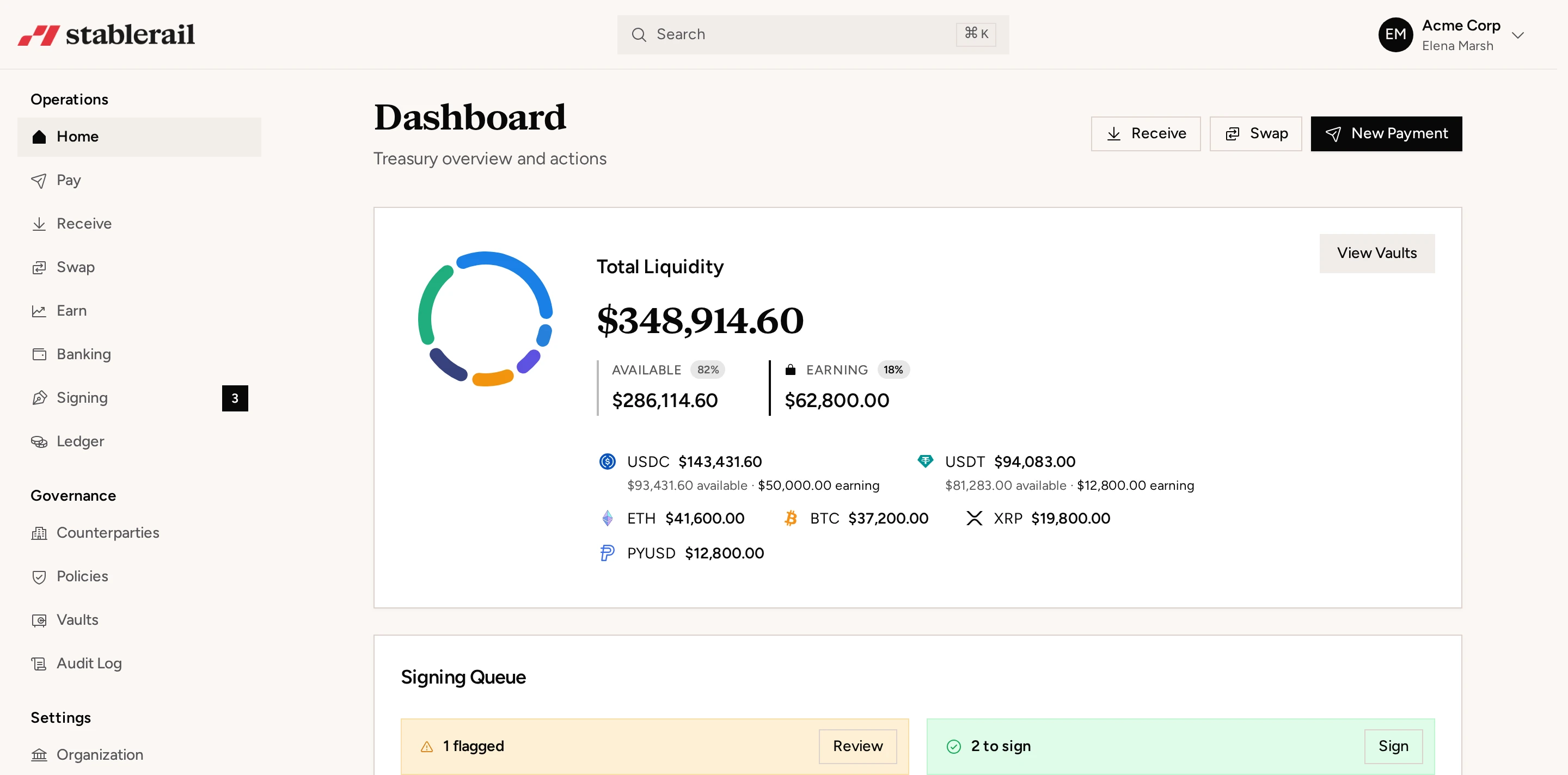
Stablerail provides one business account for USDC and USDT treasury, with approvals and signing quorum, sanctions and address screening before send, corporate cards, global payouts and fiat off-ramp, plus exportable audit evidence.
Finance should also document who can change user access, reset authentication, amend beneficiary details and participate in recovery. Test the process for removing a leaver and restoring access after a lost device. Screening is an important control, but it does not replace confirming the beneficiary’s identity, payment purpose, token and network.
4. Verify and allowlist addresses
Add the destination address to the exchange withdrawal allowlist where available. If the exchange imposes a cooling-off period after an address is added or changed, incorporate it into the migration timetable rather than seeking a last-minute exception.
Use independent verification: one person enters the address and network, while another compares them with a trusted source. Do not rely only on an address copied from email or chat. Confirm the beginning and end of the full address, and retain the approval evidence. Where the business account supports beneficiary controls, add approved vendor wallets and any retained exchange deposit addresses using the same process.
5. Test each route in both directions
Send a controlled test for every asset-network combination. The amount must exceed the exchange minimum and cover applicable fees, but remain small relative to the intended migration. A successful USDC transfer on one network does not validate USDT or another network.
For each inbound test, confirm that the exchange marks the withdrawal complete, the transaction hash appears on the intended blockchain, and the destination credits the correct token and net amount. Reconcile the gross withdrawal, exchange fee, onchain amount and destination credit. Save the transaction hash and relevant account records.
Then test an outbound payment to a company-controlled address or approved counterparty. Use the intended maker-checker process, confirm all approvals appear in the record and verify receipt on the correct network. This proves that the team can operate the account after funds arrive.
6. Test fiat on-ramps and off-ramps separately
A completed blockchain transfer does not prove that a fiat conversion or bank payment will work. Test each currency, beneficiary type and banking corridor the company expects to use. Confirm the account name and payment reference requirements before sending.
Record the quoted exchange rate or conversion basis, service fee, expected destination amount, bank cut-off and stated settlement estimate. Weekends, holidays, compliance review and intermediary banks can affect the fiat leg even when the stablecoin transaction settles promptly. Reconcile the stablecoin debit, conversion entry, fees and bank credit as one linked transaction.
7. Move the balance in reconciled tranches
After all tests pass, migrate in stages. Tranching limits disruption if the exchange reviews a withdrawal, an allowlist change is pending or a blockchain network becomes congested. The tranche size should reflect the company’s risk tolerance, near-term payment obligations and ability to investigate an exception.
- Pause non-essential exchange activity and capture a timestamped opening balance.
- Download balances, deposits, withdrawals, trades and fee reports.
- Send the first tranche and wait for destination credit.
- Reconcile the exchange debit, fee, transaction hash and destination credit.
- Repeat only after the prior tranche is signed off.
- Retain enough at the exchange for pending trades, fees or unresolved transactions.
- Export final records before reducing user permissions or closing the account.
Do not assume that an exchange balance should reach exactly zero. Pending orders, dust balances, withdrawal fees and delayed credits can create residuals. Record each remainder, its owner and planned disposition.
8. Close the migration with finance evidence
The migration is complete only when operations and accounting both work in the new environment. Store the approved migration schedule, address-verification evidence, transaction hashes, exchange statements, destination exports and sign-offs in the close file. Define who reviews balances, stale beneficiaries, user access and retained exchange exposure after go-live.
Finance should also confirm how stablecoins, network fees and conversion charges map into the chart of accounts. Document the source used for period-end valuation and the treatment of transfers that are initiated before close but credited afterward. This avoids recording an internal transfer as revenue, expense or an unexplained balance difference.
Go-live checklist
- KYB is complete and all required account features are active.
- Every token-network pair and destination address is independently verified.
- Individual users, approvals, signing quorum and recovery procedures are tested.
- Inbound, outbound and required fiat routes reconcile successfully.
- The operating balance has moved in approved, reconciled tranches.
- Exchange reports and transaction evidence are stored with the close records.
- Any retained exchange account has a documented purpose, balance limit and owner.
A controlled migration leaves the company with more than a new place to hold stablecoins. It creates a repeatable treasury process in which asset movement, approvals, counterparties, fiat settlement and accounting evidence are managed together.
Frequently asked questions
How do I transfer USDC from an exchange to a business account safely?
Confirm the destination supports the exact USDC network selected at the exchange, independently verify the address, and send a small test above the withdrawal minimum. Reconcile the exchange debit, fee, blockchain transaction and destination credit before moving the remaining balance in stages.
Should a company close its crypto exchange account after migrating?
Not necessarily. An approved exchange may still be needed for trading or liquidity, but its permitted use, balance limit, authorized users and review frequency should be documented. Export all historical records before reducing access or closing it.
Can USDT or USDC be lost by choosing the wrong network?
Yes. The same token ticker can exist on several blockchains, and an address that looks valid may not be supported by the destination account. Recovery from an unsupported route may be costly, delayed or impossible, so verify every asset-network pair and run a test first.
What records should finance retain during a stablecoin migration?
Keep opening and closing exchange statements, withdrawal records, transaction hashes, destination credits, fee details, address approvals and user approval logs. These records should connect each exchange debit to the corresponding onchain transfer and destination entry.
How should a company test a stablecoin fiat off-ramp?
Test each currency and banking corridor separately using a controlled amount. Record the conversion basis, fees, expected bank credit, beneficiary details and settlement timing, then reconcile the stablecoin debit through to the bank statement.
Finance writers covering stablecoin treasury, payments, compliance, and risk controls.
More about the Stablerail team- Stablecoin treasury managementApprovals, limits, yield and reporting on one balance.
- Stablecoin payoutsBatch contractor and vendor payments with screening.
- USDT vs USDCWhich stablecoin your company should settle in.
- Stablecoin finance glossaryMPC, off-ramp, travel rule and the rest, in plain English.
- Product updatesEverything we ship, month by month.