
How to Make Stablecoin Vendor Payments With the Right Controls
A practical control framework for paying vendors in USDC or USDT, covering wallet verification, sanctions screening, approvals, signing, evidence and reconciliation.
Stablecoin vendor payments should follow the same control principles as bank payments, with added checks for the token, blockchain network and wallet address. Verify instructions independently, screen the vendor and destination address, separate preparation from approval and signing, and retain the transaction hash with the invoice and approval record. Reconcile the payment only after the network confirms it and the vendor or receiving provider credits the funds.
%22%20x1%3D%220%22%20y1%3D%220%22%20x2%3D%221%22%20y2%3D%221%22%3E%0A%20%20%20%20%20%20%20%20%3Cstop%20offset%3D%220%25%22%20stop-color%3D%22%232A0608%22%20%2F%3E%0A%20%20%20%20%20%20%20%20%3Cstop%20offset%3D%2250%25%22%20stop-color%3D%22%23420D12%22%20%2F%3E%0A%20%20%20%20%20%20%20%20%3Cstop%20offset%3D%22100%25%22%20stop-color%3D%22%23621619%22%20%2F%3E%0A%20%20%20%20%20%20%3C%2FlinearGradient%3E%0A%20%20%20%20%20%20%3CradialGradient%20id%3D%22glow%22%20cx%3D%22634%22%20cy%3D%22-223%22%20r%3D%22520%22%20gradientUnits%3D%22userSpaceOnUse%22%3E%0A%20%20%20%20%20%20%20%20%3Cstop%20offset%3D%220%25%22%20stop-color%3D%22%23FF9577%22%20stop-opacity%3D%220.45%22%20%2F%3E%0A%20%20%20%20%20%20%20%20%3Cstop%20offset%3D%2255%25%22%20stop-color%3D%22%23FF9577%22%20stop-opacity%3D%220.08%22%20%2F%3E%0A%20%20%20%20%20%20%20%20%3Cstop%20offset%3D%22100%25%22%20stop-color%3D%22%23FF9577%22%20stop-opacity%3D%220%22%20%2F%3E%0A%20%20%20%20%20%20%3C%2FradialGradient%3E%0A%20%20%20%20%20%20%3ClinearGradient%20id%3D%22glass%22%20x1%3D%220%22%20y1%3D%220%22%20x2%3D%221%22%20y2%3D%221%22%3E%0A%20%20%20%20%20%20%20%20%3Cstop%20offset%3D%220%25%22%20stop-color%3D%22%23F8D6D2%22%20stop-opacity%3D%220.26%22%20%2F%3E%0A%20%20%20%20%20%20%20%20%3Cstop%20offset%3D%22100%25%22%20stop-color%3D%22%23FFFFFF%22%20stop-opacity%3D%220.08%22%20%2F%3E%0A%20%20%20%20%20%20%3C%2FlinearGradient%3E%0A%20%20%20%20%20%20%3ClinearGradient%20id%3D%22accent%22%20x1%3D%220%22%20y1%3D%220%22%20x2%3D%221%22%20y2%3D%221%22%3E%0A%20%20%20%20%20%20%20%20%3Cstop%20offset%3D%220%25%22%20stop-color%3D%22%23FF9577%22%20%2F%3E%0A%20%20%20%20%20%20%20%20%3Cstop%20offset%3D%22100%25%22%20stop-color%3D%22%23D03B2D%22%20%2F%3E%0A%20%20%20%20%20%20%3C%2FlinearGradient%3E%0A%20%20%20%20%20%20%3Cfilter%20id%3D%22soft%22%3E%3CfeGaussianBlur%20stdDeviation%3D%2210%22%20%2F%3E%3C%2Ffilter%3E%0A%20%20%20%20%3C%2Fdefs%3E%0A%20%20%20%20%3Crect%20width%3D%221600%22%20height%3D%22900%22%20fill%3D%22url(%23bg)%22%20%2F%3E%0A%20%20%20%20%3Crect%20width%3D%221600%22%20height%3D%22900%22%20fill%3D%22url(%23glow)%22%20%2F%3E%0A%20%20%20%20%3Cpath%20d%3D%22M180%20280%20C%20600%20280%2C%20600%20380%2C%201420%20380%22%20stroke%3D%22url(%23accent)%22%20stroke-width%3D%2244%22%20fill%3D%22none%22%20opacity%3D%220.75%22%2F%3E%3Cpath%20d%3D%22M180%20440%20C%20600%20440%2C%20600%20520%2C%201420%20520%22%20stroke%3D%22%23F8D6D2%22%20stroke-width%3D%2224%22%20fill%3D%22none%22%20opacity%3D%220.4%22%2F%3E%3Cpath%20d%3D%22M180%20600%20C%20600%20600%2C%20600%20660%2C%201420%20660%22%20stroke%3D%22url(%23accent)%22%20stroke-width%3D%2210%22%20fill%3D%22none%22%20opacity%3D%220.55%22%2F%3E%3Crect%20x%3D%22140%22%20y%3D%22240%22%20width%3D%2240%22%20height%3D%22420%22%20rx%3D%226%22%20fill%3D%22%23F8D6D2%22%20opacity%3D%220.7%22%2F%3E%3Crect%20x%3D%221420%22%20y%3D%22340%22%20width%3D%2240%22%20height%3D%22360%22%20rx%3D%226%22%20fill%3D%22url(%23accent)%22%2F%3E%0A%20%20%20%20%3Crect%20x%3D%2226%22%20y%3D%2226%22%20width%3D%221548%22%20height%3D%22848%22%20rx%3D%2218%22%20fill%3D%22none%22%20stroke%3D%22%23F2D0C8%22%20stroke-opacity%3D%220.12%22%2F%3E%0A%20%20%3C%2Fsvg%3E)
Stablecoin vendor payments should follow the same control principles as bank payments, with added checks for the token, blockchain network and wallet address. Verify instructions independently, screen the vendor and destination address, separate preparation from approval and signing, and retain the transaction hash with the invoice and approval record. Reconcile the payment only after the network confirms it and the vendor or receiving provider credits the funds.
Decide whether stablecoin is the right payment method
USDC and USDT can support cross-border payments and settlement outside banking hours, but they introduce risks that do not exist in the same form with bank transfers. Blockchain transactions are generally irreversible, addresses are difficult to identify by sight, and a transfer on the wrong network may not be credited by the recipient.
Start with the commercial obligation. The contract, purchase order or invoice should permit stablecoin settlement and identify who bears network, conversion and intermediary fees. It should also define when the obligation is settled: when the transaction is confirmed onchain, when it reaches the vendor’s wallet, or when the vendor’s exchange or payment provider credits the deposit.
Record the invoice currency separately from the settlement asset. A US dollar invoice paid in USDC remains a USD-denominated payable settled with a stablecoin. If a euro invoice is paid in USDC, document the exchange-rate source, calculation time and treatment of rounding or rate movements.
| Payment route | Best suited to | Main controls | Reconciliation evidence |
|---|---|---|---|
| Direct USDC or USDT transfer | Vendor controls a compatible wallet or supported exchange account | Token and network validation, wallet verification, address screening, signing quorum | Transaction hash, wallet record and vendor credit confirmation |
| Stablecoin-funded fiat payout | Vendor requires local currency in a bank account | Provider due diligence, payout instructions, rate and fee approval, sender-of-record review | Stablecoin debit, conversion record, bank payout reference and delivery status |
| Conventional bank payment | Contract or vendor process does not support stablecoin settlement | Standard beneficiary verification and banking controls | Bank statement, payment reference and remittance record |
Add wallet details to controlled vendor onboarding
Treat a wallet address like bank account information. Do not accept new instructions through an informal message, a reply to a changed email thread or a screenshot that cannot be independently verified.
Collect the vendor’s legal name, registered address, tax or company identifier, authorised payment contact, stablecoin, exact blockchain network, complete wallet address and any required memo or destination tag. If an exchange, custodian or payment provider receives funds for the vendor, record that relationship and the name shown on the receiving account.
Confirm instructions through a second channel using contact information already on file. For example, call the vendor’s authorised representative at a previously verified number rather than using a number supplied in the wallet-change request. Any change to the address, network, token or receiving provider should trigger renewed verification.
Control rule: never approve a wallet change solely through the same channel that requested it.
Validate the token, network and destination
A wallet address is not complete payment information. Some address formats can appear valid on more than one blockchain, while a receiving platform may credit deposits only on a specific network. Sending a supported token over an unsupported network can require manual recovery or result in permanent loss.
- Confirm that the treasury wallet can send the requested token on the requested network.
- Verify the token contract or mint address using an approved source rather than relying on its displayed ticker.
- Confirm that the vendor’s wallet or provider accepts deposits on that network.
- Check whether a memo, tag or other routing field is required.
- Use a controlled address book or allowlist instead of copying an address from recent transaction history.
- Maintain enough of the network’s native asset to pay transaction fees where required.
A small test transfer can confirm that the technical route works, but it does not prove the vendor’s legal identity or ownership of the address. Define when tests are mandatory, such as for a first payment, changed address or unfamiliar network. The vendor should confirm receipt before the remaining amount is released, and both transfers should be linked to the same payable.
Screen the parties and wallet before sending
Run the vendor through the company’s normal due diligence process, including applicable sanctions and restricted-party checks. Depending on the risk and jurisdiction, review beneficial owners, destination country, intermediaries and the party operating a custodial receiving account.
The destination wallet should also be screened with an appropriate blockchain risk tool. Screening may identify direct or indirect links to sanctioned addresses, stolen assets, fraud, mixers or other activity requiring review. A vendor name check and a wallet check answer different questions; neither replaces the other.
Define which results block a payment, which require compliance review and who can approve an exception. Screen during onboarding and again close to release because sanctions designations and wallet exposure can change. Retain the address screened, network, result, timestamp, data source and disposition of any alert.
Separate preparation, approval and signing
No employee should be able to create a vendor, enter an address and unilaterally release funds. At minimum, separate the preparer from the approver or signer. Higher-value or higher-risk transfers should require additional approval and, where supported, more than one signer.
| Role | Required review | Evidence to retain |
|---|---|---|
| Preparer | Matches invoice to contract or purchase order and enters asset, network, address, amount and due date | Payment record and source documents |
| Approver | Checks vendor, amount, settlement terms, wallet verification and screening result | Timestamped approval and any exception rationale |
| Signer | Compares the final transaction with the approved record before release | Signing record and transaction hash |
| Reviewer | Matches the payable, wallet movement, blockchain record and vendor receipt | Reconciliation status and exception resolution |
Approval thresholds should consider both value and risk. A first payment to a new address may deserve stronger review than a routine payment of the same amount to an established destination. Urgency should not remove wallet verification, screening or documented approval.
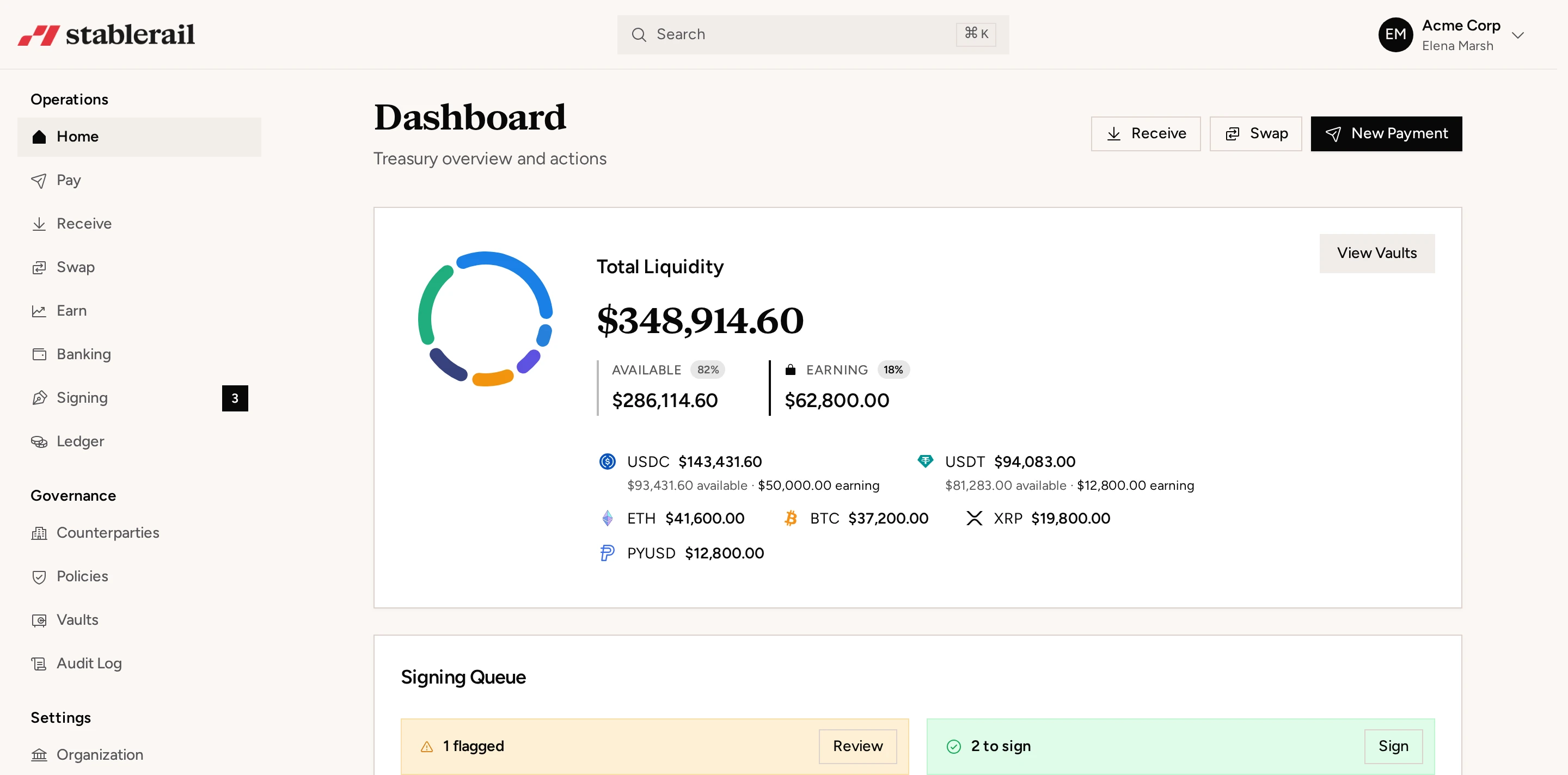
A stablecoin treasury platform can centralise these controls. For example, Stablerail provides one business account for USDC and USDT treasury operations, with approvals and signing quorum, sanctions and address screening before send, global payouts, fiat off-ramp and exportable audit evidence.
Perform a final pre-signing check
The signer should review the actual transaction presented for signature, not only the payment request. Confirm the legal entity funding the payment, token, network, complete destination address, memo or tag, amount and network fee. Use a trusted address-book entry and compare the full address rather than relying on the first and last characters alone.
After broadcast, record the transaction hash and monitor the transfer until it meets the company’s confirmation policy. Required confirmation depth should reflect the network and receiving provider. Submission is not the same as settlement: a technically confirmed transfer may still be pending internal credit at an exchange or payment provider.
Build an audit-ready payment record
The accounts payable record should connect the commercial obligation, control evidence and blockchain settlement. Retain the invoice or contract, vendor identity record, wallet verification, screening result, approval history, signing record, token, network, address, transaction hash, fees and completion time. Where currencies differ, retain the exchange-rate source and calculation.
Record network fees separately from the vendor expense where required by the company’s accounting policy. If an intermediary deducts a fee and the vendor receives less than the invoice amount, determine whether the payable remains open or whether the contract assigns that cost to the vendor.
Reconcile payments and treasury balances
Reconcile stablecoin payments against three sources: the accounts payable system, the wallet or custodian activity, and the blockchain record. Match the transaction hash, asset, network, amount, destination, timestamp and fee. Obtain vendor or provider confirmation where onchain delivery does not establish that the vendor received usable funds.
Investigate duplicate transfers, wrong amounts, pending transactions, unsupported deposits, unrecorded fees, payments from the wrong legal entity and differences caused by conversion or intermediary charges. Treasury reconciliation should also confirm token quantities by wallet and custodian and apply the company’s approved policy for classification, valuation and gains or losses.
Use a controlled process when the vendor requires fiat
A vendor does not need to accept stablecoins for the company to fund a payment from USDC or USDT reserves. A payment provider, exchange or banking partner may convert the stablecoin and send local fiat to the vendor’s bank account.
Before using that route, confirm country and currency coverage, beneficiary requirements, quoted rate, spread, fees, expected delivery path, sender of record and available payment references. Establish whether failed or refunded payouts return as fiat or stablecoin and to which account. Reconciliation should connect the original payable to the stablecoin debit, conversion and final bank payout.
Finance team release checklist
- Confirm the invoice permits the chosen settlement method and defines fees and exchange rates.
- Verify the vendor, token, network, wallet and any memo through an independent channel.
- Complete party screening and wallet screening close to payment time.
- Match the final transaction to the approved payment record.
- Obtain the required approvals and wallet signatures.
- Save the transaction hash and monitor network confirmation and recipient credit.
- Attach all evidence to the payable and reconcile the transfer promptly.
Prepare for errors before they happen
Maintain an incident procedure for suspected fraud, wrong-address transfers, incorrect networks and duplicate payments. The first steps should include stopping related releases, preserving transaction and approval evidence, notifying treasury, compliance and legal teams, and contacting the receiving provider or vendor through verified channels. Recovery may not be possible, so the control framework should focus on preventing an incorrect transaction from being signed.
Frequently asked questions
What controls are required for stablecoin vendor payments?
Core controls include independently verified wallet instructions, token and network validation, sanctions and address screening, segregation of duties, approval thresholds and signing quorum. Finance should also retain the transaction hash and reconcile the payable to wallet activity and recipient credit.
How do you verify a vendor’s crypto wallet address?
Collect the address through a controlled onboarding process and confirm it through a separate channel using contact details already on file. Verify the exact token, network and any memo or tag, and repeat the process whenever the payment instructions change.
Should a company send a test stablecoin payment first?
A test transfer is useful for a first-time address, changed wallet or unfamiliar network because it confirms the technical route. It does not prove the vendor’s identity or legal control of the wallet, so normal onboarding and screening controls still apply.
How are USDC or USDT vendor payments reconciled?
Match the payable to the wallet or custodian record and blockchain transaction using the hash, asset, network, amount, address, timestamp and fee. Keep the payment open until the company’s confirmation standard is met and the vendor or receiving provider has credited the funds where appropriate.
Can a company pay a fiat-only vendor from stablecoin reserves?
Yes. A payment provider, exchange or banking partner can convert USDC or USDT and deliver fiat to the vendor’s bank account. Finance should review the rate, fees, sender of record, payout reference, delivery evidence and treatment of failed or refunded payments.
Finance writers covering stablecoin treasury, payments, compliance, and risk controls.
More about the Stablerail team- Stablecoin treasury managementApprovals, limits, yield and reporting on one balance.
- Stablecoin payoutsBatch contractor and vendor payments with screening.
- USDT vs USDCWhich stablecoin your company should settle in.
- Stablecoin finance glossaryMPC, off-ramp, travel rule and the rest, in plain English.
- Product updatesEverything we ship, month by month.