
Stablecoin Transaction Converter
Estimate USDC and USDT conversions into fiat or another stablecoin. Learn how rates, spreads, network fees, off-ramp charges and settlement affect proceeds.
A stablecoin transaction converter estimates how much USDC, USDT or fiat you receive after applying the relevant exchange rate. For an accurate treasury decision, distinguish the displayed reference rate from an executable quote and account for trading spreads, blockchain network fees, platform charges, fiat off-ramp costs and bank deductions. Always confirm the stablecoin, blockchain network, destination currency and final amount receivable before approving a transfer.

How a stablecoin transaction converter works
A stablecoin transaction converter translates an amount of USDC, USDT or another supported asset into an estimated amount of fiat or another stablecoin. Enter the source asset, destination asset and amount, then apply the quoted exchange rate.
The basic calculation is:
Estimated destination amount = source amount × conversion rate − applicable fees
The arithmetic is simple, but the result is only useful when the inputs reflect the actual transaction route. A conversion from USDC to USD may involve an issuer redemption, exchange trade, liquidity provider or business off-ramp. Each route can use a different rate and fee structure.
A converter should therefore be treated as an estimate unless it displays a live, executable quote that is available for a stated period. A market reference rate shows an indicative value. It does not guarantee how many dollars, euros or stablecoins will arrive in the recipient account.
USDC, USDT and fiat are not always interchangeable at par
USDC and USDT are designed to track the US dollar, but a one-token-to-one-dollar result should not be assumed for every transaction. The market price can move slightly above or below the intended peg, particularly when liquidity is fragmented or markets are stressed.
Even when a stablecoin trades near one dollar, the final amount received may be lower because of the spread and transaction costs. Converting into a non-USD currency also introduces a foreign exchange conversion. For example, a USDT-to-EUR transaction can include both a USDT-to-USD component and a USD-to-EUR component, whether or not the provider displays them separately.
Finance teams should identify four different figures:
- Reference value: the amount implied by a market or accounting rate.
- Quoted amount: the amount offered by the execution venue before additional deductions.
- Net settlement amount: the amount sent after trading, platform and network costs.
- Amount received: the final amount credited after any intermediary or receiving-bank deductions.
Compare stablecoin conversion routes
The right route depends on asset support, transaction size, destination currency, settlement requirements and internal controls. Compare the complete path rather than selecting a provider solely because its headline rate appears attractive.
| Conversion route | Common use | Rate or price basis | Costs to verify | Operational consideration |
|---|---|---|---|---|
| Issuer redemption | Converting a supported stablecoin into its reference fiat currency | Issuer redemption terms | Account, transfer and banking charges | Requires an eligible account, supported bank destination and compliance review |
| Centralized exchange | Trading between stablecoins or selling into fiat | Order book or quoted trade price | Trading, withdrawal, network and fiat transfer fees | Execution can depend on market depth, account limits and withdrawal availability |
| Over-the-counter provider | Larger or negotiated conversions | Executable bilateral quote | Spread, settlement and transfer charges | Confirm quote expiry, settlement instructions and counterparty terms |
| Onchain liquidity venue | Stablecoin-to-stablecoin swaps | Pool pricing or routed onchain quote | Price impact, protocol charges, gas and bridging costs | Smart-contract, token and network risks must be reviewed |
| Business fiat off-ramp | Paying suppliers or moving stablecoin proceeds into a bank account | Provider quote, potentially including FX | Conversion, payout, intermediary-bank and receiving-bank deductions | Beneficiary details, compliance checks and payout-rail cutoffs affect settlement |
Costs a converter may not capture
Trading spread and price impact
The spread is the difference between the available buy and sell prices or between a provider's reference rate and executable rate. Price impact occurs when an order consumes available liquidity and executes at multiple prices. It can be more significant for large transactions or less-liquid trading pairs.
Blockchain network fees
Sending stablecoins requires use of a specific blockchain network. The fee may be paid in the network's native asset rather than in USDC or USDT. If a platform deducts withdrawal fees from the stablecoin amount, the destination can receive less than the conversion screen initially shows.
Token symbols alone are not sufficient instructions. USDC and USDT exist on multiple networks, and the sender and recipient must support the same asset on the same network. Sending to an unsupported network or incompatible address can result in delayed or unrecoverable funds.
Platform and off-ramp charges
A provider may charge separately for conversion, custody withdrawal, fiat payout or expedited processing. Alternatively, compensation may be embedded in the rate. Ask whether the quote is gross or net and whether any fees will be deducted after execution.
Foreign exchange and banking deductions
When the destination is EUR, GBP or another fiat currency, the transaction may include an FX spread or conversion fee. Correspondent banks and receiving banks may also deduct charges. The off-ramp provider may not control or know every downstream deduction in advance.
How to interpret the displayed conversion rate
Before relying on a result, check the rate source and timestamp. A useful conversion record should show the source amount and asset, destination asset, rate, time, fee assumptions and whether the result is indicative or executable.
For an executable quote, also confirm:
- How long the quote remains valid.
- Whether the rate applies to the entire transaction amount.
- Whether fees are included in or added to the quote.
- What happens if funds arrive after the quote expires.
- Whether the provider guarantees the destination amount or only the conversion rate.
Rate selection matters for accounting as well. The rate used to estimate a transaction may differ from the rate required by the company's accounting policy for initial recognition, remeasurement or disposal. Preserve both the approval-time estimate and the final execution evidence rather than overwriting one with the other.
A finance-team checklist before converting
- Verify the legal asset name and ticker. Confirm whether the transaction uses USDC, USDT or another token.
- Confirm the blockchain network. Match the sending platform, token contract where relevant and recipient support.
- Screen the destination. Complete sanctions, address and counterparty checks before funds are sent.
- Compare net proceeds. Evaluate the amount expected at the final wallet or bank account, not just the headline rate.
- Test new routes carefully. Validate beneficiary details and operational compatibility before committing a material amount.
- Apply approvals. Use appropriate transaction limits, segregation of duties and signing quorum.
- Retain evidence. Export the quote, approvals, transaction hash, fee records, payout confirmation and bank receipt.
- Reconcile the transaction. Record differences between the estimate, executed amount and amount received.
Using a converter for treasury decisions
A converter is most useful for planning liquidity, comparing routes and preparing an approval request. It can help answer whether enough stablecoin is available to fund a fiat obligation or whether a USDC-to-USDT conversion is economical. It should not replace an executable quote, destination verification or treasury controls.
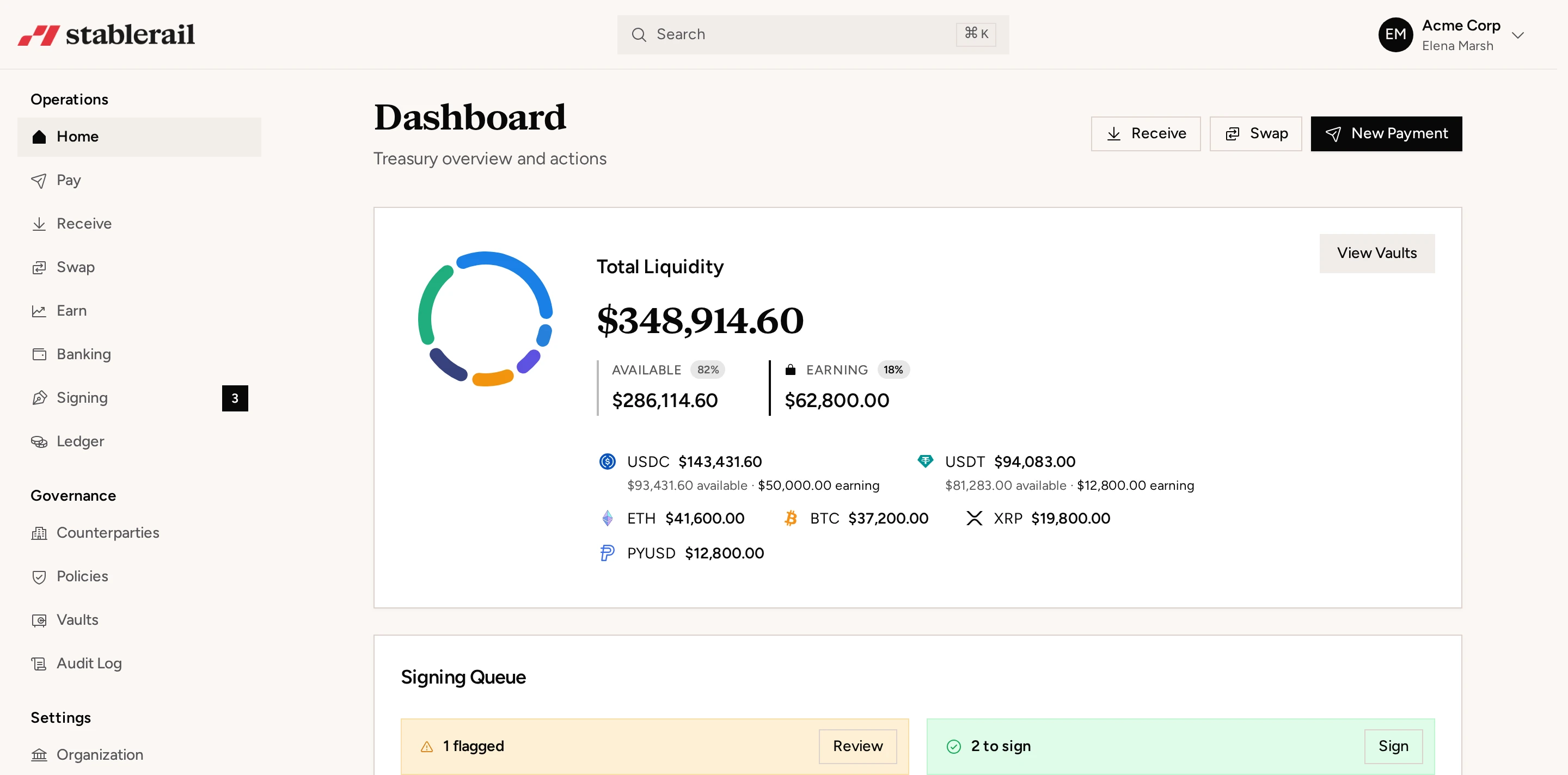
For recurring operations, finance teams benefit from connecting conversion with the rest of the transaction workflow. Stablerail provides one business account for USDC and USDT treasury, with approvals and signing quorum, sanctions and address screening before send, global payouts, fiat off-ramp capabilities and exportable audit evidence.
Records to retain after conversion
A complete transaction file allows the controller to explain the rate, costs and movement of funds. Retain the original quote or converter output, execution confirmation, wallet transaction hash, source and destination addresses, blockchain network, fee breakdown, approval evidence, off-ramp receipt and bank statement entry.
Reconciliation should separate market movement from explicit fees and operational deductions. If the amount received differs from the estimate, determine whether the variance came from quote expiry, spread, price impact, network fees, FX conversion or bank charges. This creates a defensible audit trail and improves future route comparisons.
The most reliable conversion result is therefore not simply a token amount multiplied by a displayed rate. It is the verified net amount expected at the final destination, supported by clear assumptions, controlled execution and complete settlement evidence.
Frequently asked questions
How do I convert USDT or USDC to USD?
Choose a route that supports the stablecoin, blockchain network and USD bank destination, then obtain an executable quote. Confirm the net dollars expected after conversion, withdrawal, payout and possible banking charges before sending the stablecoin.
Is one USDC or USDT always worth one US dollar?
No. Both stablecoins are intended to track the US dollar, but their market prices can trade slightly above or below one dollar. Conversion spreads, fees and off-ramp deductions can also make the final proceeds different from a one-to-one calculation.
Can I convert USDT directly to USDC?
Yes, if an exchange, onchain venue or liquidity provider supports the pair and the relevant networks. Compare the executable rate, price impact, trading fees, network costs and withdrawal requirements rather than relying only on the displayed ratio.
Does a stablecoin converter include transaction fees?
Not necessarily. Some converters show only a reference value, while others include selected trading or platform fees. Network fees, FX costs, off-ramp charges and bank deductions may still apply, so check whether the result is gross or net.
What information should I save for a stablecoin conversion audit?
Retain the quote, rate timestamp, approval evidence, execution confirmation, transaction hash, wallet addresses, blockchain network and fee breakdown. For fiat settlement, also keep the payout confirmation and bank statement showing the amount actually received.
Former CEO of Simple, a self-custodial wallet with $2B+ in transaction volume across 75+ countries.
More about the Stablerail team- Stablecoin treasury managementApprovals, limits, yield and reporting on one balance.
- Stablecoin payoutsBatch contractor and vendor payments with screening.
- USDT vs USDCWhich stablecoin your company should settle in.
- Stablecoin finance glossaryMPC, off-ramp, travel rule and the rest, in plain English.
- Product updatesEverything we ship, month by month.