
Stablecoin Transaction Approval Generator
Learn how to generate stablecoin transaction approvals that connect business purpose, wallet details, screening, authorization, execution and audit evidence.
A stablecoin transaction approval generator creates a standardized record showing who requested, reviewed and authorized a USDC or USDT payment before it was signed. A useful record includes the business purpose, amount, token, blockchain network, source wallet, destination address, screening result, approval quorum and supporting documents. After execution, add the transaction hash and reconcile the final on-chain amount and fees.

What a stablecoin transaction approval generator should produce
A stablecoin transaction approval generator turns a proposed USDC or USDT payment into a structured authorization record. Its purpose is not merely to make a polished document. It should give reviewers enough information to decide whether a transaction is legitimate, correctly configured and ready to sign.
The record should connect three stages that are often separated in wallet workflows: the underlying business obligation, the internal approval decision and the blockchain transaction that ultimately settles the payment. That connection matters because a transaction hash proves that an on-chain transfer occurred, but it does not explain why the company sent the funds or who authorized the payment.
A complete approval package should include the following information:
- Business details: payment purpose, requesting department, beneficiary name, invoice or payroll reference and supporting documents.
- Transaction details: amount, token, blockchain network, source wallet, destination address and expected network fee.
- Risk checks: beneficiary verification, address screening result, wallet ownership evidence when required and confirmation that the token contract is correct.
- Authorization: requester, reviewers, approvers, timestamps and the required signing quorum.
- Execution evidence: signer identities, transaction hash, block timestamp, actual fee and reconciliation status.
The generator should assign an internal approval ID before execution. This is different from the blockchain transaction hash, which does not exist until a transaction has been signed and broadcast.
Approval record versus blockchain evidence
Stablecoin teams should preserve both internal and on-chain evidence. Neither is a substitute for the other.
| Evidence | What it establishes | When it is available | What it does not establish |
|---|---|---|---|
| Invoice, payroll file or payout instruction | The commercial reason and expected amount | Before approval | Whether the wallet details were approved or funds were sent |
| Approval record | Who reviewed the payment, what they reviewed and whether the required authority was met | Before signing | That the final blockchain transaction matched the approved instruction |
| Wallet signature record | Which signing keys authorized the transaction | During execution | The business purpose or beneficiary relationship |
| Transaction hash and block explorer data | The token, amount, addresses, network, fee and settlement status recorded on-chain | After broadcast | Why the transaction was valid under company policy |
| Reconciliation record | Whether the executed transfer matched the approved obligation and accounting entry | After execution | Whether pre-send screening and approval were completed |
This distinction prevents a common control gap: approving a spreadsheet row or invoice without confirming that the transaction presented to signers contains the same token, network, amount and destination address.
Fields to include in the approval template
Business purpose and beneficiary
Start with the reason for the payment. Record the legal or trading name of the beneficiary, the internal owner of the relationship, the invoice or obligation being settled and the relevant entity making the payment. Supporting files should be referenced by stable identifiers rather than stored only in an employee’s inbox or chat history.
If the beneficiary has changed its wallet address, document how the new instructions were verified. An email from a compromised account can look authentic, so teams may require confirmation through a previously established communication channel. The reviewer should be able to see whether an address is new, previously approved or recently modified.
Token, network and wallet details
“Send USDC” is not a complete payment instruction. Stablecoins can exist on multiple blockchain networks, and an address with the same character format may be usable across several networks. The approval must specify the exact token, issuing contract where relevant, blockchain network, amount, source wallet and destination address.
Display full addresses or provide a controlled way to inspect them. Truncated addresses are useful for compact interfaces but should not be the only information available to reviewers. Clipboard substitution and lookalike-address risks make comparison of only the first and last few characters insufficient.
Fees and amount treatment
The record should distinguish the beneficiary amount from the network fee. It should also state whether the payment must deliver an exact token amount or whether deductions are permitted. The source wallet needs enough native network asset to pay gas when fees cannot be paid in the stablecoin itself.
If the payment amount may change because of a fee, batch allocation or conversion step, define the permitted treatment before approval. Material changes should trigger a new review rather than silently carrying forward an approval for a different transaction.
Screening and authorization
Record whether sanctions and address screening was performed before the send, when it occurred and what address was checked. A screening result is time-sensitive evidence tied to a particular address and transaction decision; it should not be treated as permanent approval of a beneficiary.
The authorization section should identify the required approver roles and signing quorum. For example, the person creating a payout should not be able to approve and execute it alone where the company’s control design requires separation of duties. The record should show actual approvals, not just names entered into a template after the transfer.
A practical approval workflow
- Create the request. Enter the beneficiary, business purpose, entity, amount, token, network, source wallet and destination address. Attach or reference the underlying obligation.
- Validate the instruction. Confirm the token contract, network compatibility, wallet balance, native gas balance and whether the destination is new or changed.
- Perform pre-send checks. Verify the beneficiary instruction and complete sanctions or address screening before funds are released.
- Route for approval. Apply the company’s authority levels and signing quorum. Keep requester, approver and signer identities distinct where required.
- Construct and inspect the transaction. Compare the transaction presented for signature with the approved token, network, amount and full destination address.
- Sign and broadcast. Record the signers and capture the transaction hash once it is available.
- Reconcile and retain evidence. Confirm settlement, record the actual network fee, link the transaction to the accounting entry and export the evidence package.
For recurring payouts, reuse beneficiary data cautiously. A saved address reduces re-entry but does not remove the need to confirm the correct beneficiary, network and payment amount. Address changes should receive stronger review than routine payments to an unchanged destination.
Choosing between a document generator and a controlled workflow
| Option | Best suited to | Strength | Control limitation |
|---|---|---|---|
| Manual document template | Low transaction volume or an interim process | Fast to adopt and easy to customize | Entries, timestamps and approvals can be incomplete or added retrospectively |
| Form-based approval generator | Teams needing standardized requests | Required fields improve consistency | May remain disconnected from wallet signing and reconciliation |
| Treasury workflow connected to execution | Teams making regular stablecoin payments | Can connect requests, approvals, screening, signing and evidence | Requires clear roles, access management and operating procedures |
| Wallet-only approval | Technical authorization of an on-chain transaction | Enforces the wallet’s signing threshold | Usually lacks complete business purpose and accounting context |
A document generator is useful when it standardizes evidence, but generating a PDF or summary does not itself enforce approval. Finance teams should determine whether the process prevents an unauthorized send or merely documents one. Preventive controls operate before signing; retrospective records are detective evidence.
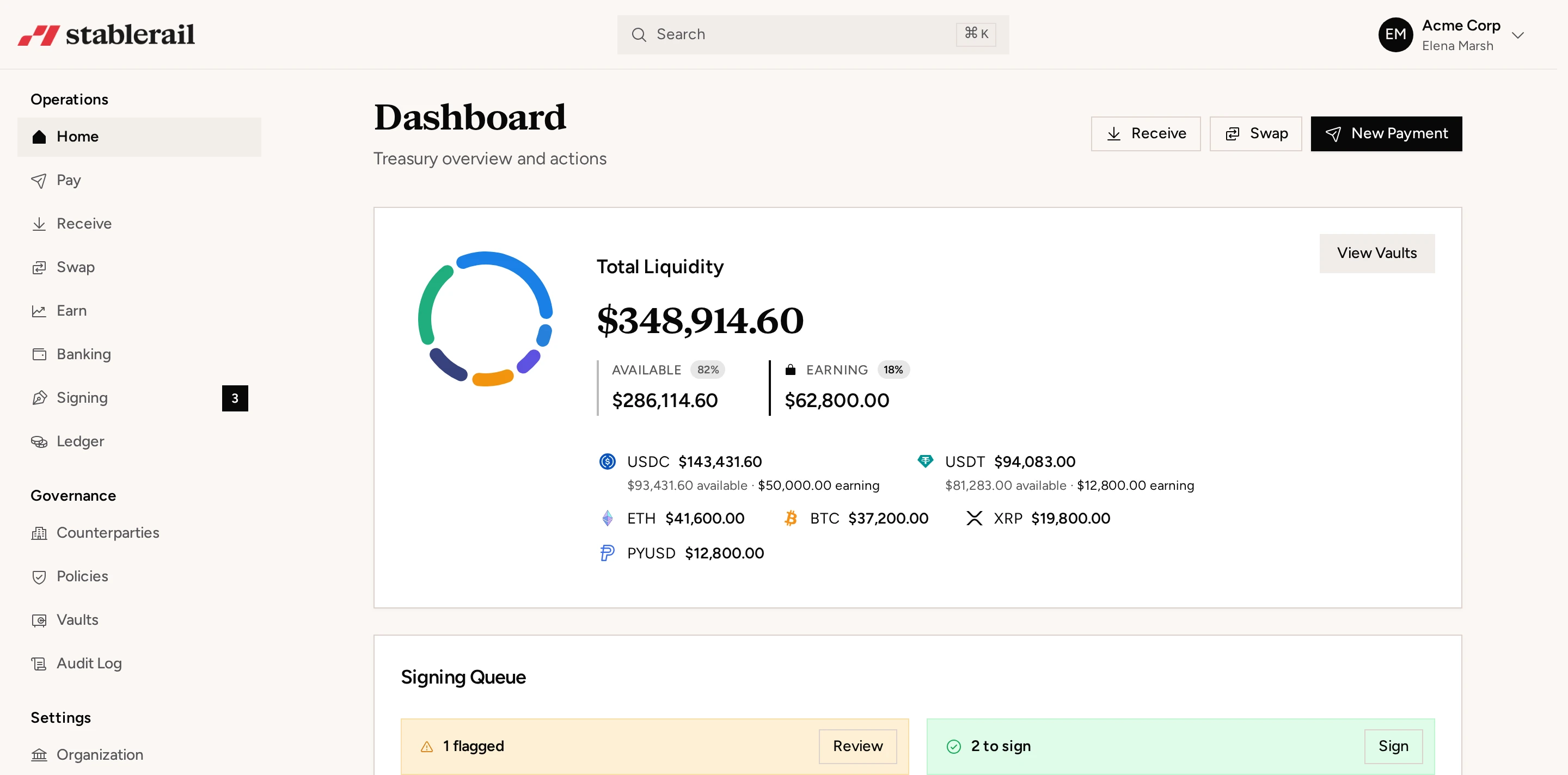
Stablerail provides one business account for USDC and USDT treasury, including approvals and signing quorum, sanctions and address screening before send, global payouts, fiat off-ramp, corporate cards and exportable audit evidence. The relevant consideration is whether a platform keeps approval data connected to the transaction that signers actually authorize.
Minimum pre-send checklist
- Confirm the correct paying entity and business purpose.
- Match the beneficiary and amount to the source document.
- Verify the exact stablecoin, token contract and blockchain network.
- Inspect the full destination address and verify any recent change.
- Check the source wallet’s stablecoin and native gas balances.
- Complete required sanctions and address screening before signing.
- Confirm that approval authority and signing quorum have been met.
- Compare the final transaction payload with the approved instruction.
Retention, reconciliation and audit readiness
After settlement, update the approval record with the transaction hash, block timestamp, final token amount and network fee. If the transaction failed, was replaced or was cancelled before broadcast, preserve that status rather than presenting the request as a completed payment.
Reconciliation should match the on-chain transfer to the payable, payroll item, intercompany movement or treasury transaction recorded in the ledger. Fees may need a separate accounting treatment from the stablecoin principal. The evidence package should make this relationship clear without requiring an auditor or controller to reconstruct it from several messaging tools and wallet exports.
Retention periods and approval thresholds depend on the company’s legal entities, accounting policies and applicable obligations. A generator should therefore support a documented internal process rather than claim that its output is automatically legally binding or sufficient for every jurisdiction. The strongest record is contemporaneous, tied to the executed transaction and exportable for later review.
Frequently asked questions
What is a stablecoin transaction approval generator?
It is a tool or workflow that creates a standardized authorization record for a proposed USDC or USDT transfer. The record connects the business purpose and supporting documents to reviewers, signers and the final blockchain transaction.
What information is required to approve a USDC or USDT payment?
Finance teams should capture the amount, token, network, source wallet, full destination address, beneficiary, business purpose and supporting reference. The approval should also show screening results, required approvers, signing quorum and, after execution, the transaction hash and fee.
Is a stablecoin approval document legally binding?
Not automatically. Its legal effect depends on company authority rules, contractual arrangements and applicable law, so it is primarily an internal authorization and audit record unless legal counsel determines otherwise.
Is a transaction hash enough for a stablecoin audit trail?
No. A transaction hash proves that an on-chain transaction occurred, but it does not explain the business purpose, beneficiary verification or internal authorization. Retain the approval record, supporting obligation, signing evidence and reconciliation alongside the hash.
Should stablecoin screening happen before or after approval?
Address and sanctions screening should occur before the transaction is sent, with the result available to the relevant reviewer or signer. If the destination address or transaction details change, the team should screen the new instruction and determine whether reapproval is required.
Former CEO of Simple, a self-custodial wallet with $2B+ in transaction volume across 75+ countries.
More about the Stablerail team- Stablecoin treasury managementApprovals, limits, yield and reporting on one balance.
- Stablecoin payoutsBatch contractor and vendor payments with screening.
- USDT vs USDCWhich stablecoin your company should settle in.
- Stablecoin finance glossaryMPC, off-ramp, travel rule and the rest, in plain English.
- Product updatesEverything we ship, month by month.