
Stablecoin to fiat off-ramp: converting USDC and USDT to bank money
Learn how businesses convert USDC and USDT into fiat, compare bank rails and net proceeds, manage approvals, and reconcile the stablecoin disposal to the bank credit.
A stablecoin-to-fiat off-ramp converts a business’s USDC or USDT into currency held in a bank account. The process combines two separate stages: selling the stablecoin for USD, EUR, GBP or another fiat currency, then sending the proceeds over a bank rail. Finance teams should compare the complete corridor, net amount received, settlement cut-offs, approval controls and evidence available for reconciliation.
%22%20x1%3D%220%22%20y1%3D%220%22%20x2%3D%221%22%20y2%3D%221%22%3E%0A%20%20%20%20%20%20%20%20%3Cstop%20offset%3D%220%25%22%20stop-color%3D%22%23450B10%22%20%2F%3E%0A%20%20%20%20%20%20%20%20%3Cstop%20offset%3D%2250%25%22%20stop-color%3D%22%23681A1F%22%20%2F%3E%0A%20%20%20%20%20%20%20%20%3Cstop%20offset%3D%22100%25%22%20stop-color%3D%22%238A2A2D%22%20%2F%3E%0A%20%20%20%20%20%20%3C%2FlinearGradient%3E%0A%20%20%20%20%20%20%3CradialGradient%20id%3D%22glow%22%20cx%3D%221277%22%20cy%3D%22248%22%20r%3D%22520%22%20gradientUnits%3D%22userSpaceOnUse%22%3E%0A%20%20%20%20%20%20%20%20%3Cstop%20offset%3D%220%25%22%20stop-color%3D%22%23FF7A59%22%20stop-opacity%3D%220.45%22%20%2F%3E%0A%20%20%20%20%20%20%20%20%3Cstop%20offset%3D%2255%25%22%20stop-color%3D%22%23FF7A59%22%20stop-opacity%3D%220.08%22%20%2F%3E%0A%20%20%20%20%20%20%20%20%3Cstop%20offset%3D%22100%25%22%20stop-color%3D%22%23FF7A59%22%20stop-opacity%3D%220%22%20%2F%3E%0A%20%20%20%20%20%20%3C%2FradialGradient%3E%0A%20%20%20%20%20%20%3ClinearGradient%20id%3D%22glass%22%20x1%3D%220%22%20y1%3D%220%22%20x2%3D%221%22%20y2%3D%221%22%3E%0A%20%20%20%20%20%20%20%20%3Cstop%20offset%3D%220%25%22%20stop-color%3D%22%23F8D6D2%22%20stop-opacity%3D%220.26%22%20%2F%3E%0A%20%20%20%20%20%20%20%20%3Cstop%20offset%3D%22100%25%22%20stop-color%3D%22%23FFFFFF%22%20stop-opacity%3D%220.08%22%20%2F%3E%0A%20%20%20%20%20%20%3C%2FlinearGradient%3E%0A%20%20%20%20%20%20%3ClinearGradient%20id%3D%22accent%22%20x1%3D%220%22%20y1%3D%220%22%20x2%3D%221%22%20y2%3D%221%22%3E%0A%20%20%20%20%20%20%20%20%3Cstop%20offset%3D%220%25%22%20stop-color%3D%22%23FF7A59%22%20%2F%3E%0A%20%20%20%20%20%20%20%20%3Cstop%20offset%3D%22100%25%22%20stop-color%3D%22%23C73128%22%20%2F%3E%0A%20%20%20%20%20%20%3C%2FlinearGradient%3E%0A%20%20%20%20%20%20%3Cfilter%20id%3D%22soft%22%3E%3CfeGaussianBlur%20stdDeviation%3D%2210%22%20%2F%3E%3C%2Ffilter%3E%0A%20%20%20%20%3C%2Fdefs%3E%0A%20%20%20%20%3Crect%20width%3D%221600%22%20height%3D%22900%22%20fill%3D%22url(%23bg)%22%20%2F%3E%0A%20%20%20%20%3Crect%20width%3D%221600%22%20height%3D%22900%22%20fill%3D%22url(%23glow)%22%20%2F%3E%0A%20%20%20%20%3Crect%20x%3D%22240%22%20y%3D%22240%22%20width%3D%22360%22%20height%3D%22420%22%20rx%3D%2220%22%20fill%3D%22url(%23glass)%22%20stroke%3D%22%23F4CDC5%22%20stroke-opacity%3D%220.55%22%2F%3E%0A%20%20%20%20%20%20%3Crect%20x%3D%22270%22%20y%3D%22290%22%20width%3D%22160%22%20height%3D%2218%22%20rx%3D%224%22%20fill%3D%22%23F8D6D2%22%20opacity%3D%220.6%22%2F%3E%0A%20%20%20%20%20%20%3Crect%20x%3D%22270%22%20y%3D%22370%22%20width%3D%22260%22%20height%3D%2248%22%20rx%3D%226%22%20fill%3D%22%23F8D6D2%22%20opacity%3D%220.8%22%2F%3E%0A%20%20%20%20%20%20%3Cpolyline%20points%3D%22270%2C590%20330%2C560%20390%2C580%20450%2C520%20510%2C540%20570%2C490%22%20fill%3D%22none%22%20stroke%3D%22%23FF8E72%22%20stroke-width%3D%225%22%2F%3E%3Crect%20x%3D%22640%22%20y%3D%22240%22%20width%3D%22360%22%20height%3D%22420%22%20rx%3D%2220%22%20fill%3D%22url(%23glass)%22%20stroke%3D%22%23F4CDC5%22%20stroke-opacity%3D%220.55%22%2F%3E%0A%20%20%20%20%20%20%3Crect%20x%3D%22670%22%20y%3D%22290%22%20width%3D%22160%22%20height%3D%2218%22%20rx%3D%224%22%20fill%3D%22%23F8D6D2%22%20opacity%3D%220.6%22%2F%3E%0A%20%20%20%20%20%20%3Crect%20x%3D%22670%22%20y%3D%22370%22%20width%3D%22260%22%20height%3D%2248%22%20rx%3D%226%22%20fill%3D%22%23F8D6D2%22%20opacity%3D%220.8%22%2F%3E%0A%20%20%20%20%20%20%3Cpolyline%20points%3D%22670%2C590%20730%2C560%20790%2C580%20850%2C520%20910%2C540%20970%2C490%22%20fill%3D%22none%22%20stroke%3D%22%23FF8E72%22%20stroke-width%3D%225%22%2F%3E%3Crect%20x%3D%221040%22%20y%3D%22240%22%20width%3D%22360%22%20height%3D%22420%22%20rx%3D%2220%22%20fill%3D%22url(%23accent)%22%20stroke%3D%22%23F4CDC5%22%20stroke-opacity%3D%220.55%22%2F%3E%0A%20%20%20%20%20%20%3Crect%20x%3D%221070%22%20y%3D%22290%22%20width%3D%22160%22%20height%3D%2218%22%20rx%3D%224%22%20fill%3D%22%23F8D6D2%22%20opacity%3D%220.6%22%2F%3E%0A%20%20%20%20%20%20%3Crect%20x%3D%221070%22%20y%3D%22370%22%20width%3D%22260%22%20height%3D%2248%22%20rx%3D%226%22%20fill%3D%22%23F8D6D2%22%20opacity%3D%220.95%22%2F%3E%0A%20%20%20%20%20%20%3Cpolyline%20points%3D%221070%2C590%201130%2C560%201190%2C580%201250%2C520%201310%2C540%201370%2C490%22%20fill%3D%22none%22%20stroke%3D%22%23FFF1ED%22%20stroke-width%3D%225%22%2F%3E%0A%20%20%20%20%3Crect%20x%3D%2226%22%20y%3D%2226%22%20width%3D%221548%22%20height%3D%22848%22%20rx%3D%2218%22%20fill%3D%22none%22%20stroke%3D%22%23F2D0C8%22%20stroke-opacity%3D%220.12%22%2F%3E%0A%20%20%3C%2Fsvg%3E)
A stablecoin-to-fiat off-ramp converts a business’s USDC or USDT into currency held in a bank account. The process combines two separate stages: selling the stablecoin for USD, EUR, GBP or another fiat currency, then sending the proceeds over a bank rail. Finance teams should compare the complete corridor, net amount received, settlement cut-offs, approval controls and evidence available for reconciliation.
What a business stablecoin off-ramp actually does
An off-ramp is not a single transfer. It joins a blockchain transaction, a currency conversion and a bank payment. Each stage has different costs, operating hours, compliance checks and failure modes.
A route described only as “USDC to USD” is therefore incomplete. Treasury needs to know the token contract, blockchain network, amount, receiving currency, beneficiary country, bank-account ownership and settlement method. USDC on one network may be supported while USDC on another is not, even though the ticker is identical.
The destination also matters. Some services settle only to a verified account in the company’s legal name. Others may support approved third-party beneficiaries, subject to additional checks. Finance should confirm this before relying on an off-ramp for supplier payments, payroll funding or intercompany transfers.
How USDC or USDT becomes bank money
- Select the complete corridor. Specify the stablecoin, blockchain, fiat currency, beneficiary jurisdiction and bank rail.
- Enter the amount. The service should show the conversion rate, separately charged fees, expected proceeds and any transaction limits.
- Review the quote. Confirm when it expires and whether the rate is fixed upon acceptance, upon receipt of the stablecoin or only when conversion executes.
- Approve the transaction. Apply the company’s signing and payment-approval requirements before assets leave the wallet.
- Send the stablecoin. Transfer the exact token on the specified network to the stated address. Verify addresses through a controlled process rather than relying on copied chat messages.
- Wait for confirmations and checks. The provider must detect the transaction and may require a number of blockchain confirmations before conversion.
- Convert and settle. The stablecoin is sold for fiat, and the fiat proceeds are sent through the selected bank route.
- Reconcile the transaction. Match the wallet movement, conversion record, fees, bank payment reference and bank-statement credit.
A confirmed blockchain transfer proves that the stablecoin moved. It does not prove that the fiat has reached the beneficiary’s bank account.
Choose the right off-ramp model
Businesses can access fiat through an issuer redemption process, an exchange or OTC relationship, or a treasury platform that combines wallet operations and banking workflows. The appropriate choice depends on eligibility, volume, supported corridors and the controls required by the finance team.
| Off-ramp model | Potential fit | Finance questions to ask |
|---|---|---|
| Issuer redemption | Eligible businesses redeeming the issuer’s own stablecoin | What are the eligibility, account, minimum-amount, network and bank-settlement requirements? |
| Exchange or OTC provider | Teams seeking liquidity across multiple assets or larger negotiated conversions | When is the rate fixed, where are assets held, and how are fiat withdrawals approved? |
| Treasury and payment platform | Operating teams that need stablecoin controls, fiat off-ramp and payout workflows together | Which corridors are supported, what approval controls apply, and what evidence can be exported? |
| Bank or payment provider with digital-asset support | Businesses prioritising integration with existing bank operations | Does the institution support the token and network directly, or rely on another conversion provider? |
Availability is not interchangeable across providers. A service may support USDC but not USDT, or accept a token only on selected networks. It may also support conversion into a currency without supporting settlement to every country where that currency is used.
Compare corridors, not headline conversion fees
The useful cost measure is the amount that reaches the bank account. A “zero fee” quote may still include a spread between the market reference rate and the offered conversion rate. Conversely, a provider with a visible fee may deliver better net proceeds.
Total economic cost can include:
- Conversion spread: the difference between a stated reference price and the executed exchange rate.
- Conversion fee: a separately disclosed charge for selling the stablecoin.
- Blockchain fee: the network cost of transferring USDC or USDT.
- Bank-rail fee: a charge associated with the domestic or cross-border payment method.
- Correspondent or recipient-bank deductions: charges that may reduce the amount credited, particularly on cross-border routes.
Compare quotes using a common calculation: expected bank credit minus the stablecoin amount’s agreed reference value. Record the reference source and timestamp, quoted rate, explicit fees and expected proceeds. This allows treasury to compare routes consistently and gives accounting an explanation for the difference between the stablecoin carrying amount and fiat received.
Also establish who bears unexpected bank deductions. If the beneficiary must receive an exact amount, a route with uncertain correspondent charges may be unsuitable even when its quoted conversion rate is competitive.
Plan blockchain and bank timing separately
End-to-end timing starts with internal approval, not with the bank payment. It may include quote acceptance, signing, blockchain inclusion, required confirmations, compliance review, conversion and bank processing. Weekends and holidays affect many fiat rails even when the blockchain operates continuously.
| Bank route | Typical operating consideration | Main timing risk |
|---|---|---|
| ACH | Batch-based US payments; same-day processing depends on eligibility and submission windows | Missing a processing window can move settlement to a later business day |
| Fedwire | US wire settlement during published operating hours | Provider and bank cut-offs may be earlier than the rail’s closing time |
| SEPA Credit Transfer | Euro payments processed on banking business days | Non-business days and receiving-bank processing can extend delivery |
| SEPA Instant | Continuous euro payment capability when the sending and receiving institutions support it | Participation, transaction controls or screening can prevent instant delivery |
| Faster Payments | UK payments can operate continuously | Provider limits, fraud checks or recipient-bank review can delay credit |
| SWIFT or correspondent route | Cross-border payment instructions may pass through intermediary banks | Time zones, compliance reviews, correspondents and fee deductions add uncertainty |
These are rail characteristics, not delivery promises. For payroll or another fixed deadline, work backwards from the required bank credit and include a contingency for manual review. A test transaction can validate beneficiary details and reconciliation fields, but it does not guarantee that a later, larger payment will follow the same review path.
Complete KYB before the conversion is urgent
Off-ramp providers generally conduct know-your-business checks on the company, its controllers and expected activity. The process often requires incorporation records, operating and registered addresses, director details, beneficial ownership information, identity evidence, a description of business activity and proof of the destination bank account.
Providers may also ask about expected volumes, source of funds, the origin of stablecoins and common payment corridors. Complex ownership, regulated activities or unusual transaction patterns can require further review. A current ownership chart and a clear funds-flow diagram can reduce avoidable follow-up.
Do not assume that account approval means every transaction or corridor is approved. A new beneficiary, materially different volume, different source wallet or new jurisdiction may trigger additional checks.
Apply treasury controls before assets leave the wallet
Stablecoin transactions are generally difficult to reverse, so preventive controls are more important than post-payment recovery. Separate transaction creation from approval, require a signing quorum appropriate to the amount and independently verify new destination addresses.
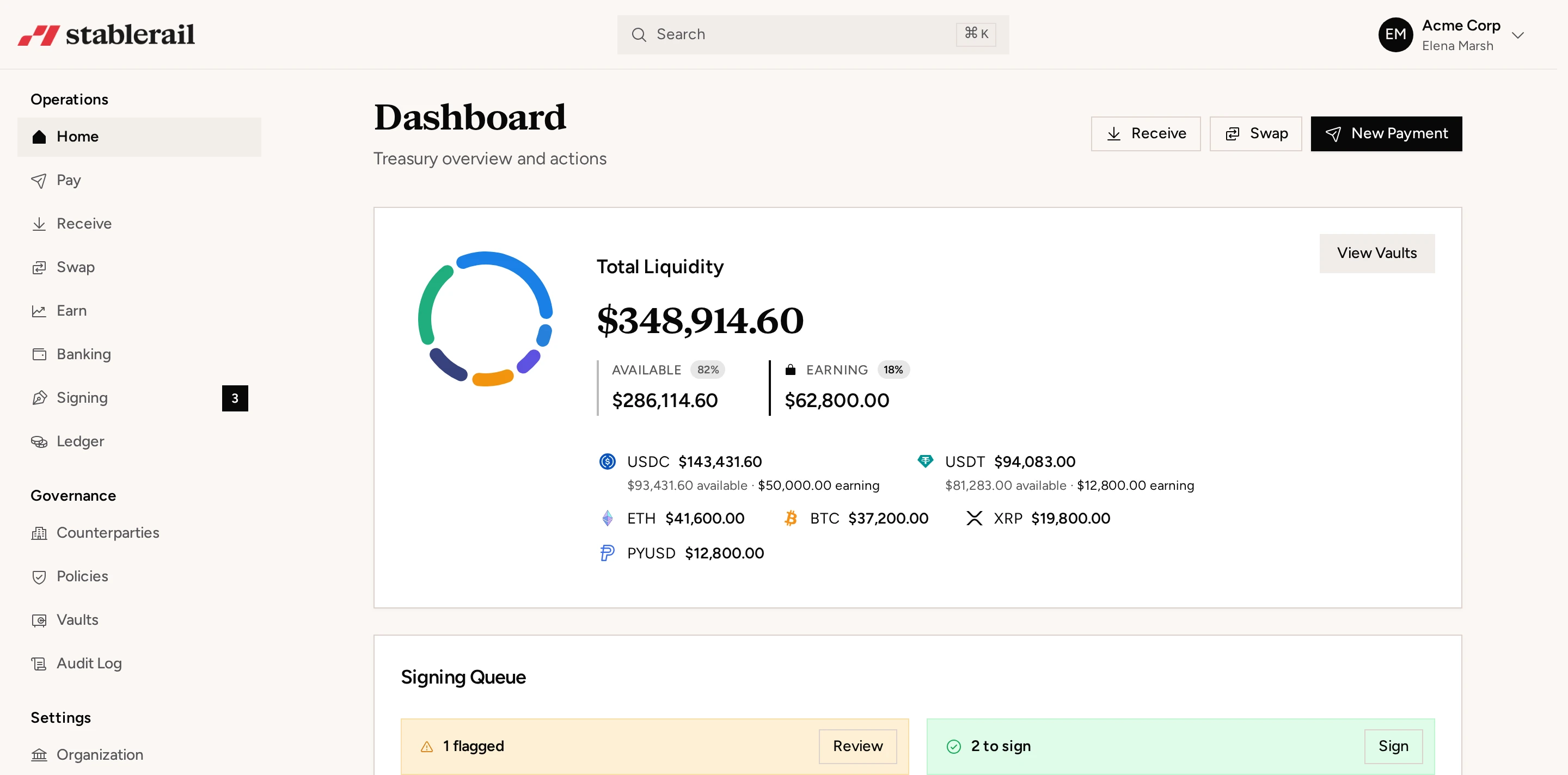
Stablerail provides one business account for USDC and USDT treasury, including approvals and signing quorum, sanctions and address screening before send, global payouts, fiat off-ramp and exportable audit evidence. Whatever provider is used, finance should document who can create, approve, sign and reconcile a conversion.
Minimum pre-send control checklist
- Confirm the token contract, network, amount and deposit address.
- Verify that the fiat corridor and beneficiary country are supported.
- Check the beneficiary’s legal name, account details and permitted account ownership.
- Review the quote rate, expiry, fees and expected bank proceeds.
- Screen the destination and retain the result under company policy.
- Apply dual approval or the required signing quorum.
- Check blockchain conditions, bank cut-offs, weekends and holidays.
- Save the quote and transaction identifiers before closing the workflow.
Build an audit trail from wallet to bank
A complete evidence pack should connect the stablecoin disposal to the fiat credit. Retain the accepted quote and timestamp, token and network, sending and receiving addresses, transaction hash, approval record, screening evidence, conversion confirmation, fees, payout reference and bank-statement entry. Record exceptions such as rejected payments, refunds or adjusted fees rather than overwriting the original transaction.
The accounting treatment depends on the applicable reporting framework, company policy and facts. Finance should determine the stablecoin’s carrying value, recognise any difference on disposal consistently, and post conversion, blockchain and banking fees to the appropriate accounts. The ledger description should include identifiers that permit a reviewer to move from the general ledger to both the blockchain record and bank statement.
For recurring conversions, use a standard corridor record containing the supported network, usual approval path, bank cut-off, evidence owner and fallback route. Stablerail can combine stablecoin treasury operations with fiat off-ramp and exportable evidence, reducing the need to reconstruct the transaction across disconnected systems.
The practical decision rule
Select a stablecoin off-ramp based on reliable net proceeds to the required bank account by the required deadline. The cheapest quoted rate is not the best route if the network is unsupported, the beneficiary is ineligible, the payment misses a cut-off or the finance team cannot produce a complete audit trail. Test the corridor before it becomes critical, then review pricing, limits and availability each time rather than assuming the previous conditions still apply.
Frequently asked questions
How do I convert USDC to money in a business bank account?
Use a business off-ramp that supports your USDC network, destination currency, beneficiary country and bank rail. After KYB approval, accept a conversion quote, send USDC to the specified address and reconcile the resulting fiat payment to the blockchain transaction and bank credit.
What is the cheapest way to off-ramp USDT or USDC?
Compare the final amount expected in the bank account rather than the advertised conversion fee. Include the spread, explicit conversion charge, blockchain fee, bank-rail fee and any potential correspondent or recipient-bank deductions.
How long does a stablecoin-to-fiat off-ramp take?
Timing depends on internal approvals, blockchain confirmations, compliance checks, conversion processing and the selected bank route. Instant-capable bank rails may still be delayed by provider controls or recipient-bank review, while business-day rails are affected by cut-offs, weekends and holidays.
Can a business send off-ramp proceeds to a third-party bank account?
It depends on the provider and corridor. Some off-ramps settle only to a verified account held in the company’s legal name, while others support approved third-party beneficiaries after additional checks.
What records should finance retain for a USDC or USDT off-ramp?
Keep the accepted quote, rate and fee details, approval record, token and network, wallet addresses, transaction hash, screening evidence, conversion confirmation, bank payment reference and bank-statement credit. Together, these records connect the stablecoin disposal to the fiat proceeds and support reconciliation and audit review.
Finance writers covering stablecoin treasury, payments, compliance, and risk controls.
More about the Stablerail team- Stablecoin treasury managementApprovals, limits, yield and reporting on one balance.
- Stablecoin payoutsBatch contractor and vendor payments with screening.
- USDT vs USDCWhich stablecoin your company should settle in.
- Stablecoin finance glossaryMPC, off-ramp, travel rule and the rest, in plain English.
- Product updatesEverything we ship, month by month.