
Stablecoin rails vs SWIFT and SEPA: a practical comparison
A practical finance comparison of SWIFT, SEPA and stablecoin rails, covering end-to-end cost, settlement time, weekend availability, controls and recovery.
Use SEPA for predictable euro payments between eligible bank accounts, SWIFT for broad international bank and currency coverage, and stablecoin rails when both parties can handle USDC or USDT and need 24/7 settlement. Compare the entire route—not just transfer speed—including funding, foreign exchange, network or bank fees, the recipient’s off-ramp, reconciliation, compliance controls and the consequences of sending funds incorrectly.
%22%20x1%3D%220%22%20y1%3D%220%22%20x2%3D%221%22%20y2%3D%221%22%3E%0A%20%20%20%20%20%20%20%20%3Cstop%20offset%3D%220%25%22%20stop-color%3D%22%233E090D%22%20%2F%3E%0A%20%20%20%20%20%20%20%20%3Cstop%20offset%3D%2250%25%22%20stop-color%3D%22%235C1218%22%20%2F%3E%0A%20%20%20%20%20%20%20%20%3Cstop%20offset%3D%22100%25%22%20stop-color%3D%22%237B1F22%22%20%2F%3E%0A%20%20%20%20%20%20%3C%2FlinearGradient%3E%0A%20%20%20%20%20%20%3CradialGradient%20id%3D%22glow%22%20cx%3D%221215%22%20cy%3D%22-387%22%20r%3D%22520%22%20gradientUnits%3D%22userSpaceOnUse%22%3E%0A%20%20%20%20%20%20%20%20%3Cstop%20offset%3D%220%25%22%20stop-color%3D%22%23FF8E72%22%20stop-opacity%3D%220.45%22%20%2F%3E%0A%20%20%20%20%20%20%20%20%3Cstop%20offset%3D%2255%25%22%20stop-color%3D%22%23FF8E72%22%20stop-opacity%3D%220.08%22%20%2F%3E%0A%20%20%20%20%20%20%20%20%3Cstop%20offset%3D%22100%25%22%20stop-color%3D%22%23FF8E72%22%20stop-opacity%3D%220%22%20%2F%3E%0A%20%20%20%20%20%20%3C%2FradialGradient%3E%0A%20%20%20%20%20%20%3ClinearGradient%20id%3D%22glass%22%20x1%3D%220%22%20y1%3D%220%22%20x2%3D%221%22%20y2%3D%221%22%3E%0A%20%20%20%20%20%20%20%20%3Cstop%20offset%3D%220%25%22%20stop-color%3D%22%23F8D6D2%22%20stop-opacity%3D%220.26%22%20%2F%3E%0A%20%20%20%20%20%20%20%20%3Cstop%20offset%3D%22100%25%22%20stop-color%3D%22%23FFFFFF%22%20stop-opacity%3D%220.08%22%20%2F%3E%0A%20%20%20%20%20%20%3C%2FlinearGradient%3E%0A%20%20%20%20%20%20%3ClinearGradient%20id%3D%22accent%22%20x1%3D%220%22%20y1%3D%220%22%20x2%3D%221%22%20y2%3D%221%22%3E%0A%20%20%20%20%20%20%20%20%3Cstop%20offset%3D%220%25%22%20stop-color%3D%22%23FF8E72%22%20%2F%3E%0A%20%20%20%20%20%20%20%20%3Cstop%20offset%3D%22100%25%22%20stop-color%3D%22%23D94030%22%20%2F%3E%0A%20%20%20%20%20%20%3C%2FlinearGradient%3E%0A%20%20%20%20%20%20%3Cfilter%20id%3D%22soft%22%3E%3CfeGaussianBlur%20stdDeviation%3D%2210%22%20%2F%3E%3C%2Ffilter%3E%0A%20%20%20%20%3C%2Fdefs%3E%0A%20%20%20%20%3Crect%20width%3D%221600%22%20height%3D%22900%22%20fill%3D%22url(%23bg)%22%20%2F%3E%0A%20%20%20%20%3Crect%20width%3D%221600%22%20height%3D%22900%22%20fill%3D%22url(%23glow)%22%20%2F%3E%0A%20%20%20%20%3Cellipse%20cx%3D%22380%22%20cy%3D%22660%22%20rx%3D%2278%22%20ry%3D%2218%22%20fill%3D%22url(%23glass)%22%20stroke%3D%22%23F4CDC5%22%20stroke-opacity%3D%220.5%22%2F%3E%3Cellipse%20cx%3D%22380%22%20cy%3D%22630%22%20rx%3D%2278%22%20ry%3D%2218%22%20fill%3D%22url(%23glass)%22%20stroke%3D%22%23F4CDC5%22%20stroke-opacity%3D%220.5%22%2F%3E%3Cellipse%20cx%3D%22380%22%20cy%3D%22600%22%20rx%3D%2278%22%20ry%3D%2218%22%20fill%3D%22url(%23glass)%22%20stroke%3D%22%23F4CDC5%22%20stroke-opacity%3D%220.5%22%2F%3E%3Cellipse%20cx%3D%22380%22%20cy%3D%22570%22%20rx%3D%2278%22%20ry%3D%2218%22%20fill%3D%22url(%23accent)%22%20stroke%3D%22%23F4CDC5%22%20stroke-opacity%3D%220.5%22%2F%3E%3Cellipse%20cx%3D%22920%22%20cy%3D%22660%22%20rx%3D%2278%22%20ry%3D%2218%22%20fill%3D%22url(%23glass)%22%20stroke%3D%22%23F4CDC5%22%20stroke-opacity%3D%220.5%22%2F%3E%3Cellipse%20cx%3D%221100%22%20cy%3D%22660%22%20rx%3D%2278%22%20ry%3D%2218%22%20fill%3D%22url(%23glass)%22%20stroke%3D%22%23F4CDC5%22%20stroke-opacity%3D%220.5%22%2F%3E%3Cellipse%20cx%3D%221100%22%20cy%3D%22630%22%20rx%3D%2278%22%20ry%3D%2218%22%20fill%3D%22url(%23glass)%22%20stroke%3D%22%23F4CDC5%22%20stroke-opacity%3D%220.5%22%2F%3E%0A%20%20%20%20%3Crect%20x%3D%2226%22%20y%3D%2226%22%20width%3D%221548%22%20height%3D%22848%22%20rx%3D%2218%22%20fill%3D%22none%22%20stroke%3D%22%23F2D0C8%22%20stroke-opacity%3D%220.12%22%2F%3E%0A%20%20%3C%2Fsvg%3E)
Use SEPA for predictable euro payments between eligible bank accounts, SWIFT for broad international bank and currency coverage, and stablecoin rails when both parties can handle USDC or USDT and need 24/7 settlement. Compare the entire route—not just transfer speed—including funding, foreign exchange, network or bank fees, the recipient’s off-ramp, reconciliation, compliance controls and the consequences of sending funds incorrectly.
SWIFT, SEPA and stablecoin rails compared
The three options solve different problems. SWIFT is a financial messaging network used to instruct international bank payments; settlement usually occurs through correspondent accounts and other banking infrastructure. SEPA is a harmonised scheme for euro transfers within its geographic coverage. Stablecoin rails transfer tokens such as USDC or USDT between compatible blockchain addresses.
| Factor | SWIFT | SEPA | Stablecoin rails |
|---|---|---|---|
| Best suited to | International bank payments across many currencies and countries | Euro payments between participating accounts | Global USDC or USDT payments between compatible wallets or platforms |
| Typical timing | Same day to several business days, depending on banks, currencies and correspondents | Standard transfers generally by the next business day; SEPA Instant usually within seconds where supported | Network confirmation often takes seconds to minutes, but platform crediting or off-ramping can add time |
| Operating window | Subject to bank, currency and correspondent cut-offs | Standard SEPA follows banking schedules; SEPA Instant is designed for continuous operation | Blockchains operate continuously, although service providers may impose processing windows |
| Cost components | Sending, receiving, correspondent, foreign-exchange and investigation fees may apply | Bank transfer fee and any currency conversion outside the euro leg | Stablecoin conversion, network, platform, off-ramp and foreign-exchange costs |
| Payment evidence | Bank statements, payment references and available SWIFT tracking records | Bank statements, scheme references and account-level payment records | Transaction hash, wallet addresses, token amount, timestamp and network status |
| Recovery | A recall or investigation can be requested, but recovery is not guaranteed | Recall and return procedures exist in defined circumstances, without guaranteed recovery | Confirmed transactions are normally irreversible; operational controls must prevent errors |
| Main limitation | Intermediaries, cut-offs and variable deductions can reduce predictability | Limited to euro payments within the scheme’s coverage and participant rules | Requires correct token, network and address, plus an off-ramp if the recipient needs fiat |
These are operational characteristics rather than service guarantees. Actual timing and cost depend on the bank, provider, blockchain, asset, destination and recipient setup.
Compare the complete payment route
A fast transfer leg does not necessarily create a fast end-to-end payment. Finance teams should measure the route from available treasury funds to funds the beneficiary can actually use.
For SWIFT, that route may include foreign-exchange conversion, correspondent-bank processing, beneficiary-bank compliance checks and final account crediting. For stablecoins, it may include purchasing USDC or USDT, withdrawing it to the correct network, receiving confirmations, crediting the beneficiary’s platform and converting the tokens into local currency.
A useful comparison separates three milestones:
- Instruction accepted: the bank, platform or wallet has accepted the payment request.
- Transfer settled: the bank payment has been credited or the blockchain transaction has reached the required confirmation state.
- Funds usable: the beneficiary can spend, withdraw or convert the funds in the form required.
Stablecoin rails can shorten the settlement stage while leaving funding or off-ramping as the slowest part. Conversely, a SEPA payment may be more direct when both companies already operate in euros and the beneficiary wants funds in a euro bank account.
Total cost: look beyond the visible fee
For SWIFT payments, the final cost may include an originating-bank fee, foreign-exchange spread, correspondent deductions and a receiving-bank fee. Fee instructions such as OUR, SHA or BEN describe how charges are allocated, but finance teams should still confirm whether the beneficiary must receive an exact net amount.
SEPA is often more predictable because an eligible euro payment does not need a chain of international correspondents. It is usually the natural benchmark when both sides have participating euro accounts.
For stablecoin payments, the blockchain fee is only one line in the calculation. Compare:
- The cost of converting treasury funds into USDC or USDT.
- The spread or execution price used for that conversion.
- The blockchain network fee and any withdrawal or platform charge.
- The beneficiary’s cost to receive and convert the stablecoin.
- The off-ramp and foreign-exchange cost if the final currency is not the stablecoin’s reference currency.
- The operational cost of approvals, reconciliation and exception handling.
Stablecoin rails are generally more compelling when the sender already holds the required token, the beneficiary can retain or use it, and the selected network is supported by both sides. Requiring conversion at both ends can remove much of the apparent cost advantage.
Timing, cut-offs and weekends
SWIFT
SWIFT transmits payment messages, but it does not itself move or settle the money. Each bank or correspondent in the route may apply its own operating hours, currency cut-offs, compliance review and liquidity process. A correctly formatted payment can therefore remain pending even after the sending bank has accepted it.
SEPA and SEPA Instant
Standard SEPA Credit Transfer works well for scheduled euro obligations where delivery by the next business day is sufficient. SEPA Instant is designed for euro transfers within seconds and continuous availability, but both the sending and receiving institutions must support the route. Account eligibility, bank controls and applicable transaction limits can still affect execution.
Stablecoin networks
Public blockchains do not close for weekends or public holidays. However, blockchain confirmation is not the same as beneficiary availability. A custodial platform may wait for multiple confirmations, pause a deposit for review or process fiat withdrawals only during supported banking windows.
Network selection is also part of the payment instruction. USDC or USDT sent on one network will not automatically appear in a wallet or deposit account configured for another. Finance teams must verify the exact combination of token, network and destination address before approving the transfer.
Controls matter more when payments are irreversible
Bank payments sometimes provide a window for rejection, investigation or recall. Those processes are requests rather than guaranteed reversals, but they can help when account details are wrong or fraud is identified quickly.
A confirmed stablecoin transfer is normally irreversible. Token issuers may have technical freezing capabilities in certain circumstances, but that is not a routine recovery process and should never replace preventive controls.
Before releasing stablecoin payments, finance teams should:
- Verify the beneficiary’s legal identity and ownership of the wallet through a trusted channel.
- Record the approved token, network and address instead of storing only the address.
- Screen the destination address before sending and document the result.
- Use separate preparation and approval roles, with a signing quorum for material payments.
- Send a small test transfer when paying a new address, then confirm receipt with the beneficiary.
- Recheck address characters after copying and avoid approving details supplied only through email.
- Store the approval record, invoice, transaction hash and beneficiary confirmation together.
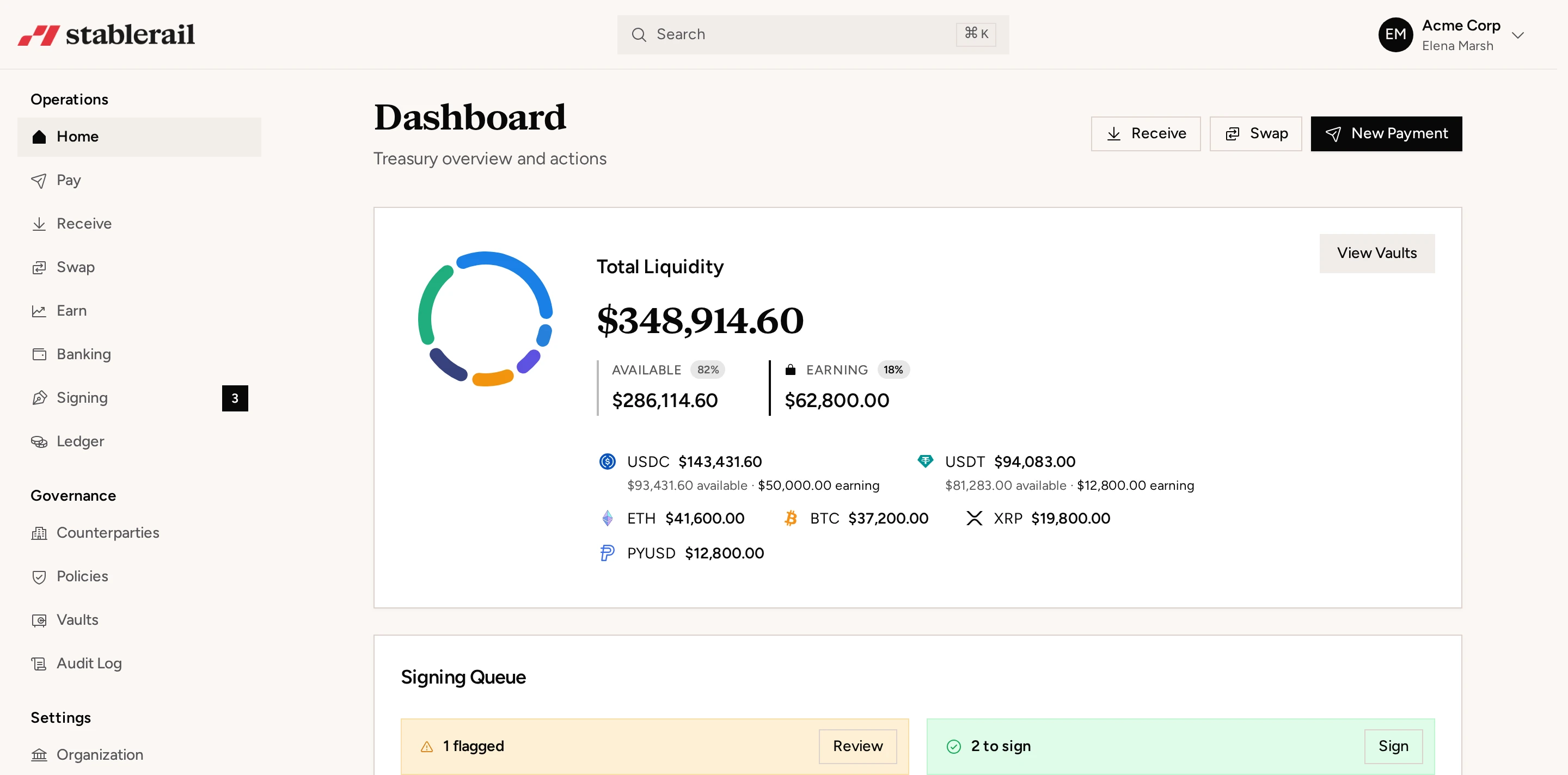
Stablerail brings USDC and USDT treasury into one business account with approvals and signing quorum, sanctions and address screening before send, global payouts, fiat off-ramping and exportable audit evidence. Those controls address the operational layer around blockchain settlement rather than changing the underlying irreversibility of the network.
Traceability is not the same as reconciliation
Bank rails provide familiar account names, statement entries and payment references. They also provide an escalation path through the sending bank, although visibility can become fragmented when several correspondents are involved.
Blockchain records provide strong evidence that a specific token amount moved between two addresses at a particular time. Anyone with the transaction hash can inspect the network status. The blockchain does not, however, identify the invoice, explain the business purpose or prove that a wallet belongs to the intended supplier.
A complete stablecoin accounting record should connect the transaction hash to the legal beneficiary, approved wallet, invoice or contract, token and network, applicable exchange rate, fees, approvers and accounting entry. Teams should also define how they record network fees and how they value stablecoin balances in their functional currency.
Which rail should finance choose?
- Choose standard SEPA for routine euro invoices, payroll or treasury transfers where next-business-day delivery is sufficient.
- Choose SEPA Instant for urgent euro payments when both institutions and accounts support it.
- Choose SWIFT when the recipient requires a bank payment in a currency or destination not served by the company’s domestic or regional rails.
- Choose stablecoin rails when both parties support the same USDC or USDT network and 24/7 transfer, global reach or independently verifiable settlement is valuable.
- Evaluate a hybrid route when one party needs fiat and the other operates in stablecoins. Include the funding or off-ramp stage in the quoted time and cost.
The best rail is payment-specific. A treasury team may use SEPA for euro suppliers, SWIFT for international fiat obligations and stablecoins for compatible counterparties without treating any single network as the default for every transaction.
Frequently asked questions
Are stablecoin payments faster than SWIFT transfers?
The blockchain transfer itself is often confirmed faster and operates 24/7, while a SWIFT payment may pass through several banks and cut-off windows. End-to-end speed still depends on purchasing the stablecoin, platform processing, compliance review and whether the recipient must off-ramp into fiat.
Is USDC cheaper than a SEPA payment?
Not necessarily. Compare conversion spreads, network and platform fees, off-ramp charges and any foreign-exchange cost against the SEPA bank fee. SEPA is often difficult to beat when both parties already hold euro accounts, while USDC can be more attractive when both parties can use the token directly.
Can a USDT or USDC transfer be reversed?
A confirmed blockchain transfer is normally irreversible. Issuer freezing capabilities are not a standard payment recall service, so finance teams should rely on address verification, screening, approval quorum and test transfers before sending material amounts.
What information is needed to reconcile a stablecoin payment?
Store the transaction hash, token, network, amount, network fee, destination address and timestamp. Link those details to the beneficiary’s legal identity, invoice or contract, approval evidence, exchange rate and accounting entry.
When should a company use SWIFT instead of stablecoins?
Use SWIFT when the beneficiary requires funds in a bank account, needs a currency not covered by the available off-ramp, or cannot accept USDC or USDT. It may also be preferable where contractual closing procedures, bank confirmation or established investigation channels are important.
Finance writers covering stablecoin treasury, payments, compliance, and risk controls.
More about the Stablerail team- Stablecoin treasury managementApprovals, limits, yield and reporting on one balance.
- Stablecoin payoutsBatch contractor and vendor payments with screening.
- USDT vs USDCWhich stablecoin your company should settle in.
- Stablecoin finance glossaryMPC, off-ramp, travel rule and the rest, in plain English.
- Product updatesEverything we ship, month by month.