
How Stablecoin Orchestration Platforms Simplify Treasury Operations
Learn how stablecoin orchestration platforms connect USDC, USDT, fiat rails, liquidity, approvals, payouts and audit records in one treasury workflow.
A stablecoin orchestration platform gives treasury teams one operating layer for USDC, USDT and fiat money movement. It connects wallets, bank rails, conversion, liquidity, approvals, payouts and reconciliation, reducing the manual handoffs between separate providers. The best platform is not simply the one with the most integrations; it is the one that reliably supports your actual currencies, blockchain networks, controls and accounting requirements.
%22%20x1%3D%220%22%20y1%3D%220%22%20x2%3D%221%22%20y2%3D%221%22%3E%0A%20%20%20%20%20%20%20%20%3Cstop%20offset%3D%220%25%22%20stop-color%3D%22%23360A0E%22%20%2F%3E%0A%20%20%20%20%20%20%20%20%3Cstop%20offset%3D%2250%25%22%20stop-color%3D%22%23551217%22%20%2F%3E%0A%20%20%20%20%20%20%20%20%3Cstop%20offset%3D%22100%25%22%20stop-color%3D%22%237A1D20%22%20%2F%3E%0A%20%20%20%20%20%20%3C%2FlinearGradient%3E%0A%20%20%20%20%20%20%3CradialGradient%20id%3D%22glow%22%20cx%3D%22818%22%20cy%3D%22319%22%20r%3D%22520%22%20gradientUnits%3D%22userSpaceOnUse%22%3E%0A%20%20%20%20%20%20%20%20%3Cstop%20offset%3D%220%25%22%20stop-color%3D%22%23FFA587%22%20stop-opacity%3D%220.45%22%20%2F%3E%0A%20%20%20%20%20%20%20%20%3Cstop%20offset%3D%2255%25%22%20stop-color%3D%22%23FFA587%22%20stop-opacity%3D%220.08%22%20%2F%3E%0A%20%20%20%20%20%20%20%20%3Cstop%20offset%3D%22100%25%22%20stop-color%3D%22%23FFA587%22%20stop-opacity%3D%220%22%20%2F%3E%0A%20%20%20%20%20%20%3C%2FradialGradient%3E%0A%20%20%20%20%20%20%3ClinearGradient%20id%3D%22glass%22%20x1%3D%220%22%20y1%3D%220%22%20x2%3D%221%22%20y2%3D%221%22%3E%0A%20%20%20%20%20%20%20%20%3Cstop%20offset%3D%220%25%22%20stop-color%3D%22%23F8D6D2%22%20stop-opacity%3D%220.26%22%20%2F%3E%0A%20%20%20%20%20%20%20%20%3Cstop%20offset%3D%22100%25%22%20stop-color%3D%22%23FFFFFF%22%20stop-opacity%3D%220.08%22%20%2F%3E%0A%20%20%20%20%20%20%3C%2FlinearGradient%3E%0A%20%20%20%20%20%20%3ClinearGradient%20id%3D%22accent%22%20x1%3D%220%22%20y1%3D%220%22%20x2%3D%221%22%20y2%3D%221%22%3E%0A%20%20%20%20%20%20%20%20%3Cstop%20offset%3D%220%25%22%20stop-color%3D%22%23FFA587%22%20%2F%3E%0A%20%20%20%20%20%20%20%20%3Cstop%20offset%3D%22100%25%22%20stop-color%3D%22%23DC4A38%22%20%2F%3E%0A%20%20%20%20%20%20%3C%2FlinearGradient%3E%0A%20%20%20%20%20%20%3Cfilter%20id%3D%22soft%22%3E%3CfeGaussianBlur%20stdDeviation%3D%2210%22%20%2F%3E%3C%2Ffilter%3E%0A%20%20%20%20%3C%2Fdefs%3E%0A%20%20%20%20%3Crect%20width%3D%221600%22%20height%3D%22900%22%20fill%3D%22url(%23bg)%22%20%2F%3E%0A%20%20%20%20%3Crect%20width%3D%221600%22%20height%3D%22900%22%20fill%3D%22url(%23glow)%22%20%2F%3E%0A%20%20%20%20%0A%20%20%3Cpath%20d%3D%22M400%20360%20L%20800%20220%20L%201200%20360%20L%201200%20410%20L%20400%20410%20Z%22%20fill%3D%22url(%23glass)%22%20stroke%3D%22%23F4CDC5%22%20stroke-opacity%3D%220.6%22%2F%3E%0A%20%20%3Crect%20x%3D%22460%22%20y%3D%22430%22%20width%3D%2280%22%20height%3D%22240%22%20fill%3D%22url(%23glass)%22%20stroke%3D%22%23F4CDC5%22%20stroke-opacity%3D%220.5%22%2F%3E%3Crect%20x%3D%22640%22%20y%3D%22430%22%20width%3D%2280%22%20height%3D%22240%22%20fill%3D%22url(%23glass)%22%20stroke%3D%22%23F4CDC5%22%20stroke-opacity%3D%220.5%22%2F%3E%3Crect%20x%3D%22820%22%20y%3D%22430%22%20width%3D%2280%22%20height%3D%22240%22%20fill%3D%22url(%23accent)%22%20stroke%3D%22%23F4CDC5%22%20stroke-opacity%3D%220.5%22%2F%3E%3Crect%20x%3D%221000%22%20y%3D%22430%22%20width%3D%2280%22%20height%3D%22240%22%20fill%3D%22url(%23glass)%22%20stroke%3D%22%23F4CDC5%22%20stroke-opacity%3D%220.5%22%2F%3E%0A%20%20%3Crect%20x%3D%22380%22%20y%3D%22690%22%20width%3D%22840%22%20height%3D%2236%22%20rx%3D%226%22%20fill%3D%22url(%23glass)%22%20stroke%3D%22%23F4CDC5%22%20stroke-opacity%3D%220.6%22%2F%3E%0A%20%20%3Ccircle%20cx%3D%22800%22%20cy%3D%22310%22%20r%3D%2222%22%20fill%3D%22url(%23accent)%22%2F%3E%0A%0A%20%20%20%20%3Crect%20x%3D%2226%22%20y%3D%2226%22%20width%3D%221548%22%20height%3D%22848%22%20rx%3D%2218%22%20fill%3D%22none%22%20stroke%3D%22%23F2D0C8%22%20stroke-opacity%3D%220.12%22%2F%3E%0A%20%20%3C%2Fsvg%3E)
A stablecoin orchestration platform gives treasury teams one operating layer for holding and moving USDC or USDT, converting between stablecoins and fiat, positioning liquidity, approving payments and reconciling transactions. Instead of coordinating bank accounts, wallets, exchanges and payout providers separately, finance can manage the workflow through a dashboard, API or batch file.
The practical benefit is fewer handoffs and fewer disconnected records. A customer payment received in EUR might be converted to USDC, allocated to treasury and paid to vendors on a supported blockchain. In the other direction, USDT received on Tron might be converted into USD and sent through ACH or Fedwire. Orchestration coordinates those steps, but finance must still evaluate the providers, counterparties, controls and settlement conditions behind each route.
What a stablecoin orchestration platform coordinates
The strongest platforms connect five capabilities that treasury teams otherwise operate separately:
- Stablecoin accounts: Infrastructure for holding, receiving and transferring USDC or USDT on supported blockchain networks.
- Fiat accounts and rails: Account details, currency balances and access to domestic or international bank transfers.
- On-ramps and off-ramps: Conversion between stablecoins and currencies such as USD, EUR and GBP.
- Liquidity management: Visibility into the assets and networks available for upcoming conversions and payments.
- Payouts: Individual, batch or API-initiated payments to vendors, contractors, customers and employees.
| Operating area | Without orchestration | With orchestration | What finance should verify |
|---|---|---|---|
| Balances | Separate bank, exchange and wallet views | Fiat and stablecoin balances in one interface | Whether balances are current and separated by currency, token and network |
| Conversion | Manual transfers to an exchange or liquidity provider | Quote and conversion within the payment workflow | Quote expiry, spread, fees, minimums and delivered amount |
| Approvals | Instructions coordinated through chat or email | Defined approval and signing steps | Roles, thresholds, quorum, edit controls and emergency access changes |
| Payouts | Different tools for bank and blockchain payments | Single, batch or API-based execution | Beneficiary validation, status detail, retries and return handling |
| Reconciliation | References collected from multiple systems | Linked instructions, approvals, fees and settlement references | Export format, transaction IDs, timestamps and accounting dimensions |
How a typical treasury workflow works
1. Receive fiat or stablecoins
A company may receive EUR through bank account details, USD through ACH or USDC directly to a blockchain address. The platform should identify the incoming asset and network, update the relevant balance and provide a reference that finance can match to a customer, invoice or internal transfer.
Stablecoin deposit instructions must identify the exact token and network. Sending USDC to an address on an unsupported chain can lead to a recovery process or permanent loss. Finance should also determine how deposits with missing bank references, unsupported assets or third-party senders are handled.
2. Convert into the required asset
The treasury team can request a conversion such as EUR to USDC or USDT to USD. Before confirmation, the interface or API should show whether the quote is firm or indicative, when it expires, applicable fees and the expected amount delivered.
Compare the route’s total cost rather than only its headline spread. Total cost can include foreign exchange, stablecoin conversion, bank rail, blockchain network and payout fees. Also confirm when the purchased asset becomes available: execution, settlement and withdrawal availability may occur at different times.
3. Position liquidity by asset and network
Stablecoins are not automatically interchangeable across blockchains. USDC on Ethereum and USDC on Base are distinct on-chain balances, even if each is intended to track the same reference currency. A payout requires the correct token on the network used by the recipient.
A useful platform displays balances by fiat currency, stablecoin and blockchain. Treasury teams should plan around banking cutoffs, blockchain confirmation requirements, conversion availability and the time needed to replenish a payout balance. If moving stablecoins between networks requires a bridge or provider-managed transfer, confirm the route, fees, execution party and failure process.
4. Approve and execute payments
Payments may be entered manually, uploaded as a batch or submitted through an API. The platform should validate beneficiary details, display the payment route and apply the company’s approval process before sending funds.
For on-chain transfers, address screening should occur before release, not only after settlement. A material edit to the address, token, network or amount should invalidate previous approvals and trigger a fresh review. For bank payments, finance should understand whether beneficiary changes, returns and recalls are supported by the underlying rail.
5. Reconcile and retain evidence
After execution, finance needs the original instruction, creator and approvers, quote, fees, exchange rate, timestamps, status and bank or blockchain reference. On-chain records should include the transaction hash and network. Bank records should preserve the provider’s payment reference and any return or rejection reason.
Exports should use stable transaction identifiers so accounting teams can update an entry when a pending payment settles instead of creating a duplicate. Evidence should remain available for month-end close, audit testing and investigations.
Fiat rails have different settlement expectations
A platform can simplify access to fiat rails, but it cannot make every rail instant or final. Delivery depends on operating windows, participant support, compliance reviews, intermediary banks, holidays and the receiving institution. The timings below are general market conventions rather than delivery guarantees.
| Rail | Market | General timing | Common treasury use |
|---|---|---|---|
| SEPA Instant | EUR | Usually seconds when both institutions participate | Urgent euro receipts and payouts |
| SEPA Credit Transfer | EUR | Typically same or next business day | Routine European payments |
| ACH | USD | Same day or one to several business days, depending on service and cutoff | Domestic US collections and payouts |
| Fedwire | USD | Same business day during operating hours | High-value or time-sensitive transfers |
| Faster Payments | GBP | Usually seconds or minutes | Everyday UK payments |
| CHAPS | GBP | Same business day before cutoff | High-value UK payments |
| BACS | GBP | Generally a three-business-day cycle | Payroll and scheduled bulk payments |
| SWIFT | Cross-border | Often one to three or more business days | International bank transfers |
Ask which rails support sending, receiving or both; whether account details are named or virtual; and whether third-party payments are allowed. Cutoffs, limits and fees should be documented by corridor. A platform should distinguish banking charges from foreign exchange, stablecoin conversion and blockchain fees.
Integrations that reduce manual work
Dashboard access can be sufficient for occasional transactions. Higher-volume operations usually need APIs, webhooks, accounting exports or file uploads. Useful API coverage includes balances, transaction queries, beneficiary creation, conversion quotes, payout creation and payment status.
Webhooks should communicate deposits, approval changes, failed payments, completed payments and returns. Because notifications can be delayed or delivered more than once, the receiving system should use unique transaction identifiers and retrieve the current status from the platform before updating its ledger.
Batch files remain important for accounts payable and payroll teams working from an ERP. A good workflow validates each row before approval, identifies the exact error and returns item-level statuses. One invalid beneficiary should not make the rest of a batch impossible to reconcile.
Controls for stablecoin treasury operations
Controls should protect funds without relying on one person to manage payment instructions and signing authority. Useful capabilities include role-based access, approval thresholds, signing quorum, recipient controls, sanctions or address screening and a complete activity log.
For example, an analyst might prepare a payment while a controller verifies the beneficiary and amount. Higher-risk or larger payments can require additional authorization. The exact thresholds should reflect the company’s own risk assessment rather than a generic template.
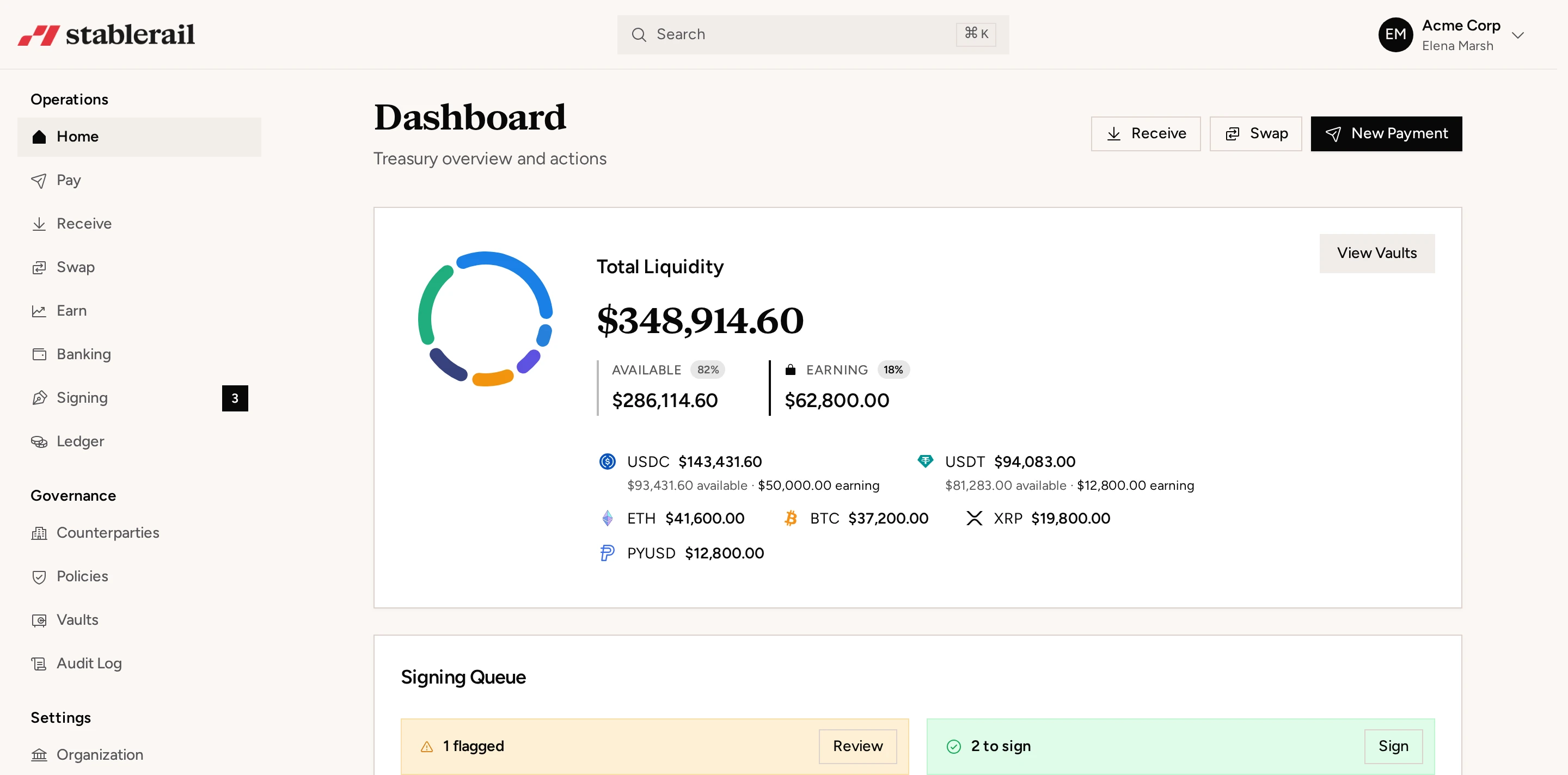
Stablerail combines a business account for USDC and USDT with approvals and signing quorum, screening before send, global payouts, fiat off-ramp, corporate cards and exportable audit evidence. Whatever platform is selected, finance should test whether its control model matches the company’s bank mandate, delegation of authority and close process.
How to evaluate a stablecoin orchestration platform
Compare complete workflows rather than isolated features. A platform may support a currency, stablecoin and network individually without supporting the conversion or payout route needed between them.
- Map representative corridors: Define the source currency, destination asset, blockchain network, recipient country, payment size and frequency.
- Request an all-in cost view: Include conversion, banking, network and payout charges, plus any cost created by pre-funding.
- Test controls: Create, edit, approve, reject and cancel payments; then change a beneficiary or network to confirm approvals reset appropriately.
- Test exceptions: Review rejected deposits, failed conversions, returned bank payments and delayed blockchain transactions.
- Export evidence: Confirm that fees, approvals, references, timestamps and transaction hashes can be retrieved without manual support.
- Complete onboarding early: Prepare incorporation documents, ownership and director information, business activity details and expected transaction patterns for KYB review.
If yield is available on idle assets, evaluate it separately from transaction orchestration. Confirm who deploys the assets, the source of yield, redemption terms, counterparty exposure and potential loss scenarios. Funds required for near-term payments should be held in a form consistent with the timing and certainty of those obligations.
The objective is one controlled view of money movement
Stablecoin orchestration is most useful when it closes the operational gaps between wallets, fiat rails, conversion, approvals and payouts. The result should be more than a consolidated dashboard: finance needs a controlled workflow from instruction through settlement and reconciliation.
The right choice depends on actual payment patterns. Test routes such as EUR to USDC on a recipient’s preferred network, USDT to USD through ACH and a multi-network contractor batch. Those tests expose the true cost, timing, liquidity needs, exception handling and manual workload more reliably than a feature checklist.
Frequently asked questions
What is a stablecoin orchestration platform?
A stablecoin orchestration platform connects stablecoin accounts, fiat rails, conversion, liquidity, approvals, payouts and transaction records in one operating layer. It reduces the need for treasury teams to coordinate separate wallets, banks, exchanges and payment providers manually.
How does stablecoin orchestration help treasury teams?
It reduces operational handoffs and gives finance a consolidated view of USDC, USDT and fiat balances. It can also standardize payment approvals, beneficiary checks, conversion quotes, payout execution and reconciliation evidence.
What should a CFO look for in a stablecoin orchestration platform?
Start with the company’s actual currencies, stablecoins, blockchain networks, payment destinations and transaction sizes. Then compare all-in costs, settlement conditions, approval controls, screening, exception handling, API coverage and the quality of accounting and audit exports.
Are USDC and USDT balances interchangeable across blockchains?
No. A stablecoin held on one network is a separate on-chain balance from the same stablecoin on another network. Treasury must hold or obtain the correct token on the recipient’s network and understand any bridge, transfer or conversion used to reposition liquidity.
How should stablecoin transactions be reconciled?
Each accounting record should link to the original instruction, approvals, quote, fees, timestamps and final status. On-chain payments should include the network and transaction hash, while fiat payments should retain bank references and any rejection or return details.
Finance writers covering stablecoin treasury, payments, compliance, and risk controls.
More about the Stablerail team- Stablecoin treasury managementApprovals, limits, yield and reporting on one balance.
- Stablecoin payoutsBatch contractor and vendor payments with screening.
- USDT vs USDCWhich stablecoin your company should settle in.
- Stablecoin finance glossaryMPC, off-ramp, travel rule and the rest, in plain English.
- Product updatesEverything we ship, month by month.