
Stablecoin Due Diligence Checklist for Corporate Treasury Teams
A practical checklist for assessing stablecoin reserve quality, redemption rights, liquidity, custody, blockchain, provider and operational risks.
Stablecoin due diligence should establish whether your treasury can safely hold, transfer and convert the asset at the required size and speed, including during market stress. Review the issuer and reserves, direct redemption rights, market liquidity, blockchain support, custody model, provider dependencies, operational controls, accounting treatment and jurisdictional availability. Approve measurable limits and exit routes, retain supporting evidence and repeat the review after material changes.
%22%20x1%3D%220%22%20y1%3D%220%22%20x2%3D%221%22%20y2%3D%221%22%3E%0A%20%20%20%20%20%20%20%20%3Cstop%20offset%3D%220%25%22%20stop-color%3D%22%23360A0E%22%20%2F%3E%0A%20%20%20%20%20%20%20%20%3Cstop%20offset%3D%2250%25%22%20stop-color%3D%22%23551217%22%20%2F%3E%0A%20%20%20%20%20%20%20%20%3Cstop%20offset%3D%22100%25%22%20stop-color%3D%22%237A1D20%22%20%2F%3E%0A%20%20%20%20%20%20%3C%2FlinearGradient%3E%0A%20%20%20%20%20%20%3CradialGradient%20id%3D%22glow%22%20cx%3D%221038%22%20cy%3D%22483%22%20r%3D%22520%22%20gradientUnits%3D%22userSpaceOnUse%22%3E%0A%20%20%20%20%20%20%20%20%3Cstop%20offset%3D%220%25%22%20stop-color%3D%22%23FFA587%22%20stop-opacity%3D%220.45%22%20%2F%3E%0A%20%20%20%20%20%20%20%20%3Cstop%20offset%3D%2255%25%22%20stop-color%3D%22%23FFA587%22%20stop-opacity%3D%220.08%22%20%2F%3E%0A%20%20%20%20%20%20%20%20%3Cstop%20offset%3D%22100%25%22%20stop-color%3D%22%23FFA587%22%20stop-opacity%3D%220%22%20%2F%3E%0A%20%20%20%20%20%20%3C%2FradialGradient%3E%0A%20%20%20%20%20%20%3ClinearGradient%20id%3D%22glass%22%20x1%3D%220%22%20y1%3D%220%22%20x2%3D%221%22%20y2%3D%221%22%3E%0A%20%20%20%20%20%20%20%20%3Cstop%20offset%3D%220%25%22%20stop-color%3D%22%23F8D6D2%22%20stop-opacity%3D%220.26%22%20%2F%3E%0A%20%20%20%20%20%20%20%20%3Cstop%20offset%3D%22100%25%22%20stop-color%3D%22%23FFFFFF%22%20stop-opacity%3D%220.08%22%20%2F%3E%0A%20%20%20%20%20%20%3C%2FlinearGradient%3E%0A%20%20%20%20%20%20%3ClinearGradient%20id%3D%22accent%22%20x1%3D%220%22%20y1%3D%220%22%20x2%3D%221%22%20y2%3D%221%22%3E%0A%20%20%20%20%20%20%20%20%3Cstop%20offset%3D%220%25%22%20stop-color%3D%22%23FFA587%22%20%2F%3E%0A%20%20%20%20%20%20%20%20%3Cstop%20offset%3D%22100%25%22%20stop-color%3D%22%23DC4A38%22%20%2F%3E%0A%20%20%20%20%20%20%3C%2FlinearGradient%3E%0A%20%20%20%20%20%20%3Cfilter%20id%3D%22soft%22%3E%3CfeGaussianBlur%20stdDeviation%3D%2210%22%20%2F%3E%3C%2Ffilter%3E%0A%20%20%20%20%3C%2Fdefs%3E%0A%20%20%20%20%3Crect%20width%3D%221600%22%20height%3D%22900%22%20fill%3D%22url(%23bg)%22%20%2F%3E%0A%20%20%20%20%3Crect%20width%3D%221600%22%20height%3D%22900%22%20fill%3D%22url(%23glow)%22%20%2F%3E%0A%20%20%20%20%0A%20%20%3Crect%20x%3D%22480%22%20y%3D%22200%22%20width%3D%22640%22%20height%3D%22500%22%20rx%3D%2232%22%20fill%3D%22url(%23glass)%22%20stroke%3D%22%23F4CDC5%22%20stroke-opacity%3D%220.6%22%20stroke-width%3D%223%22%2F%3E%0A%20%20%3Ccircle%20cx%3D%22800%22%20cy%3D%22450%22%20r%3D%22180%22%20fill%3D%22none%22%20stroke%3D%22%23F4CDC5%22%20stroke-opacity%3D%220.6%22%20stroke-width%3D%226%22%2F%3E%0A%20%20%3Ccircle%20cx%3D%22800%22%20cy%3D%22450%22%20r%3D%22130%22%20fill%3D%22url(%23glass)%22%20stroke%3D%22%23F4CDC5%22%20stroke-opacity%3D%220.5%22%2F%3E%0A%20%20%3Ccircle%20cx%3D%22800%22%20cy%3D%22450%22%20r%3D%2236%22%20fill%3D%22url(%23accent)%22%2F%3E%0A%20%20%3Crect%20x%3D%22958.4348903516518%22%20y%3D%22486.0779740156158%22%20width%3D%2216%22%20height%3D%2236%22%20rx%3D%223%22%20fill%3D%22%23F4CDC5%22%20opacity%3D%220.7%22%20transform%3D%22rotate(18%20966.4348903516518%20504.0779740156158)%22%2F%3E%3Crect%20x%3D%22871.4483374544207%22%20y%3D%22587.9261417329644%22%20width%3D%2216%22%20height%3D%2236%22%20rx%3D%223%22%20fill%3D%22%23F4CDC5%22%20opacity%3D%220.7%22%20transform%3D%22rotate(63%20879.4483374544207%20605.9261417329644)%22%2F%3E%3Crect%20x%3D%22737.9220259843842%22%20y%3D%22598.4348903516519%22%20width%3D%2216%22%20height%3D%2236%22%20rx%3D%223%22%20fill%3D%22%23F4CDC5%22%20opacity%3D%220.7%22%20transform%3D%22rotate(108%20745.9220259843842%20616.4348903516519)%22%2F%3E%3Crect%20x%3D%22636.0738582670356%22%20y%3D%22511.44833745442065%22%20width%3D%2216%22%20height%3D%2236%22%20rx%3D%223%22%20fill%3D%22%23F4CDC5%22%20opacity%3D%220.7%22%20transform%3D%22rotate(153%20644.0738582670356%20529.4483374544207)%22%2F%3E%3Crect%20x%3D%22625.5651096483482%22%20y%3D%22377.92202598438416%22%20width%3D%2216%22%20height%3D%2236%22%20rx%3D%223%22%20fill%3D%22%23F4CDC5%22%20opacity%3D%220.7%22%20transform%3D%22rotate(198%20633.5651096483482%20395.92202598438416)%22%2F%3E%3Crect%20x%3D%22712.5516625455793%22%20y%3D%22276.07385826703563%22%20width%3D%2216%22%20height%3D%2236%22%20rx%3D%223%22%20fill%3D%22%23F4CDC5%22%20opacity%3D%220.7%22%20transform%3D%22rotate(243%20720.5516625455793%20294.07385826703563)%22%2F%3E%3Crect%20x%3D%22846.0779740156157%22%20y%3D%22265.5651096483481%22%20width%3D%2216%22%20height%3D%2236%22%20rx%3D%223%22%20fill%3D%22%23F4CDC5%22%20opacity%3D%220.7%22%20transform%3D%22rotate(288%20854.0779740156157%20283.5651096483481)%22%2F%3E%3Crect%20x%3D%22947.9261417329644%22%20y%3D%22352.5516625455793%22%20width%3D%2216%22%20height%3D%2236%22%20rx%3D%223%22%20fill%3D%22%23F4CDC5%22%20opacity%3D%220.7%22%20transform%3D%22rotate(333%20955.9261417329644%20370.5516625455793)%22%2F%3E%0A%0A%20%20%20%20%3Crect%20x%3D%2226%22%20y%3D%2226%22%20width%3D%221548%22%20height%3D%22848%22%20rx%3D%2218%22%20fill%3D%22none%22%20stroke%3D%22%23F2D0C8%22%20stroke-opacity%3D%220.12%22%2F%3E%0A%20%20%3C%2Fsvg%3E)
Stablecoin due diligence is not simply a review of whether a token usually trades near its reference currency. A corporate treasury must assess the complete operating path: acquiring the stablecoin, holding it securely, transferring it on an approved network and converting it back into usable bank money.
That path may depend on an issuer, reserve custodians, wallet technology, exchanges, liquidity providers, banks, blockchain networks and fiat payment rails. A weakness in any one dependency can prevent treasury from meeting a payroll, supplier or liquidity deadline. The review should therefore produce an evidence-backed approval with exposure limits, authorised networks, permitted providers and a defined exit plan.
1. Define the intended treasury use
Start with the transaction rather than the token. A stablecoin suitable for occasional supplier payments may not be appropriate for customer funds, payroll or a large operating reserve.
- Use case: Document whether the asset supports collections, cross-border payouts, payroll, working capital or short-term holdings.
- Currency path: Identify the source fiat currency, stablecoin, blockchain network and destination currency.
- Exposure: Set expected and maximum balances, individual transaction limits and maximum holding periods.
- Timing: Record settlement deadlines, bank cut-offs and weekend or public-holiday requirements.
- Exit requirement: Define how quickly the full position must become cleared funds in the required bank account.
This scope creates measurable approval criteria. For example, a treasury could require two operationally independent conversion routes for its maximum balance. Those routes are not genuinely independent if they ultimately rely on the same exchange, bank or liquidity provider.
2. Review the issuer, reserves and holder rights
Identify the legal entity responsible for issuing and redeeming the stablecoin. Review its contracting jurisdiction, ownership, operating history, eligibility rules and the terms that govern token holders. Determine whether your company has a direct contractual redemption right or merely expects to sell the token to another market participant.
Obtain the latest reserve disclosures and record:
- The proportions held in cash, bank deposits, government bills, money market instruments or other assets.
- The maturity and liquidity profile of reserve investments.
- Whether reserves are described as segregated from operating assets.
- The concentration of banks, custodians and investment managers where disclosed.
- The reporting date, publication frequency and comparison of reserve assets with tokens outstanding.
- Whether the document is an attestation, financial statement audit or management report, including its scope and exclusions.
An attestation reports on specified information under a defined engagement. It should not be treated automatically as a full financial statement audit, a legal opinion on asset ownership or a guarantee of immediate redemption. Treasury should retain the actual report reviewed, not only a webpage stating that reserves are backed.
3. Test redemption and secondary-market liquidity
Direct redemption and exchange liquidity are different exit routes. Direct redemption depends on issuer eligibility, onboarding, minimums, fees, processing procedures and access to the relevant bank rail. A market sale depends on available bids, trading limits, venue access and the ability to withdraw the fiat proceeds.
| Exit test | Evidence to collect | Failure to model |
|---|---|---|
| Direct redemption eligibility | Approved issuer account, eligible legal entity and jurisdiction, current terms | Treasury holds tokens but cannot redeem with the issuer |
| Maximum-position exit | Executable quote or depth at treasury’s transaction size, provider limits | Headline volume masks slippage at the required size |
| Fiat settlement | Receiving bank details, payment rail, cut-offs and expected value date | Tokens sell, but cash is unavailable when needed |
| Weekend operation | Provider operating hours and actual availability of the receiving fiat rail | Blockchain transfer completes while bank settlement waits |
| Alternative route | Second onboarded provider, tested wallet route and verified bank account | The backup exists on paper but is not operational |
| All-in conversion cost | Issuer or provider fee, spread, network fee and bank deductions | Advertised fees understate the total cost |
Blockchains can process transfers outside banking hours, but that does not mean fiat proceeds can reach a bank account continuously. ACH, Fedwire, SEPA, SEPA Instant, SWIFT, Faster Payments, CHAPS and BACS differ in availability, cut-offs and participant coverage. Verify the actual rail and receiving bank used for each corridor.
Model the all-in cost under normal and stressed spreads. Use quotes at representative transaction sizes rather than relying only on an advertised fee or aggregate daily volume. Conduct a small end-to-end test and document the time from initiating the stablecoin transfer to receiving cleared fiat.
4. Examine depeg events and hidden concentration
Review historical periods when the stablecoin traded away from its reference value. Record the size and duration of the movement, available depth at your expected transaction size, whether minting or redemption continued and whether relevant networks or providers suspended transfers.
Investigate the cause rather than treating every depeg alike. Possible drivers include concerns about reserve assets, disruption at a banking partner, exchange-specific liquidity, network congestion or broader market stress. Review how quickly the issuer communicated and what evidence supported its statements.
Map concentration across the complete arrangement. Holding two stablecoins does not necessarily diversify risk if both depend on the same reserve bank, custodian, exchange, blockchain or off-ramp. Likewise, two providers may rely on the same underlying banking partner.
5. Approve the token and blockchain together
A ticker is not enough to identify an asset. Record the issuer-confirmed contract address, blockchain and whether the token is issued natively or represented through a bridge. A bridged version introduces dependencies on bridge smart contracts, operators and the assets locked on another network.
Approve supported networks explicitly and configure address books or allowlists accordingly. For each network, review transaction finality, fee variability, operational history and provider support for both deposits and withdrawals. Confirm whether the receiving counterparty supports the exact token and network combination.
Before increasing limits, send a small test transaction in each required direction. Document what happens if funds are sent to the correct address over an unsupported network, including whether recovery is possible, which provider must act and whether recovery is discretionary.
6. Evaluate custody and provider counterparty risk
Map legal ownership and operational control at every stage. In a custodial arrangement, a provider generally controls the private keys while recording the customer’s entitlement. Review contractual segregation, withdrawal rights, administrator powers and the stated treatment of customer assets in insolvency. Obtain legal advice where the ownership analysis is material.
With self-custody, the company controls transaction authorisation but still depends on wallet software, key-management processes and infrastructure. Multiparty computation can distribute signing activity so that a complete private key need not exist in one place. A signing quorum can require several authorised parties before a transfer is broadcast. Treasury must still test recovery, staff departures, lost devices, credential compromise and provider unavailability.
For every custodian, exchange, wallet or off-ramp, collect the legal entity name, contracting jurisdiction, supported assets and networks, transaction limits, fee schedule, banking arrangements where disclosed, incident contacts and complaint escalation route. Complete KYB early enough to identify beneficial ownership, source-of-funds and expected-volume requirements.
7. Verify treasury controls and audit evidence
Controls should reflect transaction size, frequency and irreversibility. At minimum, separate payment creation from approval, require quorum for material transfers, restrict destination wallets and review changes to users or approval settings independently.
Sanctions and address screening should occur before funds are sent, with documented procedures for alerts, false positives and escalation. Screening is a control input, not a substitute for deciding whether the counterparty and transaction are legitimate.
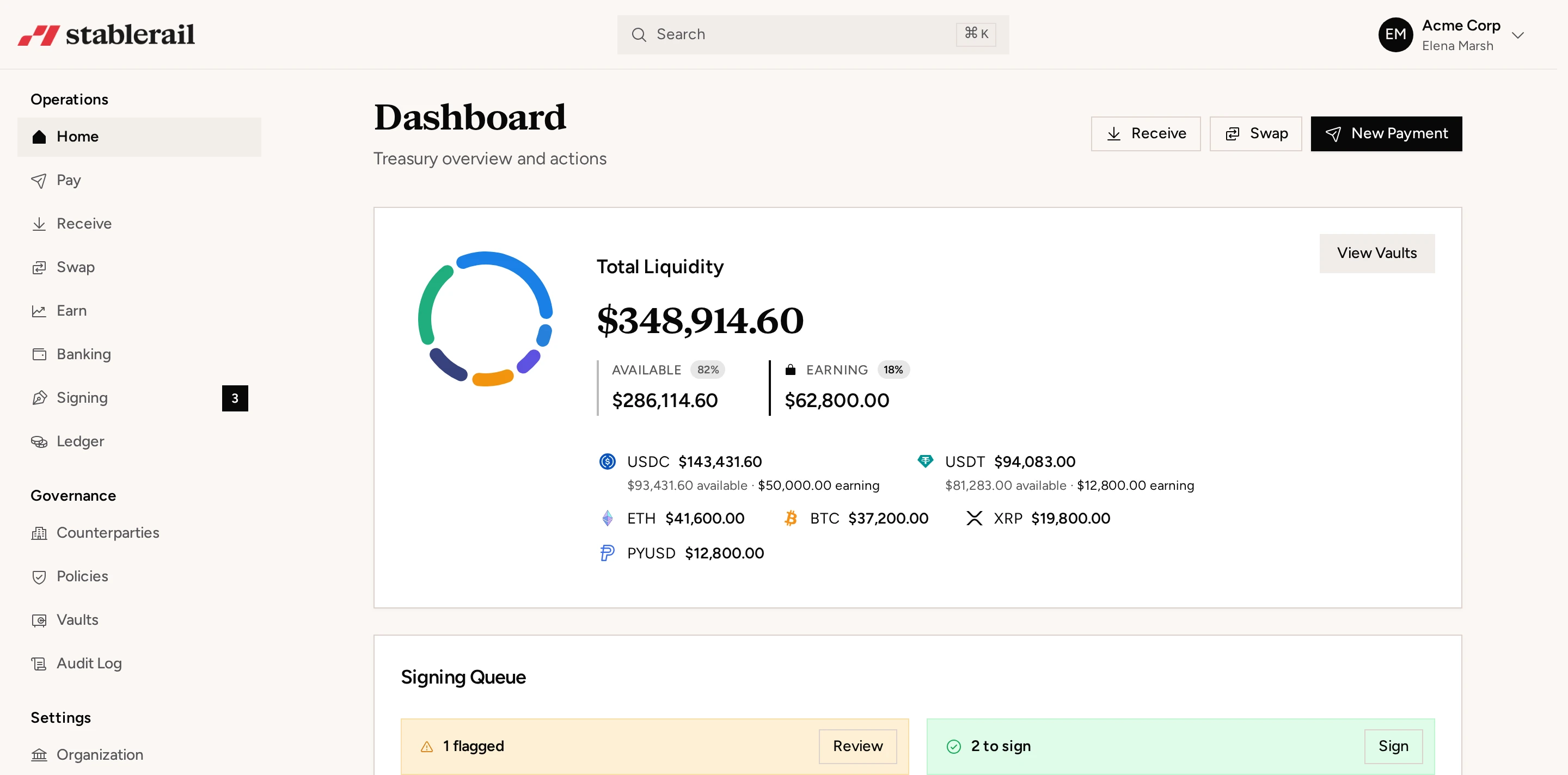
The evidence pack for each payment should connect the business request, invoice, beneficiary, approved wallet address, screening result, approvers, transaction hash, exchange rate, fees and final bank or counterparty confirmation. Stablerail supports USDC and USDT treasury workflows with approvals and signing quorum, pre-send sanctions and address screening, global payouts, fiat off-ramp and exportable audit evidence.
8. Resolve accounting, tax and jurisdiction questions
Ask accounting advisers how the stablecoin should be classified under the company’s applicable reporting framework. Set a consistent valuation source and time, and define the treatment of spreads, provider charges, blockchain fees and realised or unrealised movements.
Reconcile on-chain balances with wallet or provider records and the general ledger. Monthly reconciliation may be insufficient for a high-volume payment account, so frequency should match activity and financial reporting risk. Investigate pending, failed and replaced transactions rather than treating a broadcast transaction as completed automatically.
Tax and reporting consequences vary by jurisdiction and activity. Fiat conversion, stablecoin swaps, yield arrangements, compensation and supplier payments may require different analysis. Confirm that the issuer, provider, asset and intended activity are available to the company’s legal entity, jurisdiction and industry before funding the account.
Final approval checklist
- Document the use case, maximum exposure, holding period and exit deadline.
- Retain issuer terms, reserve reports and evidence of redemption eligibility.
- Test primary and backup conversion routes at a representative scale.
- Approve exact contract addresses, networks, providers and transaction limits.
- Confirm custody, recovery, segregation and insolvency terms.
- Test approvals, signing quorum, address controls, screening and evidence exports.
- Approve accounting, reconciliation, tax and jurisdictional treatment.
- Assign an owner and review date, with earlier reassessment after material incidents or changes.
The decision should be more precise than “approved” or “rejected.” State the permitted use cases, maximum balance, networks, providers and required controls. Repeat due diligence periodically and when reserve composition, redemption terms, banking partners, supported networks, legal terms or the treasury’s exposure materially changes.
Frequently asked questions
What should a stablecoin due diligence checklist include?
It should cover the issuer, reserve assets, redemption rights, market liquidity, depeg history, blockchain implementation, custody, service providers, treasury controls, accounting and jurisdictional availability. The review should end with documented limits, approved networks, tested exit routes and retained evidence.
How can a corporate treasury assess stablecoin reserve risk?
Review the latest reserve report, asset composition, maturity profile, custodian concentration, segregation statements and the relationship between reserves and tokens outstanding. Also identify whether the report is an attestation, audit or management statement and record its scope and exclusions.
What is the difference between stablecoin redemption and liquidity?
Redemption is the process by which an eligible customer returns tokens to the issuer for fiat. Market liquidity is the ability to sell through an exchange or trading provider; it can remain available when direct redemption is inaccessible, but spreads and withdrawal constraints may increase risk.
How should treasury test a stablecoin exit route?
Complete an end-to-end conversion using the intended wallet, provider, fiat rail and bank account, then record timing, spread, fees and operational steps. Model the maximum planned position separately because a small test does not prove that sufficient liquidity exists at treasury scale.
How often should stablecoin due diligence be repeated?
Set a periodic review based on the company’s exposure and use case, with more frequent monitoring for material balances or payment activity. Reassess sooner after depegs, reserve changes, revised redemption terms, provider incidents, banking-partner changes or new blockchain deployments.
Finance writers covering stablecoin treasury, payments, compliance, and risk controls.
More about the Stablerail team- Stablecoin treasury managementApprovals, limits, yield and reporting on one balance.
- Stablecoin payoutsBatch contractor and vendor payments with screening.
- USDT vs USDCWhich stablecoin your company should settle in.
- Stablecoin finance glossaryMPC, off-ramp, travel rule and the rest, in plain English.
- Product updatesEverything we ship, month by month.