
Regulatory Compliance for MPC Wallets: Guide
A practical guide to MPC wallet compliance covering sanctions screening, Travel Rule obligations, signing quorums, transaction monitoring and audit evidence.
MPC wallets are not a separate regulatory category. Compliance depends on who controls the wallet, what services the company provides, where it operates and which counterparties are involved. A defensible program combines customer and counterparty due diligence, pre-transaction sanctions and address screening, transaction monitoring, approval segregation, signing quorums, record retention and escalation procedures. MPC secures signing; it does not replace AML, sanctions or Travel Rule controls.

MPC wallets are not a separate regulatory category. Compliance depends on who controls the wallet, what services the company provides, where it operates and which counterparties are involved. A defensible program combines customer and counterparty due diligence, pre-transaction sanctions and address screening, transaction monitoring, approval segregation, signing quorums, record retention and escalation procedures. MPC secures signing; it does not replace AML, sanctions or Travel Rule controls.
How regulation applies to MPC wallets
Multi-party computation, or MPC, divides cryptographic signing authority among multiple key shares. A defined threshold of participants must cooperate to produce a valid signature, without reconstructing the complete private key in one place. This can reduce single-person and single-device risk, but regulators generally focus on the activity being performed rather than the signing technology.
A company using an MPC wallet solely to manage its own treasury is not automatically a virtual asset service provider, money transmitter or crypto-asset service provider. The analysis can change if it holds assets for customers, executes transfers on their behalf, exchanges assets, operates a payment service or otherwise acts as an intermediary. Legal entities, transaction flows and contractual control matter more than whether a wallet uses MPC.
That distinction should be documented before configuring the wallet. Treasury teams should obtain jurisdiction-specific legal advice identifying which entities are regulated, which transactions are in scope and which obligations apply. Do not assume that self-custody eliminates sanctions, tax, accounting, fraud-prevention or recordkeeping responsibilities.
Major regulatory frameworks
Rules differ by jurisdiction, and global companies may face overlapping requirements. The table below provides an operating map rather than a substitute for legal analysis.
| Framework or jurisdiction | Who may be in scope | Operational implication for an MPC wallet |
|---|---|---|
| United States sanctions rules | U.S. persons and companies, plus transactions with a U.S. nexus | Screen counterparties and wallet addresses before release, block or reject prohibited transactions as required, investigate alerts and retain evidence. OFAC can impose civil penalties on a strict-liability basis, meaning knowledge is not always required. |
| United States BSA rules | Money services businesses and other covered financial institutions | Determine whether the business is transmitting or exchanging value for others. If covered, implement the applicable AML, reporting, customer identification and recordkeeping program. A company moving only its own funds may have a different status. |
| FATF standards | Implemented through national laws governing virtual asset service providers | Covered providers may need to identify customers, monitor transactions and transmit originator and beneficiary information under the Travel Rule. FATF recommendations are not directly binding until implemented locally. |
| European Union MiCA and Transfer of Funds Regulation | Crypto-asset service providers and transfers involving covered providers | Assess authorization, governance, custody and asset-segregation duties under MiCA. Build workflows for originator and beneficiary information, including applicable checks involving self-hosted addresses, under the Transfer of Funds Regulation. |
| Singapore Payment Services Act | Businesses providing regulated digital payment token services | Determine whether the activity requires licensing or an exemption. Covered providers face AML and counter-terrorist-financing controls in addition to operational and safeguarding requirements that depend on the service. |
| Hong Kong virtual asset framework | Licensed virtual asset trading platforms and other businesses conducting regulated activities | Confirm whether custody, trading or transfer services fall within a licensing perimeter. Wallet governance must support the controls, records and supervisory access required for the relevant activity. |
Useful primary sources include OFAC’s sanctions compliance guidance for the virtual currency industry, the FATF Recommendations, the EU’s Transfer of Funds Regulation and MiCA. Requirements and implementation dates should always be checked against current local law.
AML, KYC, KYT and the Travel Rule
KYC and KYT solve different problems. KYC establishes who a customer or counterparty is, including legal name, ownership, business purpose and expected activity. KYT is an industry term for evaluating blockchain transactions and addresses for sanctions exposure, illicit-finance indicators or behavior inconsistent with the expected profile.
Address screening should not be treated as a simple match against a list of published wallet addresses. Sanctions lists often identify people and entities rather than every address they control. Screening tools therefore combine official list data with address attribution and blockchain exposure analysis. An indirect connection is a risk signal, not automatically proof that a transaction is prohibited; the response should follow documented legal and risk criteria.
The Travel Rule is also frequently misunderstood. It generally applies to covered transfers involving regulated providers, not automatically to every transfer from a corporate self-hosted wallet. Thresholds, required data fields and treatment of self-hosted addresses vary by jurisdiction. A corporate treasury may still receive information requests from an exchange, bank or other regulated counterparty before a deposit or withdrawal is processed.
Controls an MPC wallet operation needs
A signing quorum is only one part of governance. Finance must connect wallet permissions to real corporate authority, ensuring that the same person cannot create a beneficiary, initiate a payment and supply every required approval.
| Control | What it should do | Evidence to retain |
|---|---|---|
| Counterparty onboarding | Verify the legal entity, beneficial ownership where required, business purpose, bank or wallet details and expected payment activity. | Due-diligence record, contracts, ownership checks and approval date. |
| Address verification | Confirm the blockchain network, token contract where relevant and ownership or control of the destination. Use an independent channel for changes. | Verification method, requester, approver, timestamp and address version. |
| Sanctions and address screening | Screen before signing, using current sanctions data and documented exposure criteria. Re-screen stored addresses because ownership and risk information can change. | Data source, screening time, result, risk indicators and disposition. |
| Approval segregation | Separate payment creation, beneficiary administration, compliance review and final approval according to role and value. | Named initiator, reviewers, approvers, timestamps and authentication events. |
| MPC signing quorum | Require the configured threshold of authorized key shares and prevent one compromised user or device from signing alone. | Signing participants, quorum reached, device or session records and transaction hash. |
| Transaction limits | Apply per-transaction and periodic limits by role, entity, asset or destination. Route exceptions to additional review rather than informal approval. | Limit in force, exception reason and additional approvals. |
| Monitoring and reconciliation | Compare confirmed on-chain activity with the approved payment instruction, ledger entry and counterparty record. | Transaction hash, confirmations, amount, fees, accounting entry and reconciliation status. |
| Incident response | Define actions for compromised credentials, suspicious deposits, screening alerts, wrong-chain requests and unauthorized address changes. | Alert, investigation notes, decision owner, actions taken and closure. |
A compliant pre-signing workflow
Compliance controls are most effective before an irreversible blockchain transaction is broadcast. A finance team can use the following sequence:
- Validate the payment purpose. Match the request to an invoice, payroll file, intercompany instruction or other approved obligation.
- Confirm the counterparty and destination. Check the legal name, wallet address, network and asset. Verify new or changed addresses through an independent channel.
- Screen immediately before approval. Run sanctions and address-risk checks close enough to signing that the result is current. Place alerts into review rather than allowing approvers to bypass them.
- Collect required transfer data. If the transaction is subject to a Travel Rule or counterparty information request, capture and transmit the required originator and beneficiary information securely.
- Apply financial authority. Route the request to approvers based on entity, value, purpose and exception status. Approval rights should match board-delegated or management-delegated authority.
- Reach the signing quorum. Use separate authenticated participants or devices as designed. Avoid storing all key shares or recovery material under one administrator’s practical control.
- Verify and reconcile. Record the transaction hash, confirm the final destination and amount, account for network fees and reconcile the transfer to the general ledger.
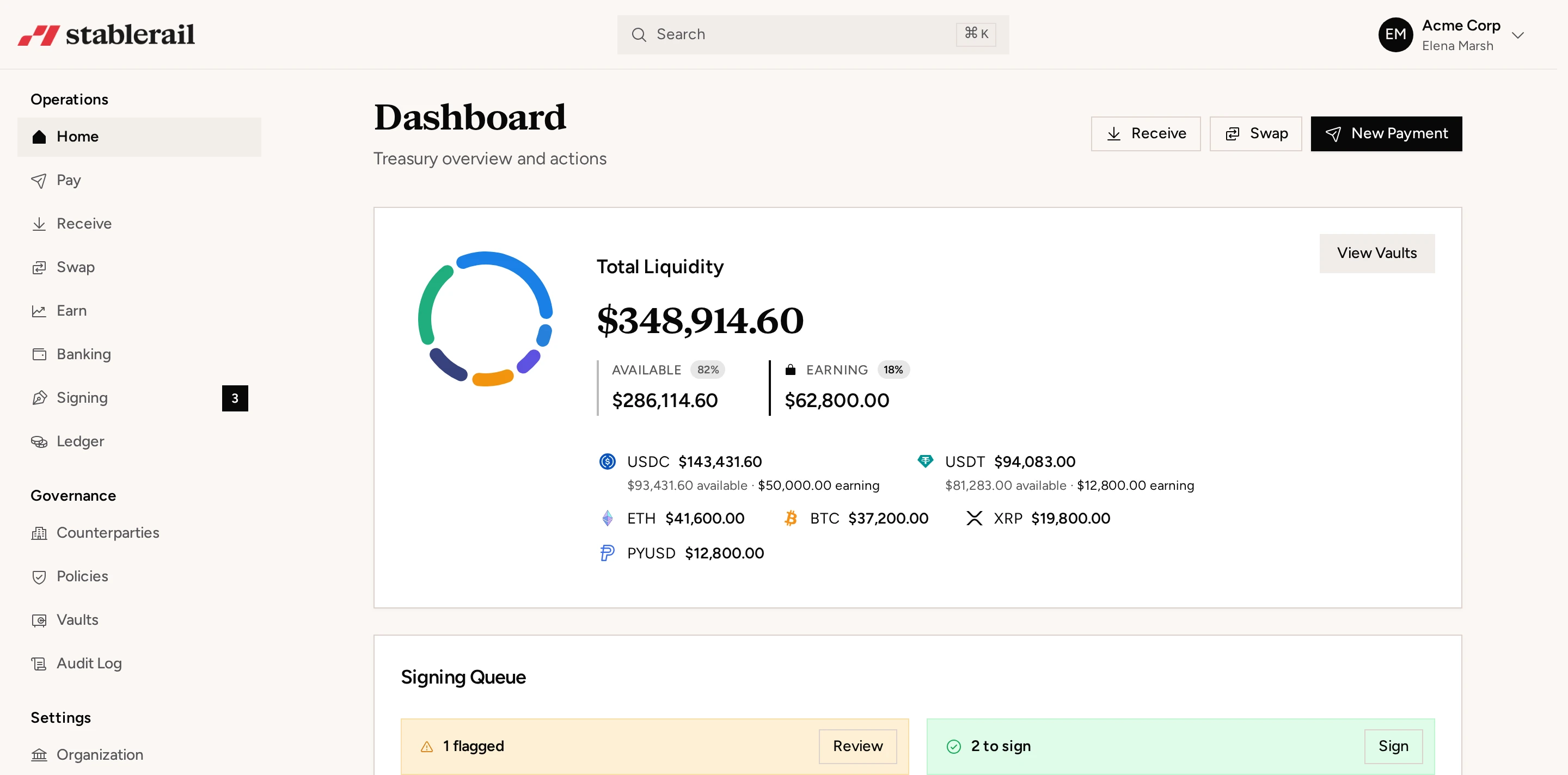
Stablerail supports this operating model through approvals and signing quorum, sanctions and address screening before send, global payouts, fiat off-ramp and exportable audit evidence for USDC and USDT treasury activity.
Building an audit-ready evidence trail
Because an MPC transaction can look like an ordinary signature on-chain, the blockchain does not prove that screening, segregation of duties or corporate approvals occurred. Those facts must be preserved off-chain.
For each transfer, retain a payment record that answers: what was sent, on which network, to whom, for what purpose, who requested it, who approved it, which screening result was used and which transaction hash settled it. The record should also show whether the transfer was routine, escalated or blocked.
Retention periods are not universally five or seven years. They depend on the company’s regulatory status, jurisdiction, tax rules, sanctions obligations, accounting policy and litigation requirements. Legal and compliance teams should establish a documented schedule that covers screening records, approvals, Travel Rule data, wallet configuration changes and incident investigations.
Common compliance failures
- Treating MPC as compliance. Distributed signing reduces key risk but does not identify a sanctioned recipient or establish payment legitimacy.
- Screening only at onboarding. Address attribution and sanctions status can change after a beneficiary is approved.
- Letting quorum equal approval. Key-share participants may be technical signers rather than authorized financial approvers.
- Ignoring incoming funds. Suspicious or sanctioned exposure can arrive without a treasury-initiated payment and may require investigation or reporting.
- Using shared administrator access. Shared credentials undermine attribution and weaken evidence that distinct people performed required actions.
- Failing to test recovery. A secure quorum that cannot be recovered after staff departures or device loss creates operational and control risk.
Choosing an MPC wallet for regulated operations
Evaluate the complete workflow rather than the cryptography alone. Confirm how the system assigns roles, changes approvers, verifies quorum, screens addresses, handles alerts, exports evidence and recovers from lost shares. Ask whether controls apply consistently across supported networks and whether transaction records can be matched to the accounting ledger.
Finally, test the system with real operating scenarios: a new beneficiary, an address change, a sanctions alert, an approver departure, a payment above authority and a failed blockchain transaction. A compliant design is one that produces predictable decisions and defensible evidence under pressure—not merely a valid cryptographic signature.
Frequently asked questions
Are MPC wallets regulated?
MPC technology itself is generally not a standalone regulated category. Regulation depends on the activities performed, such as custody, exchange, payment transmission or transfers for customers, as well as the jurisdictions and entities involved.
Does a self-custodial MPC wallet need AML and KYC controls?
A company moving only its own funds may not have the same AML program obligations as a regulated financial institution. It still needs controls appropriate to its sanctions exposure, counterparties, fraud risk, accounting duties and any local requirements, and its banks or exchanges may request KYC or Travel Rule information.
Does the Travel Rule apply to transfers from an MPC wallet?
The Travel Rule applies based on the parties and regulated transfer activity, not the use of MPC. A transfer involving a self-hosted corporate wallet may still trigger information collection or ownership checks when the other party is a regulated provider, particularly under jurisdiction-specific rules.
What should be screened before an MPC wallet transaction?
Screen the counterparty and destination address against applicable sanctions data, then assess relevant blockchain exposure and transaction-risk indicators. Also verify the network, asset, address ownership, payment purpose and any recent beneficiary changes before signing.
What audit evidence should an MPC wallet retain?
Retain the payment purpose, counterparty record, destination address, screening result, initiator, approvers, signing participants, timestamps, amount, network, fees and transaction hash. Records should also capture exceptions, alert investigations, configuration changes and the final reconciliation to the ledger.
Is an MPC signing quorum the same as payment approval?
No. A signing quorum proves that the required key shares participated in producing a signature, but it does not necessarily prove that authorized finance leaders approved the payment. Companies should map wallet signers to documented approval authority and preserve both approval and signing evidence.
Former CEO of Simple, a self-custodial wallet with $2B+ in transaction volume across 75+ countries.
More about the Stablerail team- Stablecoin treasury managementApprovals, limits, yield and reporting on one balance.
- Stablecoin payoutsBatch contractor and vendor payments with screening.
- USDT vs USDCWhich stablecoin your company should settle in.
- Stablecoin finance glossaryMPC, off-ramp, travel rule and the rest, in plain English.
- Product updatesEverything we ship, month by month.