
Multi-Entity Treasury: Running Accounts for Several Group Companies
A practical guide to separating group-company accounts, moving fiat and stablecoins between entities, documenting intercompany transfers, and producing consolidated treasury reporting.
%22%20x1%3D%220%22%20y1%3D%220%22%20x2%3D%221%22%20y2%3D%221%22%3E%0A%20%20%20%20%20%20%20%20%3Cstop%20offset%3D%220%25%22%20stop-color%3D%22%23450B10%22%20%2F%3E%0A%20%20%20%20%20%20%20%20%3Cstop%20offset%3D%2250%25%22%20stop-color%3D%22%23681A1F%22%20%2F%3E%0A%20%20%20%20%20%20%20%20%3Cstop%20offset%3D%22100%25%22%20stop-color%3D%22%238A2A2D%22%20%2F%3E%0A%20%20%20%20%20%20%3C%2FlinearGradient%3E%0A%20%20%20%20%20%20%3CradialGradient%20id%3D%22glow%22%20cx%3D%22557%22%20cy%3D%22328%22%20r%3D%22520%22%20gradientUnits%3D%22userSpaceOnUse%22%3E%0A%20%20%20%20%20%20%20%20%3Cstop%20offset%3D%220%25%22%20stop-color%3D%22%23FF7A59%22%20stop-opacity%3D%220.45%22%20%2F%3E%0A%20%20%20%20%20%20%20%20%3Cstop%20offset%3D%2255%25%22%20stop-color%3D%22%23FF7A59%22%20stop-opacity%3D%220.08%22%20%2F%3E%0A%20%20%20%20%20%20%20%20%3Cstop%20offset%3D%22100%25%22%20stop-color%3D%22%23FF7A59%22%20stop-opacity%3D%220%22%20%2F%3E%0A%20%20%20%20%20%20%3C%2FradialGradient%3E%0A%20%20%20%20%20%20%3ClinearGradient%20id%3D%22glass%22%20x1%3D%220%22%20y1%3D%220%22%20x2%3D%221%22%20y2%3D%221%22%3E%0A%20%20%20%20%20%20%20%20%3Cstop%20offset%3D%220%25%22%20stop-color%3D%22%23F8D6D2%22%20stop-opacity%3D%220.26%22%20%2F%3E%0A%20%20%20%20%20%20%20%20%3Cstop%20offset%3D%22100%25%22%20stop-color%3D%22%23FFFFFF%22%20stop-opacity%3D%220.08%22%20%2F%3E%0A%20%20%20%20%20%20%3C%2FlinearGradient%3E%0A%20%20%20%20%20%20%3ClinearGradient%20id%3D%22accent%22%20x1%3D%220%22%20y1%3D%220%22%20x2%3D%221%22%20y2%3D%221%22%3E%0A%20%20%20%20%20%20%20%20%3Cstop%20offset%3D%220%25%22%20stop-color%3D%22%23FF7A59%22%20%2F%3E%0A%20%20%20%20%20%20%20%20%3Cstop%20offset%3D%22100%25%22%20stop-color%3D%22%23C73128%22%20%2F%3E%0A%20%20%20%20%20%20%3C%2FlinearGradient%3E%0A%20%20%20%20%20%20%3Cfilter%20id%3D%22soft%22%3E%3CfeGaussianBlur%20stdDeviation%3D%2210%22%20%2F%3E%3C%2Ffilter%3E%0A%20%20%20%20%3C%2Fdefs%3E%0A%20%20%20%20%3Crect%20width%3D%221600%22%20height%3D%22900%22%20fill%3D%22url(%23bg)%22%20%2F%3E%0A%20%20%20%20%3Crect%20width%3D%221600%22%20height%3D%22900%22%20fill%3D%22url(%23glow)%22%20%2F%3E%0A%20%20%20%20%3Crect%20x%3D%22240%22%20y%3D%22240%22%20width%3D%22360%22%20height%3D%22420%22%20rx%3D%2220%22%20fill%3D%22url(%23glass)%22%20stroke%3D%22%23F4CDC5%22%20stroke-opacity%3D%220.55%22%2F%3E%0A%20%20%20%20%20%20%3Crect%20x%3D%22270%22%20y%3D%22290%22%20width%3D%22160%22%20height%3D%2218%22%20rx%3D%224%22%20fill%3D%22%23F8D6D2%22%20opacity%3D%220.6%22%2F%3E%0A%20%20%20%20%20%20%3Crect%20x%3D%22270%22%20y%3D%22370%22%20width%3D%22260%22%20height%3D%2248%22%20rx%3D%226%22%20fill%3D%22%23F8D6D2%22%20opacity%3D%220.8%22%2F%3E%0A%20%20%20%20%20%20%3Cpolyline%20points%3D%22270%2C590%20330%2C560%20390%2C580%20450%2C520%20510%2C540%20570%2C490%22%20fill%3D%22none%22%20stroke%3D%22%23FF8E72%22%20stroke-width%3D%225%22%2F%3E%3Crect%20x%3D%22640%22%20y%3D%22240%22%20width%3D%22360%22%20height%3D%22420%22%20rx%3D%2220%22%20fill%3D%22url(%23glass)%22%20stroke%3D%22%23F4CDC5%22%20stroke-opacity%3D%220.55%22%2F%3E%0A%20%20%20%20%20%20%3Crect%20x%3D%22670%22%20y%3D%22290%22%20width%3D%22160%22%20height%3D%2218%22%20rx%3D%224%22%20fill%3D%22%23F8D6D2%22%20opacity%3D%220.6%22%2F%3E%0A%20%20%20%20%20%20%3Crect%20x%3D%22670%22%20y%3D%22370%22%20width%3D%22260%22%20height%3D%2248%22%20rx%3D%226%22%20fill%3D%22%23F8D6D2%22%20opacity%3D%220.8%22%2F%3E%0A%20%20%20%20%20%20%3Cpolyline%20points%3D%22670%2C590%20730%2C560%20790%2C580%20850%2C520%20910%2C540%20970%2C490%22%20fill%3D%22none%22%20stroke%3D%22%23FF8E72%22%20stroke-width%3D%225%22%2F%3E%3Crect%20x%3D%221040%22%20y%3D%22240%22%20width%3D%22360%22%20height%3D%22420%22%20rx%3D%2220%22%20fill%3D%22url(%23accent)%22%20stroke%3D%22%23F4CDC5%22%20stroke-opacity%3D%220.55%22%2F%3E%0A%20%20%20%20%20%20%3Crect%20x%3D%221070%22%20y%3D%22290%22%20width%3D%22160%22%20height%3D%2218%22%20rx%3D%224%22%20fill%3D%22%23F8D6D2%22%20opacity%3D%220.6%22%2F%3E%0A%20%20%20%20%20%20%3Crect%20x%3D%221070%22%20y%3D%22370%22%20width%3D%22260%22%20height%3D%2248%22%20rx%3D%226%22%20fill%3D%22%23F8D6D2%22%20opacity%3D%220.95%22%2F%3E%0A%20%20%20%20%20%20%3Cpolyline%20points%3D%221070%2C590%201130%2C560%201190%2C580%201250%2C520%201310%2C540%201370%2C490%22%20fill%3D%22none%22%20stroke%3D%22%23FFF1ED%22%20stroke-width%3D%225%22%2F%3E%0A%20%20%20%20%3Crect%20x%3D%2226%22%20y%3D%2226%22%20width%3D%221548%22%20height%3D%22848%22%20rx%3D%2218%22%20fill%3D%22none%22%20stroke%3D%22%23F2D0C8%22%20stroke-opacity%3D%220.12%22%2F%3E%0A%20%20%3C%2Fsvg%3E)
A multi-entity treasury should give the finance team one operating view without blurring the legal boundaries between companies. Each subsidiary needs clearly owned accounts, balances, approvals and transaction records, while group treasury needs consolidated visibility and a practical way to fund entities.
For groups using USDC or USDT alongside fiat, this means coordinating bank rails, stablecoin networks, conversion routes and intercompany accounting. The objective is not to pool everything into one wallet. It is to make each movement attributable, documented and easy to reconcile.
Start with separate accounts for each legal entity
Each operating company should be onboarded and maintained as a distinct legal entity. Depending on jurisdiction and eligibility, that can include fiat accounts or virtual IBANs, multi-currency balances, and self-custodial MPC vaults for USDC and USDT.
MPC, or multi-party computation, distributes the authority needed to sign a blockchain transaction. Quorum signing can require approval from more than one authorised person without relying on a single private key.
A practical entity structure should keep the following separate:
- Account ownership: The legal entity that owns each fiat account, virtual IBAN and stablecoin vault.
- Balances: Fiat and stablecoins belonging to one company should not appear as another company’s available funds.
- Approvers: Each entity can have its own payment limits and signing quorum.
- Beneficiaries: Vendor and wallet allowlists should identify which entity approved the destination.
- Records: Statements, transaction hashes, invoices and approval histories should be exportable by entity.
This separation makes it possible to centralise operations without commingling assets. A parent-company finance team may administer several accounts, but each transaction should still be initiated and recorded in the name of the company that owns the funds.
What is needed to open accounts for several companies?
KYB, or know-your-business review, is generally completed for each legal entity. Requirements vary by jurisdiction, ownership structure and industry, but finance teams should prepare a consistent document pack before onboarding begins.
- Certificate of incorporation and current company extract
- Articles of association or equivalent constitutional documents
- Registered and operating addresses
- Director and authorised signatory details
- Ultimate beneficial owner information
- Group ownership chart showing parent and subsidiary relationships
- Description of products, customers, expected transaction volumes and corridors
- Source-of-funds or source-of-wealth evidence where required
Not every group company will necessarily qualify for the same fiat rails, currencies or stablecoin services. Jurisdiction and industry eligibility should be checked per entity rather than inferred from the parent company’s approval.
Choose the right route for intercompany transfers
Intercompany transfers may be executed in fiat or stablecoins. The right route depends on the currency required by the receiving company, the location of its account, timing, network compatibility and total cost.
| Route | Typical timing | Best suited to | Cost components |
|---|---|---|---|
| USDC or USDT on the same network | Usually seconds to minutes after submission, subject to network confirmation and screening | Fast transfers where both entities can hold the same token on the same network | Blockchain network fee and any applicable withdrawal or service fee |
| SEPA Instant | Usually seconds, where both banks participate and the payment passes checks | Urgent EUR funding | Rail or account fee, if applicable |
| Standard SEPA | Commonly same or next business day | Routine EUR transfers | Rail or account fee |
| ACH | Commonly one to three business days | Non-urgent USD transfers | Rail fee and possible receiving-bank fee |
| Fedwire or CHAPS | Usually same business day before applicable cut-off | Urgent, higher-value USD or GBP transfers | Wire fee and possible intermediary or receiving-bank fees |
| SWIFT | Often one to five business days | Cross-border currencies or destinations not covered by local rails | Sending, intermediary, receiving-bank and FX charges |
These timings are indicative, not guarantees. Bank cut-offs, weekends, beneficiary checks, sanctions screening and blockchain congestion can all affect completion.
If one company holds USDC and another needs EUR, the transfer includes two separate decisions: which entity performs the conversion, and which entity sends the resulting funds. Review the quoted on/off-ramp corridor price, blockchain fee, bank-rail charge and FX rate before execution. The accounting record should follow the actual sequence rather than treating the movement as a single unexplained journal entry.
Avoid accidental cross-network transfers
USDC and USDT are available across networks including Ethereum, Base, Arbitrum, Polygon, Tron, BNB Chain, Optimism and Solana. The sending and receiving accounts must support the same token and network. A USDC address on one network should not be assumed to support USDC on every other network.
Before sending a new intercompany payment, confirm the token, network and destination address. A small test transfer may be appropriate for a newly added destination. Wallet allowlisting can reduce the risk of selecting an unapproved address.
Document the purpose of every transfer
Moving cash between related companies does not determine its accounting treatment. Before payment, the finance team should classify the transaction as an intercompany loan, capital contribution, service charge, dividend, expense reimbursement or another supported category.
The payment record should include:
- Sending and receiving legal entities
- Transfer amount, currency or token, and blockchain network where applicable
- Business purpose and supporting agreement
- Invoice, loan reference or board approval where required
- Applicable exchange rate and valuation timestamp
- Blockchain transaction hash or bank payment reference
- Fees and the entity responsible for them
This evidence supports reconciliation, audit review and transfer-pricing analysis. It also prevents an operational transfer from being posted differently by the two entities.
Build consolidated reporting without losing entity detail
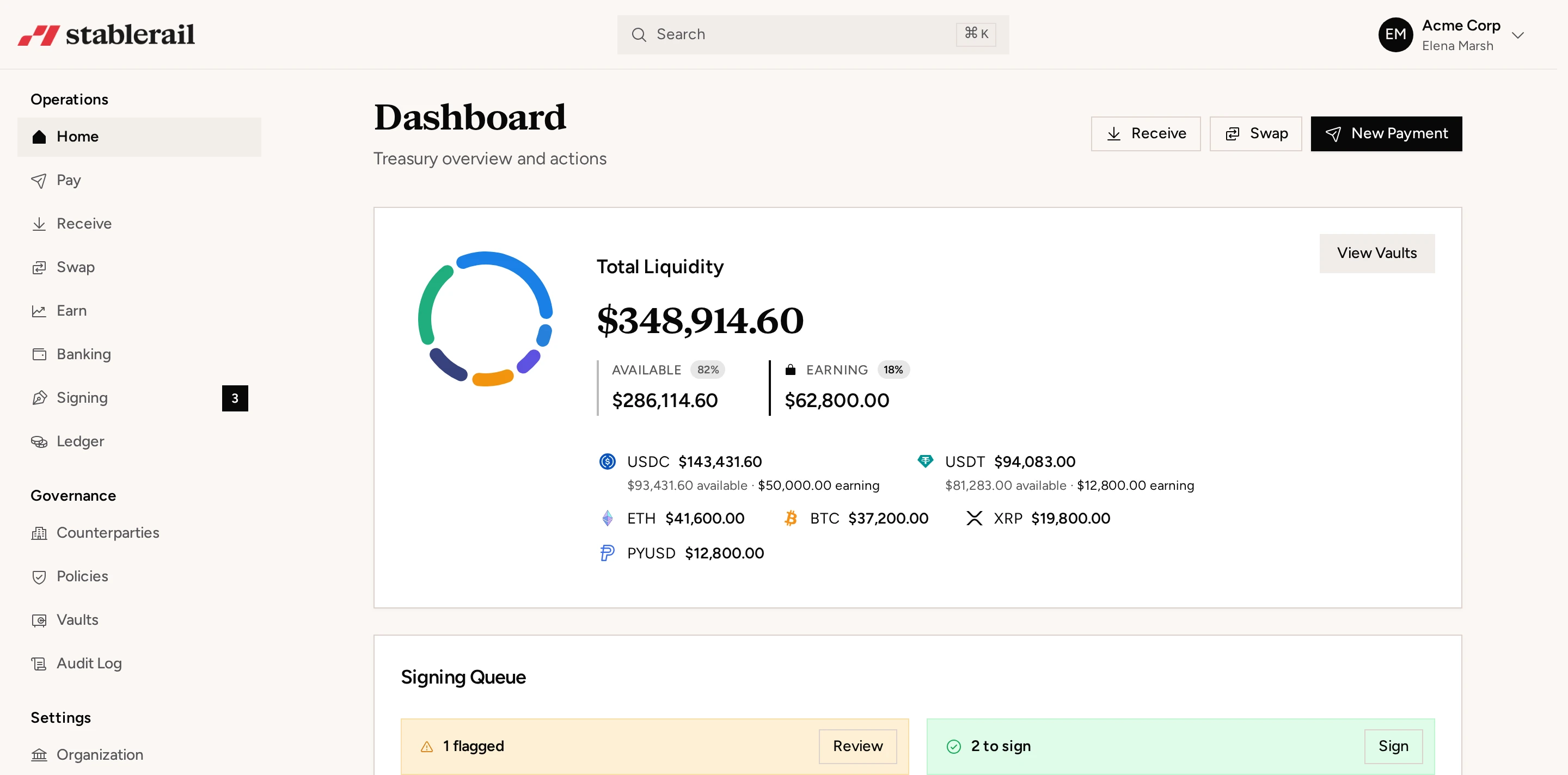
Consolidated reporting should combine balances while retaining the underlying legal owner. A useful group treasury view shows fiat and stablecoin balances by entity, currency, token and network, with a group-level total in the chosen reporting currency.
Finance teams should also be able to identify:
- External cash versus intercompany receivables and payables
- Transfers in progress across bank and blockchain rails
- Stablecoin balances by issuer and network
- Conversion fees, network fees and bank charges
- Amounts requiring elimination on consolidation
Use a consistent valuation policy for USDC and USDT rather than assuming every token always equals exactly one US dollar for accounting purposes. Record the rate source and timestamp used at the transaction date and reporting cut-off.
Intercompany balances should reconcile in pairs. If Company A records a $100,000 receivable from Company B, Company B should record the corresponding payable using the same reference. Differences caused by fees, exchange rates or timing should be investigated before period close.
A practical month-end workflow
- Export fiat and stablecoin transactions separately for every entity.
- Match bank references and blockchain transaction hashes to internal payment records.
- Reconcile intercompany receivables and payables between entity pairs.
- Post conversion charges, gas fees and bank fees to the correct company.
- Value stablecoin balances under the group’s documented accounting policy.
- Eliminate intercompany balances and transactions in the consolidated accounts.
- Retain statements, approvals and supporting documents in the period evidence pack.
Stablerail can support a group structure with business stablecoin accounts, fiat rails, on/off-ramps and entity-level transaction evidence, subject to onboarding and service eligibility. For an overview of the operating model, see multi-entity treasury.
The most effective setup combines clear legal separation with one repeatable operating process. Group treasury gains visibility and execution capacity, while each subsidiary retains identifiable ownership, approvals and accounting records.
Finance writers covering stablecoin treasury, payments, compliance, and risk controls.
More about the Stablerail team- Stablecoin treasury managementApprovals, limits, yield and reporting on one balance.
- Stablecoin payoutsBatch contractor and vendor payments with screening.
- USDT vs USDCWhich stablecoin your company should settle in.
- Stablecoin finance glossaryMPC, off-ramp, travel rule and the rest, in plain English.
- Product updatesEverything we ship, month by month.