
Month-End Close With a Stablecoin Treasury: A Practical Checklist
A practical month-end checklist for reconciling USDC, USDT, fiat accounts, conversions, payouts, cards, fees and FX while producing review-ready evidence.
To close a stablecoin treasury, set one cutoff timestamp, inventory every wallet, account, token and network, and reconcile each balance to independent evidence. Review conversions and transfers in transit, post fees and required FX or valuation entries, and investigate exceptions rather than forcing differences. Finish with an evidence pack containing source exports, transaction hashes, rate support, approvals, screening records and reviewer sign-off.
%22%20x1%3D%220%22%20y1%3D%220%22%20x2%3D%221%22%20y2%3D%221%22%3E%0A%20%20%20%20%20%20%20%20%3Cstop%20offset%3D%220%25%22%20stop-color%3D%22%232E0709%22%20%2F%3E%0A%20%20%20%20%20%20%20%20%3Cstop%20offset%3D%2250%25%22%20stop-color%3D%22%234A0F14%22%20%2F%3E%0A%20%20%20%20%20%20%20%20%3Cstop%20offset%3D%22100%25%22%20stop-color%3D%22%236B181C%22%20%2F%3E%0A%20%20%20%20%20%20%3C%2FlinearGradient%3E%0A%20%20%20%20%20%20%3CradialGradient%20id%3D%22glow%22%20cx%3D%221081%22%20cy%3D%22411%22%20r%3D%22520%22%20gradientUnits%3D%22userSpaceOnUse%22%3E%0A%20%20%20%20%20%20%20%20%3Cstop%20offset%3D%220%25%22%20stop-color%3D%22%23FFB199%22%20stop-opacity%3D%220.45%22%20%2F%3E%0A%20%20%20%20%20%20%20%20%3Cstop%20offset%3D%2255%25%22%20stop-color%3D%22%23FFB199%22%20stop-opacity%3D%220.08%22%20%2F%3E%0A%20%20%20%20%20%20%20%20%3Cstop%20offset%3D%22100%25%22%20stop-color%3D%22%23FFB199%22%20stop-opacity%3D%220%22%20%2F%3E%0A%20%20%20%20%20%20%3C%2FradialGradient%3E%0A%20%20%20%20%20%20%3ClinearGradient%20id%3D%22glass%22%20x1%3D%220%22%20y1%3D%220%22%20x2%3D%221%22%20y2%3D%221%22%3E%0A%20%20%20%20%20%20%20%20%3Cstop%20offset%3D%220%25%22%20stop-color%3D%22%23F8D6D2%22%20stop-opacity%3D%220.26%22%20%2F%3E%0A%20%20%20%20%20%20%20%20%3Cstop%20offset%3D%22100%25%22%20stop-color%3D%22%23FFFFFF%22%20stop-opacity%3D%220.08%22%20%2F%3E%0A%20%20%20%20%20%20%3C%2FlinearGradient%3E%0A%20%20%20%20%20%20%3ClinearGradient%20id%3D%22accent%22%20x1%3D%220%22%20y1%3D%220%22%20x2%3D%221%22%20y2%3D%221%22%3E%0A%20%20%20%20%20%20%20%20%3Cstop%20offset%3D%220%25%22%20stop-color%3D%22%23FFB199%22%20%2F%3E%0A%20%20%20%20%20%20%20%20%3Cstop%20offset%3D%22100%25%22%20stop-color%3D%22%23E85D3A%22%20%2F%3E%0A%20%20%20%20%20%20%3C%2FlinearGradient%3E%0A%20%20%20%20%20%20%3Cfilter%20id%3D%22soft%22%3E%3CfeGaussianBlur%20stdDeviation%3D%2210%22%20%2F%3E%3C%2Ffilter%3E%0A%20%20%20%20%3C%2Fdefs%3E%0A%20%20%20%20%3Crect%20width%3D%221600%22%20height%3D%22900%22%20fill%3D%22url(%23bg)%22%20%2F%3E%0A%20%20%20%20%3Crect%20width%3D%221600%22%20height%3D%22900%22%20fill%3D%22url(%23glow)%22%20%2F%3E%0A%20%20%20%20%0A%20%20%3Cpath%20d%3D%22M800%20180%20L%201020%20260%20L%201020%20470%20C%201020%20600%2C%20920%20700%2C%20800%20740%20C%20680%20700%2C%20580%20600%2C%20580%20470%20L%20580%20260%20Z%22%20fill%3D%22url(%23glass)%22%20stroke%3D%22%23F4CDC5%22%20stroke-opacity%3D%220.7%22%20stroke-width%3D%223%22%2F%3E%0A%20%20%3Cpath%20d%3D%22M800%20220%20L%20980%20290%20L%20980%20460%20C%20980%20570%2C%20900%20660%2C%20800%20700%20C%20700%20660%2C%20620%20570%2C%20620%20460%20L%20620%20290%20Z%22%20fill%3D%22url(%23accent)%22%20opacity%3D%220.85%22%2F%3E%0A%20%20%3Cpath%20d%3D%22M710%20460%20L%20780%20530%20L%20900%20380%22%20fill%3D%22none%22%20stroke%3D%22%23FFF1ED%22%20stroke-width%3D%2222%22%20stroke-linecap%3D%22round%22%20stroke-linejoin%3D%22round%22%2F%3E%0A%0A%20%20%20%20%3Crect%20x%3D%2226%22%20y%3D%2226%22%20width%3D%221548%22%20height%3D%22848%22%20rx%3D%2218%22%20fill%3D%22none%22%20stroke%3D%22%23F2D0C8%22%20stroke-opacity%3D%220.12%22%2F%3E%0A%20%20%3C%2Fsvg%3E)
Why a stablecoin month-end close is different
A stablecoin treasury adds data sources to the normal close: self-custodial wallets, public blockchains, fiat accounts, conversion orders, payout batches, corporate cards and, where applicable, yield positions or exchange accounts. The accounting disciplines remain familiar, but transaction status, cutoff evidence and reconciliation keys differ from a bank-only treasury.
Blockchain networks operate continuously, while banks and payment systems follow business-day calendars, processing windows and local holidays. A conversion can be debited on one side before the corresponding stablecoin or fiat proceeds arrive. Card authorisations can also appear before capture and settlement. Finance therefore needs a precise cutoff and a controlled method for recording in-transit items.
This checklist is designed for companies managing their own funds in USDC or USDT. Accounting classification, measurement, exchange-rate sources and materiality thresholds should follow the company’s reporting framework, jurisdiction and documented accounting policy.
Month-end close timetable
| Timing | Finance task | Required output |
|---|---|---|
| Two business days before close | Review open conversions, payout batches, card settlements, withdrawals and expected receipts | Pre-close list of in-transit and high-risk items |
| Final business day | Confirm cutoff, scope, approved rate sources and reviewer ownership | Close instructions and account inventory |
| Close timestamp | Capture wallet, fiat, card and other treasury balances using the same defined cutoff | Unmodified balance snapshots and exports |
| Day 1 | Reconcile subledgers to blockchain and bank evidence | Reconciliation workbook and exception log |
| Days 2–3 | Post FX, valuation, fees, accruals and reclassifications | Journal entries with supporting calculations |
| Final review | Resolve or approve exceptions and verify evidence completeness | Signed close package |
1. Lock the cutoff and reconciliation scope
Record one exact cutoff using a date, time and timezone, such as 23:59:59 UTC. Do not rely solely on the date displayed by a wallet interface or block explorer. Exports may use UTC, local time or a provider-specific reporting timezone.
Build the scope by legal entity and list every location holding or moving treasury funds: self-custodial vaults, operational wallets, fiat accounts, virtual account details, card balances, exchanges, conversion accounts and yield positions. Include dormant accounts if they remain open or carry a balance.
Record each token and network separately. USDC on Ethereum and USDC on Solana are distinct reconciliation lines because they have different token contracts, transaction identifiers and fee assets. Apply the same approach to USDT across supported networks.
Document when a transaction counts as complete. For blockchain transfers, define the confirmation or finality evidence Finance accepts. For fiat payments, distinguish submitted, processing, settled, rejected and returned transactions. Export source files promptly after cutoff and retain the originals without manual editing.
2. Capture and reconcile every balance
Create a balance inventory by entity, asset, network, wallet or account, and general-ledger classification. Token symbols alone are not sufficient. Record wallet addresses and token contract addresses so reviewers can identify exactly what was reconciled.
| Balance type | Primary evidence | Key reconciliation test |
|---|---|---|
| USDC and USDT wallets | Treasury export and public blockchain record | Token quantity at the cutoff block or corresponding timestamp |
| Native fee assets | Wallet export and blockchain record | Opening balance plus receipts minus sends and network fees |
| Fiat accounts | Account statement and pending-transaction report | Ledger, available and pending balances |
| Payout wallets and batches | Wallet activity and payout export | Completed, processing, failed and returned payments |
| Corporate cards | Card activity and settlement reports | Authorisations, captures, reversals and unsettled spend |
| Yield or exchange positions | Position and activity statements | Principal, earnings, withdrawals and restricted amounts |
For each wallet, reconcile opening quantity plus receipts minus sends and fees to the closing quantity. Preserve full token precision in the workbook and round only when posting under the ledger policy. Common differences include omitted gas fees, duplicate imports, decimal truncation, wrong-period transactions and transfers recorded on only one side.
Reconcile native assets such as ETH, SOL, TRX or BNB even if they are held only to pay network fees. Their disposal for gas can create an expense and may also require a gain or loss calculation under the applicable accounting treatment.
For fiat, separate rails where their timing or return behaviour differs. Examples include ACH and Fedwire for US dollars, SEPA and SEPA Instant for euros, Faster Payments, BACS and CHAPS for sterling, and SWIFT for cross-border transfers.
3. Review transfers and conversions in transit
A movement can leave its source before reaching its destination. This commonly occurs during fiat-to-stablecoin conversions, stablecoin redemptions, bank transfers around cutoff, cross-network movements and payments awaiting beneficiary credit.
Match each conversion using the order reference, source amount, destination amount, quoted or executed rate, fees, timestamps and settlement status. Confirm whether both legs belong in the same reporting period. Separate initiated, processing, completed, failed, cancelled and returned items instead of treating every submitted order as settled.
Internal transfers require particular care. A movement between company-controlled wallets should not be recorded as revenue, expense or an external payment. Match the outgoing and incoming transaction hashes or other transfer references, including any bridge or conversion step, and record network fees separately.
If one leg has settled by cutoff, use the company’s approved clearing or in-transit account rather than forcing the amount into cash or stablecoins. Record an owner and expected resolution date, then clear or reverse the balance when settlement completes.
4. Post FX and valuation entries
Stablecoins target a reference currency, but that does not remove translation or measurement work. A company whose functional currency is EUR, GBP or another non-USD currency will generally need to translate USD-denominated USDC and USDT using its approved closing-rate policy. A USD-functional company may still need to assess the applicable accounting measurement and any observable difference from par.
- Retain rate evidence: Record the rate, source, timestamp and currency pair used.
- Apply the policy consistently: Use consistent methods across fiat USD and USD-denominated stablecoins unless the accounting policy requires different treatment.
- Separate realised amounts: Calculate gains or losses on sales, redemptions or payments where required.
- Post closing remeasurement: Retain calculations by legal entity, asset and ledger account.
- Assess deviations from par: Do not automatically substitute one US dollar for one token if the approved measurement basis requires observable pricing.
Stablecoin classification varies by reporting framework, jurisdiction and facts. It should not be assumed that a stablecoin receives the same treatment as bank cash. Confirm the policy with the company’s accounting advisers and apply it consistently.
5. Accrue fees and unsettled expenses
Review gross activity rather than posting only the net wallet or bank movement. Fees may be deducted from proceeds, charged separately, paid in a native cryptoasset or invoiced after month-end.
The review population should include blockchain fees, fiat transfer charges, conversion fees, card and foreign-exchange charges, payout fees, and third-party accounting, custody or exchange costs incurred but not yet invoiced. For each accrual, retain the service period, calculation, currency, counterparty and expected reversal date.
If a fee was paid in a cryptoasset, record the quantity and functional-currency value. Confirm whether disposal accounting is also required under the company’s policy.
6. Reconcile payouts, cards, payroll and receivables
Reconcile payout batches at both batch and beneficiary level. A batch shown as complete can still contain a failed, rejected or returned payment. Match the approved batch total to wallet or fiat outflows, then explain every difference using transaction-level status.
For payroll, separate compensation expense, employer costs, withholding liabilities and the stablecoin settlement entry. For receivables, match the received token, network, transaction hash, payer reference and invoice. Investigate unidentified receipts and do not recognise revenue solely because funds reached a wallet.
For cards, distinguish authorisations from captured and settled transactions. Accrue material spend incurred before cutoff even if settlement occurs later, and remove expired or reversed authorisations from the expected settlement population.
7. Verify controls and assemble the evidence pack
The close package should allow a reviewer to reproduce material balances without signing into a live wallet. Where structured exports are available, retain them instead of relying only on screenshots.
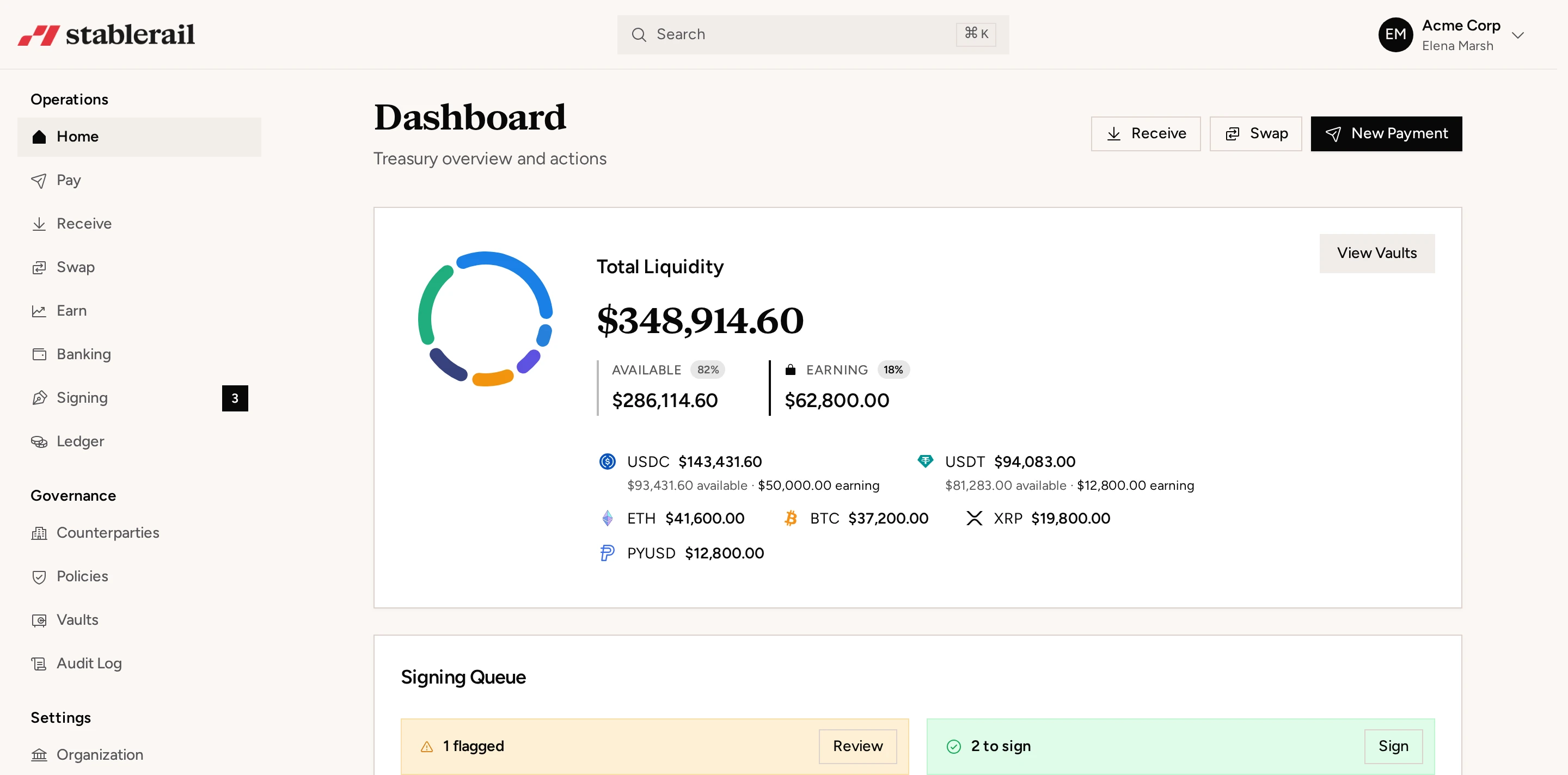
For material treasury movements, verify that the sending wallet was approved, the required signing quorum was met, and sanctions or address screening occurred before the send. Stablerail can consolidate evidence for a company’s own USDC and USDT activity across approvals, screening, conversions, cards and global payouts, with exports for the close and audit process.
Final finance-team checklist
- Document the cutoff timestamp, timezone and accepted transaction statuses.
- Confirm every legal entity, wallet, token, network, fiat account, card account and external position is included.
- Reconcile token and native-fee balances to blockchain evidence.
- Reconcile fiat balances and pending entries to statements or account reports.
- Match conversions and internal transfers on both sides.
- Classify unresolved movements in the approved clearing account.
- Post supported FX, valuation, fee and accrual entries.
- Review failed, returned, duplicate and unidentified transactions.
- Retain hashes, contract addresses, rate evidence, approvals and screening records.
- Obtain preparer and reviewer sign-off with owners and deadlines for open exceptions.
A clean stablecoin close is not merely a matching exercise. It demonstrates that every balance existed at cutoff, belonged to the correct entity, was measured under the approved policy and can be traced through settlement, approval and accounting evidence.
Frequently asked questions
How do you reconcile stablecoins at month-end?
Reconcile each token and network separately using opening quantity plus receipts minus sends and fees to arrive at the closing quantity. Compare the result with a treasury export and independent blockchain evidence at the documented cutoff, then investigate rather than write off differences.
Should USDC and USDT be treated as cash in the financial statements?
Not automatically. Classification depends on the reporting framework, jurisdiction, redemption terms and the company’s facts, so Finance should document a position with its accounting advisers and apply it consistently.
What cutoff should be used for blockchain transactions?
Use an exact date, time and timezone, supported by a documented rule for when a transaction is considered complete. Map the cutoff to the relevant blockchain timestamp or block and retain evidence of pending, failed or replaced transactions.
How should stablecoin conversions in transit be recorded?
Match the fiat and token legs using the order reference, amounts, rate, fees and settlement status. If only one side has settled by cutoff, use the company’s approved clearing or in-transit account and clear it when settlement completes.
What evidence should be kept for a stablecoin treasury audit?
Retain original wallet and account exports, blockchain transaction hashes, wallet and token contract addresses, conversion records, FX-rate support, fee calculations and exception logs. Include approval history, signing evidence, screening records and preparer and reviewer sign-off for material activity.
Finance writers covering stablecoin treasury, payments, compliance, and risk controls.
More about the Stablerail team- Stablecoin treasury managementApprovals, limits, yield and reporting on one balance.
- Stablecoin payoutsBatch contractor and vendor payments with screening.
- USDT vs USDCWhich stablecoin your company should settle in.
- Stablecoin finance glossaryMPC, off-ramp, travel rule and the rest, in plain English.
- Product updatesEverything we ship, month by month.