
Internal Controls for Stablecoin Payments
A practical control framework for USDC and USDT payments, covering address verification, sanctions screening, approval tiers, signing security, reconciliation and audit evidence.
Effective internal controls for stablecoin payments separate payment creation, approval and signing; verify the asset, network and recipient address; screen addresses before sending; and preserve evidence for every decision. Finance teams should also reconcile blockchain transactions to their ledger, restrict wallet access, require approval quorum for material payments and maintain an incident process for compromised keys, incorrect transfers or compliance alerts.

Internal controls for stablecoin payments should prevent an unauthorized, non-compliant or technically incorrect transfer before it reaches the blockchain. The core framework combines verified payment instructions, sanctions and address screening, risk-based approvals, secure signing, post-transaction reconciliation and complete audit evidence. Because blockchain transfers are generally irreversible, preventive controls matter more than relying on recovery after an error.
Why stablecoin payments need specific controls
Traditional payment controls still apply: segregation of duties, delegated authority, counterparty verification, fraud prevention and ledger reconciliation. Stablecoin operations add technical details that bank payment workflows do not usually encounter.
A valid-looking wallet address may belong to the wrong recipient, exist on a different network or have exposure to sanctioned or illicit activity. USDC or USDT may also exist on multiple blockchains, and unsupported token contracts can resemble legitimate assets. Once a transaction is confirmed, neither the sender nor the stablecoin issuer should be assumed to have a reliable way to reverse it.
Finance teams therefore need to control the complete payment instruction: legal counterparty, amount, stablecoin, token contract, blockchain, destination address, business purpose and approval path. Checking only the amount and address leaves important failure modes uncovered.
A three-layer control framework
A practical framework has three connected layers. Preventive controls validate and approve the payment before signing. Execution controls protect signing authority and ensure the approved instruction is the instruction broadcast. Detective controls confirm settlement, reconcile records and identify exceptions after execution.
| Risk | Primary control | Evidence to retain |
|---|---|---|
| Wrong recipient address | Verify new or changed addresses through an independent channel and restrict use to approved counterparties | Verification record, counterparty identity, address and verifier |
| Wrong network or token | Require the payment request to specify the blockchain, stablecoin and approved token contract | Payment instruction and approved asset register |
| Sanctions or illicit-finance exposure | Screen the destination address before signing and escalate alerts under a documented procedure | Screening result, provider output, timestamp and disposition |
| Unauthorized payment | Separate initiation from approval and require an appropriate signing quorum | Initiator, approvers, signer records and timestamps |
| Key compromise | Limit signing access, protect recovery material and maintain revocation and wallet-migration procedures | Access reviews, custody configuration and incident records |
| Incomplete accounting | Reconcile the transaction hash, fees and wallet balance to the subledger and general ledger | Transaction hash, reconciliation and exception resolution |
Build controls around the payment lifecycle
1. Create a complete payment intent
The initiator should record the amount, asset, network, destination address, counterparty, invoice or purpose, due date and originating entity. The workflow should reject incomplete requests rather than allowing approvers to reconstruct the payment from chat messages or spreadsheets.
New addresses and changes to existing addresses deserve additional scrutiny. Verify them using contact details already held on file, not contact information supplied in the same message that requested the change. For material transfers, teams may use a small test payment, but this does not replace independent verification: an attacker controlling the destination can also receive the test.
2. Perform pre-signing compliance and technical checks
Screen the destination address before funds are sent. Address-screening tools can identify direct sanctions designations and risk indicators based on on-chain exposure, but a score is not a final compliance decision. The review procedure should define which alerts are blocked, which require investigation and who can approve an exception.
Know Your Transaction analysis complements rather than replaces Know Your Customer or vendor due diligence. On-chain screening examines wallet activity; it may not establish the legal identity, ownership or commercial purpose of the counterparty. Finance and compliance teams should connect both records.
Technical validation should confirm that the address format is compatible with the selected network, the stablecoin and token contract are approved, and the sending wallet has sufficient funds for both the payment and network fees. Screening should be refreshed near signing if a payment sits in an approval queue, because address risk can change after the request is created.
3. Apply risk-based approvals
Approval requirements should reflect more than transaction value. Relevant factors include whether the beneficiary is new, whether the address changed, the destination jurisdiction, screening results, payment timing and deviation from normal activity.
| Payment category | Possible treatment | Control focus |
|---|---|---|
| Routine payment to a verified address | Standard finance approval and required signing quorum | Amount, invoice, available balance and current screening result |
| New or changed destination address | Independent address verification plus additional approval | Counterparty authenticity and network confirmation |
| Material or unusual payment | Senior finance approval and enhanced review | Business purpose, source documentation and anomaly explanation |
| Sanctions or high-risk alert | Hold before signing and escalate to compliance | Alert investigation, legal analysis and documented disposition |
| Unsupported asset, network or contract | Block until treasury approves the configuration | Asset legitimacy, operational support and accounting treatment |
Each company should set its own monetary thresholds based on risk appetite, transaction profile and delegated-authority policy. An example amount copied from another company is not a defensible control. Thresholds should also be reviewed periodically so that inflation, growth or changing payment patterns do not make them ineffective.
4. Secure signing and broadcast
No single person should be able to create, approve and sign a material payment. The exact design may use institutional custody, multi-party computation, threshold signing or a smart-contract multisignature wallet. What matters is that signing authority, recovery procedures and approval quorum match the company’s risk policy.
The final signer or signing system should confirm that the approved amount, network, token and destination address have not changed. Displaying a shortened address without a way to inspect the full value creates avoidable risk. Access to signing devices and administrative settings should be restricted, reviewed and removed promptly when responsibilities change.
On-chain data alone may not prove who approved a transaction. Depending on the wallet design, the blockchain may show only a wallet interaction or aggregated signature. The company must retain off-chain evidence showing the payment request, checks, approvals, overrides and people involved.
5. Confirm settlement and reconcile
After broadcast, capture the transaction hash, sending and receiving addresses, block timestamp, amount, asset, network fee and transaction status. Confirmation standards should reflect the blockchain used and the company’s settlement policy; a submitted transaction is not necessarily final.
Reconciliation should connect the on-chain transfer to the invoice, treasury subledger and general ledger. Record network fees separately where the accounting policy requires it, investigate balance differences and account for transactions initiated near period-end in the correct reporting period. Wallet balances should be independently reconciled rather than accepted from an operations dashboard without review.
Segregation of duties and ownership
A workable control model assigns named responsibility for each stage. Treasury or accounts payable creates the payment, an authorized budget owner confirms the business obligation, finance approves under delegated authority, compliance resolves relevant screening alerts, and authorized signers execute the approved instruction. Accounting then performs reconciliation independently of the initiator where staffing permits.
Smaller teams may not be able to assign a different employee to every role. Compensating controls can include dual approval, restricted transaction limits, independent daily review and board or executive review of wallet activity. The key is to document where duties overlap and how the resulting risk is mitigated.
What an audit-ready record should contain
The evidence package should make it possible for someone outside the payment team to reconstruct what happened without relying on memory. At minimum, retain:
- The original payment request and underlying invoice or obligation
- The legal counterparty, destination address, stablecoin and blockchain
- Address-screening results and the time each check was performed
- All approvals, rejections, escalations and override rationales
- The signing participants or quorum evidence available from the wallet system
- The transaction hash, confirmation status and network fee
- The accounting entry, reconciliation and resolution of exceptions
Evidence should follow the company’s record-retention policy and be exportable in a form auditors can review. Informal approval in a messaging channel is weak evidence if it cannot be reliably linked to the final signed transaction.
Implementation checklist for finance teams
- Inventory every wallet, blockchain, stablecoin, token contract and person with access.
- Define approved assets, networks, counterparties and address-verification procedures.
- Set delegated-authority thresholds and signing quorum by risk category.
- Require sanctions and address screening before every send.
- Separate payment creation, approval, signing and reconciliation where practical.
- Test key-compromise, lost-access, wrong-address and compliance-alert procedures.
- Export evidence and complete a sample audit walkthrough before relying on the process.
Controls should be tested with realistic scenarios, including a changed vendor address, an unsupported network, a failed transaction, a signer leaving the company and a screening alert immediately before payment. A control that exists in a policy but cannot stop or evidence a test transaction is not operating effectively.
Operationalizing the framework
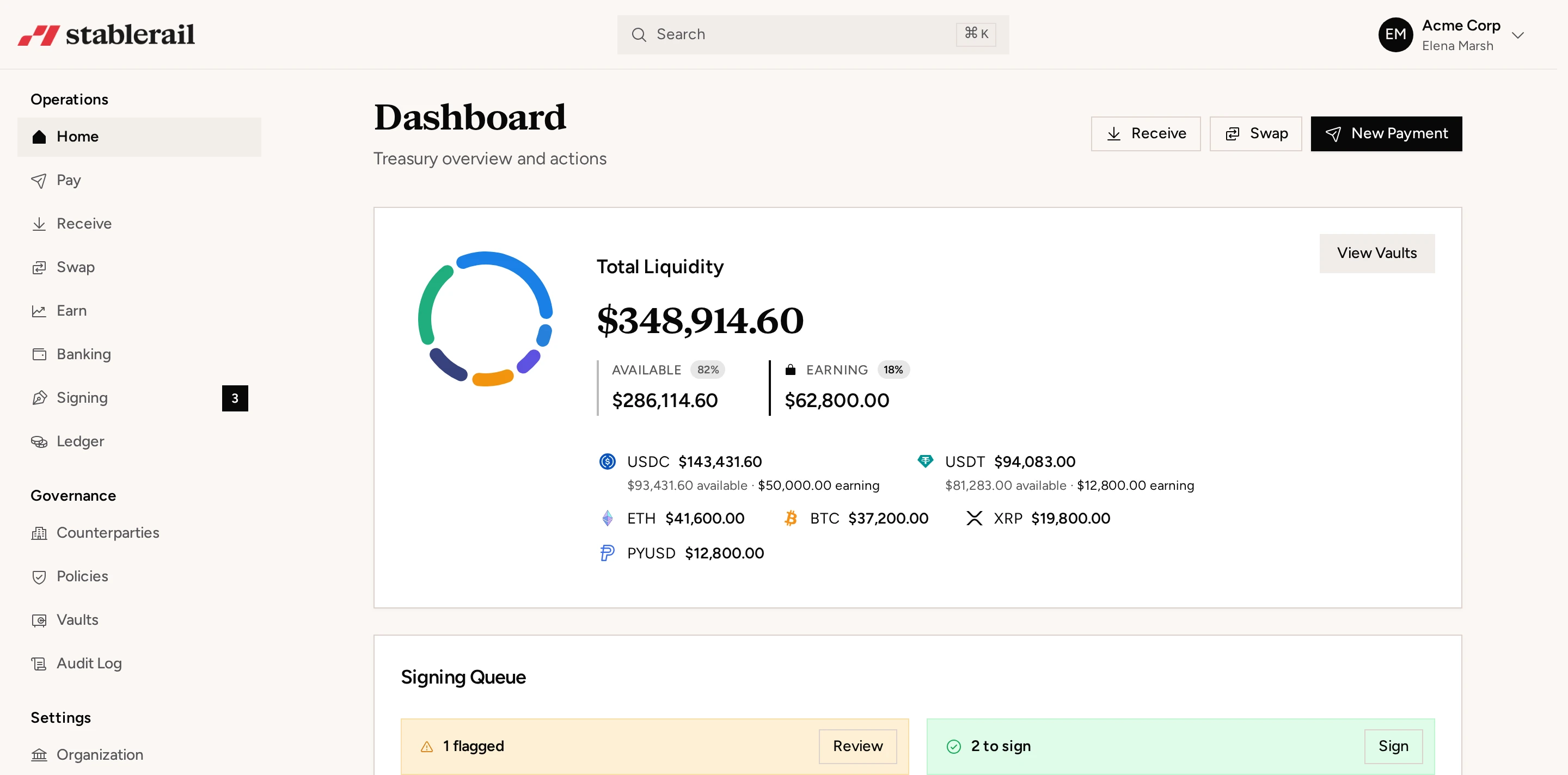
The strongest design is one finance staff can follow consistently under time pressure. Stablerail brings USDC and USDT treasury into one business account with approvals and signing quorum, sanctions and address screening before send, corporate cards, global payouts, fiat off-ramp and exportable audit evidence. Whether using one platform or several, the company should map each control to an owner, system, frequency and retained artifact.
Stablecoin speed should shorten settlement, not bypass governance. Clear pre-signing controls, human review of genuine exceptions and disciplined reconciliation let finance teams use blockchain payments while preserving the accountability expected of any corporate payment process.
Frequently asked questions
What internal controls are needed for stablecoin payments?
Core controls include verified payment instructions, sanctions and address screening, segregation of duties, approval thresholds, secure signing quorum and blockchain-to-ledger reconciliation. The company should also retain the transaction hash, screening results, approvals and exception decisions as audit evidence.
How should a company verify a stablecoin wallet address?
Verify a new or changed wallet address through an independent channel using contact information already held on file. Confirm the legal counterparty, full address, blockchain, stablecoin and token contract; a small test payment can supplement but not replace this verification.
Do stablecoin payments require sanctions screening?
Businesses should screen destination addresses before sending and investigate alerts under a documented compliance procedure. Blockchain screening can identify sanctions designations and on-chain risk exposure, but it does not replace KYC, vendor due diligence or legal review.
How do auditors test controls over stablecoin payments?
Auditors may trace a sample from the invoice and payment request through screening, approval, signing, blockchain confirmation and ledger reconciliation. They may also review wallet access, approval quorum, address changes, exceptions and evidence that controls operated at the required time.
How should stablecoin transactions be reconciled?
Match each payment request to its transaction hash, wallet addresses, stablecoin amount, network fee, confirmation status and accounting entry. Investigate failed, duplicated, pending or unmatched transactions and independently reconcile wallet balances to the relevant subledger and general ledger.
Former CEO of Simple, a self-custodial wallet with $2B+ in transaction volume across 75+ countries.
More about the Stablerail team- Stablecoin treasury managementApprovals, limits, yield and reporting on one balance.
- Stablecoin payoutsBatch contractor and vendor payments with screening.
- USDT vs USDCWhich stablecoin your company should settle in.
- Stablecoin finance glossaryMPC, off-ramp, travel rule and the rest, in plain English.
- Product updatesEverything we ship, month by month.