
How Much of Your Treasury Should Sit in Yield? A CFO Allocation Framework
A practical framework for deciding how much treasury can earn yield while protecting payroll, taxes and vendor payments across fiat and stablecoin rails.
There is no safe universal percentage of treasury that should sit in yield. First reserve immediately spendable cash for near-term obligations, then add a stress-tested liquidity buffer. Only funds not needed within those periods should be considered for yield. The final allocation must account for redemption timing, principal risk, currency and network requirements, provider concentration, bank cut-offs and the time required to convert stablecoins into spendable fiat.
%22%20x1%3D%220%22%20y1%3D%220%22%20x2%3D%221%22%20y2%3D%221%22%3E%0A%20%20%20%20%20%20%20%20%3Cstop%20offset%3D%220%25%22%20stop-color%3D%22%232E0709%22%20%2F%3E%0A%20%20%20%20%20%20%20%20%3Cstop%20offset%3D%2250%25%22%20stop-color%3D%22%234A0F14%22%20%2F%3E%0A%20%20%20%20%20%20%20%20%3Cstop%20offset%3D%22100%25%22%20stop-color%3D%22%236B181C%22%20%2F%3E%0A%20%20%20%20%20%20%3C%2FlinearGradient%3E%0A%20%20%20%20%20%20%3CradialGradient%20id%3D%22glow%22%20cx%3D%22291%22%20cy%3D%22211%22%20r%3D%22520%22%20gradientUnits%3D%22userSpaceOnUse%22%3E%0A%20%20%20%20%20%20%20%20%3Cstop%20offset%3D%220%25%22%20stop-color%3D%22%23FFB199%22%20stop-opacity%3D%220.45%22%20%2F%3E%0A%20%20%20%20%20%20%20%20%3Cstop%20offset%3D%2255%25%22%20stop-color%3D%22%23FFB199%22%20stop-opacity%3D%220.08%22%20%2F%3E%0A%20%20%20%20%20%20%20%20%3Cstop%20offset%3D%22100%25%22%20stop-color%3D%22%23FFB199%22%20stop-opacity%3D%220%22%20%2F%3E%0A%20%20%20%20%20%20%3C%2FradialGradient%3E%0A%20%20%20%20%20%20%3ClinearGradient%20id%3D%22glass%22%20x1%3D%220%22%20y1%3D%220%22%20x2%3D%221%22%20y2%3D%221%22%3E%0A%20%20%20%20%20%20%20%20%3Cstop%20offset%3D%220%25%22%20stop-color%3D%22%23F8D6D2%22%20stop-opacity%3D%220.26%22%20%2F%3E%0A%20%20%20%20%20%20%20%20%3Cstop%20offset%3D%22100%25%22%20stop-color%3D%22%23FFFFFF%22%20stop-opacity%3D%220.08%22%20%2F%3E%0A%20%20%20%20%20%20%3C%2FlinearGradient%3E%0A%20%20%20%20%20%20%3ClinearGradient%20id%3D%22accent%22%20x1%3D%220%22%20y1%3D%220%22%20x2%3D%221%22%20y2%3D%221%22%3E%0A%20%20%20%20%20%20%20%20%3Cstop%20offset%3D%220%25%22%20stop-color%3D%22%23FFB199%22%20%2F%3E%0A%20%20%20%20%20%20%20%20%3Cstop%20offset%3D%22100%25%22%20stop-color%3D%22%23E85D3A%22%20%2F%3E%0A%20%20%20%20%20%20%3C%2FlinearGradient%3E%0A%20%20%20%20%20%20%3Cfilter%20id%3D%22soft%22%3E%3CfeGaussianBlur%20stdDeviation%3D%2210%22%20%2F%3E%3C%2Ffilter%3E%0A%20%20%20%20%3C%2Fdefs%3E%0A%20%20%20%20%3Crect%20width%3D%221600%22%20height%3D%22900%22%20fill%3D%22url(%23bg)%22%20%2F%3E%0A%20%20%20%20%3Crect%20width%3D%221600%22%20height%3D%22900%22%20fill%3D%22url(%23glow)%22%20%2F%3E%0A%20%20%20%20%0A%20%20%3Cpath%20d%3D%22M800%20180%20L%201020%20260%20L%201020%20470%20C%201020%20600%2C%20920%20700%2C%20800%20740%20C%20680%20700%2C%20580%20600%2C%20580%20470%20L%20580%20260%20Z%22%20fill%3D%22url(%23glass)%22%20stroke%3D%22%23F4CDC5%22%20stroke-opacity%3D%220.7%22%20stroke-width%3D%223%22%2F%3E%0A%20%20%3Cpath%20d%3D%22M800%20220%20L%20980%20290%20L%20980%20460%20C%20980%20570%2C%20900%20660%2C%20800%20700%20C%20700%20660%2C%20620%20570%2C%20620%20460%20L%20620%20290%20Z%22%20fill%3D%22url(%23accent)%22%20opacity%3D%220.85%22%2F%3E%0A%20%20%3Cpath%20d%3D%22M710%20460%20L%20780%20530%20L%20900%20380%22%20fill%3D%22none%22%20stroke%3D%22%23FFF1ED%22%20stroke-width%3D%2222%22%20stroke-linecap%3D%22round%22%20stroke-linejoin%3D%22round%22%2F%3E%0A%0A%20%20%20%20%3Crect%20x%3D%2226%22%20y%3D%2226%22%20width%3D%221548%22%20height%3D%22848%22%20rx%3D%2218%22%20fill%3D%22none%22%20stroke%3D%22%23F2D0C8%22%20stroke-opacity%3D%220.12%22%2F%3E%0A%20%20%3C%2Fsvg%3E)
There is no safe universal percentage of treasury that should sit in yield. The defensible allocation is the amount left after reserving immediately spendable operating cash, a stress-tested liquidity buffer and any restricted or strategically committed funds. Even then, yield is only appropriate when the principal can be redeemed, converted and delivered in the required currency and location before the company needs it.
Start with access to principal, not the headline rate
A treasury position is only as liquid as its complete route back to spendable cash. For a USDC position funding USD payroll, that route may include submitting a redemption, completing provider checks, transferring onchain, converting into fiat and settling into the correct bank account before the payroll cut-off.
Finance should classify access based on documented terms and stressed operational timing. Do not treat labels such as “liquid” or “on demand” as sufficient evidence.
| Liquidity class | Access characteristics | Potential treasury use | Key checks |
|---|---|---|---|
| Immediate | Available on demand, subject to platform, blockchain and banking processing | Secondary operating liquidity where the risks are acceptable | Daily limits, network availability, conversion route and bank cut-offs |
| Same day or T+1 | Expected to settle that day or one business day after an accepted request | Liquidity buffer | Request cut-off, weekend treatment, settlement currency and delayed-redemption rights |
| Notice period | Requires advance notice before withdrawal | Later runway months | When the notice clock starts, whether it uses business days and whether notice can be suspended |
| Fixed term | Principal is committed until maturity or subject to an early-exit mechanism | Funds with a known, sufficiently distant use date | Maturity date, early-exit cost, renewal settings and repayment method |
“T+1” generally means one business day after the redemption request is accepted, not necessarily the day after someone clicks withdraw. Confirm the applicable time zone, cut-off, holidays, minimum amounts, fees and contractual circumstances in which withdrawals may be delayed or suspended.
For each opportunity, document the source of yield, the entities holding or using the assets, whether returns are fixed or variable, how fees are deducted and what could impair principal. A higher stated rate does not solve a liquidity mismatch with payroll.
Use a four-bucket runway framework
1. Immediate operating cash
This bucket covers obligations that cannot tolerate a redemption or conversion delay: payroll, taxes, rent, critical suppliers, debt service, card settlement and known exceptional payments. A practical starting point is one to two months of gross cash outflows plus committed one-off expenses, adjusted to the company’s forecast accuracy and operational risks.
Gross outflows are generally more useful than net burn when collections are volatile. An expected customer payment cannot fund an obligation until it has settled and is available in the correct account.
Hold this bucket where payments originate. A company paying EUR payroll through SEPA and USD vendors through ACH or Fedwire should not assume that a USDC balance is equivalent to cash already present in both bank accounts.
2. Liquidity buffer
The liquidity buffer protects the next several months of runway against forecast error and operational disruption. Some of it may qualify for same-day or T+1 opportunities, but only if stressed access remains comfortably ahead of payment deadlines.
Size the buffer using scenarios rather than historical averages. Model delayed customer receipts, an expense increase, blockchain congestion, a provider review, off-ramp delays, weekends and public holidays. Also test an urgent need to change currency or move to another network.
For example, four months of expenses at $800,000 per month equals $3.2 million. If the company’s approved stress policy adds a 10% cushion, the buffer becomes $3.52 million. The 10% is an example policy assumption, not a universal standard.
3. Extended runway
Funds needed later in the forecast may be considered for notice-period or fixed-term positions. Stagger maturity dates so the company does not depend on one large redemption. If monthly gross outflows are $800,000, finance might cap each maturity date at no more than one month of expenses and arrange for a portion to become available as each spending month approaches.
A ladder does not eliminate provider or principal risk. It reduces the timing concentration created when multiple obligations depend on a single maturity date.
4. Strategic surplus
Cash beyond approved runway may support acquisitions, expansion, debt repayment or shareholder distributions. It is not automatically spare cash. Its permitted duration should follow the board-approved capital plan, including any dates when management may need to deploy it.
Worked example: a $12 million treasury
Consider a company holding $12 million across USD and USDC. Gross monthly outflows are $800,000, management requires at least 12 months of runway, and a $400,000 tax payment plus a $200,000 annual software renewal are due within 60 days.
| Bucket | Calculation | Allocation | Possible treatment |
|---|---|---|---|
| Immediate operating cash | 2 months × $800,000 + $600,000 known payments | $2.20 million | Immediately available fiat and stablecoins in payment locations |
| Liquidity buffer | 4 months × $800,000 + 10% example cushion | $3.52 million | Outside yield or same-day/T+1 positions that pass stress testing |
| Extended runway | 6 months × $800,000 | $4.80 million | Potentially staggered across notice or term positions |
| Strategic surplus | Remaining treasury | $1.48 million | Managed according to the approved capital plan |
Under this framework, $2.2 million, or 18.3% of treasury, remains immediately available and outside yield. Up to $9.8 million, or 81.7%, could be evaluated for yield. That figure is an eligibility ceiling, not a recommendation to allocate the full amount.
The actual allocation may be materially lower after excluding network-fee balances, restricted cash, uninsured operating balances, concentration-limit headroom and funds whose conversion route cannot meet stressed deadlines. Finance may also keep part or all of the liquidity buffer outside yield.
Separate runway by currency, stablecoin and network
A consolidated USD-equivalent balance can hide operational shortfalls. Forecast the location and form of cash needed for each obligation.
- Fiat obligations: Include the time to redeem or sell USDC or USDT, convert currency and settle through the required rail, such as ACH, Fedwire, SEPA, Faster Payments or SWIFT.
- Stablecoin obligations: Hold enough of the required asset on the network accepted by the recipient. Moving between networks adds execution, fee and operational dependencies.
- Blockchain fees: Maintain the relevant network token where transaction fees cannot be paid in the stablecoin being sent.
- Restricted balances: Exclude pledged, reserved or otherwise unavailable funds from operating runway.
- Banking calendars: Map payroll and supplier deadlines against cut-offs, weekends and public holidays in every relevant jurisdiction.
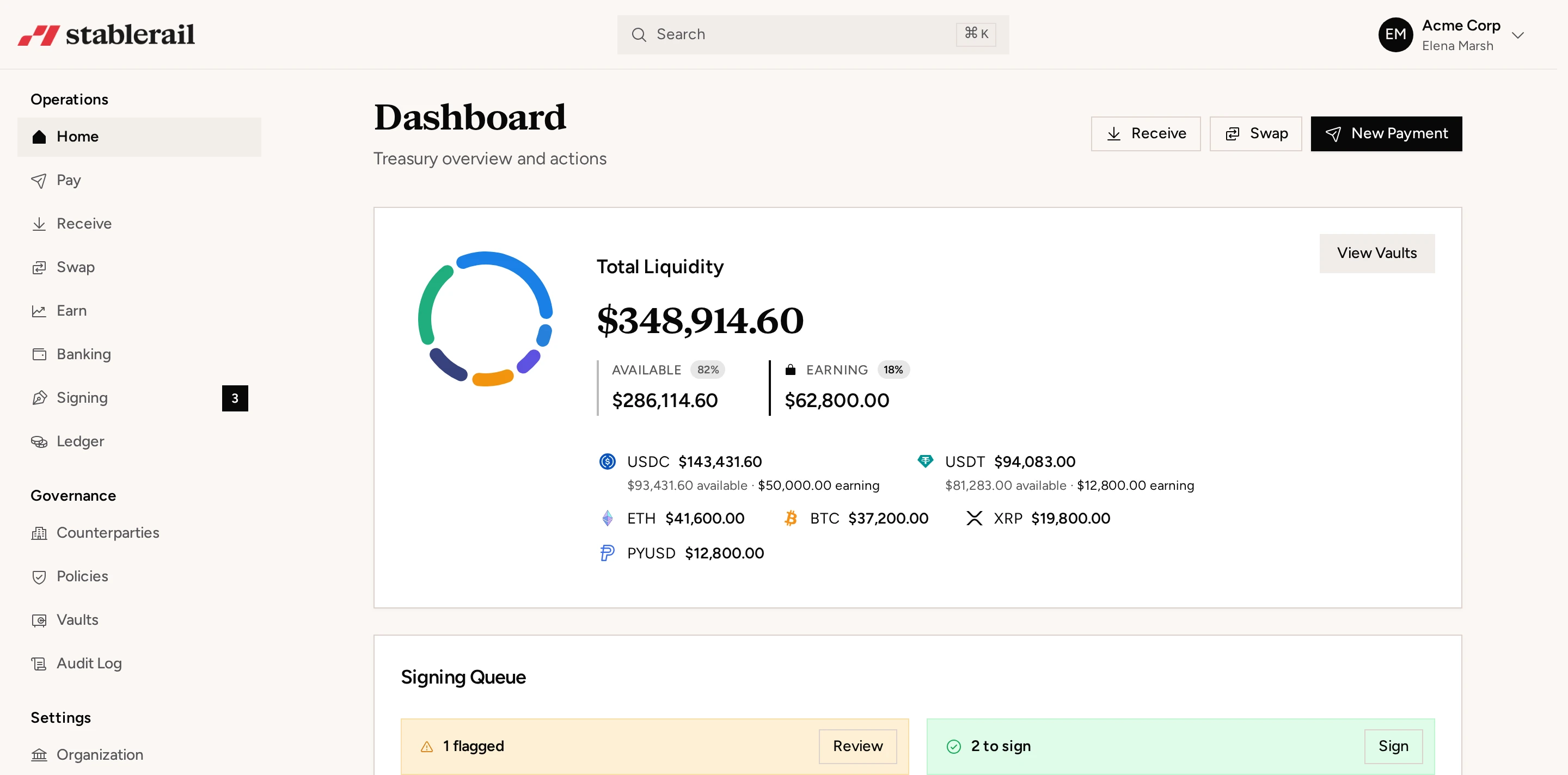
A business account such as Stablerail can bring fiat, USDC and USDT treasury operations together with approvals and signing quorum, sanctions and address screening before send, global payouts, fiat off-ramp, corporate cards and exportable audit evidence. Those operating controls help govern movement, but they do not replace diligence on the risk or redemption terms of a yield position.
Apply risk and concentration limits after calculating liquidity
Liquidity determines which funds may be considered for yield. Risk limits determine how much should actually be allocated. Finance should evaluate the legal claim, asset custody, source of return, counterparty chain, stablecoin exposure and loss scenarios for each position.
| Limit | Why it matters | Example policy expression |
|---|---|---|
| Provider or counterparty | Prevents one failure or suspension from blocking too much runway | Maximum amount or percentage with any named provider |
| Asset or stablecoin | Controls dependence on one issuer, reserve structure or market | Maximum exposure by USDC, USDT or other asset |
| Network | Limits operational dependence on one chain or bridge route | Minimum operating balances on approved payment networks |
| Maturity date | Avoids a large portion of runway becoming available at once | Maximum principal maturing on a single date or week |
| Liquidity class | Stops long-dated positions from consuming near-term reserves | Permitted classes for each runway bucket |
Set the policy before funds move
A treasury policy should define more than a maximum yield percentage. It should identify minimum operating cash, the required liquidity buffer, approved assets and providers, exposure limits, permitted maturities, authorized approvers and the evidence retained for each decision.
Finance can use this implementation checklist:
- Forecast gross outflows by payment date, currency, bank account, stablecoin and network.
- Reserve immediate operating cash and known exceptional payments.
- Stress customer receipts, expenses, redemption timing and off-ramp settlement.
- Classify each opportunity using contractual liquidity terms, not marketing labels.
- Apply provider, asset, network and maturity concentration limits.
- Require appropriate approvals for allocations, redemptions and exceptions.
- Record balances, terms, approvals and transaction evidence for audit and close.
- Recalculate after financings, acquisitions, material forecast changes or market events.
Monthly review may be a workable baseline, but review frequency should match the company’s cash volatility and payment cadence. A company with weekly payroll and variable collections may need more frequent monitoring.
The CFO decision rule
Allocate funds to yield only when the expected redemption time, conversion time and a documented stress margin all fall before the earliest date the cash could be needed.
Protect operating cash first, size the liquidity buffer second and stagger any extended-runway positions. The appropriate percentage is the output of those decisions—not a target selected in advance. Return matters only after principal risk, access, currency, network and payment timing are acceptable.
Frequently asked questions
What percentage of corporate treasury should be invested for yield?
There is no universal percentage. The eligible amount is what remains after reserving immediate operating cash, a stress-tested liquidity buffer, restricted funds and capital committed to strategic uses; risk and concentration limits may reduce it further.
How many months of operating cash should a company keep liquid?
Many finance teams begin by testing one to two months of gross outflows as immediate cash, then add a separate buffer for later runway and disruption. The final amount should reflect forecast accuracy, payroll frequency, collection volatility, banking cut-offs and stablecoin conversion time.
Can T+1 yield positions count as operating liquidity?
They may count toward a liquidity buffer if the contractual terms and stressed redemption route meet payment deadlines. They generally should not replace cash needed for obligations that cannot tolerate a business-day delay, especially around weekends or holidays.
Should stablecoins be counted as cash runway?
Stablecoins can support runway when they are available on the correct network and can fund the relevant obligation directly or be converted into fiat in time. Finance should account for off-ramp processing, bank settlement, network fees, provider limits and asset-specific risks.
How should a CFO ladder treasury yield maturities?
Match maturities to forecast spending dates and avoid concentrating too much principal on one date. A practical policy can cap each maturity by a defined amount, such as a portion of monthly expenses, while leaving sufficient time for redemption and conversion before payment deadlines.
Finance writers covering stablecoin treasury, payments, compliance, and risk controls.
More about the Stablerail team- Stablecoin treasury managementApprovals, limits, yield and reporting on one balance.
- Stablecoin payoutsBatch contractor and vendor payments with screening.
- USDT vs USDCWhich stablecoin your company should settle in.
- Stablecoin finance glossaryMPC, off-ramp, travel rule and the rest, in plain English.
- Product updatesEverything we ship, month by month.