
How to Earn Yield on Idle Treasury Without Locking Up Working Capital
A practical framework for earning yield on idle USDC, USDT and fiat reserves while preserving payroll, vendor and customer-payment liquidity.
To earn yield without locking up working capital, separate immediately available operating funds from reserves that are genuinely idle for the product’s full redemption period. Size the operating balance using stressed cash forecasts, not average spending. Then compare products by net yield, worst-case redemption time, return asset and principal risk. Start with a small allocation, test the complete withdrawal path and increase it only after reconciliation.
%22%20x1%3D%220%22%20y1%3D%220%22%20x2%3D%221%22%20y2%3D%221%22%3E%0A%20%20%20%20%20%20%20%20%3Cstop%20offset%3D%220%25%22%20stop-color%3D%22%23450B10%22%20%2F%3E%0A%20%20%20%20%20%20%20%20%3Cstop%20offset%3D%2250%25%22%20stop-color%3D%22%23681A1F%22%20%2F%3E%0A%20%20%20%20%20%20%20%20%3Cstop%20offset%3D%22100%25%22%20stop-color%3D%22%238A2A2D%22%20%2F%3E%0A%20%20%20%20%20%20%3C%2FlinearGradient%3E%0A%20%20%20%20%20%20%3CradialGradient%20id%3D%22glow%22%20cx%3D%221337%22%20cy%3D%22527%22%20r%3D%22520%22%20gradientUnits%3D%22userSpaceOnUse%22%3E%0A%20%20%20%20%20%20%20%20%3Cstop%20offset%3D%220%25%22%20stop-color%3D%22%23FF7A59%22%20stop-opacity%3D%220.45%22%20%2F%3E%0A%20%20%20%20%20%20%20%20%3Cstop%20offset%3D%2255%25%22%20stop-color%3D%22%23FF7A59%22%20stop-opacity%3D%220.08%22%20%2F%3E%0A%20%20%20%20%20%20%20%20%3Cstop%20offset%3D%22100%25%22%20stop-color%3D%22%23FF7A59%22%20stop-opacity%3D%220%22%20%2F%3E%0A%20%20%20%20%20%20%3C%2FradialGradient%3E%0A%20%20%20%20%20%20%3ClinearGradient%20id%3D%22glass%22%20x1%3D%220%22%20y1%3D%220%22%20x2%3D%221%22%20y2%3D%221%22%3E%0A%20%20%20%20%20%20%20%20%3Cstop%20offset%3D%220%25%22%20stop-color%3D%22%23F8D6D2%22%20stop-opacity%3D%220.26%22%20%2F%3E%0A%20%20%20%20%20%20%20%20%3Cstop%20offset%3D%22100%25%22%20stop-color%3D%22%23FFFFFF%22%20stop-opacity%3D%220.08%22%20%2F%3E%0A%20%20%20%20%20%20%3C%2FlinearGradient%3E%0A%20%20%20%20%20%20%3ClinearGradient%20id%3D%22accent%22%20x1%3D%220%22%20y1%3D%220%22%20x2%3D%221%22%20y2%3D%221%22%3E%0A%20%20%20%20%20%20%20%20%3Cstop%20offset%3D%220%25%22%20stop-color%3D%22%23FF7A59%22%20%2F%3E%0A%20%20%20%20%20%20%20%20%3Cstop%20offset%3D%22100%25%22%20stop-color%3D%22%23C73128%22%20%2F%3E%0A%20%20%20%20%20%20%3C%2FlinearGradient%3E%0A%20%20%20%20%20%20%3Cfilter%20id%3D%22soft%22%3E%3CfeGaussianBlur%20stdDeviation%3D%2210%22%20%2F%3E%3C%2Ffilter%3E%0A%20%20%20%20%3C%2Fdefs%3E%0A%20%20%20%20%3Crect%20width%3D%221600%22%20height%3D%22900%22%20fill%3D%22url(%23bg)%22%20%2F%3E%0A%20%20%20%20%3Crect%20width%3D%221600%22%20height%3D%22900%22%20fill%3D%22url(%23glow)%22%20%2F%3E%0A%20%20%20%20%3Crect%20x%3D%22340%22%20y%3D%22220%22%20width%3D%22118%22%20height%3D%22108%22%20rx%3D%2210%22%20fill%3D%22url(%23accent)%22%20fill-opacity%3D%220.9%22%20stroke%3D%22%23F4CDC5%22%20stroke-opacity%3D%220.4%22%2F%3E%3Crect%20x%3D%22480%22%20y%3D%22220%22%20width%3D%22118%22%20height%3D%22108%22%20rx%3D%2210%22%20fill%3D%22url(%23glass)%22%20fill-opacity%3D%221%22%20stroke%3D%22%23F4CDC5%22%20stroke-opacity%3D%220.4%22%2F%3E%3Crect%20x%3D%22620%22%20y%3D%22220%22%20width%3D%22118%22%20height%3D%22108%22%20rx%3D%2210%22%20fill%3D%22url(%23accent)%22%20fill-opacity%3D%220.9%22%20stroke%3D%22%23F4CDC5%22%20stroke-opacity%3D%220.4%22%2F%3E%3Crect%20x%3D%22760%22%20y%3D%22220%22%20width%3D%22118%22%20height%3D%22108%22%20rx%3D%2210%22%20fill%3D%22url(%23glass)%22%20fill-opacity%3D%221%22%20stroke%3D%22%23F4CDC5%22%20stroke-opacity%3D%220.4%22%2F%3E%3Crect%20x%3D%22900%22%20y%3D%22220%22%20width%3D%22118%22%20height%3D%22108%22%20rx%3D%2210%22%20fill%3D%22url(%23accent)%22%20fill-opacity%3D%220.9%22%20stroke%3D%22%23F4CDC5%22%20stroke-opacity%3D%220.4%22%2F%3E%3Crect%20x%3D%221040%22%20y%3D%22220%22%20width%3D%22118%22%20height%3D%22108%22%20rx%3D%2210%22%20fill%3D%22url(%23accent)%22%20fill-opacity%3D%220.9%22%20stroke%3D%22%23F4CDC5%22%20stroke-opacity%3D%220.4%22%2F%3E%3Crect%20x%3D%221180%22%20y%3D%22220%22%20width%3D%22118%22%20height%3D%22108%22%20rx%3D%2210%22%20fill%3D%22url(%23glass)%22%20fill-opacity%3D%221%22%20stroke%3D%22%23F4CDC5%22%20stroke-opacity%3D%220.4%22%2F%3E%3Crect%20x%3D%22340%22%20y%3D%22350%22%20width%3D%22118%22%20height%3D%22108%22%20rx%3D%2210%22%20fill%3D%22url(%23glass)%22%20fill-opacity%3D%221%22%20stroke%3D%22%23F4CDC5%22%20stroke-opacity%3D%220.4%22%2F%3E%3Crect%20x%3D%22480%22%20y%3D%22350%22%20width%3D%22118%22%20height%3D%22108%22%20rx%3D%2210%22%20fill%3D%22url(%23glass)%22%20fill-opacity%3D%221%22%20stroke%3D%22%23F4CDC5%22%20stroke-opacity%3D%220.4%22%2F%3E%3Crect%20x%3D%22620%22%20y%3D%22350%22%20width%3D%22118%22%20height%3D%22108%22%20rx%3D%2210%22%20fill%3D%22url(%23glass)%22%20fill-opacity%3D%221%22%20stroke%3D%22%23F4CDC5%22%20stroke-opacity%3D%220.4%22%2F%3E%3Crect%20x%3D%22760%22%20y%3D%22350%22%20width%3D%22118%22%20height%3D%22108%22%20rx%3D%2210%22%20fill%3D%22url(%23glass)%22%20fill-opacity%3D%221%22%20stroke%3D%22%23F4CDC5%22%20stroke-opacity%3D%220.4%22%2F%3E%3Crect%20x%3D%22900%22%20y%3D%22350%22%20width%3D%22118%22%20height%3D%22108%22%20rx%3D%2210%22%20fill%3D%22url(%23glass)%22%20fill-opacity%3D%221%22%20stroke%3D%22%23F4CDC5%22%20stroke-opacity%3D%220.4%22%2F%3E%3Crect%20x%3D%221040%22%20y%3D%22350%22%20width%3D%22118%22%20height%3D%22108%22%20rx%3D%2210%22%20fill%3D%22url(%23accent)%22%20fill-opacity%3D%220.9%22%20stroke%3D%22%23F4CDC5%22%20stroke-opacity%3D%220.4%22%2F%3E%3Crect%20x%3D%221180%22%20y%3D%22350%22%20width%3D%22118%22%20height%3D%22108%22%20rx%3D%2210%22%20fill%3D%22url(%23accent)%22%20fill-opacity%3D%220.9%22%20stroke%3D%22%23F4CDC5%22%20stroke-opacity%3D%220.4%22%2F%3E%3Crect%20x%3D%22340%22%20y%3D%22480%22%20width%3D%22118%22%20height%3D%22108%22%20rx%3D%2210%22%20fill%3D%22url(%23accent)%22%20fill-opacity%3D%220.9%22%20stroke%3D%22%23F4CDC5%22%20stroke-opacity%3D%220.4%22%2F%3E%3Crect%20x%3D%22480%22%20y%3D%22480%22%20width%3D%22118%22%20height%3D%22108%22%20rx%3D%2210%22%20fill%3D%22url(%23glass)%22%20fill-opacity%3D%221%22%20stroke%3D%22%23F4CDC5%22%20stroke-opacity%3D%220.4%22%2F%3E%3Crect%20x%3D%22620%22%20y%3D%22480%22%20width%3D%22118%22%20height%3D%22108%22%20rx%3D%2210%22%20fill%3D%22url(%23glass)%22%20fill-opacity%3D%221%22%20stroke%3D%22%23F4CDC5%22%20stroke-opacity%3D%220.4%22%2F%3E%3Crect%20x%3D%22760%22%20y%3D%22480%22%20width%3D%22118%22%20height%3D%22108%22%20rx%3D%2210%22%20fill%3D%22url(%23glass)%22%20fill-opacity%3D%221%22%20stroke%3D%22%23F4CDC5%22%20stroke-opacity%3D%220.4%22%2F%3E%3Crect%20x%3D%22900%22%20y%3D%22480%22%20width%3D%22118%22%20height%3D%22108%22%20rx%3D%2210%22%20fill%3D%22url(%23accent)%22%20fill-opacity%3D%220.9%22%20stroke%3D%22%23F4CDC5%22%20stroke-opacity%3D%220.4%22%2F%3E%3Crect%20x%3D%221040%22%20y%3D%22480%22%20width%3D%22118%22%20height%3D%22108%22%20rx%3D%2210%22%20fill%3D%22url(%23accent)%22%20fill-opacity%3D%220.9%22%20stroke%3D%22%23F4CDC5%22%20stroke-opacity%3D%220.4%22%2F%3E%3Crect%20x%3D%221180%22%20y%3D%22480%22%20width%3D%22118%22%20height%3D%22108%22%20rx%3D%2210%22%20fill%3D%22url(%23glass)%22%20fill-opacity%3D%221%22%20stroke%3D%22%23F4CDC5%22%20stroke-opacity%3D%220.4%22%2F%3E%3Crect%20x%3D%22340%22%20y%3D%22610%22%20width%3D%22118%22%20height%3D%22108%22%20rx%3D%2210%22%20fill%3D%22url(%23accent)%22%20fill-opacity%3D%220.9%22%20stroke%3D%22%23F4CDC5%22%20stroke-opacity%3D%220.4%22%2F%3E%3Crect%20x%3D%22480%22%20y%3D%22610%22%20width%3D%22118%22%20height%3D%22108%22%20rx%3D%2210%22%20fill%3D%22url(%23glass)%22%20fill-opacity%3D%221%22%20stroke%3D%22%23F4CDC5%22%20stroke-opacity%3D%220.4%22%2F%3E%3Crect%20x%3D%22620%22%20y%3D%22610%22%20width%3D%22118%22%20height%3D%22108%22%20rx%3D%2210%22%20fill%3D%22url(%23glass)%22%20fill-opacity%3D%221%22%20stroke%3D%22%23F4CDC5%22%20stroke-opacity%3D%220.4%22%2F%3E%3Crect%20x%3D%22760%22%20y%3D%22610%22%20width%3D%22118%22%20height%3D%22108%22%20rx%3D%2210%22%20fill%3D%22url(%23glass)%22%20fill-opacity%3D%221%22%20stroke%3D%22%23F4CDC5%22%20stroke-opacity%3D%220.4%22%2F%3E%3Crect%20x%3D%22900%22%20y%3D%22610%22%20width%3D%22118%22%20height%3D%22108%22%20rx%3D%2210%22%20fill%3D%22url(%23accent)%22%20fill-opacity%3D%220.9%22%20stroke%3D%22%23F4CDC5%22%20stroke-opacity%3D%220.4%22%2F%3E%3Crect%20x%3D%221040%22%20y%3D%22610%22%20width%3D%22118%22%20height%3D%22108%22%20rx%3D%2210%22%20fill%3D%22url(%23accent)%22%20fill-opacity%3D%220.9%22%20stroke%3D%22%23F4CDC5%22%20stroke-opacity%3D%220.4%22%2F%3E%3Crect%20x%3D%221180%22%20y%3D%22610%22%20width%3D%22118%22%20height%3D%22108%22%20rx%3D%2210%22%20fill%3D%22url(%23accent)%22%20fill-opacity%3D%220.9%22%20stroke%3D%22%23F4CDC5%22%20stroke-opacity%3D%220.4%22%2F%3E%0A%20%20%20%20%3Crect%20x%3D%2226%22%20y%3D%2226%22%20width%3D%221548%22%20height%3D%22848%22%20rx%3D%2218%22%20fill%3D%22none%22%20stroke%3D%22%23F2D0C8%22%20stroke-opacity%3D%220.12%22%2F%3E%0A%20%20%3C%2Fsvg%3E)
Start with liquidity, not the highest rate
Earning yield on idle treasury is primarily an asset-liability matching decision. Before comparing rates, determine how much USDC, USDT and fiat must remain available for payroll, vendors, card settlement, taxes, customer withdrawals and unexpected obligations.
Only funds that are not needed during the entire redemption and settlement period should be considered for yield. That period includes more than the time required to submit a withdrawal request. It can also include product processing, blockchain confirmation, stablecoin conversion, banking cut-offs and fiat settlement.
Yield is variable unless explicitly fixed, and principal may be exposed to credit, market, liquidity, protocol, stablecoin and counterparty risk. A stablecoin yield product is not the same as an insured bank deposit. Treat the quoted return as compensation for identifiable risks rather than as free income on cash.
Divide treasury into liquidity buckets
A practical treasury structure separates balances according to when the business may need them:
- Operating float: Funds available for obligations due soon, forecast errors, delayed collections and settlement disruption.
- Idle reserve: Funds not expected to be required during the product’s stressed redemption period and potentially eligible for yield.
- Strategic reserve: Additional liquid funds held for acquisitions, market shocks, unusually large customer redemptions or other low-frequency events.
Do not define idle funds as whatever remains in an account at month-end. Build a rolling cash forecast covering at least the next 30 to 90 days, with greater detail for the period in which payment obligations are concentrated. Update it for actual collections, customer withdrawal patterns and changes in redemption conditions.
A practical operating-float formula
Operating float = near-term obligations − haircut-adjusted inflows + stress buffer + settlement buffer
Assume a business holds $2 million equivalent in treasury assets. It has $620,000 of obligations due within 30 days and expects $450,000 of customer receipts. Applying a 30% haircut means only $315,000 of those receipts is treated as reliable. The company also adds a $200,000 stress buffer and an $80,000 settlement buffer.
The resulting minimum operating float is $585,000: $620,000 minus $315,000, plus $200,000 and $80,000. That leaves $1.415 million outside the minimum operating requirement, but it does not make the full amount investable. The team might retain $415,000 as a strategic reserve and initially allocate $1 million.
These figures illustrate the method, not a recommended allocation. The correct buffers depend on revenue predictability, payment concentration, customer redemption behavior, access to credit and how quickly funds can actually return to a spendable account.
Match the allocation to the complete redemption journey
“On demand” or “instant access” should describe the journey back to usable funds, not merely the ability to click a redeem button. Finance teams should map every step from the yield position to the account from which the obligation will be paid.
| Step or route | Planning assumption | Potential constraint |
|---|---|---|
| Yield product redemption | Use the stated processing window and model the slowest permitted outcome | Notice periods, business-day processing, withdrawal queues or gates |
| Stablecoin transfer | Allow for network confirmation and internal review | Congestion, outages, unsupported networks or address-screening holds |
| Stablecoin-to-fiat conversion | Include order execution, conversion and account crediting | Liquidity, spreads, limits, compliance review or counterparty availability |
| ACH payment | Commonly one to three business days | Weekends, holidays, returns and bank processing |
| Fedwire payment | Generally same business day within operating hours | Cut-off times, banking days and manual review |
| SWIFT payment | Often one to five business days | Correspondent banks, currency conversion and compliance checks |
If payroll must arrive in employees’ bank accounts on Friday, beginning redemption on Friday morning may be too late. The operating float should cover the full product-to-payment timeline plus a delay scenario. It should also account for weekends and holidays in every relevant jurisdiction.
Demand clear liquidity terms before allocating
A headline annual percentage yield does not establish whether working capital will remain accessible. Obtain the terms in writing and record at least the following:
- Redemption period: Is redemption on demand, same day, next business day or subject to notice?
- Processing windows: Are requests processed continuously, on business days or only before a cut-off?
- Lockups and penalties: Is there a minimum holding period or a reduction in proceeds for early redemption?
- Gates and queues: Can withdrawals be delayed, capped or processed in order during stressed conditions?
- Return asset: Does principal return in USDC, USDT, fiat or another asset?
- Fees: Are there management, subscription, network, redemption or conversion charges?
- Yield calculation: Is the rate fixed or variable, when does it accrue, and how often is it credited or compounded?
- Source of return: Which assets, borrowers, protocols or counterparties generate the yield?
Use the maximum stated or contractually possible redemption time in liquidity planning. The fastest historical withdrawal is not a reliable treasury assumption.
Compare net return and access on the same basis
For illustration, a 4% annual rate on a $1 million allocation produces approximately $40,000 over a full year before fees, rate changes, losses and tax. A simple, non-compounded 30-day estimate is about $3,288: $1 million multiplied by 4%, then by 30 divided by 365.
This is not a promised return. A variable rate can change during the holding period, while network fees, product charges and conversion spreads can reduce the amount ultimately received. Comparing products on headline APY alone can therefore produce the wrong decision.
| Decision field | What finance should record | Why it matters |
|---|---|---|
| Expected net yield | Rate after disclosed product fees and expected transaction costs | Shows the estimated economic return rather than the advertised rate |
| Redemption time | Normal timeline and slowest stated or contractual timeline | Determines whether the balance can support working-capital needs |
| Rate type | Fixed, variable or promotional, including reset mechanics | Identifies how quickly expected income can change |
| Principal exposure | Underlying credit, market, protocol, custody and counterparty risks | Explains what risk produces the return |
| Return asset | USDC, USDT, fiat or another instrument | Reveals whether another conversion is required before payment |
| Operational fit | Supported network, minimum allocation, approvals and reporting | Reduces transfer errors and reconciliation work |
Understand what can go wrong
Stablecoin yield products are not interchangeable. Their risk depends on how the return is generated and who controls the assets during the investment period.
- Credit risk: A borrower, issuer or counterparty may fail to repay.
- Liquidity risk: Redemptions may be delayed or limited when many holders seek to exit.
- Stablecoin risk: USDC or USDT may trade away from its target value, and access to issuance or redemption channels may be disrupted.
- Protocol risk: Smart-contract defects, exploits, oracle failures or governance actions may cause losses.
- Network risk: Congestion, outages or incorrect network selection can delay or jeopardize transfers.
- Custody and operational risk: Compromised credentials, incorrect addresses or weak approval controls can result in loss.
- Legal, regulatory and tax risk: Treatment can vary by entity, jurisdiction, product structure and source of return.
A higher yield may reflect greater borrower risk, longer duration, weaker liquidity or added technical complexity. Finance should identify the source of yield and the loss path before approving an allocation.
Set a repeatable allocation and control rule
A policy should define when funds can move into a yield product and when allocation must stop. For example: allocate only balances above the 45-day stressed operating requirement, review coverage weekly and suspend new allocations when forecast liquidity falls below the threshold.
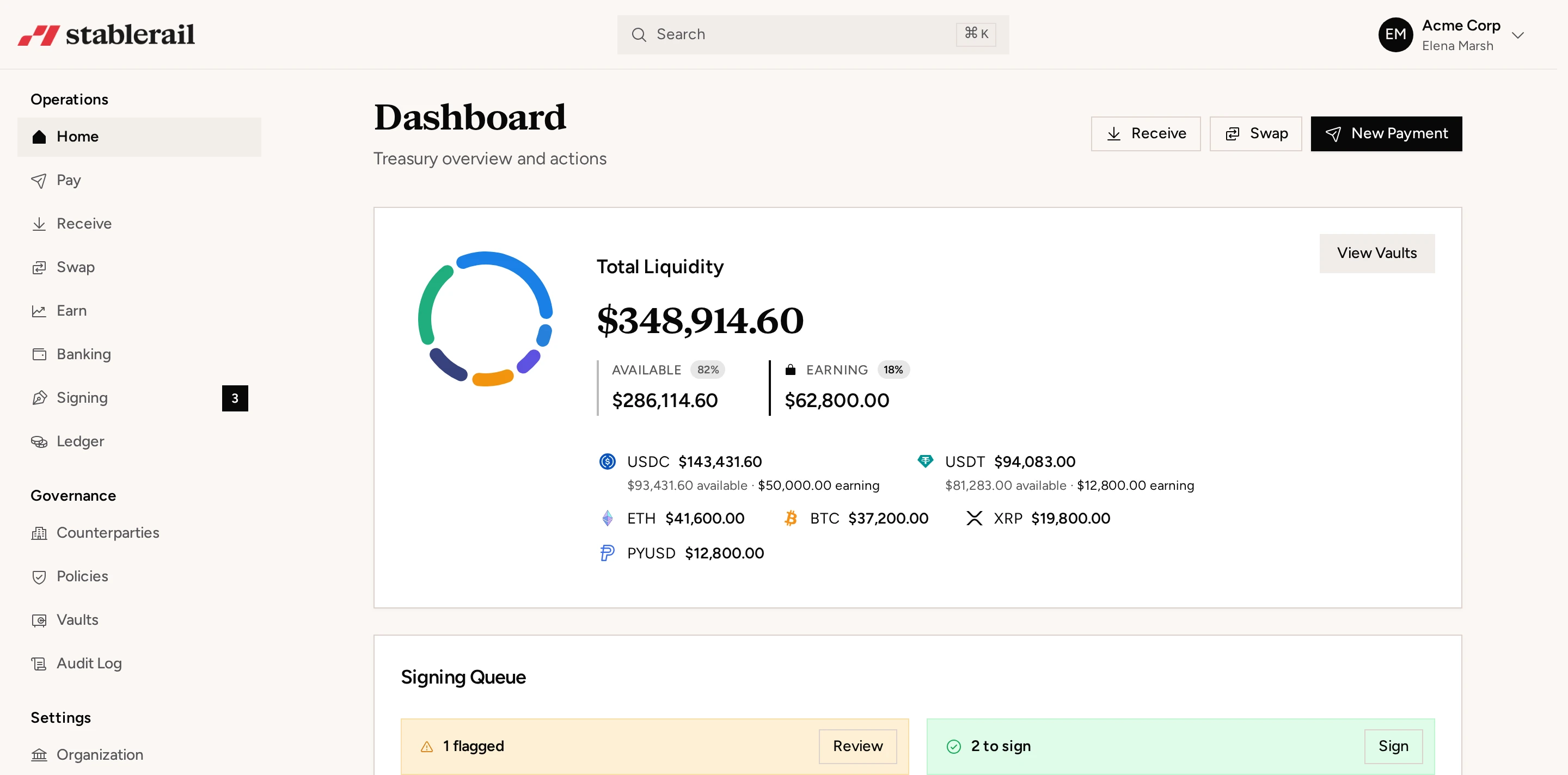
Use approval limits and signing quorum so one person cannot move a material reserve alone. Record the approved amount, destination address, network, product terms, expected redemption time and decision date. Stablerail provides one business account for USDC and USDT treasury with approvals and signing quorum, sanctions and address screening before send, global payouts, fiat off-ramp and exportable audit evidence.
Pre-allocation checklist
- Update the rolling cash forecast and apply haircuts to uncertain inflows.
- Calculate operating and strategic liquidity buffers.
- Document the source of yield, principal exposure and legal counterparty.
- Model the slowest redemption-to-payment timeline.
- Estimate net yield after fees, spreads and transfer costs.
- Approve the amount, address, network and signers under treasury controls.
- Confirm how positions, income, fees and redemptions will be reconciled.
Test the route before increasing the allocation
Begin with an amount the business can operate without for the entire stressed redemption period. Complete a small subscription, verify yield accrual, request redemption and measure how long it takes for the proceeds to become usable USDC, USDT or fiat.
Reconcile the principal, income, fees, transaction identifiers and final amount received. Retain product statements, approvals and wallet or bank evidence for the audit trail. Accounting classification and income recognition can depend on the contractual terms, so the controller should review the structure rather than assuming every product is cash or a cash equivalent.
Increase the allocation only after the test matches the documented terms and the liquidity forecast remains adequate. The objective is not to maximize yield continuously. It is to earn a measured return on genuinely idle reserves while maintaining enough immediately available working capital to meet every obligation on time.
Frequently asked questions
How much idle treasury should a company allocate to stablecoin yield?
Allocate only the amount above stressed operating and strategic liquidity requirements. The calculation should account for near-term obligations, haircut-adjusted inflows, unexpected payments and the complete time required to redeem, convert and settle funds.
Can stablecoin yield be earned without a lockup?
Some products allow on-demand redemption, but that does not guarantee immediate access to spendable funds. Processing windows, withdrawal queues, blockchain confirmation, conversion and banking settlement can still delay availability.
Is stablecoin yield equivalent to interest on a bank deposit?
No. Stablecoin yield may expose principal to credit, liquidity, stablecoin, protocol, custody and counterparty risks, and it is not automatically covered by deposit insurance. Finance teams should understand the underlying source of return and contractual claim.
How should a treasury team compare stablecoin earn products?
Compare expected net yield, maximum redemption time, rate type, return asset, fees and principal exposure using the same assumptions. Also assess supported networks, approval controls, reporting and the steps required to convert proceeds into payment-ready fiat.
How often should an idle-treasury allocation be reviewed?
Review it whenever the cash forecast, payment calendar, customer withdrawal behavior or product terms change, with a regular weekly review being a practical operating rule for many teams. New allocations should stop automatically when forecast liquidity falls below the approved threshold.
Finance writers covering stablecoin treasury, payments, compliance, and risk controls.
More about the Stablerail team- Stablecoin treasury managementApprovals, limits, yield and reporting on one balance.
- Stablecoin payoutsBatch contractor and vendor payments with screening.
- USDT vs USDCWhich stablecoin your company should settle in.
- Stablecoin finance glossaryMPC, off-ramp, travel rule and the rest, in plain English.
- Product updatesEverything we ship, month by month.