
How to Run a Batch Payout to Contractors in 40 Countries
A practical finance workflow for paying contractors across 40 countries by stablecoin and bank transfer, with controls for validation, approvals, partial failures, retries and reconciliation.
To pay contractors across 40 countries, separate batch preparation from payment execution. Confirm each recipient’s eligible currency, network or bank rail; validate and screen every row; reconcile funding and fees; require readable approvals; then track each transfer independently. If some payments fail, retry only those rows after confirming their final status. Finish by reconciling completed payments and exporting approval, screening, transaction and exception evidence.
%22%20x1%3D%220%22%20y1%3D%220%22%20x2%3D%221%22%20y2%3D%221%22%3E%0A%20%20%20%20%20%20%20%20%3Cstop%20offset%3D%220%25%22%20stop-color%3D%22%233E090D%22%20%2F%3E%0A%20%20%20%20%20%20%20%20%3Cstop%20offset%3D%2250%25%22%20stop-color%3D%22%235C1218%22%20%2F%3E%0A%20%20%20%20%20%20%20%20%3Cstop%20offset%3D%22100%25%22%20stop-color%3D%22%237B1F22%22%20%2F%3E%0A%20%20%20%20%20%20%3C%2FlinearGradient%3E%0A%20%20%20%20%20%20%3CradialGradient%20id%3D%22glow%22%20cx%3D%22770%22%20cy%3D%22316%22%20r%3D%22520%22%20gradientUnits%3D%22userSpaceOnUse%22%3E%0A%20%20%20%20%20%20%20%20%3Cstop%20offset%3D%220%25%22%20stop-color%3D%22%23FF8E72%22%20stop-opacity%3D%220.45%22%20%2F%3E%0A%20%20%20%20%20%20%20%20%3Cstop%20offset%3D%2255%25%22%20stop-color%3D%22%23FF8E72%22%20stop-opacity%3D%220.08%22%20%2F%3E%0A%20%20%20%20%20%20%20%20%3Cstop%20offset%3D%22100%25%22%20stop-color%3D%22%23FF8E72%22%20stop-opacity%3D%220%22%20%2F%3E%0A%20%20%20%20%20%20%3C%2FradialGradient%3E%0A%20%20%20%20%20%20%3ClinearGradient%20id%3D%22glass%22%20x1%3D%220%22%20y1%3D%220%22%20x2%3D%221%22%20y2%3D%221%22%3E%0A%20%20%20%20%20%20%20%20%3Cstop%20offset%3D%220%25%22%20stop-color%3D%22%23F8D6D2%22%20stop-opacity%3D%220.26%22%20%2F%3E%0A%20%20%20%20%20%20%20%20%3Cstop%20offset%3D%22100%25%22%20stop-color%3D%22%23FFFFFF%22%20stop-opacity%3D%220.08%22%20%2F%3E%0A%20%20%20%20%20%20%3C%2FlinearGradient%3E%0A%20%20%20%20%20%20%3ClinearGradient%20id%3D%22accent%22%20x1%3D%220%22%20y1%3D%220%22%20x2%3D%221%22%20y2%3D%221%22%3E%0A%20%20%20%20%20%20%20%20%3Cstop%20offset%3D%220%25%22%20stop-color%3D%22%23FF8E72%22%20%2F%3E%0A%20%20%20%20%20%20%20%20%3Cstop%20offset%3D%22100%25%22%20stop-color%3D%22%23D94030%22%20%2F%3E%0A%20%20%20%20%20%20%3C%2FlinearGradient%3E%0A%20%20%20%20%20%20%3Cfilter%20id%3D%22soft%22%3E%3CfeGaussianBlur%20stdDeviation%3D%2210%22%20%2F%3E%3C%2Ffilter%3E%0A%20%20%20%20%3C%2Fdefs%3E%0A%20%20%20%20%3Crect%20width%3D%221600%22%20height%3D%22900%22%20fill%3D%22url(%23bg)%22%20%2F%3E%0A%20%20%20%20%3Crect%20width%3D%221600%22%20height%3D%22900%22%20fill%3D%22url(%23glow)%22%20%2F%3E%0A%20%20%20%20%3Cpolygon%20points%3D%22800%2C370%20869.282032302755%2C410%20869.282032302755%2C490%20800%2C530%20730.717967697245%2C490%20730.717967697245%2C410%22%20fill%3D%22none%22%20stroke%3D%22%23F4CDC5%22%20stroke-opacity%3D%220.3%22%2F%3E%3Cpolygon%20points%3D%22800%2C300%20929.9038105676658%2C375%20929.9038105676658%2C525%20800%2C600%20670.0961894323342%2C525%20670.0961894323342%2C375%22%20fill%3D%22none%22%20stroke%3D%22%23F4CDC5%22%20stroke-opacity%3D%220.3%22%2F%3E%3Cpolygon%20points%3D%22800%2C230%20990.5255888325764%2C340%20990.5255888325765%2C560%20800%2C670%20609.4744111674236%2C560.0000000000001%20609.4744111674236%2C340%22%20fill%3D%22none%22%20stroke%3D%22%23F4CDC5%22%20stroke-opacity%3D%220.3%22%2F%3E%3Cpolygon%20points%3D%22800%2C160%201051.1473670974872%2C305%201051.1473670974872%2C595%20800%2C740%20548.8526329025128%2C595.0000000000001%20548.8526329025128%2C305%22%20fill%3D%22none%22%20stroke%3D%22%23F4CDC5%22%20stroke-opacity%3D%220.3%22%2F%3E%3Cpolygon%20points%3D%22800%2C240%20909.9852262806237%2C386.5%20969.74097914175%2C548%20800%2C709%20601.6801825333636%2C564.5000000000001%20685.6846467004541%2C384%22%20fill%3D%22url(%23accent)%22%20fill-opacity%3D%220.55%22%20stroke%3D%22url(%23accent)%22%20stroke-width%3D%224%22%2F%3E%0A%20%20%20%20%3Crect%20x%3D%2226%22%20y%3D%2226%22%20width%3D%221548%22%20height%3D%22848%22%20rx%3D%2218%22%20fill%3D%22none%22%20stroke%3D%22%23F2D0C8%22%20stroke-opacity%3D%220.12%22%2F%3E%0A%20%20%3C%2Fsvg%3E)
Paying contractors in 40 countries is not one payment operation. It is a controlled set of transfers across different currencies, blockchain networks, banking systems, cut-off times and recipient eligibility rules. The safest process validates the entire batch before release, but treats each row as an independent payment afterward. That structure lets finance resolve partial failures without delaying successful recipients or paying them twice.
1. Choose the payment route for each contractor
Start with the contractor’s approved invoice currency and the route they can reliably receive. Some contractors may accept USDC or USDT in a self-custodial wallet. Others may require USD, EUR, GBP or local currency in a bank account.
Do not select a route based only on headline speed or fees. Consider whether the recipient can access the asset, whether the corridor is eligible, what information is required and how the payment will be documented.
| Route | Best suited to | Required payment data | Main operational risk |
|---|---|---|---|
| Stablecoin transfer | Contractors able to receive USDC or USDT on an agreed network | Legal or invoicing name, wallet address, asset, network and amount | Wrong address, asset or network; completed transfers are generally irreversible |
| Domestic or regional bank rail | Recipients with eligible accounts in the destination market | Beneficiary name, account details, routing data, currency and reference | Bank cut-offs, recipient-name mismatch, local limits or returns |
| International wire or SWIFT | Corridors without a suitable domestic route | Beneficiary and bank details, account or IBAN, BIC or SWIFT code and reference | Intermediary deductions, compliance review and uncertain arrival time |
| Stablecoin with fiat off-ramp | Contractors who need bank-account delivery funded from stablecoin treasury | Beneficiary bank data, payout currency, source asset and corridor information | Conversion cost, corridor eligibility and inconsistent beneficiary data |
Delivery estimates are not guarantees. Public holidays, receiving-bank controls, intermediary banks, network congestion and compliance reviews can extend settlement. For stablecoins, confirm that the exact asset is supported on the selected network. USDC on one network is not interchangeable with USDC on another at the point of transfer.
2. Build a clean recipient file
A CSV or structured upload is usually the most practical way to create a large batch. Use one row per contractor and retain a permanent internal contractor ID across payment periods. The payment file should also contain a unique invoice number or disbursement reference.
For stablecoin payments, capture the contractor ID, legal or invoicing name, country, invoice reference, amount, asset, exact blockchain network and wallet address. For fiat payments, replace wallet fields with the beneficiary name, bank-account data, payout currency and country-specific routing fields.
Normalize the file before uploading. Remove thousands separators from amount fields, use the supported decimal precision, standardize country and currency codes, and eliminate blank rows. Keep tax forms, contracts and worker-classification records outside the payment file but confirm that required documents are current.
Calculate control totals by currency, stablecoin and network. If the approved invoice register totals USD 310,000 but the upload totals USD 315,000, stop and investigate before creating the batch. A batch should never be approved merely because the row count looks reasonable.
3. Validate every row before funds can move
Uploading a file should create a draft, not release money. Validation should identify exceptions while the batch can still be corrected safely.
- Format: Check whether wallet addresses, IBANs, routing numbers, sort codes and account numbers have the expected structure.
- Asset and network: Confirm that the named stablecoin exists on the selected network and that the recipient expects that combination.
- Duplicates: Flag repeated contractor IDs, invoice numbers, bank accounts and wallet addresses for review.
- Eligibility: Confirm that the destination country, recipient type, currency and intended rail can be served.
- Funding: Verify sufficient balances for principal, conversion costs, transfer charges and blockchain network fees.
Country coverage does not mean that every asset or rail is available to every recipient in that country. Eligibility can differ by currency, beneficiary type, bank, industry and source of funds. Confirm the specific corridor before promising a payment date.
4. Screen recipients and wallet addresses
Stablecoin addresses should be screened before approval against sanctions information and relevant blockchain risk indicators. A risk alert may reflect exposure to a sanctioned entity, theft, fraud or another flagged category. It should create a review case rather than an automatic conclusion about the contractor.
The designated compliance or operations owner should document whether the row is cleared, removed or held for more information. Where appropriate, the contractor may be asked to provide a different wallet. The remaining eligible rows should be able to continue without forcing finance to rebuild the entire batch.
Fiat beneficiaries are also subject to sanctions and bank checks. A name similarity may require a full legal name, date of birth, address or business-registration details. Keep the evidence supporting any exception decision with the payment record.
5. Reconcile funding, fees and approvals
Before signing, reconcile three amounts: principal by currency or stablecoin, expected conversion and corridor charges, and transaction or network fees. Stablecoin fees vary by network activity, but the cheapest network is not automatically the right one. The contractor must be able to receive and use the selected asset on that network.
Approvers should receive a readable summary showing recipient count, totals, assets, networks, payout currencies, fees and unresolved exceptions. Apply approval limits to both the aggregate batch and unusually large individual rows. An opaque file hash is not an adequate payment summary for a finance approver.
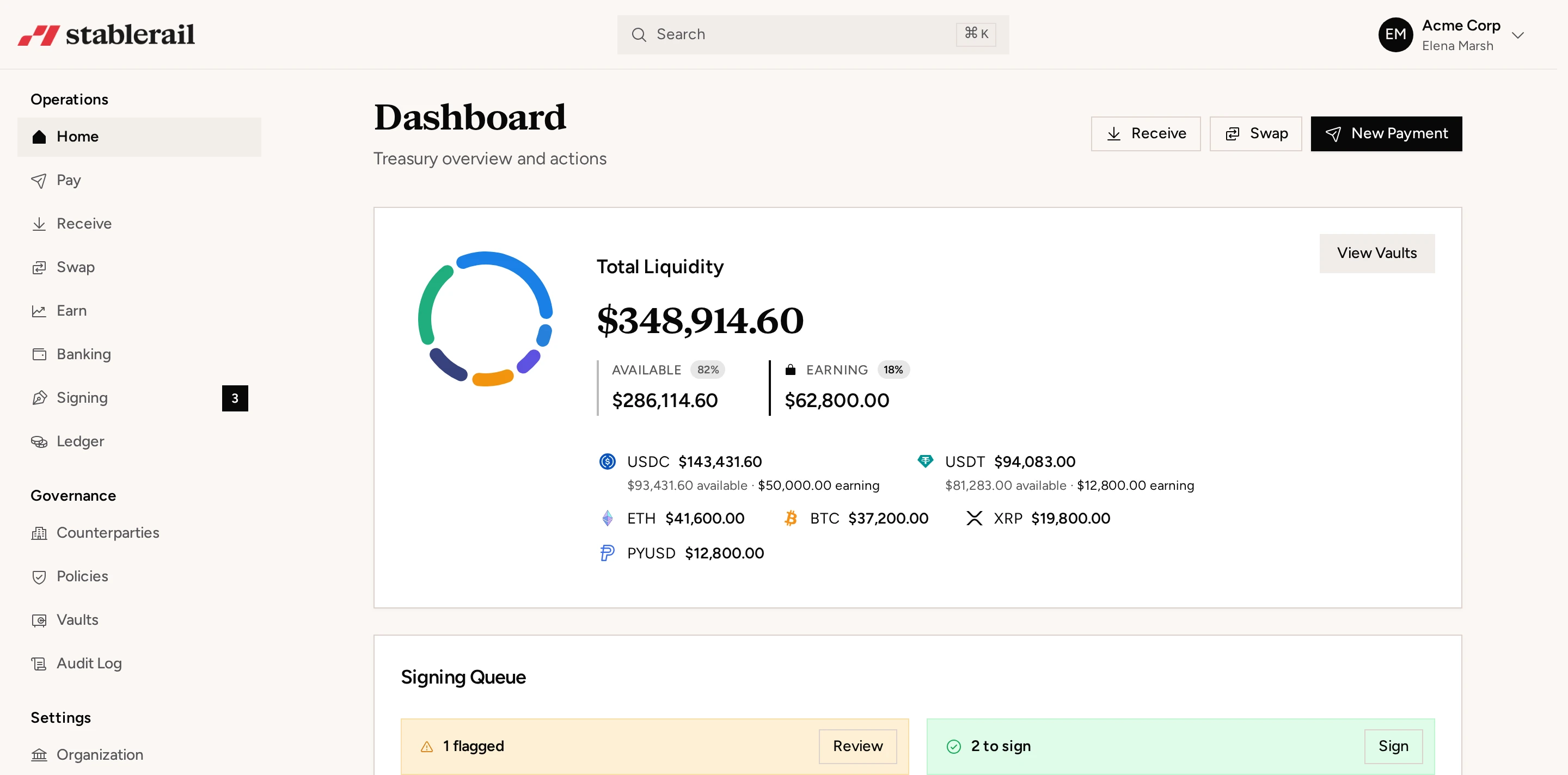
Where a business uses distributed signing, require the configured quorum before release rather than relying on one person or private key. Stablerail supports approvals and signing quorum alongside sanctions and address screening before send, helping place preparation, review and execution in one stablecoin treasury workflow.
6. Execute and monitor payments independently
After approval, create a separate payment record for every row. A 500-payment run might finish with 493 completed, four pending and three failed. That is a partially completed batch, not a reason to rerun all 500 payments.
Use statuses with clear operational meanings:
- Queued: Accepted for processing but not submitted to the payment rail.
- Pending: Submitted to a blockchain or banking partner but not yet confirmed.
- Completed: Confirmed according to the relevant rail’s completion rules.
- Failed: Rejected before or during submission.
- Returned: Initially accepted but later returned by a bank.
- Needs review: Paused because data, eligibility or screening must be resolved.
For an on-chain payment, retain the transaction hash, network, sending address, destination address, asset and amount. For a bank payment, retain the payment reference and any available tracking identifier. Remittance notices should identify the relevant invoice without exposing unnecessary treasury or contractor data.
7. Retry failures without duplicating successes
Never upload the original file again as a shortcut. Export or filter only the failed rows, investigate each cause, and create a retry batch linked to the original batch and payment IDs.
Common causes include invalid bank data, an unsupported corridor, insufficient balance for network fees, stale compliance information or rejection by a receiving bank. A successful on-chain payment is generally irreversible, making address and network checks pre-release controls rather than post-payment fixes.
Before retrying anything marked pending, determine whether it was actually submitted. Status reporting can lag behind execution. Check the transaction hash, bank reference or provider record to establish the final state; otherwise, a delayed update can become a duplicate contractor payment.
8. Reconcile and export the evidence pack
After the run, reconcile completed payments to the accounts payable register and treasury ledger. Hold pending, returned and disputed items in appropriate clearing accounts until their final status is known. Record fees and foreign-exchange differences separately from invoice principal so accounting can explain the cash movement.
The evidence pack should include:
- The original upload and final normalized recipient file.
- Batch ID, timestamps, approval history and signer records.
- Screening results and documented exception decisions.
- Totals by currency, stablecoin, network and payment status.
- Conversion records, fees, transaction hashes and bank references.
- Failure reasons, return records and linked retry batch IDs.
- Invoice references and remittance confirmations.
Contractor payouts are not global payroll
Contractors are generally paid against invoices and remain responsible for their own tax arrangements, subject to local law. Employees may require payroll withholding, statutory benefits, payslips and employer filings. A batch payout process moves money; it does not determine worker classification or satisfy employment obligations.
If a payment run contains both employees and contractors, separate the workflows. Use an appropriate payroll process for employees and preserve a distinct invoice, approval and reconciliation trail for contractors.
Final pre-release checklist
- Match recipient totals to the approved invoice register by asset and currency.
- Confirm each recipient’s country, payout route, asset and network eligibility.
- Resolve duplicate, formatting, screening and high-value exceptions.
- Verify principal, conversion costs, transfer fees and fee balances.
- Give approvers a readable batch summary and obtain the required quorum.
- Release once, monitor each row, and retry only confirmed failures.
- Reconcile the ledger and retain exportable audit evidence.
Frequently asked questions
What is the safest way to run a batch payout to international contractors?
Validate the complete recipient file before release, require approval of readable totals and exceptions, and then track every transfer independently. If a payment fails, retry only that row after confirming it was not already submitted or completed.
Can I pay contractors in different countries with one CSV file?
Yes, provided the file supports route-specific fields and each row is validated separately. Stablecoin recipients need an asset, network and wallet address, while fiat recipients need beneficiary, account, currency and local routing information.
How do I avoid duplicate contractor payments when retrying a batch?
Do not rerun the original upload. Create a new batch containing only confirmed failed rows, link it to the original payment IDs, and verify pending transfers through their blockchain transaction hash or bank reference before retrying.
Should international contractors be paid in stablecoins or fiat?
Use the route the contractor can legally and reliably receive. Stablecoins can provide direct settlement to an agreed wallet, while fiat may be preferable when the contractor needs bank-account delivery or cannot use the selected stablecoin network.
What records should finance keep after a global contractor payout?
Retain the source file, normalized recipient list, approval and signing history, screening results, fee and conversion records, transaction hashes or bank references, final statuses and retry links. Reconcile those records to invoices, accounts payable and the treasury ledger.
Finance writers covering stablecoin treasury, payments, compliance, and risk controls.
More about the Stablerail team- Stablecoin treasury managementApprovals, limits, yield and reporting on one balance.
- Stablecoin payoutsBatch contractor and vendor payments with screening.
- USDT vs USDCWhich stablecoin your company should settle in.
- Stablecoin finance glossaryMPC, off-ramp, travel rule and the rest, in plain English.
- Product updatesEverything we ship, month by month.