
Audit-Ready Evidence for Stablecoin Transactions
A practical framework for linking USDC and USDT transactions to approvals, counterparty checks, source documents, accounting entries and blockchain settlement evidence.
Audit-ready evidence for a stablecoin transaction must connect the blockchain record to its business purpose, authorized approvers, counterparty screening, accounting treatment and final settlement. A transaction hash alone is insufficient. Finance teams should create a consistent evidence package before funds move, retain system-generated timestamps and approval records, reconcile wallet activity to the general ledger, and preserve supporting documents under the company’s record-retention policy.

Audit-ready evidence for a stablecoin transaction must connect the blockchain record to its business purpose, authorized approvers, counterparty screening, accounting treatment and final settlement. A transaction hash alone is insufficient. Finance teams should create a consistent evidence package before funds move, retain system-generated timestamps and approval records, reconcile wallet activity to the general ledger, and preserve supporting documents under the company’s record-retention policy.
Why blockchain records are not enough
A blockchain provides strong evidence that a transfer occurred between two addresses. Depending on the network, the record can show the token contract, amount, sending and receiving addresses, transaction hash, block number, timestamp and network fee.
It does not explain why the payment was made, whether the recipient was the intended vendor, who authorized it or how it should appear in the financial statements. It also does not establish legal ownership of a wallet by itself. A signed message may demonstrate control of a key at a particular time, but auditors may still need organizational records showing that the address belongs to the reporting entity.
Stablecoin audit evidence therefore has two connected layers:
- On-chain evidence: the executed transfer and its network confirmation.
- Off-chain evidence: the commercial purpose, ownership records, approvals, screening results, accounting entries and reconciliation.
The evidence is only complete when both layers can be traced through a common payment, invoice or journal identifier.
What an audit-ready transaction file should contain
The exact evidence depends on the transaction, control environment and auditor’s procedures. However, a standard outgoing payment file should usually cover the following areas.
| Audit question | Evidence to retain | Control objective |
|---|---|---|
| Why was the payment made? | Invoice, contract, purchase order, expense report or treasury instruction linked to a payment ID | Valid business purpose and occurrence |
| Who is the counterparty? | Legal name, wallet address, address-verification record and relevant onboarding documents | Correct recipient and counterparty attribution |
| Was the address screened? | Timestamped screening result, data source or provider, lists checked and disposition of any alert | Documented sanctions and address-risk review before send |
| Who authorized the transfer? | Requester, reviewers, approvers, signing quorum, timestamps and comments on exceptions | Segregation of duties and authorization |
| What was signed? | Token, network, amount, destination address and expected fee presented to approvers | Approval of the actual transaction rather than a separate summary |
| Did it settle as intended? | Transaction hash, block number, status, actual fee and confirmation record | Execution, accuracy and cutoff |
| How was it recorded? | Journal entry ID, account mapping, valuation source, recognition timestamp and realized gain or loss analysis where applicable | Completeness, valuation and presentation |
Incoming transfers require a similar package, although authorization evidence may be replaced by remittance information, customer attribution and revenue or receivable support. Unidentified deposits should enter an exception queue rather than being automatically treated as revenue.
Capture evidence before the transaction is signed
Reconstructing a payment months later is difficult. Email and chat approvals may omit the final destination address, while a spreadsheet can change without a durable record of who changed it. The stronger approach is to collect the business record, recipient details and approvals in the same workflow used to prepare the transaction.
Verify the destination address
Wallet addresses are long, pseudonymous and difficult to inspect visually. Finance teams need a documented method for connecting an address to a counterparty. That may include verification through a trusted communication channel, a portal controlled by the vendor, a signed message or a small test transfer where appropriate.
Address changes should receive heightened review. A change received by email should not be accepted solely through a reply to the same email account, because compromised vendor communications are a common payment-fraud path.
Record screening details, not only the result
A label such as “screened” provides little audit value. The record should identify the address checked, time of screening, relevant sanctions lists, screening provider or source and alert disposition. The OFAC sanctions compliance guidance for the virtual currency industry describes risk-based controls relevant to virtual currency participants.
Screening should occur close enough to signing that the result supports the payment decision. If an alert is overridden, retain the reviewer, rationale and supporting analysis. Screening does not establish that every counterparty is lawful; it documents the procedure performed and the information available when the decision was made.
Make approvals transaction-specific
An approval should display the asset, chain, amount, destination and business purpose. “Approved to pay vendor” is weaker than approval of “25,000 USDC on Ethereum to address 0x… for invoice 1842.” If transaction details change after approval, the revised transaction should be approved again.
Signing controls should match the company’s authority matrix. Larger or unusual payments may require additional approval, but thresholds must be documented and applied consistently. The evidence should distinguish the person who requested the payment, the people who approved it and the key holders or service that signed it.
Reconcile the blockchain, subledger and general ledger
Transaction-level evidence does not replace period-end reconciliation. Finance must demonstrate that the recorded population is complete, including transfers initiated outside the normal workflow, network fees, failed transactions and movements between company-controlled wallets.
A practical reconciliation compares:
- The complete on-chain activity for every in-scope company address.
- The wallet or treasury subledger, including internal transfers and fees.
- The corresponding general-ledger accounts and journal entries.
- Custodian or exchange statements for assets held outside company-controlled addresses.
Differences should be assigned, investigated and resolved with evidence. Common exceptions include transactions recorded in the wrong period, fees omitted from the ledger, unsupported incoming tokens, duplicate journal entries and transfers incorrectly classified as expenses rather than movements between company wallets.
Document valuation and classification separately
A stablecoin’s target value does not eliminate valuation or accounting questions. Finance should document the price source, valuation time and method used for period-end reporting and transaction conversion. It should also retain evidence supporting any conclusion about classification, impairment, gains and losses, and financial-statement presentation.
The appropriate accounting treatment depends on the asset’s terms, the entity’s facts and the applicable reporting framework. Companies should not assume that every USDC or USDT balance automatically qualifies as cash or a cash equivalent merely because it is designed to track the US dollar.
Manual records versus a controlled evidence workflow
| Area | Fragmented manual process | Controlled evidence workflow |
|---|---|---|
| Business support | Invoice stored separately from the wallet transaction | Source document linked to a unique payment record |
| Approval | General approval in email or chat | Named approvers review the exact transaction details |
| Address review | Copied address with no verification record | Counterparty attribution, verification and screening retained |
| Execution | Single operator prepares and sends | Role separation and required signing quorum |
| Reconciliation | Explorer exports matched manually at period end | Transaction IDs connect activity to ledger records and exceptions |
| Audit delivery | Evidence collected from multiple systems on request | Consistent, exportable package with timestamps and decision history |
A manual process can still be controlled, but it requires disciplined access management, version history and evidence retention. Technology does not make a record inherently reliable either. Auditors may evaluate who could edit the data, how access was granted, whether exports are complete and whether system timestamps and approval logs can be tied to source activity.
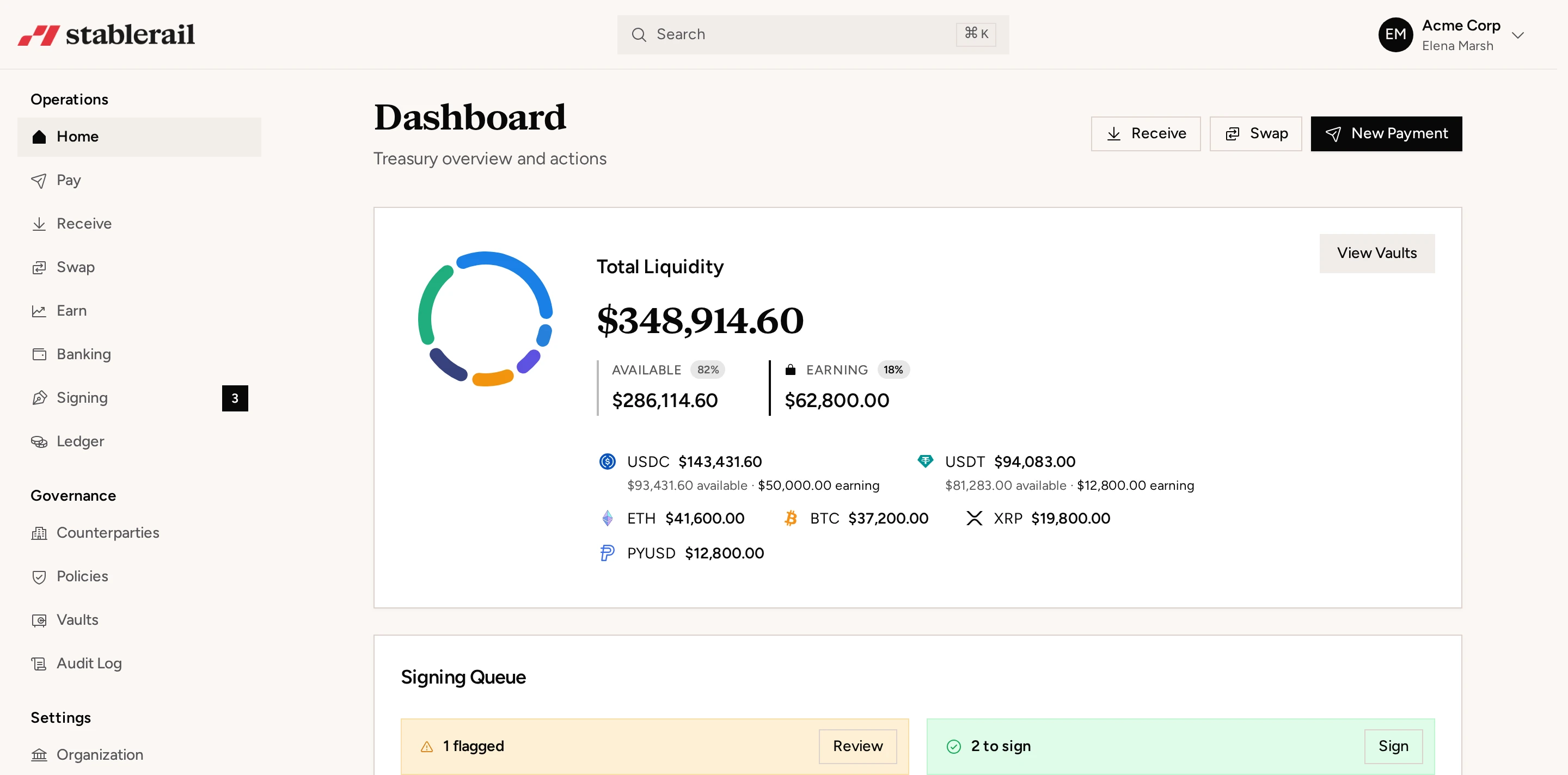
Stablerail brings USDC and USDT treasury activity into one business account with approvals and signing quorum, sanctions and address screening before send, global payouts, fiat off-ramp and exportable audit evidence. The relevant audit benefit is the ability to preserve the payment context and control record alongside execution rather than reconstructing it later.
How the GENIUS Act affects the analysis
The GENIUS Act, signed into US law in July 2025, established a federal framework for payment stablecoin issuers. It includes reserve, disclosure, examination and certification requirements, with obligations depending on the issuer and the law’s implementation.
Those issuer requirements should not be confused with the evidence an operating company needs for its own USDC or USDT activity. An issuer’s reserve disclosures do not prove that a company’s vendor payment was valid, properly approved or correctly recorded. Corporate finance teams still need transaction-level controls and period-end evidence for their own balances and transfers.
Finance team implementation checklist
- Inventory every wallet, exchange and custody account used by the legal entity, including dormant addresses.
- Assign owners and permitted purposes for each wallet and document who can request, approve and sign transactions.
- Create a standard payment ID linking the invoice, counterparty, approvals, screening result, transaction hash and journal entry.
- Require address verification and screening before send, with documented handling for alerts and address changes.
- Reapprove changed transactions whenever the amount, asset, network or destination differs from what approvers reviewed.
- Reconcile all addresses to the ledger at a defined frequency and investigate unmatched deposits, fees and internal transfers.
- Test the evidence package by selecting sample transactions and confirming that an independent reviewer can reconstruct each decision.
The goal is not to produce more screenshots. It is to create a reliable chain from commercial intent to authorization, execution, accounting and reporting. When each piece shares a stable identifier and is retained under a controlled process, auditors can test the transaction without rebuilding its history from wallets, spreadsheets and chat messages.
Frequently asked questions
What evidence do auditors need for a stablecoin transaction?
Auditors commonly need the source document, business purpose, counterparty and wallet attribution, pre-send screening, named approvals, signing record, transaction hash and accounting entry. They may also test wallet ownership, period cutoff, valuation and the completeness of the transaction population.
Is a blockchain transaction hash sufficient audit evidence?
No. A hash proves that a particular on-chain transaction was recorded, but it does not establish its business purpose, authorization, counterparty identity or accounting treatment. It should be linked to the relevant invoice, approvals, screening record and journal entry.
How should a company prove that it owns a stablecoin wallet?
Evidence may include wallet-creation records, key-custody documentation, access lists, board or treasury authorizations and, where appropriate, a signed-message procedure. Auditors may combine those records with transaction history and control testing because a blockchain address does not identify its legal owner.
How often should stablecoin wallets be reconciled?
The frequency should reflect transaction volume, risk and the company’s close process. High-activity treasury wallets may need daily or continuous operational review, while formal reconciliations should support each reporting period and include fees, failed transactions and transfers between company wallets.
Does the GENIUS Act require every company using stablecoins to obtain monthly audits?
No. The GENIUS Act’s reserve, disclosure, examination and certification framework is directed primarily at permitted payment stablecoin issuers. A company that merely pays or receives USDC or USDT still needs evidence for its own financial reporting and controls, but it is not automatically subject to issuer obligations.
Former CEO of Simple, a self-custodial wallet with $2B+ in transaction volume across 75+ countries.
More about the Stablerail team- Stablecoin treasury managementApprovals, limits, yield and reporting on one balance.
- Stablecoin payoutsBatch contractor and vendor payments with screening.
- USDT vs USDCWhich stablecoin your company should settle in.
- Stablecoin finance glossaryMPC, off-ramp, travel rule and the rest, in plain English.
- Product updatesEverything we ship, month by month.