
How AI Enhances Approval Chain Verification
AI can detect unusual stablecoin payments, interpret supporting documents, assess counterparties and explain exceptions. The strongest design combines AI analysis with deterministic policies, approval quorum and human sign-off.
AI enhances approval chain verification by detecting unusual transactions, extracting policy-relevant details, assessing counterparty risk and explaining why a payment should pass, be reviewed or be blocked. It should support—not replace—deterministic controls and human approval. For stablecoin payments, the safest design binds approvals to the exact transaction, screens the destination before signing and preserves evidence of every check, decision and signer.

AI enhances approval chain verification by detecting unusual transactions, extracting policy-relevant details, assessing counterparty risk and explaining why a payment should pass, be reviewed or be blocked. It should support—not replace—deterministic controls and human approval. For stablecoin payments, the safest design binds approvals to the exact transaction, screens the destination before signing and preserves evidence of every check, decision and signer.
What approval chain verification must prove
An approval chain is more than a sequence of names in a spreadsheet or messages in a chat channel. It must show that the right people reviewed the right payment under the right policy—and that the transaction eventually signed was the same one they approved.
For a USDC or USDT payment, a defensible process should verify:
- Authority: Each approver had permission to act for the relevant entity, account and payment amount.
- Segregation of duties: The person creating or importing the payment could not complete it alone.
- Policy compliance: The transaction followed approval thresholds, counterparty requirements and exception procedures.
- Transaction integrity: The chain, token contract, amount and destination address did not change after approval.
- Counterparty risk: The recipient was screened using current address and sanctions data before the payment was signed.
- Evidence: Finance can export the request, checks, approvals, timestamps, exceptions and signing result for audit or investigation.
AI is most useful where those checks involve large volumes of data, unstructured documents or patterns that are difficult to express as a simple threshold. Deterministic software remains better for controls that must always produce the same result.
Where AI improves approval verification
Behavioral anomaly detection
Machine-learning models can establish a baseline for normal payment activity and identify transactions that differ from it. Useful signals include payment size, timing, velocity, destination novelty, chain, token, initiating user, approver sequence and changes to vendor instructions.
An anomaly can take several forms. A point anomaly is a single transfer far outside the normal amount range. A contextual anomaly may be an otherwise ordinary payment submitted at an unusual time or by an unexpected entity. A collective anomaly emerges from a sequence, such as several transfers just below an approval threshold to newly observed addresses.
The model should not automatically label every anomaly as fraud. A treasury rebalance, acquisition payment or new-market launch may be unusual but legitimate. The practical output is a review signal with the contributing factors, not an unexplained risk score.
Policy and document analysis
Natural language processing can extract payment terms, invoice numbers, legal entities, beneficiary details and approval requirements from invoices, contracts and written policies. It can then compare those details with the payment request and identify inconsistencies, such as a destination address that differs from the approved vendor record.
AI can also turn an exception into a plain-English explanation: the recipient is new, the amount exceeds the controller’s authority, or the invoice currency does not match the settlement token. This reduces the time an approver spends reconstructing context across email, spreadsheets and blockchain explorers.
However, natural-language interpretation should not be the final enforcement layer. Finance should translate critical requirements—such as amount thresholds, required approver roles and prohibited destinations—into explicit system controls. AI can suggest how a policy applies, but an authorized owner should approve any new or changed rule.
Counterparty and address risk assessment
Stablecoin transactions introduce address-level questions that do not arise in ordinary bank payment files. A recipient address may have direct sanctions exposure, links to known illicit services or indirect exposure through prior on-chain transfers. AI can help organize these signals, identify related activity and summarize why a destination requires review.
Risk scoring must preserve the difference between direct and indirect exposure. A direct match to a sanctioned address is not equivalent to remote exposure several transactions away. Results also depend on address labels, attribution quality, the lookback period and the screening provider’s methodology. Reviewers need those details to make a defensible decision.
Duplicate and inconsistency detection
AI can compare invoices, payout files and historical activity to flag possible duplicates even when descriptions or formatting differ. Deterministic checks should then confirm exact matches using fields such as invoice number, vendor, amount, destination, chain and token.
This combination is stronger than either method alone: AI finds approximate similarities, while exact rules prevent a confirmed duplicate from advancing.
AI versus deterministic and human controls
| Verification stage | Best use of AI | Required control | Evidence to retain |
|---|---|---|---|
| Payment intake | Extract invoice, vendor and payment details | Validate required fields and approved token contracts | Source document, extracted fields and corrections |
| Policy review | Explain which policy provisions may apply | Enforce thresholds, roles and segregation of duties | Policy version, rule result and exception reason |
| Address screening | Summarize complex exposure patterns | Run sanctions and address screening before send | Provider result, timestamp and reviewed findings |
| Anomaly detection | Identify unusual amounts, timing or behavior | Route material alerts to an authorized reviewer | Signals, model version and reviewer disposition |
| Approval | Present concise context to approvers | Require named approvers and signing quorum | Identity, role, timestamp and decision |
| Pre-sign verification | Highlight last-minute inconsistencies | Bind approval to the final transaction fields | Approved intent and final transaction comparison |
| Post-transaction review | Cluster exceptions and recurring control failures | Reconcile on-chain result to the ledger | Transaction hash, status and accounting reference |
A safer pre-sign workflow
The control point that matters most is immediately before signing. Screening a draft payment is not enough if the address or amount can later change without invalidating the approvals.
- Create a payment intent. Record the legal entity, chain ID, token contract, amount, destination address, business purpose and supporting-document reference.
- Validate the asset. Confirm that the token contract and blockchain are approved; symbols such as USDC or USDT are not sufficient identifiers.
- Check the counterparty. Compare the destination with the vendor master and run sanctions and address screening using current data.
- Apply policy. Determine the required approver roles, quorum and any enhanced review triggered by amount, destination novelty or exception status.
- Run anomaly analysis. Compare the transaction with historical activity and show reviewers the specific factors behind any alert.
- Collect human approvals. Require each approver to review the complete payment intent rather than an abbreviated message.
- Revalidate before signing. Confirm that no protected field changed and refresh time-sensitive screening when required by the company’s procedures.
- Record execution. Store the transaction hash, blockchain status, signers, approvals and reconciliation reference.
If the destination, amount, chain or token contract changes, the system should invalidate prior approvals and restart the relevant checks. This prevents an approved request from becoming authorization for a materially different transfer.
Human oversight and signing authority
AI should not hold signing keys, approve its own exceptions or silently alter control thresholds. Its role is to identify, summarize and route risk. Authorized people remain responsible for approving the business purpose, resolving exceptions and meeting the required signing quorum.
That separation matters because model outputs can be wrong. Transaction patterns evolve, address labels can be incomplete and document models can misread invoices. A low risk score must never override a direct sanctions match or a missing approval. Likewise, a high anomaly score should trigger investigation rather than establish wrongdoing by itself.
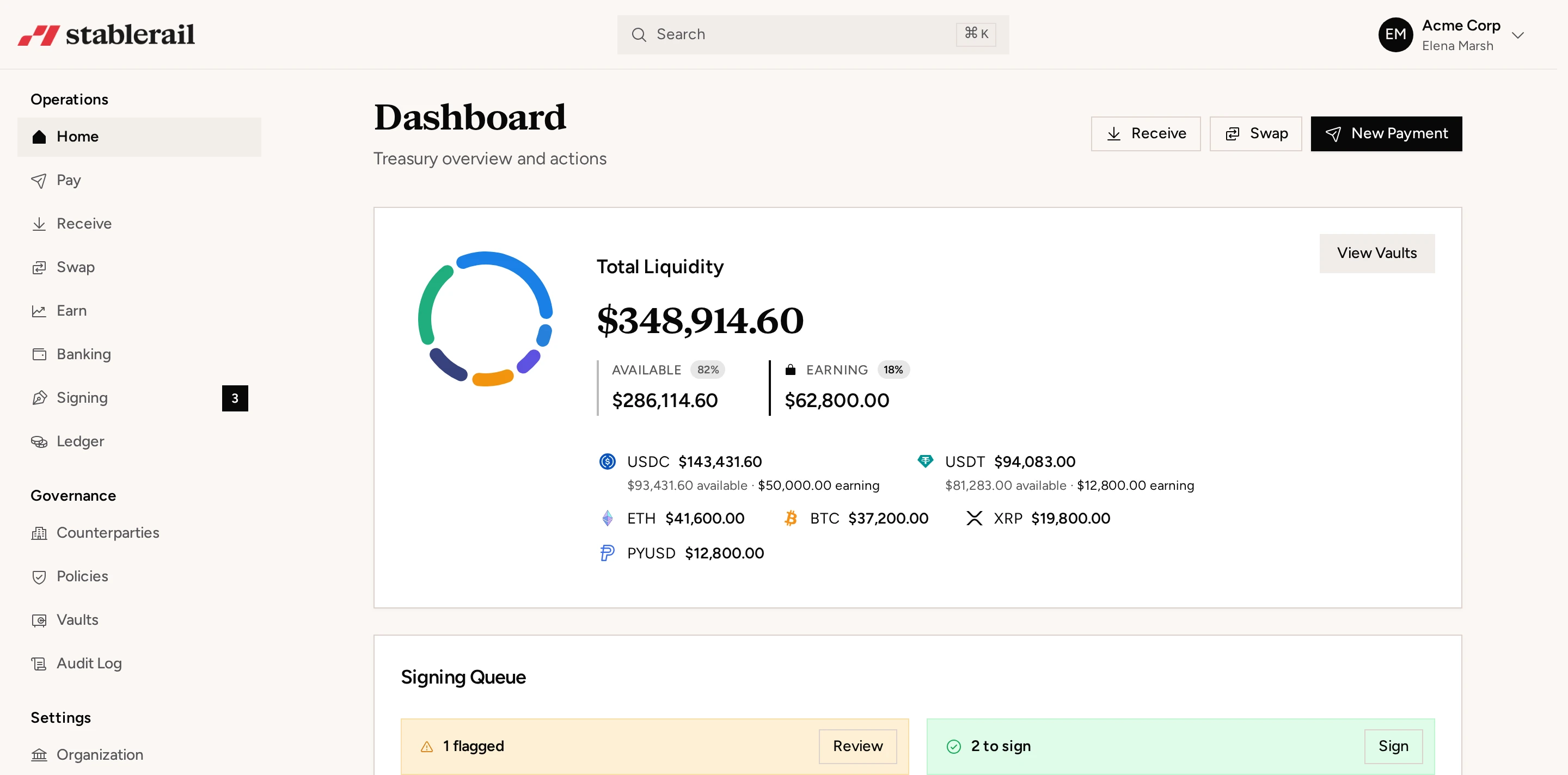
Stablerail supports this operating model through one business account for USDC and USDT treasury, with approvals and signing quorum, sanctions and address screening before send, and exportable audit evidence. Finance teams can also use the account for corporate cards, global payouts and fiat off-ramp while retaining a consistent approval record.
Controls needed around the AI itself
Finance and risk teams should govern AI outputs as part of the control environment. That means documenting the model’s permitted role, monitoring changes in alert volume and reviewing whether users routinely override particular findings.
Unstructured documents require special care. An invoice or email can contain misleading instructions, accidental inconsistencies or text designed to influence an automated assistant. Extracted data should therefore be validated against trusted records, and document content should never be able to change approval rules or signing authority.
Audit records should distinguish among the model’s recommendation, the deterministic control result and the human decision. Combining them into a single pass-or-fail label makes it difficult to understand why a payment proceeded.
Implementation checklist for finance teams
- Define the exact transaction fields that approvals cover.
- Require reapproval when a protected field changes.
- Separate payment creation, approval and signing responsibilities.
- Use explicit controls for thresholds, roles, quorum and approved assets.
- Screen the final destination before signing, not only during onboarding.
- Make anomaly alerts explainable and assign an owner for disposition.
- Document how direct and indirect on-chain exposure are treated.
- Test duplicate, changed-address, wrong-chain and stale-approval scenarios.
- Export evidence showing requests, checks, decisions, signers and execution.
- Review false positives, overrides and missed issues on a recurring basis.
The strongest approval chain does not depend on AI making every decision. It uses AI to surface context that people and static rules may miss, while deterministic controls guarantee that required approvals and screening cannot be bypassed. That combination gives treasury teams faster review without weakening accountability for stablecoin movements.
Frequently asked questions
How does AI verify a stablecoin payment approval chain?
AI can analyze transaction patterns, extract information from invoices, compare payment details with policies and summarize counterparty risk. Deterministic controls should separately verify approver authority, required quorum and whether the signed transaction matches the approved chain, token, amount and address.
Can AI approve USDC or USDT transactions automatically?
AI can recommend a decision or route a transaction for review, but it should not independently approve exceptions or control signing keys. Material stablecoin payments should remain subject to explicit approval rules, human authorization and the required signing quorum.
What should be checked before signing a stablecoin transaction?
Finance should confirm the legal entity, blockchain, token contract, amount, destination address, business purpose and supporting documents. The final destination should undergo sanctions and address screening, and any change to a protected transaction field should invalidate earlier approvals.
How should AI risk scores be used in payment approvals?
A risk score should prioritize review and explain the signals that influenced it, such as unusual timing, a new destination or indirect on-chain exposure. It should not override a deterministic block, a direct sanctions finding or a missing approval.
What audit evidence should a stablecoin approval process retain?
Retain the payment request, supporting documents, policy version, screening results, anomaly findings, approver identities, timestamps, exceptions and signing records. The final record should also include the blockchain transaction hash, execution status and accounting or reconciliation reference.
Former CEO of Simple, a self-custodial wallet with $2B+ in transaction volume across 75+ countries.
More about the Stablerail team- Stablecoin treasury managementApprovals, limits, yield and reporting on one balance.
- Stablecoin payoutsBatch contractor and vendor payments with screening.
- USDT vs USDCWhich stablecoin your company should settle in.
- Stablecoin finance glossaryMPC, off-ramp, travel rule and the rest, in plain English.
- Product updatesEverything we ship, month by month.