
Governance Tools for Stablecoin Payments
Governance tools secure stablecoin payments with pre-transaction screening, policy-as-code, MPC approvals, and immutable audit trails for compliance.

Jan 19, 2026
Stablecoins are transforming payments, with $27.6 trillion in transaction volume recorded in 2024 - surpassing Visa and Mastercard. As adoption grows, managing risks and ensuring compliance becomes critical for businesses using stablecoins. Governance tools provide a way to secure stablecoin payments by introducing pre-transaction controls, policy enforcement, and detailed audit trails. These tools help finance teams prevent fraud, comply with regulations like the GENIUS Act (enacted in 2025), and maintain operational control by following a stablecoin compliance checklist without sacrificing the speed and cost benefits of blockchain.
Key Features of Governance Tools:
Pre-Transaction Screening: Automatically blocks risky transactions, ensuring compliance with AML and sanctions laws.
Role-Based Approvals: Multi-party approvals and granular access controls to prevent unauthorized transactions.
Policy-as-Code: Automates treasury rules for consistency and efficiency.
Auditability: Creates immutable records for regulatory reviews and audits.
Platforms like Stablerail enable businesses to implement these controls while preserving the efficiency of stablecoin payments. By integrating governance tools, companies can reduce risks, meet regulatory requirements, and streamline financial operations.
Unlocking the Full Potential of Stablecoins for Institutions - Fireblocks
What Governance Tools Must Provide
4 Essential Features of Stablecoin Governance Tools for Corporate Treasury
Corporate treasury teams need governance tools that combine traditional controls - like multi-party approvals, transaction limits, and audit trails - with the efficiency of on-chain settlement. Let’s break down the core features that make these tools indispensable.
Pre-Transaction Screening and Monitoring
Governance tools should stop risky transactions before they ever hit the blockchain. This involves real-time, automated checks that kick in the moment a payment is initiated.
At a minimum, tools must ensure sanctions and AML compliance, screening payments against global frameworks like OFAC and Anti-Money Laundering databases. This prevents funds from reaching restricted entities. But compliance doesn’t stop there. Advanced platforms can flag unusual behaviors - like high-frequency transactions, off-hours activity, or amounts that deviate from normal patterns - indicating potential fraud or account compromise.
Some platforms go further with pre-transaction simulation, allowing treasury teams to preview the outcome of a payment before funds are moved. This feature helps catch errors or risks that might otherwise go unnoticed.
Another layer of control comes from geographic and entity routing. Treasury teams can approve or block payments based on factors like the recipient’s country, business type (e.g., B2B vs. P2P), or regulatory status. This is especially relevant as stablecoin demand grows - 75% of surveyed firms in Latin America report increasing customer interest in stablecoin payments.
"Operational rules apply proactively. If two parties' settings clash, they'll never be matched in the first place. That means faster straight-through processing for in-policy flows."
Strong screening naturally leads into structured approval processes.
Role-Based Approvals and Limits
Once potential risks are flagged, clear approval workflows ensure only authorized transactions move forward.
Multi-party computation (MPC) has become the gold standard for custody, splitting private keys across multiple parties to eliminate single points of failure. This technology enables threshold signatures, where transactions require a set number of approvals - known as a quorum - before being executed.
Governance tools should support granular access controls that align with corporate hierarchies. For instance, treasury policies might specify that payments to new vendor addresses over $5,000 need CFO approval plus verification from a second authorized signer.
Customizable transaction limits are equally important. These allow treasury teams to set thresholds that align with their policies. For example, a weekend transfer exceeding $10,000 might require extra approvals, while routine payroll payments under $1,000 could auto-execute with a single authorized signature.
To prevent internal fraud and meet regulatory expectations, systems must maintain strict role separation. For example, cold storage reserves should use multi-party quorum controls, ensuring no single person has unchecked access. With 90% of financial institutions either using or planning to integrate stablecoins into their treasury systems, these controls are quickly becoming standard.
Policy-as-Code Implementation
Manual compliance processes are slow and prone to errors. Policy-as-code transforms treasury rules into automated, enforceable processes.
This approach externalizes treasury policies into programmable rules that enforce governance at the transaction level. Instead of relying on email or Slack approvals, finance teams can define machine-enforceable rules like "Only allow USDC on Base/Ethereum" or "Payments over $5,000 require CFO approval and secondary verification." These rules are applied automatically, blocking any transaction that violates preset risk parameters - whether it involves a sanctioned region, an unapproved counterparty, or exceeds a spending limit.
Policy-as-code enables seamless processing for transactions within policy while maintaining strict controls for exceptions. Rules can be set at both the project and account levels, allowing for broad corporate mandates as well as department-specific policies. For example, vendor-specific allowlists can coexist with global spend limits.
API-driven signing logic adds another layer of flexibility. For instance, "service accounts" can auto-sign routine transactions - like payroll - while adhering to governance thresholds that protect against unauthorized actions.
"Stablecoins enable something traditional payment rails can't: programmable payments and automated financial operations that execute 24/7 without manual intervention."
Bentzi Rabi, CEO, Utila
Auditability and Evidence
To complement pre-transaction controls and approval workflows, governance tools must provide thorough audit trails. Every stablecoin payment should be backed by evidence that can withstand scrutiny from boards, regulators, and external auditors.
Governance tools should maintain an immutable, timestamped audit trail for every action - whether it’s intent creation, checks performed, flags raised, or approvals granted. Advanced systems even issue cryptographic "SettlementProof" documents to ensure traceability, meeting SOX compliance standards.
Audit trails should also include plain-English explanations that point to specific policies, timestamps, and checks. This transparency is critical when explaining decisions to auditors or defending why a payment was blocked or approved.
The value of automation here is clear. Fintech companies that adopted regulatory technology (RegTech) tools saw a 35% reduction in regulatory fines by 2025. Automated reporting and consistent audit trails aren’t just helpful - they’re essential. Tools should generate regulator-specific reports (like SAR/STR) directly from harmonized data, ensuring accuracy and timeliness for audits.
How Stablerail Enables Governance for Stablecoin Payments
Stablerail serves as a governance layer that operates between custody and transaction signing. This layer allows finance teams to implement bank-level controls - such as approvals, transaction limits, and policy checks - without sacrificing the speed of on-chain payments. Notably, Stablerail never holds unilateral signing authority, ensuring it cannot independently initiate transfers.
Self-Custodial MPC-Based Wallets
Stablerail employs Multi-Party Computation (MPC) and Distributed Key Generation (DKG) to split and distribute key fragments among independent nodes, ensuring the complete key is never assembled in one place. This setup ensures that funds only move with explicit multi-party approval, maintaining governance controls throughout the transaction process.
Pre-Sign Verification with Risk Dossiers
Stablerail enhances its wallet security by subjecting every payment intent to a thorough pre-sign evaluation. Each transaction is assessed against a customizable policy graph. During this process, specialized agents perform critical checks, including:
Sanctions and taint screening
Policy enforcement and transaction limit checks
Behavioral anomaly detection (e.g., unusual transaction times or amounts)
Counterparty risk scoring
The result is a detailed Risk Dossier summarizing the transaction’s status as PASS, FLAG, or BLOCK. The dossier includes policy references, timestamps, and, in cases of rejection, structured error codes like POLICY_THRESHOLD_EXCEEDED. This transparency not only helps teams address issues quickly but also supports compliance with regulations such as the U.S. GENIUS Act.
Policy-as-Code Console for Treasury Teams
Stablerail’s Policy Console gives treasury teams the tools to enforce automated, machine-readable rules. Teams can define parameters like maxSinglePayment limits, jurisdictional allowlists (e.g., "US", "CA"), or asset restrictions (e.g., "Only allow USDC on Base/Ethereum"). These policies are automatically applied to every payment intent before signing.
For example, you might configure rules such as:
"Payments over $5,000 to new addresses require CFO approval and verification."
"Weekend transfers exceeding $10,000 need additional approval."
The console integrates compliance measures directly, automating processes like AML protocols, wallet screening, and Travel Rule adherence through partnerships with providers like Elliptic and NotaBene [6, 16]. These rules are converted into programmable JSON objects, ensuring every payment adheres to the defined limits and compliance standards.
Human-in-the-Loop Approvals and Audit Trails
Stablerail enforces strict M-of-N approval rules (e.g., 2 out of 3 executive approvals), requiring each participant to validate policy compliance before their share contributes to the final signature. Every step of the process - from payment intent creation to final signing - is recorded in a deterministic audit trail. This trail includes details such as the initiator, approvers, and policies evaluated.
The platform also generates cryptographic "SettlementProof" documents, which confirm ledger entries, signatures, and compliance flags. These records provide comprehensive, auditable evidence of compliance, embedding accountability into every stage of the payment process.
Modules and Workflow Features
Stablerail’s integrated modules simplify treasury operations while reinforcing governance. Key modules include:
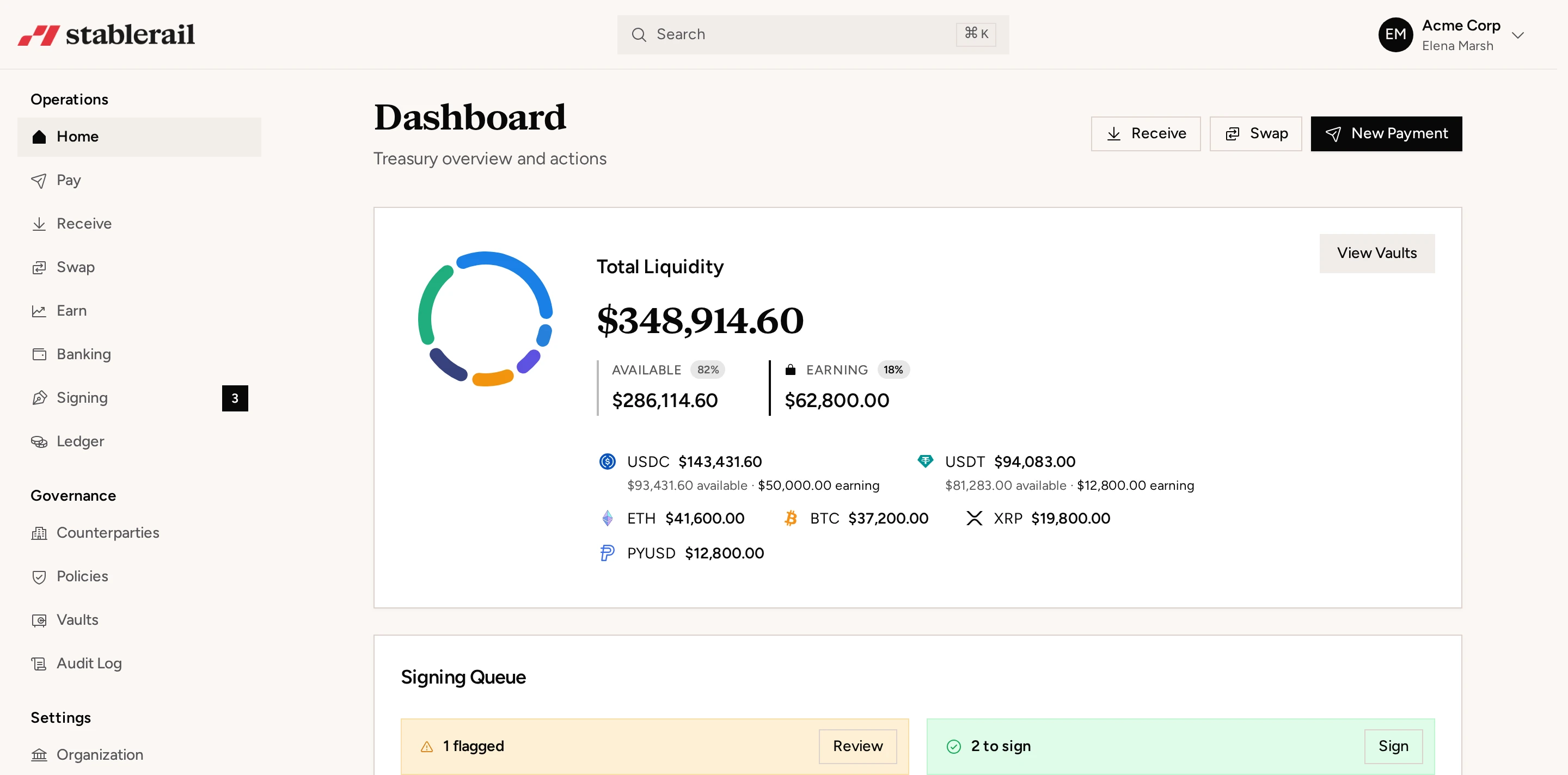
Treasury Hub: Offers visibility into balances, entities, and blockchain networks.
Policy Console: Manages roles, limits, and approvals.
Vendor & B2B Payments: Facilitates governed transfers.
Additional features on the roadmap include payroll processing, recurring payment flows, accounting exports, anomaly detection tools, forecasting, and SOX compliance mechanisms.
The payment workflow follows a consistent sequence: draft → pending (policy checks) → authorized (fund reservation) → captured (settlement) → settled. Regardless of how the payment intent is initiated, the process ensures rigorous checks, approver decisions, and final signing via MPC. Each transaction is recorded with a receipt that includes full compliance evidence, creating a reliable, transparent system for payment governance.
How to Evaluate Governance Tools
When choosing governance tools, it’s crucial to assess them across several dimensions to ensure bank-level controls are in place without slowing down on-chain transactions. With stablecoins projected to handle $27.6 trillion in transaction volume in 2024 - surpassing Visa and Mastercard combined - and about 90% of financial institutions either using or planning to adopt stablecoins, selecting the right governance infrastructure is more important than ever. These criteria build on earlier discussions about pre-transaction controls and policy enforcement.
Control Model and Custody Approach
The first factor to consider is who controls the keys and how signing authority is distributed. Tools that utilize multi-party computation (MPC) split keys across multiple parties, eliminating single points of failure. This ensures clear separation of duties throughout the transaction process, allowing finance teams to maintain control while enforcing threshold-based approvals for added security.
Governance Depth
The ability to enforce policy-as-code is what sets advanced governance platforms apart from basic custody tools. The best tools allow for detailed, conditional rules based on factors like destination address, transaction value, timing, and contract operations. To ensure consistency, these tools should support policy enforcement at both the project and account levels. Platforms that enforce these "operational rules" in real time - before a transaction is submitted - help prevent policy conflicts and unauthorized activities, unlike systems that rely on post-transaction reviews.
Risk and Compliance Features
Beyond control models, a tool’s compliance capabilities are critical. The most effective platforms integrate fiat and crypto data into a unified monitoring system, which can reduce false positive alerts by up to 93%. Key features to look for include:
Fuzzy matching for sanctions screening to identify aliases and partial names.
Real-time wallet screening to detect tainted funds.
Dynamic behavioral analytics that adapt based on statistical trends rather than static thresholds.
Additionally, with the GENIUS Act passed in July 2025, governance tools must automate compliance with the Travel Rule by collecting and transmitting required originator and beneficiary details for transactions.
"The GENIUS Act requires FinCEN to amend its AML rules to add a new category of financial institution... for permitted payment stablecoin issuers and to issue rules specific to them."
Brad Resnikoff, Partner at Mayer Brown
Integration with Treasury Systems
Governance tools should seamlessly connect blockchain wallets with ERP systems and treasury management systems (TMS) via robust APIs. This integration allows stablecoin operations to blend into the broader financial ecosystem, enabling teams to initiate and monitor payments without toggling between multiple platforms. Tools that offer automated reconciliation and real-time tracking through smart contracts are especially valuable.
Audit and Reporting Capabilities
Lastly, governance tools must provide thorough evidence for audit-ready stablecoin operations and regulatory reviews. Look for platforms that log every action - like intent creation, policy checks, approvals, overrides, and signing - while maintaining a deterministic audit trail with timestamps, user roles, and evaluated policies. Advanced systems also generate cryptographic "Settlement Proofs" that link back to the original payment intent and policy decisions. Additionally, tools should enforce maker-checker workflows for adjusting risk parameters and maintain version control for risk models. With nearly half of financial institutions already using stablecoins and another 41% piloting or planning to adopt them by early 2025, presenting a clear and rigorous compliance framework has become essential.
Implementation Considerations for U.S. Corporate Treasurers
Bringing governance tools into stablecoin payment processes requires careful planning to balance traditional banking controls with the speed and efficiency of on-chain settlements. Below are actionable steps U.S. corporate treasurers can take to ensure effective implementation.
Defining Policy Baselines
Start by converting your current wire transfer policies into machine-enforceable rules for on-chain transactions. Set clear transaction limits in USD - smaller payments can go through a simplified approval process, while larger transactions might need multi-tier approval from senior executives. Daily outflow caps can help manage risk. Use role-based approval workflows that mirror your existing authorization structure.
To further enhance security, create jurisdictional allowlists to restrict transfers to pre-approved countries, minimizing exposure to higher-risk regions. Additionally, specify which stablecoins (like USDC or USDT) and networks (such as Ethereum) are permitted for specific payment types, ensuring alignment with company policies.
Mapping Controls to Payment Flows
Once your policies are in place, align them with your payment flows. Different types of payments require tailored governance measures:
Vendor Payments: Use address allowlisting to ensure funds only go to verified supplier wallets. Assign dedicated pay-in wallets for major vendors to simplify reconciliation.
Cross-Border Settlements: Apply escrow-like controls, releasing payments only after confirming delivery or service completion.
Intercompany Transfers: Since these involve lower counterparty risk, a more relaxed approval process may be appropriate, but maintain audit trails for tax and accounting purposes.
Examples from the industry highlight the benefits of mapping controls to payment flows. For instance, MoneyGram’s stablecoin-powered remittance service (expected by 2025) aims to reduce settlement times to within 60 days, while Toku has already processed over $1 billion in payroll using similar tools. These cases demonstrate how effective governance can optimize different transaction types.
Aligning Governance with Risk and Compliance
To meet regulatory requirements, treasurers must ensure their governance tools align with laws like the GENIUS Act, signed in July 2025. This legislation mandates 1:1 reserve backing for payment stablecoins with liquid assets and annual audits for issuers. It also prohibits stablecoin issuers from offering interest to holders, distinguishing them from traditional bank deposits.
Key compliance measures include integrating real-time AML/KYT screening to block or flag suspicious transactions automatically. Introduce velocity limits to cap both individual transaction amounts and cumulative outflows over set periods. For higher-risk scenarios - such as payments to new vendors or transactions during off-hours - require human oversight, with documented reasons for any exceptions forming part of the audit trail.
Testing and Phased Adoption
Start small by testing in a controlled environment. Use a sandbox to simulate policy rules, approval workflows, and settlement processes. A low-risk pilot, such as transferring funds between company-controlled wallets or paying a single trusted vendor, is a good first step. For example, Stripe reported a 30% month-over-month increase in stablecoin transaction volume after integrating stablecoin payment rails, showing how pilots can validate operational efficiency and cost savings.
During the pilot, track key metrics like settlement times and error rates from manual processes. Once the pilot proves successful, expand gradually to more vendors, regions, and payment types. Regularly update your policies to keep pace with growth and evolving business needs.
Conclusion: The Future of Stablecoin Payment Governance
Stablecoin payments have quickly become a cornerstone for U.S. corporate treasurers, evolving into a critical piece of financial infrastructure. Today, 90% of financial institutions are either using stablecoins or planning to integrate them into their operations. This widespread adoption has created a pressing need for stronger oversight and compliance measures.
The passage of the GENIUS Act in July 2025 was a game-changer. This legislation introduced clear requirements for reserves and compliance, providing much-needed regulatory certainty. As Christopher L. Boone, Partner at Venable LLP, explains:
"Stablecoins are moving from proofs of concept to live payment programs because they promise faster settlement and programmable features".
This clarity has been pivotal. Now, 88% of payments executives report that regulatory hurdles are no longer a barrier to adoption.
To ensure these digital payments remain secure and efficient, robust governance tools are bridging the gap between traditional financial controls and blockchain technology. Platforms like Stablerail are leading the way. By integrating self-custodial MPC-based wallets, policy-as-code enforcement, pre-sign risk checks, and detailed audit trails, Stablerail equips finance teams with the tools to uphold the governance standards of traditional wire transfers - while reaping the speed and cost benefits of blockchain settlements.
With the stablecoin market projected to hit $2 trillion by 2028, businesses that implement strong governance frameworks today stand to gain significant advantages in speed, cost efficiency, and operational resilience. As highlighted by the ETA Strategic Leadership Forum:
"The trajectory points toward inevitability. Those who adapt will thrive, while those who resist will be left behind".
For U.S. corporate treasurers, platforms like Stablerail offer a way to combine rigorous controls with the unmatched efficiency of on-chain transactions.
FAQs
How do governance tools ensure compliance in stablecoin payments?
Governance tools bring structure and compliance to stablecoin transactions by turning policies into programmable rules. These tools can automatically block or flag payments that violate sanctions, exceed set dollar limits, or involve unauthorized addresses - essentially stopping non-compliant transactions before they’re ever signed.
Today’s governance systems go a step further with pre-sign checks like sanctions screening, anomaly detection, and counterparty risk scoring. These checks provide a detailed risk assessment for each transaction and create a tamper-proof audit trail. Every step, from creating the payment intent to final approval, is recorded, ensuring full transparency and accountability for finance teams and regulators alike.
When used alongside self-custodial wallets, governance tools become the decision-making layer, enforcing compliance without taking over signing authority. This setup enables businesses to adhere to AML regulations, sanctions, and internal policies while still enjoying the speed and efficiency that stablecoin payments offer.
How does policy-as-code enhance stablecoin transaction governance?
Policy-as-code takes the rules set by a finance team - like transaction limits, counterparty restrictions, or approval workflows - and converts them into executable code that automatically applies to every stablecoin transaction. This means payments are instantly evaluated against pre-set policies, running checks such as sanction screenings, transaction amount thresholds, and approved blockchain networks before any signing happens.
By automating these controls, policy-as-code removes the need for manual approvals through spreadsheets or messaging tools, ensuring that compliance with both internal policies and external regulations is consistent. It also generates a detailed, tamper-proof audit trail for every action taken. For instance, policies like “transactions over $5,000 to new addresses require CFO approval” or “only USDC on Ethereum is permitted” are enforced seamlessly. This approach combines the speed and efficiency of blockchain payments with the governance standards expected in traditional banking.
Why is pre-transaction screening important for securing stablecoin payments?
Pre-transaction screening plays a key role in safeguarding stablecoin payments by spotting risks and addressing problems before they arise. It ensures that transfers align with sanctions, blocks suspicious or malicious addresses, enforces internal policies like spending limits, and flags unusual activity, such as unexpected transaction patterns.
By tackling these issues before a transaction is finalized, pre-screening helps protect against fraud, regulatory breaches, and potential financial losses. This process not only reduces risks but also gives your team the assurance needed to make informed payment decisions.
Related Blog Posts
Former CEO of Simple, a self-custodial wallet with $2B+ in transaction volume across 75+ countries.
More about the Stablerail team- Stablecoin treasury managementApprovals, limits, yield and reporting on one balance.
- Stablecoin payoutsBatch contractor and vendor payments with screening.
- USDT vs USDCWhich stablecoin your company should settle in.
- Stablecoin finance glossaryMPC, off-ramp, travel rule and the rest, in plain English.
- Product updatesEverything we ship, month by month.