
How Pre-Execution Checks Prevent Sanctions Violations
Pre-execution sanctions checks stop or hold risky stablecoin payments before signing. Learn which controls matter, where screening falls short and what evidence auditors need.
Pre-execution checks reduce sanctions violations by screening the destination wallet and counterparty, applying transaction controls, and requiring approval before a stablecoin payment is signed. A failed check places the payment on hold or blocks signing, rather than generating an alert after settlement. Effective controls also preserve the screening result, list version, policy decision, approvers, timestamps, and transaction details for investigation and audit.

Pre-execution checks reduce sanctions risk by creating an enforceable gate between a payment request and cryptographic signing. Before USDC or USDT can move, the business screens the destination, verifies the counterparty, evaluates relevant on-chain exposure, and applies its approval rules. A high-risk result stops signing; an uncertain result moves the payment to review.
This timing matters because confirmed blockchain transactions generally cannot be recalled through the banking system. A post-transaction alert may support investigation and reporting, but it cannot prevent the original transfer. Pre-execution screening therefore turns sanctions controls from an advisory monitoring process into a preventive payment control.
Why stablecoin sanctions checks must happen before signing
A stablecoin payment can be created, signed, broadcast, and confirmed without the settlement windows associated with many bank payments. Once confirmed, recovering funds usually requires the recipient’s cooperation, an issuer action where technically and legally available, or a legal process. None is a substitute for screening before funds leave the company’s wallet.
Sanctions exposure is also broader than a list of prohibited blockchain addresses. Authorities may designate people, companies, vessels, jurisdictions, or other property interests. A counterparty can be restricted even when its payment address does not appear explicitly on a published list. For example, the OFAC 50 Percent Rule can apply to entities owned 50% or more, directly or indirectly and in aggregate, by blocked persons.
Finance teams therefore need to answer two separate questions before sending:
- Is this wallet associated with a sanctioned or otherwise prohibited party?
- Is the business counterparty, its ownership, location, or payment purpose restricted even if the wallet itself has no direct match?
A wallet result of no match answers neither question conclusively. It means only that the screening process did not find a match using the data, rules, and risk thresholds applied at that time.
The pre-execution control sequence
The strongest workflow screens a complete payment intent rather than an address copied into a separate compliance dashboard. The intent should include the legal counterparty, destination address, blockchain network, asset, amount, source wallet, payment purpose, relevant jurisdiction, and supporting invoice or contract.
- Validate the payment details. Confirm the address format, network, asset, amount, and beneficiary. Address-book changes and first-time destinations should receive additional verification because malware, impersonation, and manual errors can redirect an otherwise legitimate payment.
- Screen the wallet. Check the destination against applicable sanctions data and identified blockchain addresses. Record the provider, query, result, timestamp, and dataset or list version where available.
- Verify the counterparty. Screen the legal name, aliases, ownership, control, country, and other identifying information. This step addresses sanctions obligations that cannot be resolved from blockchain data alone.
- Assess on-chain exposure. Use blockchain analytics to identify direct or indirect connections to sanctioned and illicit activity. Exposure thresholds should reflect the company’s risk assessment; proximity alone should not automatically be treated as proof that two parties are the same person.
- Apply payment controls. Enforce destination allowlists, transaction limits, user permissions, segregation of duties, and enhanced approval for unusual payments.
- Re-screen before signing. Lists, address intelligence, and transaction details can change between request creation and final approval. Bind the final result and approvals to the exact destination, network, asset, and amount being signed.
- Retain the evidence. Store the decision, triggered rules, reviewers, approvals, exceptions, timestamps, and resulting transaction hash in an exportable record.
Which controls prevent a payment from proceeding?
| Control | What it tests | Typical outcome | Evidence to retain |
|---|---|---|---|
| Exact sanctions match | Whether the address or identified owner matches an applicable designation | Block signing and escalate to compliance or legal counsel | Matched record, source list, timestamp, and payment details |
| Potential name or ownership match | Whether the counterparty, alias, owner, or controller may be restricted | Hold for identity and ownership review | Search inputs, match rationale, ownership records, and reviewer decision |
| On-chain exposure alert | Whether the address has direct or indirect exposure to identified risky activity | Hold, request more information, or block under the company’s risk policy | Exposure category, relationship, threshold, provider result, and disposition |
| New or changed destination | Whether the beneficiary address differs from verified payment instructions | Require out-of-band verification and additional approval | Verification method, requester, approvers, and address history |
| Policy or approval failure | Whether the amount, user, entity, destination, or signing quorum violates internal controls | Prevent signing until the requirement is satisfied | Triggered rule, approval record, exception, and final decision |
| Stale screening result | Whether too much time or a material payment change occurred after screening | Run screening again before signature | Original and refreshed results with timestamps |
Pass, hold, and block decisions
A binary pass-or-fail design can either stop legitimate payments unnecessarily or allow ambiguous cases through. A three-level outcome is more operationally useful:
- Pass: No relevant match or policy exception was identified, and all required approvals are complete.
- Hold: The result is uncertain, the counterparty needs enhanced verification, or the destination has changed. Signing remains unavailable while an authorized reviewer investigates.
- Block: A confirmed prohibited match or non-waivable policy condition prevents execution.
The important control is not the label but its effect. If an employee can ignore an alert and sign from another wallet interface, the screening process is advisory. Preventive control requires the signing workflow, custody setup, and operating procedure to ensure that unresolved payments cannot be executed through an uncontrolled route.
Exceptions also need governance. An authorized reviewer should document why an alert was cleared, the evidence considered, and whether legal or compliance advice was obtained. The person who requested the payment should not be able to clear a sanctions alert alone.
What pre-execution screening cannot guarantee
Pre-execution controls materially reduce risk, but they do not guarantee sanctions compliance. Blockchain attribution can be incomplete, counterparties can use newly created addresses, ownership information can be unavailable, and sanctions designations may occur after a payment settles. Different legal entities within a group may also have different obligations based on jurisdiction and applicable sanctions regimes.
Risk scoring needs careful interpretation. A direct identified relationship generally warrants more scrutiny than distant transactional exposure, and analytics providers may classify the same activity differently. Thresholds should be documented, tested against the company’s risk appetite, and reviewed when its markets, products, or payment patterns change.
Companies should also avoid relying on the stablecoin issuer as their compliance control. Issuers may be able to restrict particular addresses under their technical capabilities, terms, or legal obligations, but such action occurs outside the payer’s approval process and may create additional operational disruption.
Post-transaction monitoring still matters
Preventive screening and ongoing monitoring solve different problems. Pre-execution checks decide whether a payment may proceed based on information available before signing. Post-transaction monitoring can detect later designations, changes in attribution, unexpected incoming transfers, or patterns that emerge across multiple transactions.
When monitoring identifies a concern, the response may include preserving records, suspending further payments, investigating the counterparty, consulting counsel, and determining whether a rejection, blocking, or regulatory report is required. The correct action depends on the relevant sanctions regime and the facts; finance teams should not improvise a legal conclusion from an analytics alert alone.
Implementation checklist for finance teams
- Map the sanctions regimes that apply to each legal entity, wallet, and payment corridor.
- Collect the beneficiary’s legal identity and ownership information, not only a wallet address.
- Screen the address and counterparty when the payment is created and again immediately before signing.
- Require independent verification for new or changed destination addresses.
- Define pass, hold, and block criteria, including who can clear an alert.
- Bind approvals to the exact asset, network, amount, source, and destination.
- Prevent unresolved payments from bypassing controls through another wallet or signing route.
- Export screening, approval, exception, and transaction evidence for audit and investigation.
- Test the workflow periodically using blocked, ambiguous, stale, and changed-address scenarios.
Building the control into stablecoin operations
The control point should sit as close as possible to signing. This may be implemented through a controlled wallet workflow, a custody integration, or a stablecoin business account, but the operating principle is the same: no signature until screening and approvals are complete.
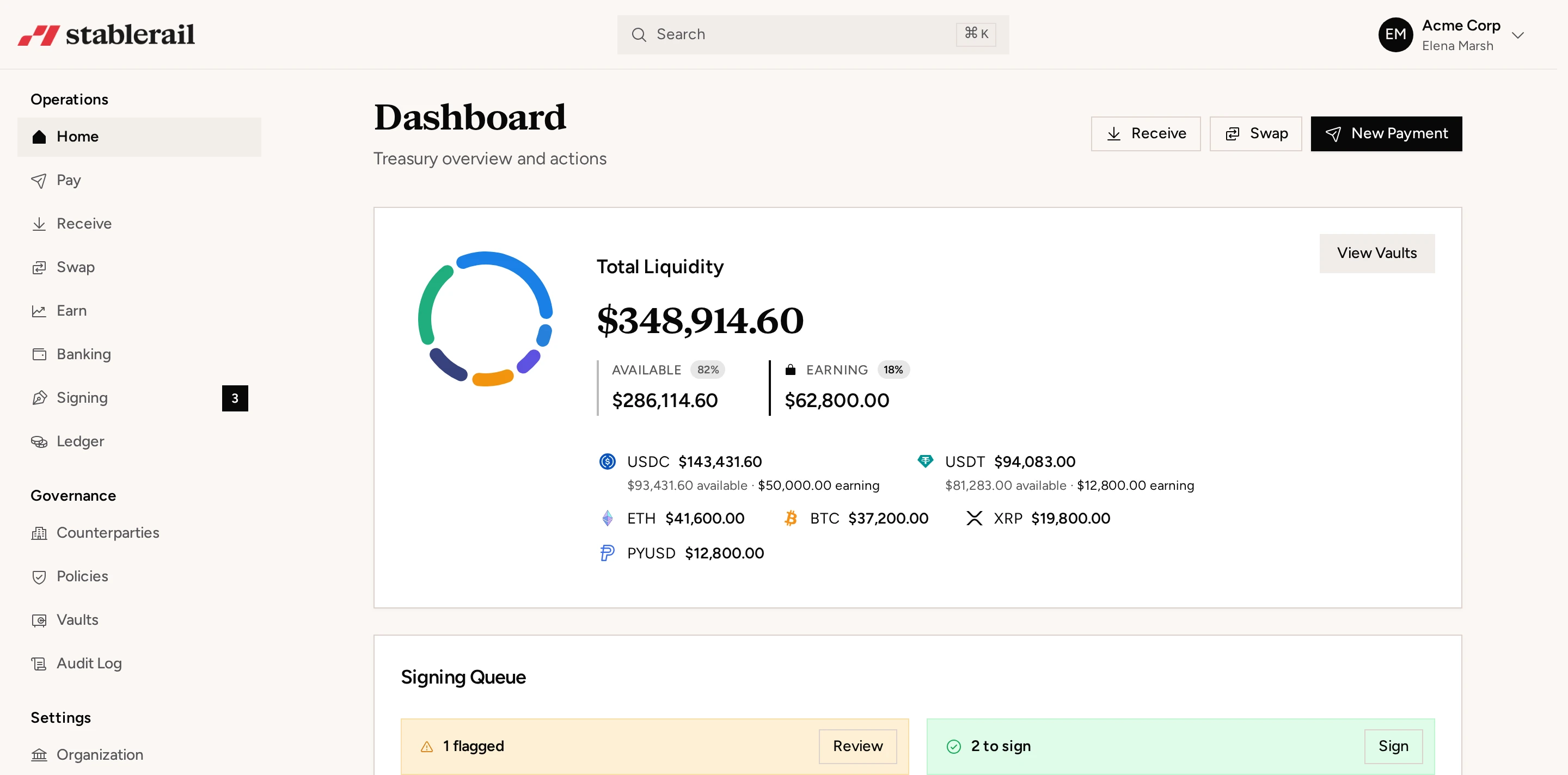
Stablerail provides one business account for USDC and USDT treasury, with sanctions and address screening before send, approvals and signing quorum, global payouts, fiat off-ramp, corporate cards, and exportable audit evidence. Whatever system a company uses, finance leaders should confirm that a failed check technically prevents execution and that every decision can be reconstructed after the fact.
For sanctions control, an alert generated after signing is evidence of what happened. A check that prevents signing can change what happens.
Frequently asked questions
When should a stablecoin address be screened for sanctions?
Screen it when the payment is created and again immediately before signing. Re-screen whenever the destination, asset, network, amount, counterparty information, or approval context changes materially.
Is checking a USDC or USDT wallet address enough for sanctions compliance?
No. Sanctions can apply to a person or entity even when its wallet is not explicitly listed, including through ownership and control rules. Businesses should screen the legal counterparty, aliases, owners, jurisdictions, and payment purpose alongside the blockchain address.
What should happen when sanctions screening returns a possible match?
Place the payment on hold so it cannot be signed while an authorized reviewer investigates. Preserve the matching data, verify identity and ownership, document the decision, and consult sanctions counsel when the legal treatment is uncertain.
Can post-transaction blockchain monitoring prevent a sanctions violation?
Post-transaction monitoring can identify later designations, new attribution, and suspicious patterns, but it cannot stop a transfer that has already settled. It complements rather than replaces screening and approval before signing.
What sanctions screening evidence should a finance team retain?
Retain the search inputs, data source or provider, list version where available, timestamp, result, triggered rules, reviewer decision, approvals, exceptions, and exact transaction details. The record should connect those checks to the final on-chain transaction hash.
Former CEO of Simple, a self-custodial wallet with $2B+ in transaction volume across 75+ countries.
More about the Stablerail team- Stablecoin treasury managementApprovals, limits, yield and reporting on one balance.
- Stablecoin payoutsBatch contractor and vendor payments with screening.
- USDT vs USDCWhich stablecoin your company should settle in.
- Stablecoin finance glossaryMPC, off-ramp, travel rule and the rest, in plain English.
- Product updatesEverything we ship, month by month.