
Standardizing AML/KYC for Global Stablecoin Use
Explains how fragmented AML/KYC enables stablecoin laundering and sanctions evasion — and how compliance-by-design and embedded real-time checks can stop it.

Mar 31, 2026
Stablecoins processed $27 trillion in 2024, but 84% of verified crypto fraud cases were linked to them. This highlights a critical issue: fragmented AML and KYC compliance regulations across the globe. These inconsistencies allow bad actors to exploit weaker jurisdictions and create compliance headaches for legitimate businesses.
Key points to know:
Fraud and laundering risks: $51 billion laundered via stablecoins in 2024.
Regulatory gaps: Different countries enforce AML/KYC rules inconsistently, making cross-border compliance complex.
Inefficiencies: Traditional compliance systems generate 95% false positives and cost Europe $136.5 billion annually.
Emerging solutions: "Compliance-by-design" integrates AML/KYC measures directly into stablecoin systems, leveraging tools like pre-transaction risk checks, automated audit trails, and behavior analysis.
Efforts like the EU’s MiCA and the U.S. GENIUS Act are setting stricter rules, but global coordination is needed to reduce fraud, enhance compliance, and ensure stablecoin market stability.
Current AML/KYC Challenges for Stablecoins
How Different Countries Enforce AML/KYC Standards
The stablecoin market may operate globally, but AML/KYC enforcement is still handled locally, creating a tangled web of compliance requirements for businesses engaged in cross-border transactions.
Take Switzerland's FINMA, for instance. They enforce one of the strictest policies, requiring full identity verification for all stablecoin holders at all times - no exceptions. On the other hand, Hong Kong's HKMA takes a different stance, allowing issuers to bypass individual identity checks as long as they can prove they have effective tech-driven monitoring and freezing systems in place. This divide between "identity-first" and "monitoring-first" models adds a layer of operational complexity for businesses.
The EU's MiCA framework introduces yet another approach, requiring quarterly reporting by crypto asset service providers (CASPs), who must provide holder names and countries to issuers. Meanwhile, the U.S. GENIUS Act focuses more narrowly on Bank Secrecy Act requirements for initial purchasers and administrators, placing less emphasis on tracking activity in secondary markets. In the UAE, the rules differ further, with wallet monitoring as the central focus, while the Central Bank prohibits non-dirham stablecoins for onshore payments.
The secondary market, however, remains a major weak spot. Most regulators emphasize KYC at issuance and redemption points, leaving peer-to-peer transfers largely unregulated. This gap became glaringly apparent in August 2025, when the New York Department of Financial Services fined Paxos for compliance failures with BUSD. Their violations included inadequate KYC procedures, failure to escalate red flags, and insufficient monitoring of Binance-related activities.
These fragmented approaches create not only operational headaches but also significant legal risks for companies navigating this regulatory patchwork.
Risks of Non-Standardized AML/KYC Protocols
The lack of uniform AML/KYC standards across jurisdictions amplifies both legal and operational risks. Under U.S. OFAC rules, companies can face steep civil penalties for unknowingly violating sanctions - even if the transaction complies with another country's laws. For instance, a transaction legal in the EU could still breach U.S. sanctions if it involves U.S. persons, infrastructure, or dollar-pegged stablecoins like USDC or USDT. With stablecoin transaction volumes hitting an eye-popping $27 trillion in 2024 - on par with Visa and Mastercard combined - manual compliance processes simply can't keep up. For startups and fintechs, the cost and complexity of building AML systems that work across jurisdictions can be a significant barrier.
Then there’s the Travel Rule, which poses its own technical challenges. Blockchains don’t inherently transmit sender and beneficiary details for transactions over $3,000, forcing companies to rely on third-party solutions. These systems often fail to integrate smoothly across borders, leaving loopholes that bad actors exploit. For example, non-custodial wallets, which lack built-in regulatory checks, are a common tool for bypassing Virtual Asset Service Provider (VASP) controls.
The consequences of these gaps are far from theoretical. In 2024, Russian entities introduced A7A5, a Ruble-backed stablecoin designed specifically to circumvent international sanctions. This stablecoin saw daily flows exceeding $1 billion, highlighting how regulatory inconsistencies can be exploited for large-scale evasion. Such examples underscore the urgent need for more coordinated global standards.
From Pilot to Production: How Banks and Payments Companies Launch Stablecoin Services
Regulatory Frameworks Shaping AML/KYC Standards
Global Stablecoin AML/KYC Regulatory Frameworks Comparison 2025
MiCA and EU Stablecoin AML Requirements
The European Union's Markets in Crypto-Assets (MiCA) framework, launched in mid-2024, introduced the first regulatory guide for stablecoins across all 27 EU member states. MiCA distinguishes between two types of stablecoins: Electronic Money Tokens (EMTs), which are tied 1:1 to a single fiat currency, and Asset-Referenced Tokens (ARTs), which are linked to baskets of assets or commodities.
Under MiCA, only EU-authorized credit or e-money institutions can issue stablecoins, and they must operate within the EU. Issuers are required to back these tokens entirely with high-quality liquid assets held by reputable custodians in the same currency as the stablecoin. Additionally, holders are guaranteed the right to redeem tokens at their face value at any time. To ensure stablecoins are not treated like investment products, MiCA prohibits issuers from offering interest to holders.
The framework also imposes strict compliance obligations on Crypto-Asset Service Providers (CASPs). These providers must conduct thorough due diligence before listing any stablecoin for EU customers, including legal classification into EMT or ART categories and verifying issuer compliance. This has led some exchanges to delist non-compliant tokens like USDT in the EU, while others, such as USDC, are gaining traction due to their alignment with MiCA’s transparency and regulatory requirements.
These standards set a high bar, offering a stark contrast to the evolving regulatory landscapes in other regions.
GENIUS Act and US AML/CFT Requirements
While the EU focuses on asset quality and issuance standards, the U.S. takes a different route. The GENIUS Act, enacted on July 18, 2025, reshaped stablecoin regulation under the Bank Secrecy Act (BSA). It introduced Permitted Payment Stablecoin Issuers (PPSIs), moving them out of the less stringent Money Services Business (MSB) framework and subjecting them to tougher Customer Identification Program (CIP) and Customer Due Diligence (CDD) requirements.
A standout feature of the GENIUS Act is the asset freezing mandate, which requires PPSIs to have the technical capability to block, freeze, and reject transactions that violate federal or state laws. This applies not just at issuance but throughout the token's lifecycle, including secondary market transactions. Evan T. Abrams, a partner at Steptoe, explained:
"An issuer that cannot halt illicit transactions on its network would be barred from issuing stablecoins under the Act's standards."
The Act also mandates annual compliance certification from PPSI leadership, confirming that their AML and sanctions programs are designed to prevent illegal activities. Issuers can use a crypto compliance checker to verify their standing against these evolving global rules. False certifications carry criminal penalties. For non-U.S. issuers, the Act offers a "safe harbor" provision. This allows foreign stablecoin issuers to serve U.S. residents, but only if they operate in jurisdictions with "comparable regulatory regimes" and register with the Office of the Comptroller of the Currency (OCC). This provision effectively pressures foreign regulators to align their frameworks with U.S. standards to maintain market access.
Hong Kong and Singapore Stablecoin Frameworks
In Asia, Hong Kong and Singapore have implemented stablecoin regulations with a focus on reserve backing, redemption rights, and stringent AML/KYC rules - though their approaches differ in key ways.
Hong Kong's Stablecoin Ordinance, effective August 1, 2025, requires all stablecoin issuers to obtain a license from the Hong Kong Monetary Authority (HKMA). The HKMA enforces continuous identity verification for all stablecoin holders, effectively eliminating anonymity in transactions within its jurisdiction. Customer Due Diligence (CDD) is mandatory for transactions of HK$8,000 or more, and issuers must retain CDD and transaction records for at least five years. SK Lee highlighted this shift:
"The HKMA envisions a stablecoin environment free of anonymity, replacing opacity with accountability."
Singapore's Monetary Authority of Singapore (MAS) framework, meanwhile, focuses on single-currency stablecoins (SCS) pegged to the Singapore Dollar or G10 currencies. Similar to Hong Kong, MAS requires 1:1 reserve backing with high-quality liquid assets and mandates the segregation of client funds from issuer assets. Both jurisdictions have adopted the Travel Rule, which mandates the collection and transmission of originator and beneficiary information for transactions.
The key difference lies in their regulatory styles. Hong Kong’s approach is more rigid, requiring continuous verification for every holder, while Singapore adopts a more flexible, label-based system with risk-based KYC/AML requirements. Despite these differences, both frameworks treat stablecoins as regulated payment instruments rather than speculative assets. These varied approaches highlight the growing need for global coordination in stablecoin regulation.
How to Implement Standardized AML/KYC Protocols
To tackle the fragmented regulatory landscape, businesses need to implement precise operational controls. With transaction volumes hitting record highs and fraud-related losses reaching $12.4 billion, relying solely on manual reviews or post-transaction monitoring simply isn’t enough. Navigating the diverse AML/KYC requirements across MiCA, the GENIUS Act, and various Asian frameworks demands systems that ensure compliance at every step of a transaction. Below are practical steps to meet these global standards effectively.
Pre-Transaction Screening and Risk Checks
The best way to avoid compliance issues is to prevent them from happening in the first place. Pre-transaction screening identifies risks before a payment is executed, rather than reacting after it’s settled on-chain. This involves checking sanctions lists like OFAC, analyzing wallet addresses for connections to illicit funds using taint analysis, and evaluating counterparty risk based on transaction history.
A risk-based approach adjusts the level of scrutiny depending on the situation. For instance, a $500 payment to a trusted vendor might only need basic checks, while a $50,000 transfer to a new wallet in a high-risk jurisdiction would require enhanced due diligence. This method aligns with FATF guidelines and the Travel Rule for transfers exceeding $3,000. Automated tools can make this process more efficient, cutting false positives by up to 40% compared to manual reviews, enabling compliance teams to focus on genuine risks rather than wasting time on routine transactions.
Audit Trails and Compliance Documentation
When regulators or auditors come knocking, having detailed records is non-negotiable. For example, the GENIUS Act requires stablecoin issuers to file Suspicious Activity Reports (SARs) and maintain records proving compliance. This also satisfies region-specific requirements for document retention.
A strong audit trail captures every step of the process: who initiated the payment, the checks performed, the policies triggered, who approved or overrode any flags, and the timeline of each action. This kind of record not only demonstrates adherence to internal policies but also proves compliance with regulatory mandates. By embedding these audit capabilities directly into the payment infrastructure from the start, rather than adding them later, companies can adopt a compliance-by-design approach. Real-time control solutions can further simplify this process, ensuring smoother operations.
Stablerail's Control Plane for AML/KYC Compliance
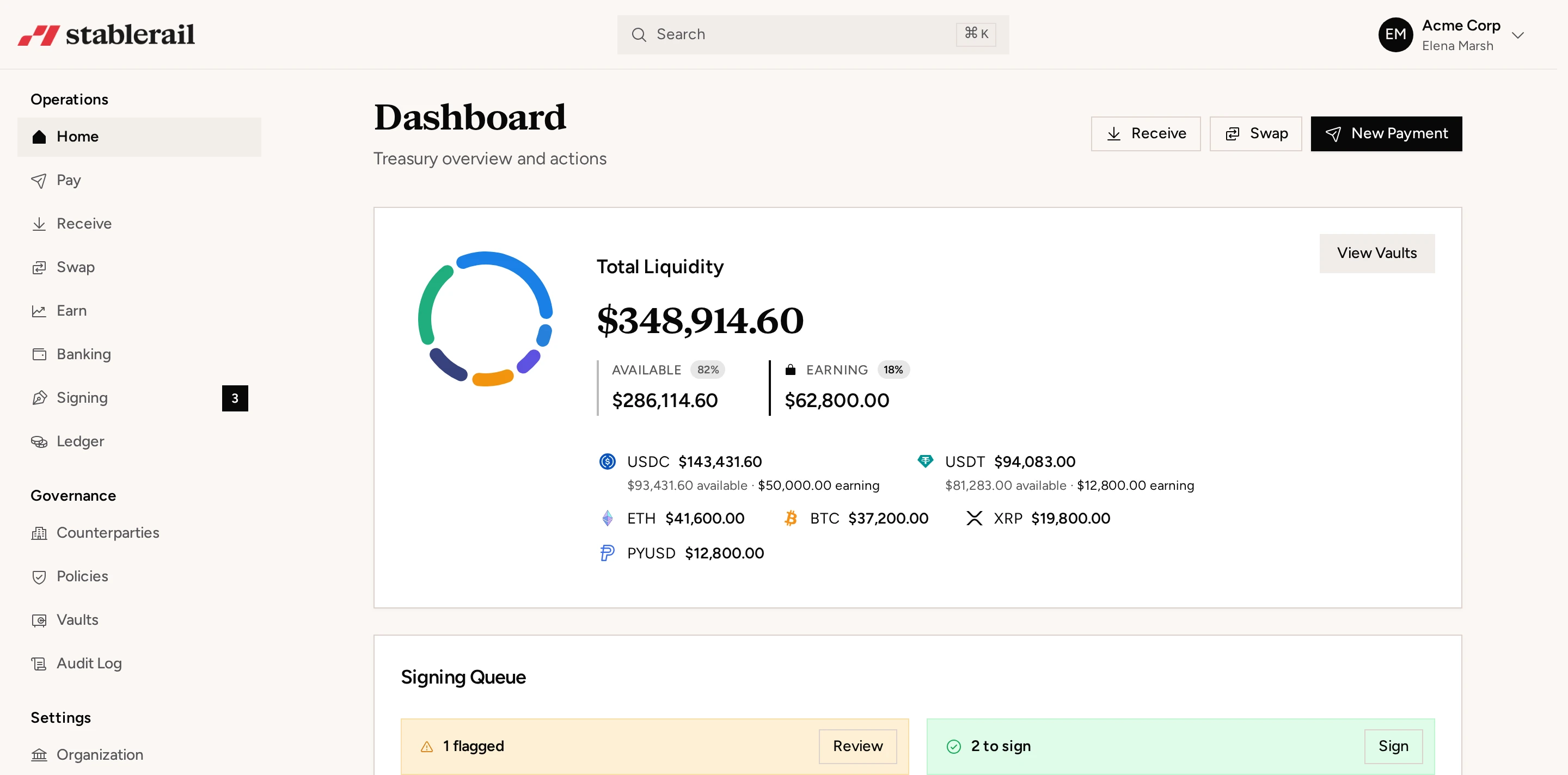
Stablerail offers a real-time solution to these challenges, integrating compliance measures seamlessly into the transaction process. Positioned above custody and prior to signing, Stablerail ensures transactions can be halted when necessary. Before any stablecoin payment is executed, the system performs pre-sign checks using specialized agents for tasks like sanctions screening, taint analysis, behavioral anomaly detection (e.g., unusual amounts or off-hours transfers), and counterparty risk scoring.
Through policy-as-code rules, finance teams can enforce machine-executable compliance policies. For example:
Payments to new addresses exceeding $5,000 require CFO approval.
Weekend transfers over $10,000 need additional verification.
Only USDC transactions on Base/Ethereum are allowed.
These rules are automatically applied to every payment intent, ensuring consistent adherence to internal guidelines. The workflow is straightforward: payments are initiated via API, invoice PDFs, or CSV files. Specialized agents then generate a Risk Dossier, delivering a PASS/FLAG/BLOCK verdict along with reasons for the decision. Designated approvers review this before final signing via MPC (multi-party computation), with every action meticulously logged in an audit trail. By using self-custodial MPC wallets, Stablerail ensures financial teams maintain full control over their keys, while Stablerail itself never has unilateral signing authority.
Research Findings and Future AML/KYC Trends
The evolution of AML/KYC practices highlights the growing importance of integrated, behavior-based solutions, as demonstrated by recent operational advancements.
Industry Research on Stablecoin Regulation
Recent studies reveal a major shift in how the financial industry approaches stablecoin compliance. Traditional rule-based AML systems, which rely on static thresholds (like the $10,000 benchmark), are proving inefficient. These systems generate false positive rates exceeding 95%, contribute to annual operating costs of $136.5 billion, and manage to intercept only 0.1% of illicit funds.
To address these inefficiencies, the focus is shifting toward behavioral detection models. For example, research into "StableAML", a tree ensemble model informed by domain-specific insights, highlights the potential of analyzing behavioral patterns - such as rapid dispersals across multiple wallets or unusual transaction timings - to more effectively identify illicit activities.
In response to these challenges, the Wolfsberg Group introduced new principles in September 2025 to help financial institutions mitigate risks when dealing with stablecoin issuers. Simultaneously, technical standards like ERC-3643 are enabling "embedded compliance", where KYC and sanctions screening are integrated directly into a token's smart contract. This allows for real-time verification without manual intervention. Such a "compliance-by-design" approach ensures regulatory adherence under frameworks like MiCA and the GENIUS Act while minimizing unnecessary asset freezes.
These developments are shaping the trajectory of AML/KYC enforcement, setting the stage for significant changes expected through 2026.
Expected AML/KYC Enforcement Trends Through 2026
Regulators are adapting quickly to address vulnerabilities exposed by criminal innovation. Early 2026 research into Southeast Asian cybercrime syndicates uncovered large-scale operations using stablecoins for everything from procuring infrastructure to laundering proceeds via complicit OTC brokers. The emergence of alternative stablecoin designs, such as A7A5, underscores the evolving risk landscape. To counter these threats, regulators are increasingly turning to embedded supervision, where compliance measures are built directly into stablecoin systems, enabling automated data sharing and real-time oversight.
This shift also reflects a move away from traditional, one-time identity checks. For instance, Hong Kong's HKMA is pioneering an approach that allows technology-driven monitoring of a stablecoin's entire lifecycle. Instead of requiring full KYC for every peer-to-peer transaction, this method emphasizes behavioral analytics and pattern detection. This is especially critical given that over 80% of stablecoin activity occurs off-chain within centralized platforms, creating substantial visibility gaps. In some regions, such as Nigeria, financial institutions are now required to submit implementation plans for automated AML solutions by June 10, 2026.
Another pressing issue is the rise of sanctions evasion-as-a-service. Criminal networks are increasingly using custom stablecoins and decentralized services to bypass asset freezes. As of early 2026, over $4 billion in USDT and $1 billion in USDC have been immobilized due to these activities. To combat this, regulators are mandating Travel Rule integration for transfers exceeding $3,000 via specific messaging protocols. Additionally, AI-powered anomaly detection is being explored to distinguish between high-velocity cybercrime patterns and static sanctioned entity behaviors.
Conclusion
Fragmented and manual compliance methods are no longer cutting it for stablecoin operations. With stablecoin transaction volumes hitting a staggering $27 trillion in 2024, the need for standardized AML/KYC protocols has become impossible to ignore. Traditional rule-based AML systems have shown their flaws, with false positive rates soaring above 95% and only managing to intercept 0.1% of illicit funds. Clearly, a new approach is overdue.
The concept of "compliance-by-design" is emerging as the next logical step. By embedding AML/KYC protocols directly into transaction workflows with real-time algorithmic oversight, finance teams can move away from inefficient manual reviews and focus on proactive risk management. This shift could dramatically cut compliance costs - currently estimated at $136.5 billion annually in Europe alone - while fostering the trust needed to meet licensing requirements under frameworks like MiCA and the GENIUS Act. It’s a forward-thinking strategy that lays the groundwork for advanced compliance solutions.
To take things further, enterprises must rethink their approach to custody. Stablerail's agentic control plane offers a standout solution by operating above custody and before transaction signing. It performs crucial pre-transaction checks - like sanctions screening, anomaly detection, and policy enforcement - while creating a detailed, plain-English audit trail. This enables finance teams to confidently present their compliance efforts to auditors, boards, and regulators. It’s a clear, practical example of "compliance-by-design" in action.
Adding to this, privacy-preserving technologies like Zero-Knowledge Proofs and deterministic verification models are making automated compliance both secure and auditable. As regulators push for lifecycle monitoring and real-time oversight, organizations adopting embedded compliance frameworks now will be better equipped to scale globally without sacrificing operational efficiency.
Standardization is the key to bridging traditional banking governance with the speed and transparency of on-chain settlement, setting the stage for the future of stablecoin payments.
FAQs
Why are stablecoins so heavily linked to crypto fraud?
Stablecoins often face scrutiny because their pseudonymous nature and compliance challenges make them attractive for misuse. Their ability to facilitate quick, cross-border transactions can be exploited for activities like money laundering, sanction evasion, and other unlawful purposes.
The situation becomes even more complex due to the absence of standardized AML (Anti-Money Laundering) and KYC (Know Your Customer) protocols. Emerging fraud techniques, such as mixers and cross-chain swaps, further complicate monitoring efforts. This underscores the importance of implementing strong compliance measures to promote transparency and safeguard against misuse.
What is the biggest AML/KYC gap in stablecoin secondary markets?
The biggest hurdle in addressing AML/KYC compliance within stablecoin secondary markets lies in tracing and screening transactions effectively. Since stablecoins operate with a pseudonymous structure, they open the door for evasion techniques such as mixers and cross-chain swaps. These methods complicate efforts to identify sanctions violations and other unlawful activities.
What does “compliance-by-design” mean for stablecoin payments?
"Compliance-by-design" is about integrating regulatory and security measures - such as sanctions screening, AML (Anti-Money Laundering), and KYC (Know Your Customer) protocols - directly into the payment process. These checks are automated using programmable controls, ensuring that every transaction aligns with regulations instantly.
This approach not only minimizes risks but also builds trust with both regulators and users. Plus, it enables smooth, scalable cross-border stablecoin payments without compromising on compliance.
Related Blog Posts
Former CEO of Simple, a self-custodial wallet with $2B+ in transaction volume across 75+ countries.
More about the Stablerail team- Stablecoin treasury managementApprovals, limits, yield and reporting on one balance.
- Stablecoin payoutsBatch contractor and vendor payments with screening.
- USDT vs USDCWhich stablecoin your company should settle in.
- Stablecoin finance glossaryMPC, off-ramp, travel rule and the rest, in plain English.
- Product updatesEverything we ship, month by month.