
Real-Time Monitoring Tools for Stablecoin Treasuries
Real-time stablecoin monitoring should prevent risky payments before signing, detect on-chain changes after broadcast and preserve evidence for reconciliation and audit.
The best real-time monitoring setup for a stablecoin treasury combines pre-send address screening, approval controls, signing quorum, transaction-status alerts and exportable audit evidence. Custody platforms are strongest at key security and wallet administration, but they may not capture the payment’s business purpose or detect every operational error before signing. Finance teams should assess controls at initiation, approval, signing, settlement and reconciliation—not monitoring speed alone.

What real-time stablecoin treasury monitoring should cover
Real-time monitoring is not simply a dashboard that displays wallet balances and confirmed transactions. For a finance team moving USDC or USDT, effective monitoring starts when a payment is requested and continues through approval, signing, blockchain confirmation, accounting and exception review.
The most important distinction is between preventive monitoring and detective monitoring. Preventive controls evaluate a payment before it becomes irreversible. Detective controls identify events during or after execution, such as an unexpected wallet outflow, failed transaction or mismatch between the ledger and the blockchain.
A complete monitoring stack should answer five questions:
- Is the recipient address correct and appropriately screened?
- Does the payment comply with the company’s approval and signing requirements?
- Did the intended transaction reach the correct network, token and recipient?
- Has it confirmed, failed, remained pending or been replaced?
- Can finance explain the business purpose, evidence and approval history later?
No single alert answers all five. Custody platforms, blockchain analytics products and treasury workflow systems solve different parts of the problem.
Treasury control systems versus custody platforms
A custody platform primarily protects cryptographic keys and governs how transactions are signed. Depending on the service, it may support role-based permissions, address allowlists, multi-user approvals and wallet activity alerts. These capabilities are essential, but key security alone does not establish that a payment is commercially valid, supported by an invoice or sent through the correct finance process.
A treasury control system adds the business workflow surrounding the transaction. It can connect the payment request, recipient, amount, supporting evidence, screening result, approvals and signing event. Its value is greatest before execution, when the team can still stop an incorrect or suspicious transfer.
| Evaluation area | Treasury control system | Custody platform | Finance team test |
|---|---|---|---|
| Primary purpose | Payment governance and operational oversight | Key security and transaction signing | Can the tool explain why a payment should occur, not only who can sign? |
| Before sending | Workflow approvals, recipient checks and business-context review | Signing permissions, allowlists and platform-specific risk checks | What can automatically stop a payment before signature? |
| During execution | Payment status and exception handling | Signing and blockchain broadcast status | Does the team see pending, failed and replaced transactions? |
| After execution | Evidence export, reconciliation context and payout records | Wallet and transaction history | Can finance connect the hash to an invoice, approvers and accounting record? |
| Best fit | Recurring payments, global payouts and controlled operating flows | Secure asset storage and wallet administration | Does the operating model require one layer or an integrated combination? |
These categories are complementary rather than mutually exclusive. A company may use custody infrastructure for key protection while placing a treasury workflow and control layer around payment initiation, approvals, screening and evidence collection.
Controls that matter before a stablecoin transfer
Recipient and address verification
Stablecoin transfers generally cannot be reversed through the banking system. The workflow should therefore display the full destination address, network and token before approval. It should also distinguish an established recipient from a newly added or recently changed address.
An allowlist can reduce typing and substitution errors, but it is not sufficient on its own. Finance should document who added the address, how ownership was verified, who approved it and when it changed. Changes to vendor payment instructions deserve a separate verification step using a trusted communication channel.
Sanctions and address screening
Screening should occur as close as practical to execution because on-chain risk information and sanctions designations can change. The result should be attached to the payment record with the time of the check and the disposition of any alert.
A screening alert is not automatically proof that a transaction is prohibited. The team needs an escalation process that defines who reviews the alert, what evidence is required and who may release or reject the payment. The tool should preserve both the original result and the final decision.
Approvals and signing quorum
Approval verifies business authority; signing authorizes the blockchain transaction. They should not be treated as interchangeable. A sound workflow separates payment creation, review and execution so that one compromised account cannot complete the entire process.
Thresholds should reflect the company’s risk profile, not generic examples. Useful criteria include payment amount, new-recipient status, source wallet, destination jurisdiction, transaction type and whether the request falls outside normal operating hours. Signing quorum should also account for staff absence and emergency recovery without creating a single-person bypass.
Transaction simulation and payload review
For direct stablecoin transfers, finance should verify the token contract, recipient, amount, source wallet and network fee. More complex smart-contract interactions require additional review because the signed payload may grant an allowance, call several contracts or produce an outcome that is not obvious from a wallet prompt.
If a platform offers simulation, determine which networks and transaction types it supports and how it handles incomplete or uncertain results. Simulation is an additional control, not a guarantee of execution outcome.
Monitoring after signature and broadcast
Once a transaction is signed, monitoring shifts from prevention to execution and exception management. The system should expose the transaction hash and distinguish among submitted, pending, confirmed, failed, dropped and replaced states where the network supports those distinctions.
Finance should also monitor for wallet activity that did not originate in the approved workflow. An unexpected outgoing transaction, token approval or change in wallet configuration may indicate a process gap or compromised access. Alerts must reach an actively monitored channel and have a named owner; an unattended dashboard is not an effective control.
Confirmation does not complete the finance process. The transaction must be matched to the approved payment, supporting document and accounting entry. Network fees should be recorded separately where appropriate, and intercompany or internal-wallet transfers should be identified so they are not mistaken for expenses or revenue.
Operational rule: every outgoing stablecoin transaction should resolve to an approved business record, and every approved payment should resolve to a final on-chain or off-ramp outcome.
How to evaluate monitoring tools
Product demonstrations often focus on dashboards. A finance-led evaluation should instead follow a transaction from request through audit export and deliberately test failure cases.
- Map the full flow: identify the requester, approver, signer, reconciler and exception owner.
- Test a new recipient: confirm that address verification, screening and additional review occur before signing.
- Change an address: check whether the alteration is visible and whether prior approval must be repeated.
- Create an exception: test a failed, pending or policy-breaking payment and inspect the alerts.
- Review access: verify that terminated users can be removed and privileged actions are recorded.
- Export evidence: confirm that finance can retrieve approvals, screening results, timestamps, transaction hashes and supporting context.
- Test continuity: document how the team operates when an approver, signer, vendor or integration is unavailable.
Teams should also establish which system is the source of truth. If the custody platform, treasury application and accounting ledger hold different statuses, the close process will depend on manual interpretation. Define status mappings and ownership before transaction volume grows.
Choosing the right architecture
A low-frequency reserve wallet may prioritize custody controls, restricted access and alerts for any movement. An operating wallet used for vendor payments, payroll funding or customer payouts needs richer workflow context, recipient management, screening and reconciliation. Automated flows require tighter limits and rapid exception handling because human review may occur only when a transaction falls outside expected parameters.
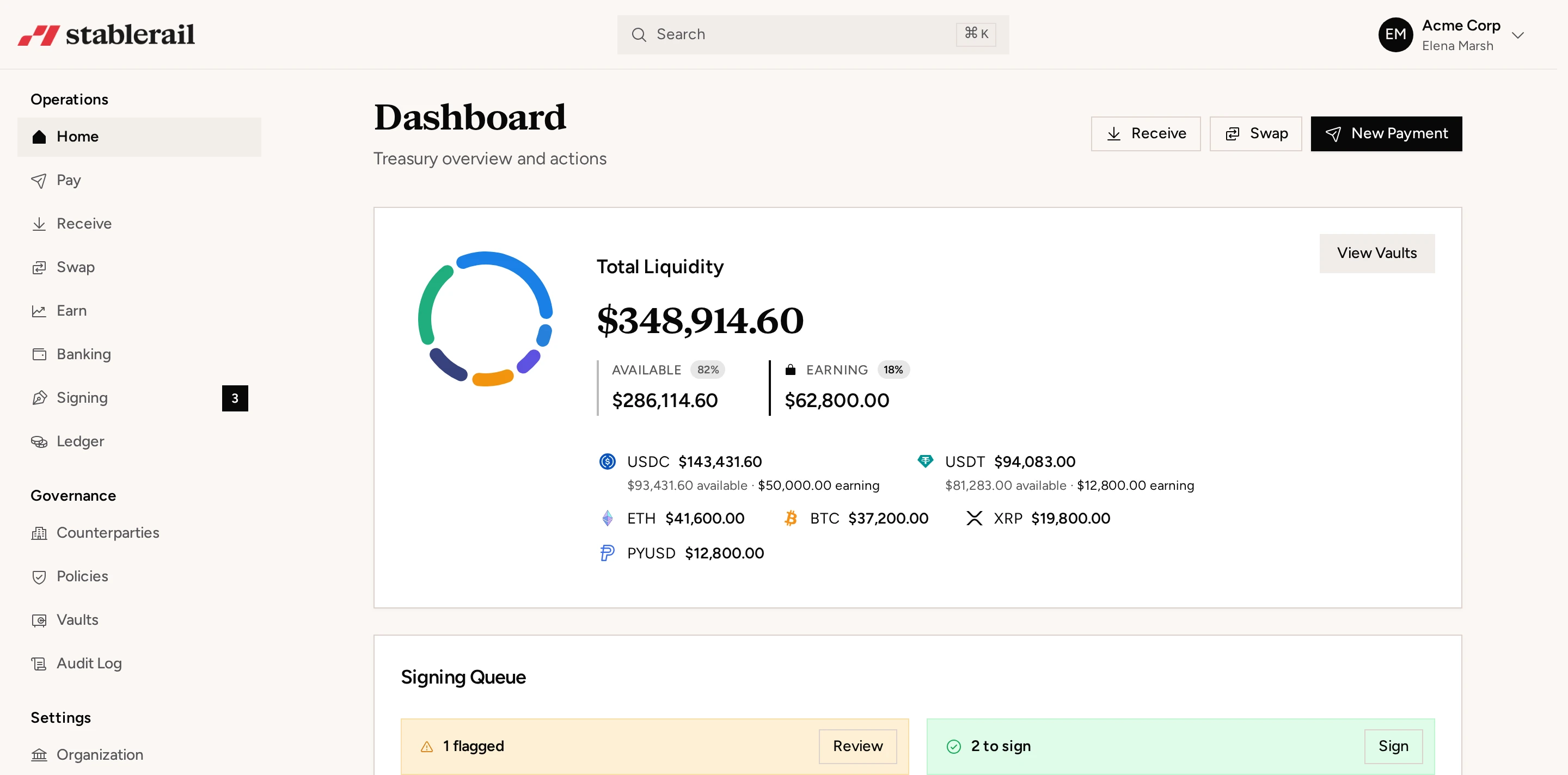
Stablerail is an example of a business account that brings USDC and USDT treasury operations into one environment, including approvals and signing quorum, sanctions and address screening before send, global payouts, fiat off-ramp, corporate cards and exportable audit evidence. Finance teams should still test its network, token, workflow and integration coverage against their own operating model.
The strongest architecture is usually layered: secure key management, preventive payment controls, on-chain status monitoring and finance-grade evidence. Buying several tools does not automatically create that architecture. The handoffs between them must preserve transaction identity, approval state and accountability.
Audit evidence and management reporting
Blockchain data proves that an address transferred a token amount to another address at a particular time. It does not, by itself, prove that the recipient was the intended vendor, the invoice was valid, the approvers had authority or the transfer was recorded in the correct accounting period.
For each material payment, retain the payment request, business purpose, recipient record, network and asset, screening result, approval history, signing record, transaction hash, final status and reconciliation reference. Evidence should be exportable in a form that auditors and controllers can inspect without relying on screenshots.
Management reporting should focus on actionable exceptions rather than raw activity. Useful categories include new-recipient payments, changed addresses, screening escalations, rejected requests, failed transactions, unreconciled transfers and wallet activity outside the approved workflow. Trends in these categories reveal process weaknesses that balance monitoring alone will miss.
The practical decision
Choose a custody platform for secure key administration and controlled signing. Add a treasury control layer when finance needs payment context, pre-send checks, structured approvals, payout operations and audit-ready evidence. For many stablecoin businesses, the answer is not one category or the other but a clearly integrated control stack.
The decisive question is whether the team can prevent an invalid transfer before signature and explain every valid transfer afterward. A monitoring tool that only reports what already happened may be real time, but it is not a complete stablecoin treasury control system.
Frequently asked questions
What should a stablecoin treasury monitor in real time?
Monitor payment requests, recipient changes, address-screening results, approvals, signatures, transaction status and unexpected wallet activity. After confirmation, match each transfer to its business record and accounting entry.
Is a custody platform enough for stablecoin treasury monitoring?
A custody platform may be sufficient for restricted reserve wallets focused on key security and controlled signing. Operating treasuries often need an additional workflow layer for payment context, pre-send screening, approvals, reconciliation and exportable audit evidence.
Should stablecoin addresses be screened before every payment?
Screening should occur close to execution because sanctions designations and on-chain risk information can change. Finance should retain the result, timestamp and review decision, while recognizing that an alert requires investigation rather than automatic conclusions.
What audit evidence should be retained for USDC and USDT payments?
Retain the payment purpose, supporting document, recipient record, asset and network, screening result, approvals, signing record, transaction hash, final status and reconciliation reference. Blockchain history alone does not establish business authorization or accounting treatment.
How do finance teams monitor failed or pending stablecoin transactions?
Use a tool that distinguishes submitted, pending, confirmed, failed, dropped and replaced transactions where the network supports those states. Assign an exception owner and reconcile the final transaction hash rather than assuming broadcast means settlement.
Former CEO of Simple, a self-custodial wallet with $2B+ in transaction volume across 75+ countries.
More about the Stablerail team- Stablecoin treasury managementApprovals, limits, yield and reporting on one balance.
- Stablecoin payoutsBatch contractor and vendor payments with screening.
- USDT vs USDCWhich stablecoin your company should settle in.
- Stablecoin finance glossaryMPC, off-ramp, travel rule and the rest, in plain English.
- Product updatesEverything we ship, month by month.