
Real-Time Address Screening for Stablecoins
Real-time address screening checks stablecoin destinations before signing. Learn the data, workflow, controls and evidence finance teams need to manage sanctions and counterparty risk.
Real-time address screening checks a stablecoin destination against sanctions data, blockchain intelligence and internal counterparty records before a transaction is signed and broadcast. The control should verify the network and address, identify direct or indirect risk, route uncertain results for review and preserve the evidence behind the decision. Screening reduces compliance risk, but it does not replace counterparty due diligence, approval controls or post-transaction monitoring.

Real-time address screening checks a stablecoin destination against sanctions data, blockchain intelligence and internal counterparty records before a transaction is signed and broadcast. An effective control verifies the network and address, identifies direct or indirect risk, routes uncertain results for review and preserves the evidence behind the decision. It reduces the chance of an irreversible payment reaching a prohibited or unacceptable counterparty.
What real-time address screening means
Address screening is a pre-transaction control for payments involving assets such as USDC and USDT. It evaluates the destination address and relevant transaction context while the payment can still be stopped. This matters because a confirmed blockchain transfer generally cannot be recalled by the sender, even when the recipient was entered incorrectly or later proves problematic.
“Real time” should mean that the screening result is current enough to govern the payment before signing. It does not require every check to finish within a particular number of milliseconds. The operational requirement is that no signer or automated process can broadcast the transaction until the required screening and approval steps are complete.
Address screening is narrower than a complete compliance program. It does not establish the beneficial owner of an unhosted wallet, collect Travel Rule information, verify an invoice or prove that a payment has a legitimate business purpose. Finance teams should combine it with counterparty onboarding, payment approvals, signing quorum and transaction monitoring.
How the screening process works
- Capture the payment intent. Record the legal counterparty, business purpose, invoice or batch reference, stablecoin, amount, blockchain network and destination address.
- Validate the address and network. Confirm that the address format is valid for the selected chain and that the treasury is using the intended token contract. An address can appear valid while still being entered for the wrong network.
- Check direct sanctions exposure. Compare the destination with digital currency addresses published by relevant sanctions authorities and other legally applicable restrictions.
- Assess blockchain exposure. Use blockchain intelligence to identify attributed entities, address clusters, transaction history and links to risk categories such as theft, fraud, ransomware, mixers or sanctioned services.
- Apply internal controls. Compare the request with approved vendor records, previously verified addresses, payment limits and known changes to counterparty instructions.
- Return a decision. Allow low-risk payments to continue, place uncertain results on hold for review and block payments that breach a non-overridable rule.
- Re-screen before signing. If approval takes time, refresh the result immediately before signature because sanctions designations, address attribution and risk intelligence can change.
- Retain evidence. Store the inputs, data-provider result, timestamp, reviewer decision, approvals and final transaction hash.
What data should be screened?
A reliable decision uses several types of evidence. No single risk score should determine whether the treasury sends funds.
| Data layer | What it detects | Operational treatment | Evidence to retain |
|---|---|---|---|
| Official sanctions data | Direct matches to listed addresses or identified sanctioned parties | Block or escalate according to applicable law and counsel-approved procedures | List source, list version or retrieval time, matched record and address |
| Blockchain intelligence | Attributed ownership, address clusters and direct or indirect exposure to risk categories | Apply documented thresholds and require review where context is uncertain | Provider, risk category, exposure path, score or severity and timestamp |
| Counterparty records | Mismatch between the requested destination and the address verified during onboarding | Hold the payment and confirm changes through a previously trusted channel | Vendor record, verification method, requestor and confirmation |
| Transaction context | Unusual amount, asset, network, timing or payment purpose | Require additional approval or supporting documentation | Invoice, payment request, approvers and exception rationale |
| Post-transaction monitoring | Risk discovered after settlement or a later designation | Investigate exposure, preserve records and follow the escalation plan | Alert, transaction hash, investigation notes and final disposition |
Official sources can include the US Office of Foreign Assets Control sanctions lists, the EU consolidated list, United Nations Security Council lists and the UK sanctions list. Which lists and restrictions apply depends on the entities, people and jurisdictions involved. Legal counsel should define the treasury’s sanctions scope rather than leaving that decision to a software vendor.
Blockchain analytics adds information that watchlists cannot provide. Providers may associate addresses with exchanges, bridges, mixers, exploits or other services and trace exposure through prior transactions. These associations are probabilistic in some cases. A cluster-level attribution or indirect link therefore requires context, including the direction of funds, number of hops, proportion of exposure, time elapsed and reliability of the attribution.
Direct matches and indirect exposure require different controls
A direct match to a listed digital currency address is not equivalent to a small, indirect historical exposure. Combining both into a generic “high-risk” score can cause inconsistent decisions.
Finance teams should define separate treatments for:
- Exact address matches: the destination is itself present in an applicable sanctions or deny list.
- Attributed entity matches: analytics connects the address to a named service or controlled wallet cluster.
- Direct exposure: the address recently sent funds to or received funds from a risky address.
- Indirect exposure: the connection exists through one or more intermediary addresses.
- Behavioral alerts: activity resembles a risk pattern but has no confirmed prohibited counterparty.
Thresholds should be documented by risk category, direction, depth and materiality. Reviewers also need the underlying transaction path, not only a score. A score without an explanation is difficult to challenge, approve or defend during an audit.
Reducing false positives without weakening the control
Crypto-address matching is normally exact; fuzzy name-matching methods do not correct a nearly typed wallet address. A one-character difference may identify an entirely different destination. Fuzzy matching is relevant when screening counterparty names, aliases or beneficial owners, but it should not be presented as a solution to address-level false positives.
False alerts more often arise from broad address clustering, indirect exposure rules, outdated attribution or risk thresholds that ignore transaction context. Teams can improve precision by separating direct from indirect links, displaying the transaction path, recording attribution confidence and requiring a second reviewer for ambiguous cases.
An approved-address list is useful, but it should not permanently bypass sanctions and blockchain screening. A previously verified wallet can be compromised, reassigned by a custodial provider or newly associated with risk. Treat approval as proof that the address belongs to the expected counterparty, then refresh risk screening before each payment or at a documented frequency appropriate to the workflow.
Where screening belongs in treasury governance
The strongest placement is after the payment request has been assembled but before final approval and signature. Screening too early can become stale; screening only after broadcast can identify exposure but cannot prevent the transfer.
The result should feed a controlled workflow with distinct roles. A requestor creates the payment, an authorized reviewer examines alerts, approvers confirm the business purpose and designated signers satisfy the required quorum. No single employee should be able to change a destination address, dismiss an alert and sign the transaction without independent oversight.
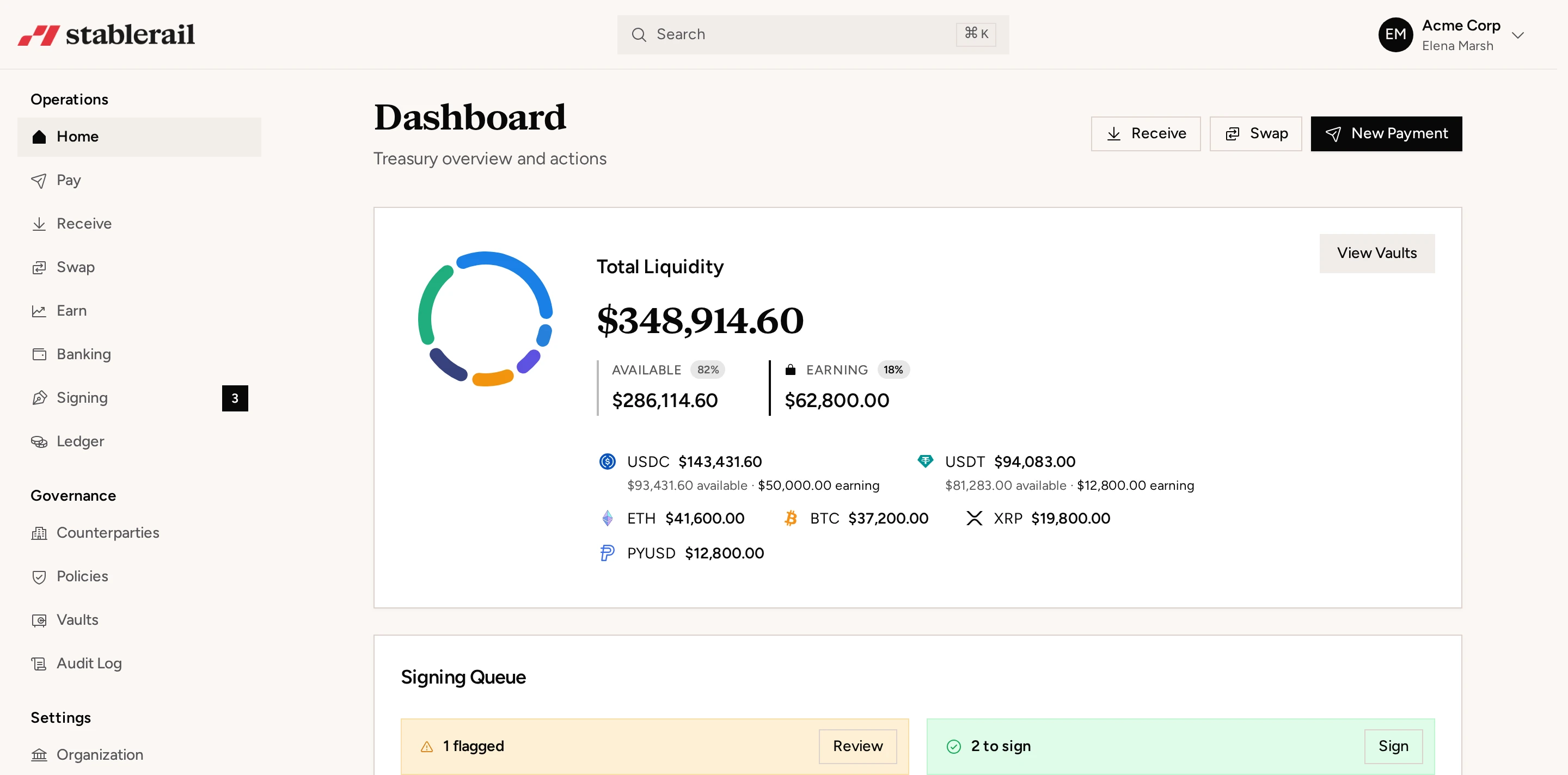
Stablerail supports this model through sanctions and address screening before send, approvals and signing quorum, and exportable audit evidence for USDC and USDT treasury activity. Screening can sit alongside corporate cards, global payouts and fiat off-ramp activity within the same business account.
Minimum evidence for each payment
- Counterparty name, payment purpose and source document
- Stablecoin, token contract, blockchain network and destination address
- Screening provider, result, categories and screening timestamp
- Transaction path or other evidence supporting any alert
- Reviewer disposition and written reason for an exception
- Approver identities, signing record and final transaction hash
Evidence should be exportable and tied to the accounting record. This lets controllers reconcile the on-chain transfer to the invoice, payroll file or redemption request and explain why the transaction was permitted at the time.
Regulatory considerations
Sanctions obligations vary by jurisdiction, entity and transaction. In the United States, OFAC publishes guidance for the virtual currency industry and identifies some digital currency addresses associated with listed persons. Screening an address is a practical control, but an address absent from a list is not automatically safe: a sanctioned person may control an unlisted wallet.
The FATF Travel Rule is related but distinct. It concerns the transmission of specified originator and beneficiary information between covered virtual asset service providers under local implementation. An address-risk check does not collect or transmit that information. Likewise, EU rules affecting crypto-asset service providers should not be reduced to a single wallet-screening requirement.
Finance teams should map each legal obligation to a specific control: sanctions screening, customer or counterparty due diligence, Travel Rule data exchange, record retention and suspicious activity escalation where applicable.
Implementation checklist for finance teams
- Document the jurisdictions, sanctions programs and risk categories that apply.
- Require chain, token contract and destination validation for every payment.
- Separate exact matches, attributed ownership and indirect exposure in the decision logic.
- Define which alerts block automatically and which require documented review.
- Verify address changes through a channel independent of the payment request.
- Refresh screening after long approval delays and immediately before signing.
- Test the workflow with blocked, held, stale and unavailable-provider scenarios.
- Export evidence regularly and reconcile it to the ledger and transaction hash.
Real-time address screening is most effective when it is treated as an enforceable treasury control rather than a standalone lookup. The objective is not simply to produce a risk score. It is to prevent an unacceptable transfer, give reviewers enough evidence to resolve uncertainty and leave a defensible record of the decision.
Frequently asked questions
When should a stablecoin address be screened?
Screen it when the payment is created and refresh the result immediately before signing or broadcast. A second check is important when approval has been delayed because sanctions lists, attribution data and address risk can change.
Does address screening make a USDC or USDT payment compliant?
No. Address screening helps identify sanctions and blockchain exposure, but it does not replace counterparty due diligence, Travel Rule obligations, payment approvals or legal analysis. Compliance depends on the parties, jurisdictions and transaction context.
What is the difference between sanctions screening and blockchain analytics?
Sanctions screening checks addresses and parties against applicable official restrictions. Blockchain analytics evaluates transaction history, attributed entities, wallet clusters and direct or indirect exposure to other risk categories.
Should an approved wallet address bypass future screening?
No. Approval can confirm that an address belongs to the expected counterparty, but the address may later be compromised, sanctioned or connected to new risk. Re-screen it before payment according to a documented control.
What should finance teams do when an address is flagged?
Pause the transaction and review the matched record, attribution confidence, transaction path and counterparty context. Record the reviewer’s decision and supporting evidence; direct matches subject to a non-overridable legal rule should not be cleared as ordinary exceptions.
Former CEO of Simple, a self-custodial wallet with $2B+ in transaction volume across 75+ countries.
More about the Stablerail team- Stablecoin treasury managementApprovals, limits, yield and reporting on one balance.
- Stablecoin payoutsBatch contractor and vendor payments with screening.
- USDT vs USDCWhich stablecoin your company should settle in.
- Stablecoin finance glossaryMPC, off-ramp, travel rule and the rest, in plain English.
- Product updatesEverything we ship, month by month.