
How to Build Vendor Payment Controls for Stablecoins
A practical framework for controlling USDC and USDT vendor payments, from wallet governance and vendor onboarding to approvals, screening, reconciliation and incident response.
Stablecoin vendor payment controls should separate payment creation, approval and signing; restrict transfers to verified vendor addresses, tokens and networks; screen recipients before sending; and preserve evidence linking each invoice to its approvals and transaction hash. Finance teams should also define value-based approval quorums, test new addresses with small transfers, reconcile on-chain activity to the ledger and maintain an incident process for suspicious or mistaken payments.

Stablecoin vendor payment controls should prevent one person from creating, approving and sending a payment without independent review. A sound process verifies the vendor and wallet address, limits permitted tokens and networks, screens the destination before signing, applies an approval quorum based on risk, and records the complete chain from invoice to on-chain settlement.
This matters because stablecoin transfers combine familiar accounts-payable risks with blockchain-specific failure modes. A fraudulent bank-detail change may sometimes be recalled; a confirmed USDC or USDT transfer generally cannot be reversed unilaterally. Controls therefore need to operate before signing, not only during month-end review.
The control model at a glance
| Payment stage | Primary risk | Required control | Evidence to retain |
|---|---|---|---|
| Vendor onboarding | Fraudulent entity or substituted wallet | Verify the legal entity, payment instructions and address through an independent channel | Vendor record, verification date, reviewer and source documents |
| Payment creation | Wrong amount, token, chain or invoice | Require structured payment fields and match them to an approved invoice | Invoice ID, amount, token, network, creator and timestamp |
| Approval | Unauthorized or conflicted payment | Separate creator and approver roles; increase quorum for higher-risk payments | Approver identities, timestamps and comments |
| Pre-send review | Sanctioned, risky or incorrect destination | Screen the address and confirm the final transaction details before signing | Screening result, list or data version, disposition and reviewer |
| Execution | Compromised signer or altered transaction | Use controlled signing devices or MPC-based signing with an appropriate quorum | Signer records, transaction hash and wallet activity |
| Reconciliation | Missing, duplicated or misclassified payment | Match the transaction to the invoice, ledger entry and applicable network fee | Reconciliation record, exceptions and accounting treatment |
Step 1: Establish wallet governance
Start by deciding where vendor-payment funds will sit and who can move them. Avoid keeping the full operating balance in a wallet controlled by one employee, one device or one recovery phrase. Separate long-term reserves from the operating wallet used for routine payments, and fund the operating wallet according to forecast needs.
MPC wallets can reduce key-person risk by distributing signing participation so that no single device holds or uses a complete private key during signing. Multisignature wallets can provide a similar governance outcome through multiple on-chain signatures. The appropriate model depends on network support, transaction volume, recovery requirements and whether counterparties need visibility into the signing structure.
Signing quorum is a governance decision, not merely a wallet feature. Document which roles may initiate, approve and sign; how signers are added or removed; where recovery materials are held; and what happens when a signer is unavailable. Test recovery and signer replacement before the wallet contains a material balance.
Step 2: Verify vendors and wallet instructions
Treat a new wallet address like a change to bank details. Collect it through an authenticated vendor channel, then confirm it through a different channel using contact information already on file. Do not rely on a reply to the same email thread that supplied the address, because the mailbox itself may be compromised.
The vendor master should record the legal entity, approved token, blockchain network, exact wallet address, address owner or beneficiary where known, verification method, verifier and verification date. For token transfers, confirm the token contract rather than relying only on a ticker symbol; fraudulent assets can use familiar names.
A wallet allowlist reduces manual entry risk, but changes to that list need their own approval process. A newly added or changed address should trigger fresh verification and elevated review. Where practical, send a small test payment and ask the vendor to confirm receipt before transmitting the remaining amount. A test transfer confirms control and network compatibility, but it does not replace identity or sanctions checks.
Step 3: Define payment and approval rules
Write rules that a controller, auditor and payment operator can understand. At minimum, specify permitted stablecoins and networks, transaction and daily limits, required approvers, prohibited self-approval, treatment of new addresses, and circumstances requiring legal or compliance review.
| Payment condition | Recommended treatment | Reason |
|---|---|---|
| Existing vendor and previously verified address | Apply the normal accounts-payable approval path | Known destination with established history |
| New or changed wallet address | Require independent callback verification and an additional reviewer | Vendor-detail changes are a common fraud point |
| Payment above the company’s materiality threshold | Require a higher signing quorum or senior finance approval | Limits the impact of error or account compromise |
| Unapproved token or network | Block and return for correction | Prevents unsupported assets, routing errors and accounting confusion |
| Screening alert or unexplained address exposure | Pause for documented compliance review | Automated alerts require contextual disposition |
| Urgent request outside the normal process | Use the same controls and document the exception | Urgency should not bypass segregation of duties |
Thresholds should reflect the company’s liquidity, risk appetite and delegated-authority matrix rather than arbitrary market examples. The process should also prevent payment splitting designed to remain below an approval threshold.
Step 4: Perform checks before signing
The final review should occur after the transaction is assembled but before it is cryptographically signed. Confirm the destination address character by character or through a trusted saved record, and verify the amount, token contract, network and applicable fee. Wallet interfaces can abbreviate addresses, so reviewers should not approve based only on the first and last few characters.
Screen the destination address before sending and document the result. Depending on the company’s obligations and risk assessment, review may include sanctions exposure, known illicit-service associations and the vendor’s jurisdiction or business activity. Screening is not a substitute for legal analysis: an alert may reflect direct designation, indirect exposure or incomplete attribution, and each can require different handling.
Rescreen if the address or transaction changes after approval. Ideally, the approved payment record should be bound to the exact recipient, amount, asset and network presented to the signer. A changed field should invalidate the prior approval rather than silently carrying it forward.
Step 5: Execute and monitor the transfer
Before sending, ensure the wallet has enough native network asset to pay gas where required. Keep gas funding controlled and monitored; an otherwise valid payment can fail or remain unsent if the wallet cannot pay the network fee.
After broadcast, record the transaction hash and monitor its status on the intended network. Distinguish between submitted, confirmed and failed transactions. Do not create a replacement merely because confirmation is slower than expected; first check the original transaction to avoid duplicate payment.
Stablecoin issuers may also have administrative capabilities under their token contracts, while blockchains can experience congestion, reorganizations or service interruptions. Treasury procedures should define when a payment is considered operationally final and when the vendor may recognize receipt.
Step 6: Reconcile and preserve audit evidence
Reconciliation should connect four records: the approved invoice, the payment instruction, the wallet transaction and the general-ledger entry. Capture the transaction hash, wallet addresses, token amount, fiat reporting value under the company’s accounting policy, network fee and confirmation timestamp.
Investigate unmatched wallet activity promptly. Common exceptions include duplicate payments, transfers from an unrecognized wallet, failed transactions, fee-only movements and a vendor receiving a different amount because of an incorrect instruction. A block explorer proves that a transaction occurred, but not that it was properly authorized or tied to a valid invoice.
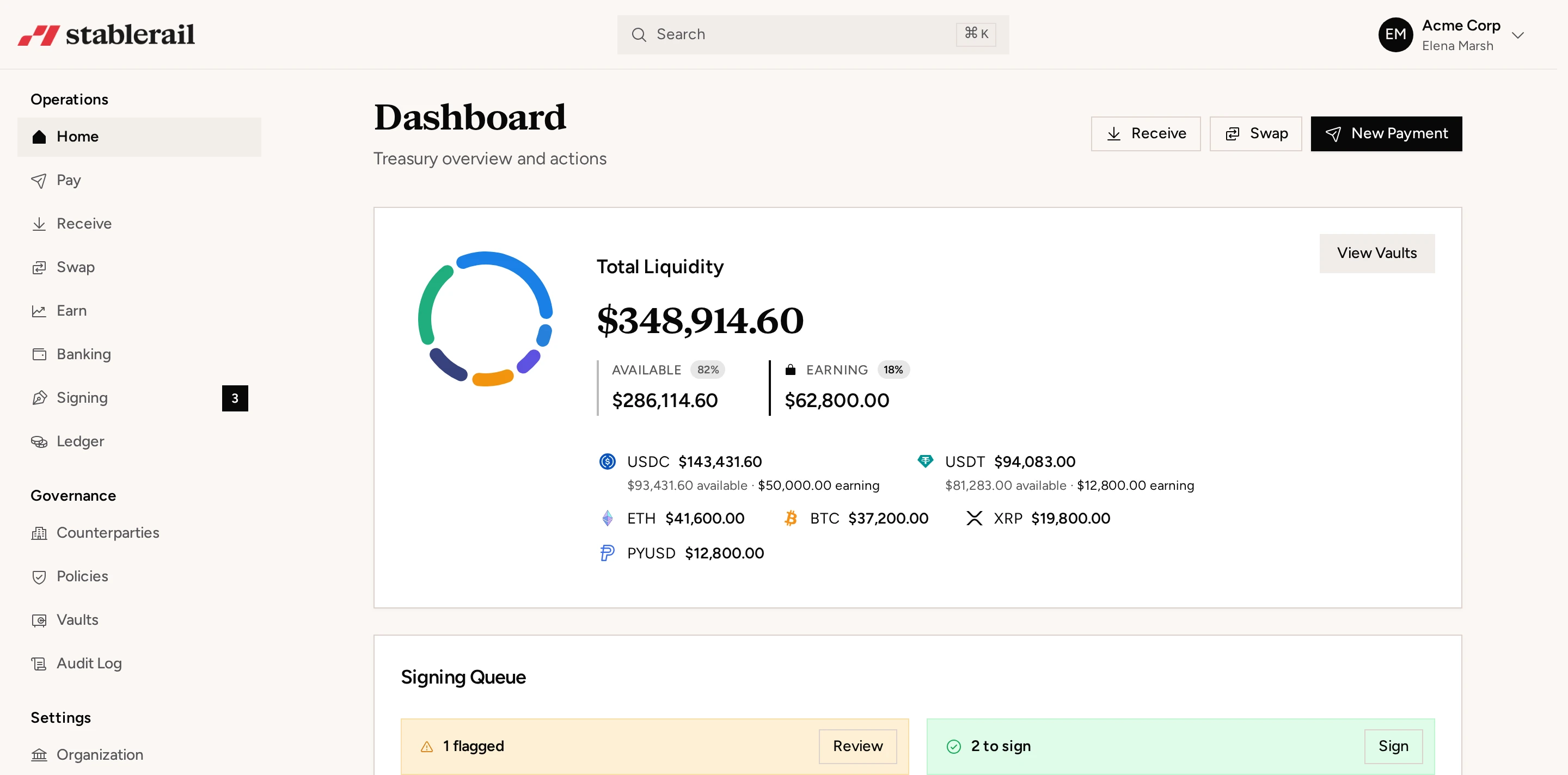
Retain exportable evidence of vendor verification, approvals, screening, signing and reconciliation. Systems such as Stablerail can centralize USDC and USDT treasury workflows with approval and signing quorums, pre-send sanctions and address screening, global payouts, fiat off-ramp and exportable audit evidence. Whatever system is used, access reviews and evidence exports should be tested periodically.
Finance team implementation checklist
- Separate payment creation, approval and signing responsibilities.
- Approve the stablecoins, token contracts and networks the company may use.
- Verify every new or changed vendor address through an independent channel.
- Set risk-based approval thresholds and prohibit self-approval.
- Screen the final destination before signing and document alert decisions.
- Confirm the exact address, amount, asset and network at the signing step.
- Reconcile each transaction hash to an invoice and ledger entry.
- Document procedures for signer loss, suspected compromise, mistaken transfers and duplicate payments.
The strongest control environment does not depend on one careful operator. It makes the safe path the normal path, requires independent action for material decisions and produces evidence that allows finance, compliance and auditors to reconstruct every payment.
Frequently asked questions
What controls are needed for stablecoin vendor payments?
At minimum, separate payment creation from approval and signing, verify vendor wallet addresses independently, restrict permitted tokens and networks, screen destinations before sending, and reconcile every transaction to an invoice. Approval evidence and the transaction hash should be retained together.
Should a company use MPC or multisig for vendor payments?
Both can reduce dependence on a single signer when configured correctly. MPC distributes cryptographic signing participation, while multisig records multiple signatures through a blockchain contract; the choice depends on network support, recovery needs, transaction visibility and operational complexity.
How should finance verify a vendor’s stablecoin wallet address?
Collect the address through an authenticated channel and confirm it using contact information already held in the vendor master. Record the token and network, require separate approval for address changes, and consider a small test transfer before sending a material amount.
Do stablecoin addresses need sanctions screening before every payment?
The address should be screened before funds are sent, particularly when it is new, changed or associated with an alert. The exact frequency and scope depend on the company’s jurisdiction, risk assessment and legal obligations, and alerts should receive documented review rather than automatic assumptions.
What evidence should auditors receive for a stablecoin payment?
Provide the invoice, vendor verification record, payment instruction, approver and signer logs, screening result, transaction hash and reconciliation to the general ledger. A block explorer record alone shows the on-chain transfer but does not prove business purpose or authorization.
Former CEO of Simple, a self-custodial wallet with $2B+ in transaction volume across 75+ countries.
More about the Stablerail team- Stablecoin treasury managementApprovals, limits, yield and reporting on one balance.
- Stablecoin payoutsBatch contractor and vendor payments with screening.
- USDT vs USDCWhich stablecoin your company should settle in.
- Stablecoin finance glossaryMPC, off-ramp, travel rule and the rest, in plain English.
- Product updatesEverything we ship, month by month.