
Stablecoin Payments vs. Bank Wires
Stablecoins offer 24/7 settlement and direct global transfers, while bank wires provide broad acceptance and established controls. Compare costs, risks and use cases.
Stablecoin payments are generally better for 24/7 settlement, cross-border treasury transfers and recipients that can accept USDC or USDT. Bank wires remain better when counterparties require fiat, banking documentation or established bank workflows. Neither rail is universally cheaper or safer: finance teams must compare total fees, settlement timing, compliance controls, custody risk, conversion costs and the recipient’s ability to use the funds.

Stablecoin payments are generally the faster option for moving value globally outside banking hours, while bank wires offer broader fiat acceptance and familiar bank-led controls. The right choice depends on more than transfer speed: treasury teams should compare the recipient’s needs, total delivered cost, settlement finality, compliance obligations, approval controls, liquidity and the work required to reconcile the payment.
Stablecoin payments vs. bank wires at a glance
| Decision factor | Bank wire | Stablecoin payment |
|---|---|---|
| Operating window | Subject to bank, payment-system, weekend and holiday schedules | Blockchain transfers are available 24/7, although exchanges and off-ramps may have their own operating constraints |
| Settlement speed | Domestic wires may settle the same day; cross-border payments can take longer when correspondent banks or reviews are involved | On-chain settlement typically occurs within seconds or minutes, depending on the network and required confirmations |
| Total cost | May include sending, receiving, correspondent and foreign-exchange charges | May include network, platform, custody, token conversion, foreign-exchange and fiat off-ramp charges |
| Recipient requirements | Recipient needs a compatible bank account and correct banking instructions | Recipient needs a compatible wallet, token, blockchain network and a way to hold or convert the funds |
| Transaction visibility | Status is provided through banks and payment messages | Transaction status is visible on-chain, but legal ownership and payment purpose require internal records |
| Error recovery | A bank may attempt a recall, but completed wires are not reliably reversible | Confirmed blockchain transfers are generally irreversible; recovery depends on the recipient’s cooperation |
| Primary operational risks | Incorrect instructions, payment fraud, cut-off delays, compliance holds and intermediary deductions | Wrong addresses or networks, key compromise, token or issuer risk, smart-contract risk and off-ramp failure |
| Best fit | Fiat-only recipients, established bank workflows and transactions requiring conventional banking records | Time-sensitive treasury movements and payments to parties already equipped to receive USDC or USDT |
How bank wires work in corporate finance
A wire begins with the beneficiary’s legal name, account number, bank name and routing information. A US domestic wire commonly requires an ABA routing number. International instructions may require an IBAN, SWIFT or BIC code, beneficiary address, payment purpose and details for an intermediary bank.
Domestic and international wires should not be treated as the same process. Fedwire, for example, is a real-time gross settlement system, so participating institutions can settle eligible US dollar payments with finality during the system’s operating window. A bank may still impose an earlier customer cut-off or hold a payment for review.
SWIFT, by contrast, primarily carries standardized financial messages. An international payment may move through correspondent accounts before reaching the beneficiary bank. Each institution can perform sanctions screening, request information or deduct a charge. Consequently, the beneficiary may receive less than the amount sent unless the fee arrangement is defined in advance.
Bank-wire strengths and limitations
Wires fit naturally into existing treasury operations. Banks already identify their customers, maintain account records and support approval workflows, statements and payment investigations. Most corporate counterparties can provide bank instructions, and the beneficiary receives fiat without having to manage a wallet or sell a digital asset.
However, a wire is not automatically reversible. If instructions are fraudulent or incorrect, the sending bank can request a recall, but recovery generally depends on timing, the receiving institution and whether the funds remain available. Finance teams should verify changes to bank instructions through a trusted channel rather than treating a possible recall as a control.
The quoted wire fee also does not reveal the full cost. Treasury should include beneficiary fees, correspondent deductions, foreign-exchange spread, investigation charges and the financing effect of uncertain delivery. For cross-border payments, compare the exact amount expected to arrive in the destination currency.
How stablecoin payments work
A stablecoin payment transfers a token such as USDC or USDT from one blockchain address to another. The sender must select the correct token and network, enter the recipient’s address, authorize the transaction and pay the network fee. Validators then confirm the transaction according to the rules of that blockchain.
On-chain confirmation can occur within seconds or minutes and is available on weekends and holidays. That does not mean every end-to-end payment is instant. Wallet providers may wait for additional confirmations, and converting the token into bank money can introduce onboarding checks, liquidity constraints, bank cut-offs and withdrawal delays.
Token symbols alone are insufficient payment instructions. The sender and recipient must agree on the asset, blockchain network and destination address. Sending a supported token over an unsupported network can leave funds inaccessible even when the address format appears valid.
The real cost of a stablecoin payment
Network fees are only one component. The sender may pay for custody or transaction infrastructure, while the recipient may incur conversion and withdrawal charges. A business buying stablecoins with fiat also needs to measure the acquisition price against the relevant currency, including any spread.
Costs vary by blockchain congestion, token, provider, transaction size and the currencies used at each end. Stablecoins can remove correspondent banks from the on-chain leg, but they do not eliminate costs if both parties ultimately need fiat. The correct comparison is the total amount debited from the sender against the usable amount received by the beneficiary.
Compliance and governance differences
Bank wires place much of the customer onboarding and transaction screening infrastructure inside regulated financial institutions. That does not remove the company’s responsibility to verify vendors, document payment purpose, protect credentials and investigate unusual activity.
Stablecoin payments shift more operational responsibility to the business and its providers. Before sending, a finance team should confirm the legal counterparty, screen applicable sanctions exposure, assess the destination address, retain supporting documents and determine whether local reporting or information-sharing rules apply. Blockchain screening can identify known or suspected exposure, but it cannot prove that a pseudonymous address belongs to the person named on an invoice.
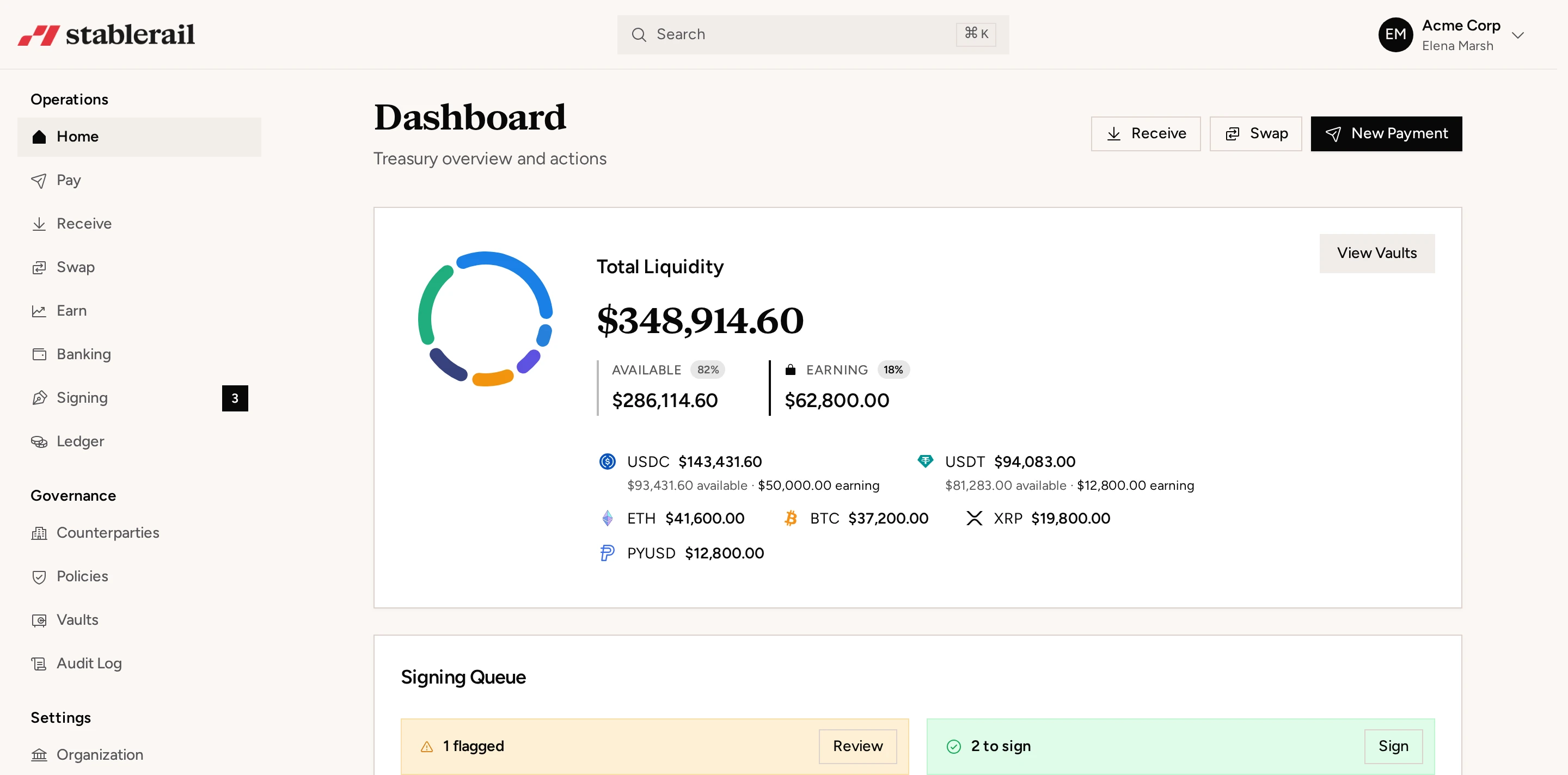
Governance should also prevent one employee from creating, approving and signing a payment. A system such as Stablerail can combine a business account for USDC and USDT with approvals and signing quorum, sanctions and address screening before send, global payouts, fiat off-ramp, corporate cards and exportable audit evidence.
Audit and accounting requirements
A blockchain transaction hash proves that tokens moved between addresses; it does not prove why the payment was made or who controlled the recipient address. For every stablecoin transaction, retain the invoice or treasury instruction, counterparty identity, approval record, sending and receiving addresses, token, network, transaction hash, timestamp, amount, network fee and accounting value.
Wallet balances should be reconciled to the general ledger and independently verified on the relevant blockchain. Finance teams also need a documented policy for token classification, valuation, fees and gains or losses. The accounting treatment can depend on the token, facts and reporting framework, so it should be agreed with the company’s accountants and auditors rather than inferred from the word “stablecoin.”
When to use each payment rail
Use a bank wire when:
- The beneficiary requires fiat in a bank account.
- The transaction depends on conventional bank documentation or established closing procedures.
- The recipient cannot securely receive, hold or convert the intended stablecoin.
- The off-ramp would add more cost or delay than the on-chain transfer saves.
Consider a stablecoin payment when:
- Both parties have agreed on the token, network and destination address.
- The payment or treasury transfer must settle outside banking hours.
- The recipient can use the stablecoin directly or has a reliable conversion route.
- Faster settlement materially improves liquidity or reduces prefunding needs.
Many companies use a hybrid model. They retain bank wires for fiat-native counterparties and use stablecoins for approved corridors, treasury movements or vendors that can accept them. The objective is not to replace every bank payment, but to select the rail that delivers the required currency, timing and evidence with acceptable risk.
Pre-send checklist for finance teams
- Verify the beneficiary: confirm new or changed instructions through a trusted contact method.
- Calculate total delivered cost: include FX, intermediary, network, conversion and off-ramp charges.
- Confirm compatibility: for stablecoins, verify the token, blockchain network and wallet support.
- Screen before sending: complete required sanctions, counterparty and destination-address checks.
- Enforce separation of duties: require independent preparation, approval and signing.
- Test unfamiliar routes: send a small amount first where commercially practical, then verify receipt.
- Capture evidence: retain instructions, approvals, fees, bank references or transaction hashes and proof of receipt.
- Reconcile promptly: match the payment to the ledger and investigate differences in amount or timing.
The best rail is the one that completes the full business payment, not merely its first leg. A stablecoin transfer that settles quickly but cannot be converted by the recipient may be less useful than a wire. Conversely, a wire that remains in correspondent review can be inferior to an approved on-chain payment when both parties already operate with stablecoins.
Frequently asked questions
Are stablecoin payments faster than bank wires?
The on-chain portion of a stablecoin payment usually settles within seconds or minutes and operates 24/7. Bank wires may settle the same day domestically, while cross-border payments can take longer because of cut-offs, correspondent banks and compliance reviews.
Are stablecoin payments cheaper than international wires?
They can be, but network fees alone are not a valid comparison. Include stablecoin acquisition, platform, custody, conversion, FX and off-ramp costs, then compare the amount the beneficiary can actually use.
Can a bank wire or stablecoin payment be reversed?
Neither should be treated as reliably reversible. A bank may attempt to recall a wire, but recovery is not guaranteed; a confirmed stablecoin transfer generally requires the recipient to cooperate in returning the funds.
What information is needed to send a stablecoin business payment?
Finance teams need the recipient’s verified wallet address, the exact token, the blockchain network and the payment amount. They should also retain counterparty records, approvals, screening results, the transaction hash and the business purpose.
Are stablecoin payments compliant for businesses?
Stablecoins can be used within a compliant corporate process, but blockchain settlement does not replace KYC, sanctions, tax, accounting or reporting obligations. Requirements vary by jurisdiction, counterparties and the service providers involved.
Should a company replace bank wires with stablecoins?
Usually not across every payment. A hybrid approach lets the company use stablecoins for approved, time-sensitive routes while retaining wires for fiat-only beneficiaries and transactions built around established banking processes.
Former CEO of Simple, a self-custodial wallet with $2B+ in transaction volume across 75+ countries.
More about the Stablerail team- Stablecoin treasury managementApprovals, limits, yield and reporting on one balance.
- Stablecoin payoutsBatch contractor and vendor payments with screening.
- USDT vs USDCWhich stablecoin your company should settle in.
- Stablecoin finance glossaryMPC, off-ramp, travel rule and the rest, in plain English.
- Product updatesEverything we ship, month by month.