
What CFOs Need for Stablecoin Audit Trails
CFOs need a pre-sign, policy-as-code audit trail tying business intent to on-chain stablecoin settlements for compliant, auditable payments.

Mar 31, 2026
When using stablecoins for payments, CFOs face a key challenge: creating detailed audit trails that connect blockchain transactions to business intent and compliance measures. Unlike traditional bank wires, stablecoin payments are instant and irreversible, making it critical to establish controls before transactions are signed. Here's what CFOs need to know:
Audit Trail Layers: A complete audit trail requires four layers:
Business Events: Links blockchain data to invoices or payroll records.
Decision Records: Explains why approvals were granted, referencing policies.
Control Checks: Verifies sanctions compliance, risk assessments, and error detection.
Blockchain Data: Captures transaction hashes, timestamps, and USD values for tax reporting.
Key Compliance Steps:
Pre-Sign Verification: Ensures every transaction aligns with internal policies and regulatory requirements.
Sanctions Screening: Checks counterparties against OFAC lists and other databases.
Anomaly Detection: Flags unusual payment patterns for review.
Policy-as-Code: Automates governance by embedding rules directly into payment workflows.
Human Oversight: Automated systems handle checks, but human approvals remain essential for high-risk transactions. Multi-step workflows ensure accountability and prevent fraud.
Four Layers of a Complete Stablecoin Audit Trail for CFOs
Stablecoins to Scale A Compliance Playbook After GENIUS
What Makes a Complete Stablecoin Audit Trail
A complete stablecoin audit trail is built on four interconnected layers that document business events, decision records, control checks, and technical execution. These layers ensure that every on-chain transaction can be traced back to its business intent, human approval, and the policies guiding its execution. Without this framework, CFOs may struggle to demonstrate to auditors or regulators that payments adhered to proper controls.
The first layer records business events and identity data - capturing the "what" and "who" behind each payment. This involves linking blockchain transaction hashes to traditional business documents like invoices or payroll entries. The second layer focuses on decision records, documenting the "why" behind approvals. This includes structured reasoning for decisions and the specific policy logic applied at the time, such as spending caps or jurisdictional rules.
The third layer monitors control checks, ensuring payments passed necessary safeguards like sanctions screening, anomaly detection, and counterparty risk assessments. Di Krupica, CPA and Senior Manager at AICPA, highlights its importance:
"The AICPA's update... responds to that environment by providing a clear, practical framework for evaluating whether the controls supporting stablecoin operations are designed and operating effectively".
Auditors consider the lack of visibility into errors and exceptions a major concern.
The fourth layer documents system actions and blockchain data, including transaction hashes, timestamps, wallet addresses, network information, and the exact USD value at execution. Since the IRS treats stablecoins as property, CFOs must record this USD value to calculate any gains or losses, even for slight peg deviations.
These four layers collectively form a "Proof-of-Control" receipt, ensuring that each transaction is not just a technical process but a governed action that meets risk checks and receives proper authorization. This is crucial for compliance with laws like the GENIUS Act of 2025, which requires CEOs and CFOs to certify monthly attestations. Without linking approvals to on-chain activity, executives cannot meet Sarbanes-Oxley (SOX) standards for segregation of duties.
Let’s break down each layer, starting with payee identity and transaction records.
Payee Identity and Transaction Records
For CFOs, tying blockchain data to traditional records is essential for accountability and compliance. This involves maintaining a ledger that links blockchain transaction IDs to business documents like invoices, contracts, or payroll entries. Such practices transform wallet addresses into verifiable business data.
Identity verification extends beyond basic KYC. For organizational payees, this includes beneficial ownership details and sanctions screening results from OFAC lists. To further ensure security, "proof of control" can be obtained - signed messages from wallet addresses confirming ownership. This prevents payments to potentially compromised or misrepresented addresses.
Key transaction metadata should include:
Transaction hash
Timestamp
Counterparty wallet address
Business purpose
Approval documentation
Fair market value at execution
Monthly reconciliation of wallet balances with accounting systems - similar to traditional bank account reconciliations - helps detect and prevent undocumented errors or leaks.
Policy and Approval Records
Blockchain data alone shows what happened, but policy and approval records provide the "why" and "who" - critical for regulatory compliance and internal accountability. This approach eliminates "blind signing", where blockchain data is often incomprehensible to human decision-makers.
CFOs should record detailed approval decisions, going beyond a simple "approved" or "denied." Documentation should explain why approval was granted, referencing specific policy rules, risk thresholds, and the authority of the approver. This level of detail is essential for addressing auditor questions, especially for complex workflows.
Key note: Personally identifiable information (PII) should not be stored directly in audit logs. Instead, use unique identifiers, hashes, or references to maintain traceability without compromising sensitive data. This method protects privacy while preserving a complete chain of custody from initial inputs (like payroll data) to final reconciliations.
Once approvals are documented, the next step is to confirm technical execution through blockchain data.
Blockchain and Payment Data
The blockchain layer provides immutable proof of execution. This includes transaction hashes, block numbers, timestamps, network details (e.g., Ethereum or Base), gas fees, and confirmation status - offering a clear record of when and how a payment was processed on-chain.
However, raw blockchain data lacks the context needed for business oversight. Systems must compare the intended policy (defined off-chain) with the actual on-chain execution to identify any deviations, such as transactions bypassing protocols or exceeding spending limits. This cross-validation is vital for spotting anomalies. The industry is increasingly adopting "policy-first" frameworks, where payments are only executed after meeting eligibility requirements, spending limits, and jurisdictional rules. By pairing blockchain data with policy records, organizations can demonstrate that every transaction was a governed action, not just a technical process.
Pre-Sign Verification: Checking Compliance Before Execution
Pre-sign verification steps in to prevent blind signing during stablecoin payments. Instead of relying solely on wallet addresses and amounts, this process ensures that every transaction aligns with internal policies and external regulations before any signature is requested. Every check - covering the policy version applied and the risk signals reviewed - is meticulously logged. This creates a detailed record that auditors can use to trace which rules were active and what data influenced the decision to approve the transaction.
The industry is shifting toward workflows where AI agents play a key role in verifying transaction intent and context, while humans retain the final signing authority. This "copilot, not autopilot" approach allows machines to handle detailed checks and analysis, leaving critical decision-making in human hands. Below are the major checks performed before a transaction is signed.
Sanctions and Risk Screening
Sanctions and risk screening are essential parts of pre-sign verification. Automated systems cross-check payment counterparties against OFAC lists and other regulatory databases to ensure compliance before funds are moved. These checks are far from routine - they are legally required. For example, sending stablecoins to a wallet address flagged on a sanctions list can result in penalties similar to those for wiring money to a restricted entity.
Additional checks, like taint and exposure screening, identify whether a wallet address has been linked to illicit activities. If an address has interacted with tools like mixers or has ties to ransomware operations, it’s flagged for further review. To ensure auditability, these screenings are both timestamped and versioned, so auditors can confirm the regulatory data used at the time of the transaction.
Behavioral Anomaly Detection
Anomaly detection focuses on spotting unusual patterns that might indicate fraud or errors before a transaction is executed. Each payment is evaluated against historical data, such as typical amounts, time-of-day trends, and payment frequencies. Contextual information, like invoice histories and vendor behavior, is also factored in to explain why a particular anomaly was flagged.
For instance, a $50,000 payment to a new vendor at 2:00 AM on a Sunday would raise concerns, even if the amount falls within standard limits. Similarly, if past transactions typically range between $1,000 and $10,000, a sudden $100,000 request would stand out as a statistical anomaly worth investigating. These checks work hand-in-hand with counterparty risk scoring to ensure that every transaction complies with both internal policies and external regulations.
Counterparty Risk Scoring
Counterparty risk scoring evaluates the financial and reputational standing of payment recipients. For new wallet addresses, this may involve verifying ownership through signed messages or similar proofs. For existing vendors, the process reviews payment history, any disputes, and changes in wallet details.
Multiple factors - such as transaction volume, frequency of address changes, sanctions screening results, and blockchain activity patterns - are combined to generate a risk score. This score is paired with clear, straightforward explanations that reference specific evidence like policy clauses, timestamps, and risk thresholds. This level of transparency helps approvers understand why a particular risk rating was assigned and creates a reliable audit trail.
Policy-as-Code: Automating Governance Controls
Policy-as-code takes the idea of pre-sign verification to the next level by embedding governance directly into every stablecoin transaction. Instead of relying on manual tracking of thresholds and limits, finance teams can now define rules that are automatically applied to every transaction. This approach eliminates the inconsistencies often caused by human discretion in manual processes.
Pat White, CEO of Bitwave, puts it succinctly:
"You put all that into smart contracts and it's not me as the accountant being a dick... payment terms aren't suggestions - they're code."
The same logic applies to stablecoin governance. Policies are baked into the system and cannot be bypassed - not even by the CEO. This ensures deterministic enforcement and creates a transparent audit trail. Every transaction decision is tied to a specific policy version, giving auditors clear insight into why a transaction was approved, flagged, or blocked. This automation not only guarantees consistent rule enforcement but also enables custom rule-setting and real-time compliance checks.
Setting Custom Rules for Stablecoin Transactions
Finance teams can craft rules that reflect the governance controls they already apply to traditional bank wires. For example, they might require CFO approval for payments over $5,000 to new addresses, additional authorization for weekend transfers exceeding $10,000, or limit transactions to specific stablecoins like USDC on Ethereum or Base. These rules are written in plain language but enforced programmatically, ensuring they’re applied consistently across all payment workflows.
The system also enforces segregation of duties, preventing one individual from proposing, approving, and executing a transaction. This control supports audit readiness by ensuring policies are always active and testable. Additionally, these rules can adapt to evolving regulations - like embedding compliance with MiCA or FATF Travel Rule standards directly into the payment process. Once the rules are set, they’re applied automatically, ensuring every transaction aligns with governance standards.
Automatic Enforcement and Documentation
After policies are defined, they’re automatically applied to every transaction before any signature is requested. The system evaluates payment intents in real time, checking them against rules for approval thresholds, daily caps, and counterparty whitelists. If a transaction crosses a limit or involves a flagged address, the system can initiate extra verification steps, enforce cooling-off periods, or require a CFO override.
Every policy interaction - whether it’s a hit, override, or approval - is recorded in a tamper-proof audit trail. This eliminates reliance on informal communication and ensures accountability. As Ken O'Friel, CEO of Toku, emphasizes:
"If you can't produce an audit package quickly, you don't have an audit trail."
For each transaction, the system generates a detailed receipt documenting the active policy version, flagged risks, and authorizations. This shift from manual to automated governance creates a reliable, CFO-grade audit trail, linking every decision to its underlying policy framework.
Human Approvals and Evidence Recording
automated crypto compliance checker systems can flag risks, but they can't replace human judgment. Ultimately, human oversight remains the final safeguard, as regulators and auditors hold organizations - not their software - accountable for financial accuracy and compliance. This is especially critical in stablecoin payment workflows, where blockchain's irreversible nature means there's no "undo" once a transfer is confirmed.
Multi-Step Approval Workflows
Approval workflows in finance teams should reflect the governance controls already in place for traditional bank wires. For smaller, routine payments, a single approver might be enough. But when it comes to high-value or high-risk transactions - like payments over $5,000 to new addresses, weekend transfers exceeding $10,000, or payments to flagged counterparties - multi-step approvals are non-negotiable.
A separation of duties is key to maintaining security. The roles of requester, approver, and signer should remain distinct, and high-risk transactions should require multi-approval quorums. This structure not only helps prevent fraud but also distributes accountability, creating a reliable audit trail.
Threshold-based escalations add another layer of oversight. While routine payments might be automated, any transfer that surpasses a certain amount or involves a new beneficiary should require a CFO’s review. Before a transaction is signed, approvers should examine a pre-sign risk dossier, which includes details like sanctions screening, taint analysis, and behavioral anomalies. This ensures decisions are made with a full understanding of the business context, not just technical transaction data. As Stablerail explains:
"Agents verify the context. Humans sign the transaction. The system protects the treasury - it never touches the money".
Such safeguards lay the groundwork for thorough documentation, capturing every decision in detail.
Recording Complete Audit Evidence
Multi-step controls are only effective if every manual decision is thoroughly documented. Each approval action should be recorded, capturing not just who approved the transaction but also what information they reviewed at the time. If a flagged transaction is approved, the approver’s reasoning must be logged as part of the audit evidence. Without this documentation, auditors can't assess whether the decision was sound or reckless.
Logging override reasons is critical. For instance, if a CFO approves a flagged payment, the system should require an explanation, which is then stored alongside the approval. This creates a deterministic audit trail that links every decision to its rationale. The result is a detailed record that goes beyond basic transaction IDs, documenting identity, intent, and the reasoning behind each action.
Ken O'Friel, CEO of Toku, underscores the challenge of automated processes:
"When a person runs a process manually, evidence is naturally created... When an agent runs the process, the evidence only exists if you intentionally design it".
This is why systems must generate Proof-of-Control receipts for every payment. These receipts provide CFO-grade documentation, detailing what was paid, why it was paid, who approved it, and the risk assessment at the time. By combining human input with automated Proof-of-Control receipts, organizations create a comprehensive audit trail. This package of evidence becomes indispensable when facing regulators or auditors.
End-to-End Workflow: From Payment Intent to Settlement
This process creates a detailed audit trail, step by step, from the moment a payment is initiated to its final settlement on the blockchain. The goal? To ensure a clear, verifiable link between the business's intent and the on-chain execution. This workflow integrates smoothly with earlier governance and pre-sign verification steps.
Creating Payment Intents
It all starts with a payment intent - a record that captures the key details of a payment, such as the payee's identity, the reference invoice, the USD amount, and the selected stablecoin. Users can create payment intents in several ways: by uploading an invoice PDF, importing a payout CSV for batch processing, or sending details through an API. This initial step lays the foundation for the audit trail, documenting the "who", "when", and "why" behind each payment. As Ken O'Friel, CEO and Co-founder of Toku, puts it:
"The new requirement is not 'automation.' It is proof".
Risk Dossiers and Approval Decisions
Once the payment intent is created, the next step is an automated risk review. This review often includes using a stablecoin risk calculator to quantify exposure. The system generates a Risk Dossier, which evaluates the transaction based on policy rules and risk checks. The outcome is straightforward: PASS, FLAG, or BLOCK. If flagged, the transaction is sent to human approvers, who review the evidence and decide whether it should proceed.
For higher-value or higher-risk transactions, additional approval layers may be required. Every decision, including overrides, is logged along with the approver's reasoning. This ensures a clear record that links each decision to its context.
Execution and Evidence Generation
After receiving all necessary approvals, the process moves seamlessly to the final stage: settlement. An authorized signer uses MPC-based wallets to approve the transaction, which is then broadcast to the blockchain for settlement. At this point, the system generates a Proof-of-Control receipt that links the original payment intent to the blockchain settlement.
This receipt is the final piece of evidence, tying the initial business intent directly to the blockchain record. It provides the transparency and traceability regulators and auditors demand, completing a comprehensive, end-to-end audit trail.
Stablerail: Building CFO-Grade Audit Trails
Control Plane for Stablecoin Payments
Stablerail introduces CFO-grade audit trails by integrating carefully designed control layers into the payment workflow. Acting as a control plane, it operates between custody and transaction signing, allowing finance teams to maintain the same governance standards they use for traditional bank wires - without losing the speed of blockchain settlements. Importantly, while you retain control of the keys, Stablerail itself cannot initiate transfers. As the company explains:
"Agents verify the context. Humans sign the transaction. The system protects the treasury - it never touches the money."
By connecting on-chain controls with broader business context, Stablerail ensures the audit trail extends beyond transactions to provide full treasury oversight.
Core Features for Audit Trails
Stablerail combines several crucial elements to create a complete audit trail for stablecoin payments. Funds are held in MPC-based wallets on major EVM-compatible chains, using stablecoins like USDC and USDT. Before any payment is processed, the platform conducts mandatory pre-sign checks. These include sanctions screening, policy enforcement, behavioral anomaly detection, and counterparty risk scoring, all with clear, traceable explanations.
With policy-as-code governance, finance rules are translated into machine-enforceable controls that automatically apply to every transaction. Every step of the process, from creating an intent to signing, is captured in a tamper-evident audit trail that ties business context directly to blockchain execution. These automated controls lay the groundwork for robust treasury management and streamlined workflows.
Treasury Management and Workflow Automation
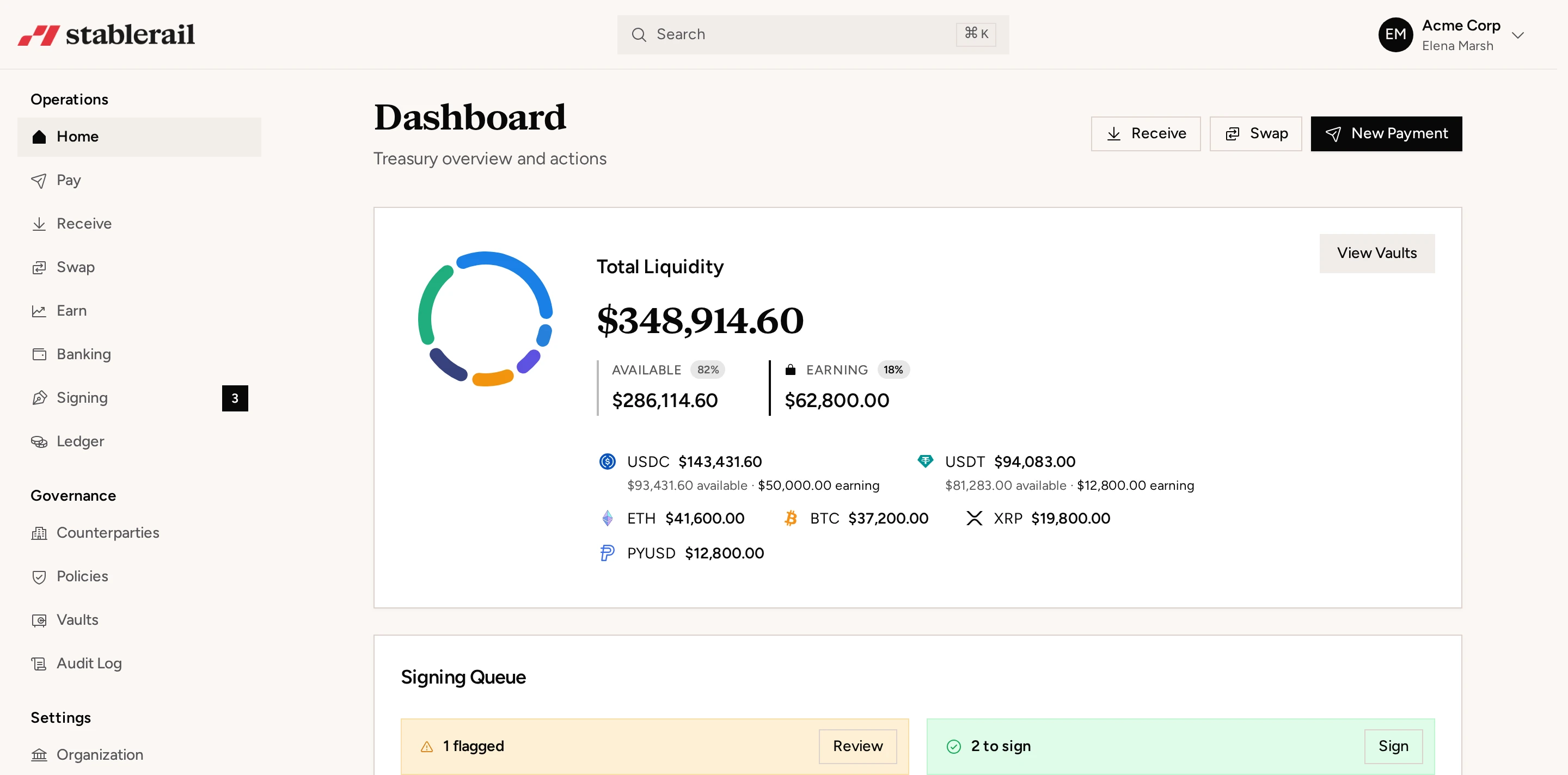
Stablerail provides essential tools for finance teams. Its Treasury Hub centralizes balance and entity monitoring, while the Policy Console allows for managing roles, transaction limits, and multi-step approvals. The platform also handles vendor and B2B payments, with plans to expand into payroll, recurring payments, accounting exports, and SOX compliance modules. Together, these features ensure comprehensive visibility from the moment a transaction is initiated to its final settlement.
The pricing model is based on an annual subscription, tailored to the number of entities, active users, and transaction volume. Stablerail typically works with organizations managing $1 million to $50 million in annual stablecoin transactions, offering dedicated onboarding and customized policy design support.
Conclusion
Blockchain payments, being irreversible, demand reliable audit trails created through pre-sign governance - especially for CFOs managing stablecoin transactions. This shift from manual compliance processes to real-time, machine-enforced "policy-as-code" marks a transformative change in how finance teams safeguard treasury assets.
Ken O'Friel, CEO of Toku, highlights the critical role of audit trails:
"Audit trails are not just logs. They are the evidence chain that proves what happened, why it happened, who authorized it, and what controls were applied".
CFOs without this comprehensive evidence chain face heightened risks during audits, regulatory reviews, or board inquiries. This underscores the importance of an integrated compliance framework.
The most effective governance strategy includes three core elements:
Pre-sign verification: Screening for sanctions, detecting anomalies, and scoring counterparty risk.
Policy-as-code enforcement: Automated rules that even high-level executives cannot override.
Complete evidence recording: Documenting every decision, approval, and override for full transparency.
Together, these components establish an audit trail that directly connects business intent to on-chain execution.
For organizations managing between $1 million and $50 million in annual stablecoin transactions, adopting a control plane architecture ensures governance standards akin to traditional banking systems are applied to on-chain payments - without compromising settlement speed. Striking this balance between control and efficiency helps protect treasury operations from fraud, regulatory penalties, and operational hiccups.
The bottom line: all compliance checks, policy enforcement, and approvals must be finalized and documented before a transaction is recorded on the blockchain.
FAQs
What’s the minimum evidence auditors expect for a stablecoin payment?
Auditors need a thorough audit trail that captures every stage of the stablecoin payment process. This means documenting everything - intent creation, checks conducted, flags raised, overrides made, approvals granted, and signatures provided. Key pieces of evidence must include policy clauses, timestamps, and well-documented explanations for decisions. This level of detail is essential to maintain transparency and meet compliance standards.
How do we prove the business purpose behind an on-chain transaction?
The purpose of an on-chain transaction is established through a thorough audit trail. This involves plain-English narrative explanations, enforcing policies, detecting unusual behavior, scoring counterparty risks, and recording timestamps - all meticulously documented prior to signing the transaction. These records serve as concrete proof of the transaction's intent.
How should we handle a payment that gets flagged but is still urgent?
For flagged but urgent payments, it's crucial to use controls that prioritize both speed and security. Stablerail offers tools to manage these situations effectively, such as automated delays, additional human approvals, or expedited reviews for flagged transactions. You can customize policies to ensure that flagged payments exceeding a specific amount are reviewed and processed promptly. This approach maintains proper oversight while keeping the process transparent and traceable.
Related Blog Posts
Former CEO of Simple, a self-custodial wallet with $2B+ in transaction volume across 75+ countries.
More about the Stablerail team- Stablecoin treasury managementApprovals, limits, yield and reporting on one balance.
- Stablecoin payoutsBatch contractor and vendor payments with screening.
- USDT vs USDCWhich stablecoin your company should settle in.
- Stablecoin finance glossaryMPC, off-ramp, travel rule and the rest, in plain English.
- Product updatesEverything we ship, month by month.